The daily stand-up meeting
Why is this Agile meme funny?
Level 1: The Sinking Ship Opportunity
A sailor runs to the captain and says, "Captain, we have a problem!" The captain, very proud of himself, says, "On this ship we don't say problem — we say opportunity!" So the sailor smiles brightly and announces: "Wonderful news, Captain! We have a sinking opportunity!" The ship still has a hole in it. The water is still coming in. The only thing that changed is the word — and that's the whole joke: pretending bad news is good news doesn't fix anything, and the funniest way to prove it is to follow the silly rule so perfectly that everyone hears how silly it is.
Level 2: Translating Boss to Engineer
The technical centerpiece, unpacked:
- DoS (Denial of Service) — an attack that makes a service unavailable, usually by overwhelming it with requests.
- DDoS (Distributed Denial of Service) — the same attack launched from many machines at once, typically a botnet of hijacked computers and IoT devices around the world. Distribution is what makes it hard to stop: you can't just block one address when the flood arrives from fifty thousand of them.
- Defenses exist — rate limiting, traffic scrubbing services, CDNs absorbing the flood — but during the attack, your site is effectively down, which for a business means lost sales, broken SLAs, and very awake executives.
The cultural vocabulary matters just as much here. "There are no problems, only opportunities" belongs to the family of motivational-poster phrases that sound empowering and function as a ban on candor. Early in your career, you'll meet this dialect: challenges instead of bugs, learnings instead of failures, opportunities for growth instead of outages. The skill the comic's developer demonstrates — reflecting the jargon back with the severity intact — is a real survival technique: it keeps the message accurate while letting the absurdity do the criticizing. Also worth noting for newcomers: "we got a problem" is, in fact, the correct opening line of incident response. Clear, early, unvarnished. The boss is the one speaking out of spec.
Level 3: Incident Severity: Synergy
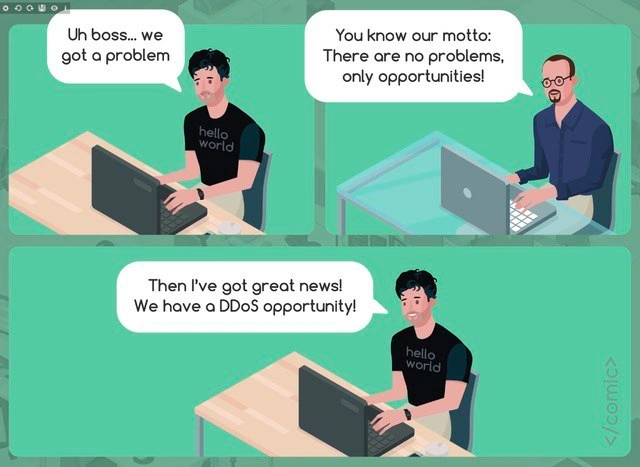
The three-panel structure is a textbook setup-reversal-detonation. The developer — wearing a hello world t-shirt, the comic's quiet signal that he's the hands-on-keyboard type — opens with "Uh boss... we got a problem." The boss, serene behind his glass desk, deploys the corporate liturgy: "You know our motto: There are no problems, only opportunities!" And the developer, instead of arguing, performs perfect malicious compliance: "Then I've got great news! We have a DDoS opportunity!" He doesn't break the rule; he executes it literally, which is the most developer way imaginable to file a grievance. Garbage in, garbage out — the boss supplied a broken language spec, and the engineer simply compiled against it.
What's being skewered is toxic positivity as an organizational protocol, and why it's uniquely corrosive in engineering. Incident response runs on precise severity language: a SEV-1 means drop everything, page everyone, status page goes yellow. Euphemism is latency. Every minute spent translating "opportunity" back into "the site is down and bleeding revenue" is a minute the attack continues. Cultures that punish the word "problem" don't eliminate problems — they eliminate early reports of problems. The engineer who learns that bad news is unwelcome starts sitting on warnings until they're catastrophes, at which point the postmortem asks why nobody escalated sooner. The motto is, functionally, an availability attack on the org's own telemetry.
The bitter cherry: a DDoS — a distributed denial-of-service attack, thousands of machines flooding your servers with junk traffic until legitimate users can't get through — is the one incident where the "opportunity" framing is most absurd, because it's adversarial. There's no silver-lining refactor hiding inside it; someone out there is paying (botnet time is rentable by the hour) to hurt you. Though every battle-scarred SRE will admit the joke's dark truth sideways: a DDoS is the only load test where the traffic generator actually matches production scale, and your capacity planning assumptions get peer-reviewed by a stranger with a grudge. The comic's </comic> closing tag on the green margin is a nice touch — the strip ends, but everyone knows the incident channel is just getting started.
Description
A popular meme format showing a group of penguins looking in different directions, with one penguin looking up at the sky. The penguin looking up is labeled 'Me trying to remember what I did yesterday'. This meme humorously captures the feeling of being put on the spot during a daily stand-up meeting and struggling to recall the previous day's accomplishments. This is a common experience for developers, especially when working on multiple tasks or complex problems
Comments
8Comment deleted
My stand-up update is always the same: 'Yesterday I made progress. Today I will make more progress.' The details are in the git log
If the KPI is ‘number of opportunities created,’ just put Cloudflare in front of the CFO’s slide deck and call the blast radius a growth metric
The same manager who insists "there are no problems, only opportunities" will somehow find budget for incident response consultants but not for the rate limiting middleware we requested six months ago
It IS an opportunity - finally a load test with realistic traffic, free of charge, and unlike the QA environment it actually resembles production
When your manager's 'growth mindset' framework meets a 500Gbps traffic spike, suddenly every outage becomes a 'learning opportunity' and every security breach is just 'unplanned penetration testing.' At least the post-mortem will have excellent spin: 'We successfully validated our incident response procedures under real-world conditions.'
DDoS: the 'opportunity' SREs live for - scaling scrubbers at 3AM while execs chase synergies
If problems are opportunities, a DDoS is just hypergrowth with 0% conversion and 100% error-budget burn
Executive spin: “organic traffic surge”; SRE reality: 200k RPS SYN flood liquidating the error budget