Skip to content
DevMeme
When the code works on your machine but not in production
Deployment Post #58, on Feb 6, 2019 in TG

When the code works on your machine but not in production

Why is this Deployment meme funny?

Level 1: Spelling It Out, Sneakily

Imagine a kid who must, by the rules of the house, write "this is an ad" on their lemonade poster — but they really don't want the neighborhood robot that erases ads to notice. So they write it in tiny pieces: "th" on one sticker, "is" on another, mixed with fake letters only the robot can see, scattered so the robot reads gibberish while every passing human reads it just fine. Technically the label is there. Practically, the robot is defeated. The man pointing and smiling is the kid's older brother who came up with the trick, very proud of himself — and the joke is that one of the biggest companies on Earth really does exactly this, every day, to keep you from skipping its ads.

Level 2: How to Hide a Word in Plain Sight

To read the top panel, you need three ideas:

  • The DOM (Document Object Model) is the tree of elements a browser builds from a page's HTML. DevTools — the panel shown in the screenshot — lets you inspect it. Every <div> and <span> you see is one node of Facebook's feed.
  • Ad blockers are browser extensions that delete or hide elements matching known patterns. The simplest pattern of all: find the element whose text says "Sponsored" and remove its post.
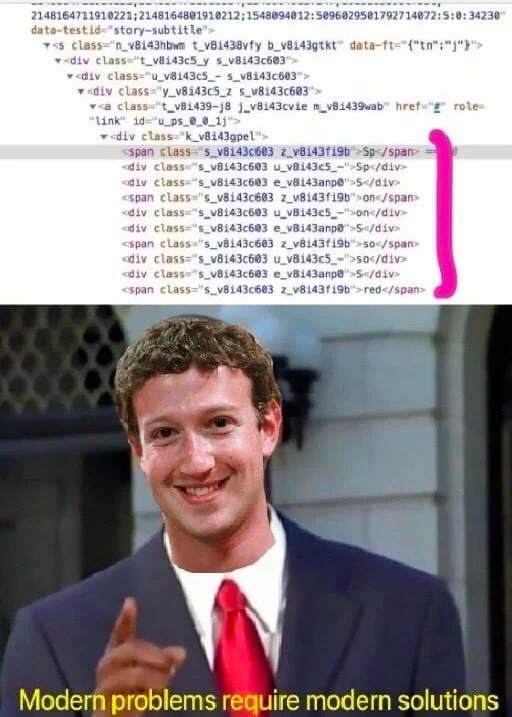
  • Obfuscation means deliberately making something hard to parse. Here, instead of <span>Sponsored</span>, the word arrives in pieces — Sp, on, so, red — mixed with extra letters in hidden elements. Your eyes see one word; a program sees confetti.

The class names like s_v8i43c603 aren't written by humans either — they're generated by the build system and change regularly, so no blocker rule targeting a class survives long. If you've just learned HTML and CSS, this screenshot is a useful shock: the tidy, semantic markup from tutorials (<article>, <header>, meaningful class names) is how pages can be written. Industrial pages at adversarial scale look like this — markup as a moving target. First time you open DevTools on a real social feed and see forty nested divs for one button, this meme is the explanation: some of that nesting is framework plumbing, and some of it is wartime architecture.

Level 3: Selector Warfare

The DevTools screenshot in the top half is real-world artillery from one of the web's longest-running arms races. Circled in pink marker: the word Sponsored, shredded into fragments — a <span> containing Sp, then on, so, red — interleaved with decoy <div>s containing stray S characters, all wrapped in machine-generated class soup like s_v8i43c603 z_v8i43f19b. Below, young Zuckerberg points and grins: "Modern problems require modern solutions."

This is Facebook's documented anti-adblock technique, and understanding why it looks this deranged requires understanding how ad blockers work. Tools like uBlock Origin rely on filter lists — rules that match elements by stable signals: a class name like .ad-banner, an attribute, or visible text such as "Sponsored." Facebook's countermeasures attack every one of those signals simultaneously. The hashed, build-regenerated class names (u_v8i43c5_) mean no selector survives a deploy. Splitting the label across many nodes means no single element's text content equals "Sponsored." The decoy characters are the nastiest touch: junk letters rendered invisible via CSS (or real letters scattered among hidden junk), so even if a blocker concatenates the text, it reads SpSonSsoSred — while the human eye, which only sees the styled result, reads "Sponsored" perfectly. The page lies to machines and tells the truth to people, which is a genuinely elegant inversion of how accessibility is supposed to work.

And that's the senior-level wince: every trick here taxes someone innocent. Screen readers walk the same DOM the ad blocker does — obfuscate one, you risk garbling the other. Layers of wrapper divs bloat the render tree. Engineering hours that could ship features instead ship camouflage, and the blockers adapt within weeks (filter lists moved to procedural cosmetic rules and :has-text heuristics; Facebook responded with new shredding schemes; repeat indefinitely). It's a Red Queen race — both sides sprinting to stay in place — funded on one side by ad revenue and on the other by volunteers maintaining filter lists on their evenings. The meme's caption is doing irony at scale: the "modern solution" to people don't want to see ads was not fewer or better ads. It was making the word "Sponsored" structurally unreadable to robots while keeping it, for regulatory reasons, technically on the screen.

Description

A popular meme format, the 'Two Buttons' meme. A cartoon character is sweating nervously, trying to decide between two red buttons. The first button is labeled 'It works on my machine,' and the second button is labeled 'Deploy to production.' This meme perfectly captures the anxiety and uncertainty developers feel when they can't reproduce a bug that only occurs in the production environment. It's a classic developer dilemma that highlights the difference between a controlled local environment and the chaotic reality of production

Comments

8
Anonymous ★ Top Pick The only thing more terrifying than a bug you can't reproduce is a bug you can't reproduce that only happens on a Friday afternoon
  1. Anonymous ★ Top Pick

    The only thing more terrifying than a bug you can't reproduce is a bug you can't reproduce that only happens on a Friday afternoon

  2. Anonymous

    2024 frontend: React hydrates at idle, Tailwind JIT compiles, and a dozen obfuscated spans collectively whisper “Sponsored” - all to dodge a one-line uBlock regex

  3. Anonymous

    This is what happens when your webpack bundle analyzer shows 847 dependencies for a 'Hello World' app, but hey, at least our CSS-in-JS solution is tree-shakeable and our component library supports atomic design patterns with zero-runtime CSS extraction

  4. Anonymous

    Somewhere a Facebook engineer's promo packet reads 'increased ad revenue by sharding a 9-letter word across 14 DOM nodes' - the only horizontal scaling that actually paid for itself

  5. Anonymous

    When your CSS-in-JS framework generates class names that look like someone smashed their keyboard during a webpack build, making 'inspect element' feel like archaeological excavation without the Rosetta Stone of source maps

  6. Anonymous

    Zuck's theorem: Every CSS edge case yields to one more wrapper div - until the bundle size rivals your legacy monolith

  7. Anonymous

    When marketing shatters 'sponsored' into micro-spans with hashed classes, they don’t beat ad blockers - they just invent string sharding and a lifelong SLA of flaky selectors

  8. Anonymous

    The ad team sharded “Sponsored” into 10 spans; ad blockers miss the write quorum and every screen reader hits a consistency outage

Use J and K for navigation