Coronavirus as a DDoS on the Healthcare System
Why is this Security meme funny?
Level 1: No Place Like Home
Imagine a small library that can only comfortably handle 10 kids at a time. Now suppose 100 kids all try to rush in together – the library would be overwhelmed. The rooms would be packed, the librarians couldn’t help everyone, and some kids would be stuck waiting outside because there’s just not enough space or people to handle them. In a sense, the library’s “system” has been overloaded by too many visitors at once. This is like what happened to hospitals during the pandemic: so many people got sick all at the same time that hospitals were struggling to help everyone – kind of like too many kids crowding the library. The meme jokes that the coronavirus made people flood into hospitals the way a cyber attack floods a website with too many visits. It’s saying the virus caused a traffic jam of sick people for the healthcare system.
So how do you fix that? Well, just like you might tell those 100 kids, “Hey, don’t all come at once! Line up or come later,” in a pandemic you try to slow down the spread of the sickness so not everyone is ill simultaneously. Essentially, you want people to stay at home so they don’t all get infected at the same time and swarm the hospital. It’s like telling everyone to keep their doors closed and not invite any visitors for a while. If nobody new comes into the library (or only a few at a time), it never exceeds capacity. In real life, this meant lockdowns and quarantine: each family stays in their own house, so the virus can’t jump around quickly. Fewer people out and about means fewer chances for germs to spread, which means the hospitals get a manageable number of patients instead of an overwhelming flood.
The funny part of the meme is how this advice is given. Instead of simply saying “stay home and don’t go out,” the cartoon uses computer language: “close your ports and stay 127.0.0.1.” Think of ports like the doors or openings to your home/computer. “Close your ports” just means close your doors to outsiders – don’t let visitors in for now. And 127.0.0.1 is a technical way to say “home.” It’s actually a special code for “home” in computer networking. So when the doctor says “stay 127.0.0.1,” it really means “stay home.” The whole line is basically the nerdy version of “Close up your house and stay inside on your own.” It’s humorous because it’s using a secret geek code to say something very ordinary. It’s as if the doctor is speaking in a silly pretend language that only computer folks understand: “Protect yourself like a secured computer and just be your own little island.”
Why is this funny? Because it’s mixing two very different worlds – computers and everyday life – in a clever way. We don’t usually describe a disease outbreak like a computer attack, and we don’t usually tell people to stay home by giving them an IP address! It’s unexpected and a bit absurd. But it also kind of makes sense once you get the code: too many people getting sick = system overload, so the solution is to isolate, i.e., stay home (like a computer that’s not connected to any network can’t get infected by a network virus). The meme tickles the tech-savvy folks because it frames a serious real-world problem as if it were an IT problem we might solve with a few firewall rules. It turns “please quarantine to avoid hospital overload” into “close the ports and stick to localhost.” That’s both a nerdy inside joke and a pretty accurate recommendation. In simple terms, the message is: if everyone stays home and doesn’t mix together (like computers closing doors and not talking to others), we can stop the big rush of sickness and keep the system (hospitals) from crashing. It’s a playful way to remind us that, sometimes, the best defense is just hunkering down in your own safe space – after all, there’s no place like home!
Level 2: No Place Like 127.0.0.1
Let’s break down the technical jargon in this meme and how it cleverly maps to the pandemic scenario. The big term here is DDoS, which stands for Distributed Denial of Service. A Denial of Service attack is when a service (like a website or online game) gets bombarded with so many requests or garbage data that it can’t handle the load, effectively shutting out real users. It’s like if you have a small shop that can serve 5 customers at once, and suddenly 500 people rush in – the shop is overwhelmed and nobody gets proper service. Now make it Distributed (the first D in DDoS): instead of one source causing the traffic spike, it’s coming from thousands of different computers all over the internet, all at once. This usually happens via a botnet (a network of malware-infected PCs or IoT devices controlled by an attacker) which is instructed to flood a target server with traffic simultaneously. The key idea is too many requests coming from too many places for the target to handle. The result? The target service slows to a crawl or crashes, and legitimate users experience a denial of service (they can’t get through because the server is busy dealing with the fake load).
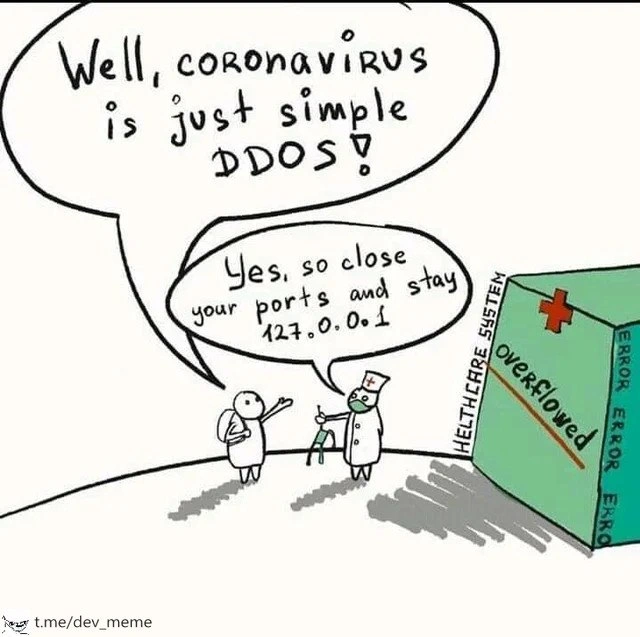
In the meme, the coronavirus pandemic is being compared to a DDoS attack. How? Think of the healthcare system (hospitals, clinics, emergency services) as the “server” providing a service. Normally, it handles a certain flow of patients (just like a server handles user traffic). But during COVID-19 surges, huge numbers of people got sick around the same time – lots of “requests” all coming in concurrently. The system was at risk of overload. That’s why you see the big green box labeled “HEALTHCARE SYSTEM” with “overflowed” on it – it represents a server out of capacity (a cheeky way to say hospitals are full, kind of like a website showing an error because too many people are trying to use it). In tech terms, the healthcare system experienced a traffic spike (a spike in patients) so large that it could crash. That’s analogous to a DDoS where the “traffic” is distributed across many sources (in COVID’s case, all the communities with outbreaks). No single person tried to crash hospitals, of course, but collectively the simultaneous infections had that effect. It’s a nerdy metaphor: lots of infected individuals = lots of malicious packets attacking a server.
Now, what does “close your ports” mean? In computer networking, a port is like a door or entry point on a computer that lets data in and out. Your computer has 65,535 TCP ports (and the same number of UDP ports), each identified by a number. Common services use well-known ports: for example, web traffic goes to port 80 (HTTP) or 443 (HTTPS), SSH (secure shell) often uses port 22, and so on. When a port is “open,” it means there’s a program listening on that port for incoming connections. If that service isn’t protected, malicious traffic could come through that door. “Closing a port” means shutting that door – either by stopping the service or by using a firewall to block incoming connections on that port. For instance, if a server is only supposed to be a web server, an admin might close ports 21 (FTP) or 23 (Telnet) if they’re not needed, to reduce attack surface. Closing ports is a basic security practice to protect against unauthorized access or attacks. In a DDoS situation, sometimes drastic steps are taken like rejecting traffic on certain ports or from certain IP ranges to stem the flood.
So when the cartoon doctor says “close your ports,” in plain language he’s saying: stop letting outside connections come in. Translate that to the pandemic context: it means don’t let other people physically come in contact with you. It’s essentially telling you to isolate by shutting yourself off like a server that isn’t accepting any new connections. It’s a nerdy metaphor for social distancing or quarantine. If your “ports” (your ways of interacting with the outside world) are closed, the virus has no way to reach you — it can’t “connect.” Think of your home’s front door as a port: normally friends can come over (open port), but during lockdown you keep that door closed to visitors (closed port) to prevent infection.
Now let’s decode 127.0.0.1. This is a special IP address known as localhost. In IPv4, any address starting with 127...* is reserved for loopback, but 127.0.0.1 is the most commonly used loopback address. Loopback means it loops right back into itself. If you tell your web browser to go to http://127.0.0.1, it will actually try to connect to a web server on your own computer. Essentially, 127.0.0.1 means “this machine here” or “myself.” By convention, it’s the address a computer uses to refer to itself in networking contexts. For example, when you run a database on your PC and your app connects to it locally, it might connect to 127.0.0.1 (instead of some external IP) because the service is hosted on the same machine. The term localhost is interchangeable with 127.0.0.1 (if you type ping localhost or ping 127.0.0.1, it’s the same target). Developers encounter 127.0.0.1 all the time when testing applications on their own machine. It’s safe and fast because it doesn’t rely on any network hardware – the traffic never leaves your computer.
When the doctor says “stay 127.0.0.1,” it’s a geeky way of saying “stay on your own machine.” In other words, stay at home! It’s referring to the practice of only using the loopback interface (yourself) and not going out to any other IP address (other places or people). There’s even a popular nerd t-shirt that reads “127.0.0.1 – there’s no place like home,” playing on the fact that 127.0.0.1 is home for your computer. So, “stay 127.0.0.1” directly equates to 127_0_0_1_stay_home in the context tags – it means keep all activities local to you, just as during lockdown everyone was told to stay in their homes and not mingle.
Let’s also clarify the “healthcare system overflow” part. In computing, an overflow (buffer overflow, stack overflow, etc.) means some data structure or capacity limit was exceeded. For example, if a buffer is meant to hold 100 entries and you try to put 150 entries in, you get an overflow – the extra 50 can spill into places they shouldn’t, causing errors. The meme shows the healthcare system as a box with “overflowed” stamped on it, as if it were a program that encountered more input than it could handle. We also see “ERROR, ERROR, ERRO” repeated on its side, mimicking what an error message might look like if the system is glitching out from overload (or possibly a sly reference to “ER” – the emergency room – being in error state). In plain terms, this depicts hospitals filled beyond capacity (we heard phrases like “the healthcare system is overwhelmed” a lot in news). It’s drawn like a server crash. Overflowed here basically means “over capacity – cannot accept more.” It’s similar to a website showing a “503 Service Unavailable – server busy” error when too many people hit it. In the early pandemic, officials were worried about an overflow of patients, meaning there’d be more sick people than the hospitals could treat at once. That’s the nightmare scenario the meme is poking fun at – it’s like a server that’s gone down because it couldn’t handle the load.
To summarize the mappings between the tech terminology and the pandemic situation, check out this comparison:
| Term/Concept | Tech Meaning | Pandemic Meaning (Analogy) |
|---|---|---|
| DDoS attack | Distributed flood of requests to crash a server | Huge wave of infections overwhelming healthcare (many sick people “at once”) |
| Healthcare System | A critical server/service (in this analogy) | Hospitals, doctors, and medical infrastructure as a whole |
| “Overflowed” error | System has maxed out capacity (buffer/queue full) | Hospitals have no more beds or resources (over capacity) |
| Open port | A network door open for connections | A person engaging with others (possible infection path) |
| Close your ports | Block/stop incoming connections (firewall it off) | Avoid outside contact (cancel gatherings, close boundaries) |
| 127.0.0.1 (localhost) | The loopback address (only talk to itself) | Your home (only stay with yourself/household, no external travel) |
| Stay 127.0.0.1 | Only communicate on the local machine | Stay at home (don’t go out to meet people) |
With these explanations, the meme’s joke becomes clear: it’s telling the story of COVID-19 using the language of hackers and network admins. The stick figure effectively says, “The coronavirus outbreak is like a DDoS attack on our hospitals,” and the doctor replies, “Roger that – then the fix is to firewall ourselves off and only operate on localhost (i.e., lock ourselves down at home)!” It’s a playful mixing of domains. The advice “close your ports and stay 127.0.0.1” is not something you’d hear in a normal press conference – it’s purely for the tech crowd. If you’re a newcomer to these terms, it might sound like gibberish, but now you can decode it: it means shut yourself off from the outside world and stay home to avoid contributing to the overload. It’s both humorous and relatable to tech folks, because it reduces a massive real-world problem to an almost routine computer problem with a straightforward (if extreme) solution. In essence, the meme is saying: treat the pandemic like a cyberattack – cut the connections, stay home, and you prevent the system (society) from going down. It’s a nerdy way to encourage good behavior during a crisis, wrapped in a wink to those of us who spend our days thinking about servers, ports, and IP addresses.
Level 3: Localhost Lockdown
For seasoned developers and sysadmins, this meme hits home with darkly funny accuracy. It takes the coronavirus_ddos_analogy and runs with it, translating pandemic directives into the language of network ops and security. The stick figure in the cartoon confidently declaring “Well, coronavirus is just simple DDoS!” sounds like that one tech friend who insists on explaining every real-world problem with a computing metaphor. It’s an absurd oversimplification (a global pandemic is anything but “simple”), yet it resonates because the situation does resemble an overloaded system. Experienced engineers have seen what happens when a critical server gets swamped by traffic — errors fly, response times spiral, logs fill with “over capacity” messages. In early 2020, we were watching news of hospitals overflowing and thought, "yep, that’s a denial-of-service on our healthcare infrastructure." It’s the kind of grim alignment where a networking concept maps uncannily well to a human crisis. This blend of truth and humor is a hallmark of DeveloperHumor and tech memes: reframing a serious scenario in terms of servers and code, partly to make sense of it, partly as a coping mechanism.
The doctor’s reply in the meme is what really sells the joke to any tech insider: “Yes, so close your ports and stay 127.0.0.1.” This is pure HumorInTech gold. It’s the public health guidance “close your doors and stay at home” translated into sysadmin jargon. No actual doctor would tell you to stay at 127.0.0.1 – that’s what makes it hilarious. The doctor character playfully speaks the lingo of firewalls and IP addresses, as if the way to fend off a virus is literally to enact a personal firewall rule! To someone in IT or security, “close your ports” immediately evokes firewall configurations or shutting down services to avoid intrusion. It’s advice we give when a server is under siege: stop accepting new connections, block everything incoming. During a massive DDoS, an exasperated network admin might indeed shout, “Just close all ports!” as a last resort to stop the flood (taking the service offline intentionally to save it – a bit like pulling the plug to reboot). Hearing a medical professional echo that sentiment is a fabulous cross-domain punchline. And “stay 127.0.0.1” – well, any programmer or network engineer reads that and cracks a smile: 127.0.0.1 is the loopback address, universally understood as “my own machine”. It’s a nerdy way of saying “stay home (on your own device)”. The phrase intentionally resembles the common COVID-era slogan “stay home,” but with a geek twist. In fact, the meme’s text close_ports + 127_0_0_1_stay_home has become a bit of a catchphrase among techies: it’s essentially “localhost lockdown.”
Notice the green HEALTHCARE SYSTEM box on the right, emblazoned with a red cross (a universal symbol for medical services) and the word “overflowed.” For a senior dev, that immediately conjures images of error logs or exceptions. It’s as if the hospital threw an error code because its capacity was exceeded – the same way an application might throw an OutOfMemoryError or a “Server too busy” message when overwhelmed. The side of the box even shows a repetition of “ERROR, ERROR, ERRO…” like a crashed program stuck in a loop, or maybe as a stylized nod to ER (Emergency Room) repeating. The visual metaphor is clear: the healthcare system is represented as a server with a big failure stamp, essentially a 500 Internal Server Error for society. Any developer who’s been on-call during a traffic surge or woken up by system overflow alerts at 3 AM gets a little jolt of “oh, I know this scenario.” It’s both funny and disturbing to see that scenario play out in real life with human stakes.
The senior engineering perspective also appreciates the irony in calling the coronavirus surge “just a simple DDoS.” We know there’s nothing “simple” about a massive DDoS attack — they are notoriously hard to defend against, often requiring sophisticated Security infrastructure and inducing a lot of stress. Likewise, a pandemic is incredibly complex to manage. The meme’s deadpan phrasing pokes fun at our tendency to apply familiar templates to unprecedented problems. It’s a kind of dry, wry humor: “Oh, hospitals overloaded? Been there, done that in prod — it’s just a traffic problem.” It trivializes the crisis on the surface, but implicitly it’s highlighting how serious it is (since DDoS events are a big deal in tech). This is a common TechHumor device: pretending something huge is no biggie by using a technical analogy, when in fact that technical problem is itself notoriously nasty. It’s a wink-wink acknowledgment among developers: we get how bad this could be.
During the spring of 2020 when this meme circulated, devs were cooped up at home (on their own 127.0.0.1 islands), watching case curves and press briefings. Seeing the world through a tech lens was our way of understanding and coping. “Flattening the curve” basically meant “don’t let the peak load exceed capacity” — a concept any performance engineer intuitively grasps. Terms like quarantine or lockdown got internally translated to “maintenance mode” or “going offline” in nerd-speak. There was a flurry of similar jokes: e.g., referring to people as “users”, calling the virus a “bug” that needed patching, or saying society was in need of a system reboot. This particular meme stands out by using network security jargon accurately: it literally tells you to implement a personal firewall against the virus. It’s DeveloperHumor at its finest because it stays true to technical meaning while being absurd in context. A doctor telling you to enable localhost-only mode on yourself is both geeky and oddly comforting — it reframes scary unknowns (global virus) as something familiar (a network problem we can tackle with known methods).
Finally, there’s a bit of feel-good nerd pride packed in: by understanding the joke, you’re part of the in-group that speaks both “COVID guideline” and “TCP/IP” fluently. It’s the kind of joke you’d forward to your dev team on Slack with a 😂, and maybe your non-tech family wouldn’t get why it’s funny. The meme lives at the intersection of TechMemes and real-life events, showing how our techie brains often interpret the world. Close your ports and stay 127.0.0.1 became a geeky rallying cry — essentially telling everyone: “Shut the external interfaces and ride out the storm from home (because that’s how we keep the system – our society – from crashing).” It’s humorous, yes, but also a succinct piece of advice that saved lives, delivered in a way that resonates with anyone who has ever defended a server under siege. In other words: Stay home, stop the packet storm, and the system (healthcare) won’t go down.
Level 4: Pandemic Packet Storm
At the most granular technical level, this meme equates a global virus outbreak with a distributed denial-of-service (DDoS) attack overwhelming a critical system. In networking terms, a DDoS is a coordinated flood of packets or requests from many distributed sources (often a botnet of malware-controlled machines) aimed at a target server or network. The goal is to exhaust the target’s resources — its CPU, memory, bandwidth, or application thread pools — so legitimate users are denied service. It’s a classic Security nightmare: imagine millions of compromised computers all hammering a web service simultaneously. The server’s connection queue overflows, error rates spike (ERROR, ERROR, ERROR…), and eventually the system becomes unresponsive or crashes.
In the cartoon, COVID-19 is portrayed as a “simple DDoS,” and the overloaded healthcare system is the target server showing an “overflowed” error. This is a surprisingly apt technical analogy. Epidemiologically, a fast-spreading virus causes exponential growth in infections — akin to exponentially growing network traffic. Each infected person can infect multiple new people (similar to how each node in a botnet can generate a flurry of requests). If R0 (the virus reproduction rate) is well above 1, the case count surges like unthrottled network traffic. The healthcare system has a maximum throughput (limited hospital beds, staff, ventilators). If incoming patients exceed that capacity (patients per day >> treatments per day), a queue builds up just like a server backlog. In computer systems, when an input queue’s capacity is exceeded, you get buffer overruns and dropped requests; in a pandemic, an overwhelmed hospital must turn people away or triage aggressively. The meme’s green cube labeled “HEALTHCARE SYSTEM” with “overflowed” stamped on it mirrors a server throwing an overflow exception because its input buffer (the ER and ICU capacity) is beyond full. In essence, the healthcare_system_overflow depicted is a real-world equivalent of a buffer overflow or a server overload crash – too many inputs, not enough handling capacity.
To mitigate a DDoS, network engineers employ drastic measures. One strategy is closing ports and filtering traffic: basically shutting all non-essential communication channels to stop the malicious flood. High-end DDoS mitigation might involve rate-limiting, IP banning, or even blackholing (dropping all incoming packets aimed at the target, sacrificing availability in the short term to save the system). This is analogous to what happened during lockdowns. Closing your ports in network terms means refusing any external connections – and in pandemic terms, it means no outside contact. The meme’s advice to “stay 127.0.0.1” is essentially telling you to restrict all network activity to the loopback interface (your own device). 127.0.0.1 is the reserved IPv4 address for your localhost – a loopback network interface that doesn’t let connections in from the outside at all. On a computer, binding a service to 127.0.0.1 means it’s only accessible from that same machine (no external client can reach it). In human terms, that’s like saying “isolate yourself completely at home, interact only with yourself or those already inside your home.” It’s a comically precise parallel to quarantine. In high-security computing, the most extreme protection is an air-gapped system – one that’s physically disconnected from any external networks. Telling people to stay at 127.0.0.1 is basically recommending an air-gap for your body: no meetings, no outside exposure, just you as a standalone node.
This analogy even extends to how we try to “flatten the curve.” In networking, if a sudden surge of traffic threatens to overwhelm a server, you might use a rate limiter or a load balancer to spread out the load, ensuring the system doesn’t get everything at once. In a pandemic, social distancing and staggered interactions are essentially rate-limiting the infection spread so that the peak load on hospitals stays within manageable bounds. We’re preventing a traffic spike from turning into total denial-of-service. When the doctor in the meme says to close your ports and stay on localhost, it’s a nerdy way of prescribing a localhost lockdown solution: cut off external connections (no social gatherings, no travel) so the virus can’t propagate through the network of people. It’s fascinating because the underlying science and math of both domains align: whether it’s TCP/IP packets or virus particles, a sudden packet storm or a surge of infections will overwhelm any finite system without throttling or isolation. The humor here is rooted in recognizing this deep structural parallel — a bit of network theory and epidemiology rolled together. By casting a serious public health crisis as just another DenialOfService scenario, the meme highlights the fundamental truth that systems (computers or hospitals) have limits, and if you exceed those limits explosively, things break. It’s a nerdy kind of elegant insight: the pandemic as a DDoS attack on society, met with the ultimate firewall rule — “deny all” (no outside packets/people allowed).
Description
A single-panel, hand-drawn cartoon that uses a tech analogy to explain the COVID-19 pandemic. A simple stick figure character says to a doctor in a mask, 'Well, coronavirus is just simple DDOS!'. The doctor replies, 'Yes, so close your ports and stay 127.0.0.1'. To their right is a large green cube, representing the 'HEALTHCARE SYSTEM', which is visibly cracking under pressure, with the word 'overflowed' written across it and 'ERROR' repeated on its side. A watermark for 't.me/dev_meme' is in the bottom left. The meme explains the pandemic through the lens of a Distributed Denial of Service (DDoS) attack, where the healthcare system is the server being overwhelmed by too many requests (patients). The doctor's advice translates technical jargon into public health guidance: 'close your ports' means to isolate and avoid contact, and 'stay 127.0.0.1' is the IP address for localhost, a clever technical way of saying 'stay at home'

Comments
7Comment deleted
The human body's firewall has a zero-day, and the only effective patch is the 'air-gap' protocol. Unfortunately, management is still debating the cost of implementation
Funny how “stay at 127.0.0.1” is just a hotfix because we shipped healthcare as a single-node, stateful service with zero autoscaling - classic ops move: patch every client instead of fixing the architecture
Finally, a distributed system where "eventual consistency" means we all get sick at different times and the healthcare load balancer crashes anyway
When your incident response plan for a global pandemic reads like a network security playbook: 'Just implement rate limiting on human interactions and force everyone to bind to 127.0.0.1.' Meanwhile, the healthcare system is experiencing the kind of traffic spike that makes your Black Friday load tests look like a health check ping. At least with a real DDoS, you can spin up more instances in the cloud - turns out ICU beds don't autoscale quite as elegantly
Healthcare monoliths under viral DDoS: no autoscaling, just straight buffer overflow on admission endpoints
COVID was the world’s biggest unthrottled DDoS - healthcare had no circuit breakers, so the hotfix was basically “bind to 127.0.0.1 and close your ports.” Funny how infection rates autoscaled faster than budgets
Flatten-the-curve was just global rate limiting with a circuit breaker; bind to 127.0.0.1 and drop inbound or the healthcare cluster returns 503s