Lockdown Rest? Not for Software Engineers
Why is this RemoteWork meme funny?
Level 1: Promised a Break, Got Chores
Imagine someone tells you that school is canceled for a week, so you expect to relax and play. But instead, your parents give you a long list of chores to do every day. Suddenly, you’re even busier at home than you were with school! You'd feel upset because the break you were promised turned into more work. That’s the feeling this meme is joking about. People told software engineers they would get to rest during the lockdown, but the engineers actually had to work even harder from home. It’s funny in a slightly sad way — like expecting a vacation and then finding out it’s just a bunch of chores.
Level 2: Remote Work Reality Check
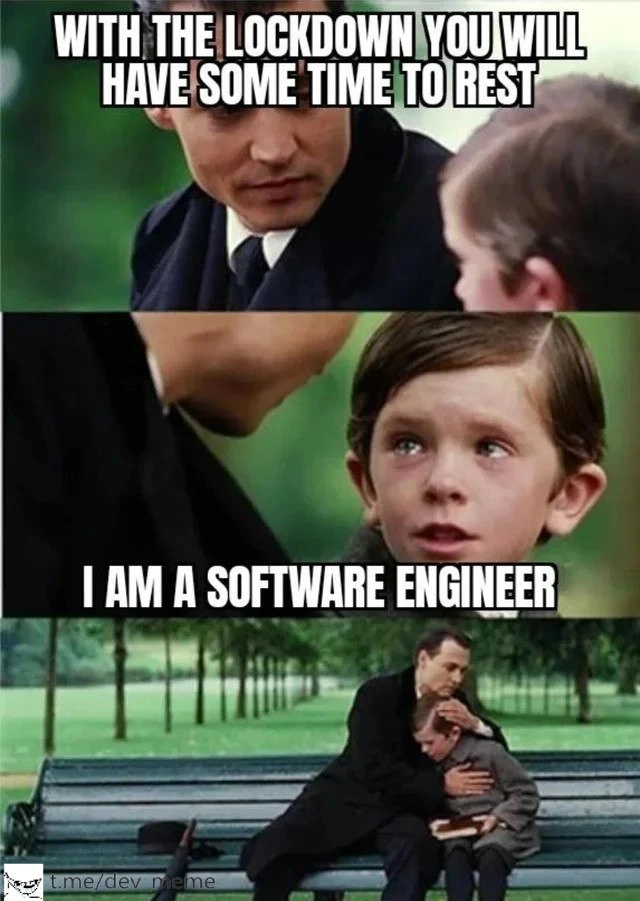
Let’s break down what’s happening in this meme. In the first panel, an optimistic adult tells a child, “With the lockdown you will have some time to rest.” Lockdown here refers to the COVID-19 stay-at-home period when normal life paused and everyone had to remain indoors. The assumption is that being stuck at home means things will slow down and you can relax. But in the second panel the child replies, “I AM A SOFTWARE ENGINEER.” In other words, “that doesn’t apply to me – I know I won’t be resting.” Software engineers quickly discovered that remote work often meant working even more, not less. The final panel shows the adult hugging the crying child. This is a joking way to show sympathy: the promise of rest was false, and the software engineer (the child in the meme) is already exhausted knowing what’s coming.
Why wouldn’t a developer get to rest at home? Several reasons became clear when offices closed:
- No boundaries between work and home: Suddenly your office was your bedroom or kitchen. It’s easy to end up coding late into the night because your computer is always right there. There’s no physical workplace to leave, so work never quite “ends” at a normal hour.
- Higher demand on tech: During lockdown, everyone was using online tools and apps more heavily (for example, video calls, streaming movies, online shopping). If you help build or maintain those systems, you probably had to handle increased load and urgent fixes. More usage means more late-night emergencies to fix servers or critical bugs.
- Persistent deadlines: Projects still had deadlines. In fact, some bosses expected faster output (since “you’re at home all day”). Many dev teams took on extra tasks to rapidly adapt products for pandemic needs. That meant overtime and weekend pushes, lockdown or not.
- On-call duties: Many engineers participate in an on-call rotation – taking turns being the person who responds to critical outages. Being on-call means if a website or service crashes at 2 AM, your phone gets a ping (an alert) and you must jump in to fix it. Lockdown didn’t stop systems from crashing. If anything, with everyone online, those 2 AM pages became even more frequent. So bye-bye sleep.
- Lots of online meetings: Ironically, working from home introduced back-to-back Zoom meetings and constant Slack messages. Co-workers would ping you at all hours because, hey, you’re home. It became harder to have uninterrupted focus time or real breaks when your day was a blur of virtual chats.
The table below sums up the expectation vs. reality for developers during the COVID lockdown:
| Lockdown Expectation | Developer Reality |
|---|---|
| “You’ll have lots of free time!” | Day filled with coding and extra meetings. |
| “No commute, you can sleep in.” | Late-night deployments cut into sleep. |
| “Quiet evenings at home.” | Phone and Slack buzz with after-hours alerts. |
| “Maybe start a fun side-project.” | Too tired; just collapse at end of day. |
As you can see, the work-from-home routine in 2020 often wasn’t the cozy break people imagined. A term like “work–life balance” became tricky – how do you balance work and personal time when it all blends together in the same space? Many developers felt burnt out, meaning completely exhausted and mentally drained, because they couldn’t disconnect from the job. There were plenty of work–life balance tip articles (suggesting things like “take walks” or “set a schedule”), but following that advice was easier said than done when your sprint backlog was on fire and production was throwing errors at 11 PM.
In simple terms: being a software engineer during lockdown meant longer hours in front of a screen, not the restful break that non-tech folks expected. The meme captures that contrast perfectly – it’s funny to those in tech because we lived it, and it’s a bit of a reality check for anyone who assumed engineers were just chilling on the couch during quarantine.
Level 3: WFH != Vacation
In late March 2020, when COVID-19 lockdowns started, many non-tech folks cheerfully assumed that remote work meant extra downtime. People said things like “With everyone stuck at home you’ll finally get some rest!” However, every software engineer reading this meme knows how laughable that promise was. The humor here is a dark, knowing laugh: the child’s shattered expression stands in for every developer who realized work-from-home was not a free vacation but an on-call marathon. Instead of restful evenings, we got 3 AM production alerts and endless feature requests to adapt systems for a suddenly all-online world.
It’s funny because it’s painfully true. That bold reply “I AM A SOFTWARE ENGINEER” in the meme’s second panel instantly subverts the well-meaning promise. As developers, we know that code deployments and sprint deadlines didn’t pause for the pandemic — if anything, they accelerated. The sprint cycles (short development iterations in Agile) became a blur with no finish line, one rolling into the next. Managers figured hey, no commute, we can squeeze in another daily stand-up or two! The result? Work–life boundaries evaporated. Many devs found themselves working in what felt like a state of permanent “crunch mode,” trading any saved commute time for extra debugging and Zoom meetings.
The third panel’s consoling hug represents the tech community’s shared commiseration. We all needed a virtual pat on the back (or a stiff drink over a video call) as we faced sleep deprivation and burnout. On Slack and Twitter, engineers joked about living at work instead of working from home. PagerDuty notifications didn’t care that it was a Sunday or that you were making lunch — when the site went down because traffic spiked, you were there patching it. Remember the push to “flatten the curve”? Meanwhile, devs were trying to flatten the spike in server loads and flatten their burnout curve, usually with poor success.
To put it bluntly, “time to rest” during lockdown was a cruel myth for engineers. Sure, the streets were quiet, but our phones and laptops never shut up. Notifications pinged day and night. There’s a grim inside joke here: the only REST we got was the kind spelled in all-caps — as in RESTful APIs — because we sure weren’t getting any actual rest. This meme nails that irony. It takes the emotional park-bench consolation scene (famous from film) and repurposes it to say what every dev felt: the world may have hit pause, but our workload hit fast-forward. Senior developers reading this are nodding wearily — we’ve been that kid on the bench, promised a break by reality, only to receive a sympathetic hug when that promise falls apart.
Description
A three-panel meme using a poignant scene from the movie 'Finding Neverland'. In the first panel, a man kindly tells a young boy, 'WITH THE LOCKDOWN YOU WILL HAVE SOME TIME TO REST'. In the second panel, the boy looks up with a sad, teary-eyed expression and replies, 'I AM A SOFTWARE ENGINEER'. The final panel shows the man sitting on a park bench, hugging and comforting the distraught boy. The watermark 't.me/dev_meme' is in the bottom left. The humor is derived from the tragic irony that while lockdowns meant a pause or break for many professions, for software engineers it often meant the opposite. The massive global shift to remote work and digital services dramatically increased the workload and pressure on the tech industry, making the idea of 'rest' a cruel joke and highlighting the struggles with burnout and work-life balance

Comments
7Comment deleted
The lockdown didn't give me time to rest; it just merged my work environment with my home environment. Now I can get paged about production issues while I'm in the shower
“They said lockdown would finally let me rest; instead I’m on a 3 a.m. PagerDuty shift because our ‘quick win’ microservice refactor turned REST into a recurring 500.”
The lockdown was when we finally had time to refactor that legacy codebase, implement proper CI/CD, migrate to microservices, learn Rust, contribute to open source, build three side projects, and attend every virtual conference while management wondered why velocity actually decreased
Ah yes, lockdown rest for software engineers: that magical time when you finally have bandwidth to refactor that legacy monolith, learn Rust, migrate to microservices, and respond to 'quick question' Slack messages at 11 PM - because production incidents respect neither pandemics nor work hours, and your side project's technical debt won't pay itself
Lockdown promised rest; the only REST I got was a wall of 429s while our “two-week WFH workaround” ossified into the architecture
Lockdown promised downtime; my calendar enforced strong consistency on Zoom while my sleep settled for eventual consistency behind a noisy PagerDuty queue
Lockdown promised rest; for us, it just scaled Jira tickets to pandemic proportions