Skip to content
DevMeme
3690 of 7435
Consultant Says Same Security Thing
Security Post #4029, on Dec 13, 2021 in TG

Consultant Says Same Security Thing

Why is this Security meme funny?

Level 1: The Expensive Echo

Imagine a child tells everyone, "The door is unlocked," but nobody listens because the child lives in the house and says things like that all the time. Then a stranger wearing a badge walks in and says, "The door is unlocked," and suddenly everyone panics and thanks the stranger. The funny part is that the warning did not change. Only the person saying it did.

An internal IT team is the group inside a company that keeps systems running: networks, laptops, servers, accounts, backups, permissions, and often a lot of security controls. When they raise security concerns, they are pointing out risks that could lead to breaches, outages, data loss, or compliance trouble.

An external security consultant is someone hired from outside the company to review systems and recommend fixes. Consultants can be genuinely useful because they bring specialized experience and an outside perspective. The joke is not "consultants bad." The joke is that management sometimes ignores internal experts until an outsider says the exact same thing with a contract attached.

For a newer developer or admin, this explains why technical correctness is not always enough. You might find a real problem, write a clear ticket, include logs, and explain the impact. That still may not move if nobody has budget, authority, or incentive to act. Then a formal security audit gives the same issue a severity rating, and suddenly it becomes a tracked executive risk.

This is also where security awareness meets communication. Teams need to describe risk in business terms: what can happen, who is affected, how likely it is, what the fix costs, and what happens if the fix is delayed. It should not require an outside consultant to translate "this is dangerous" into "this can cost us money," but many organizations apparently enjoy learning lessons in the most expensive dialect.

Level 3: Invoice-Driven Risk

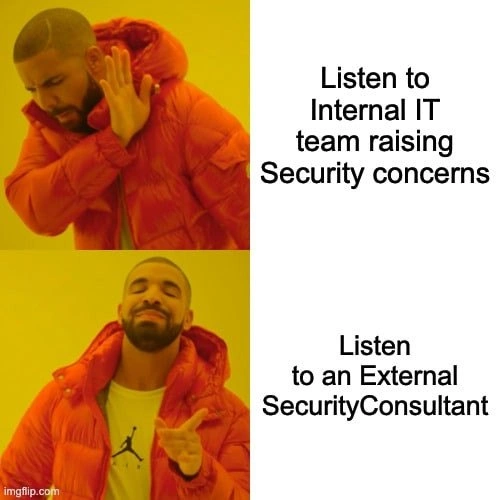
The meme uses the familiar two-panel Drake format: the top panel rejects

Listen to Internal IT team raising Security concerns

and the bottom panel approves

Listen to an External SecurityConsultant

The missing space in SecurityConsultant almost makes it better, because the whole joke is about packaging. The technical content is not a specific exploit; it is the corporate failure mode where the same information security warning has radically different weight depending on whether it arrives from an internal team or an outside firm with a polished slide deck and a day rate that could fund several overdue firewall upgrades.

Experienced security and systems teams recognize this immediately. Internal IT says, "We need MFA on admin accounts," "These backups have not been tested," "That public service is running an unsupported version," or "This vendor access model is indefensible." The response is often delay: budget constraints, roadmap pressure, "accepted risk," or the sacred phrase "let's revisit next quarter." Then an external consultant performs a security audit, writes the same finding in a PDF, labels it High Risk, and suddenly executives discover urgency like it was shipped overnight.

The humor lands because security governance is supposed to be about evidence, risk, impact, and controls. In practice, organizations often treat credibility as a function of distance. Internal people are seen as blockers, complainers, or "too close to the problem." Consultants are seen as objective, even when they are repeating exactly what the internal team already documented in tickets, emails, risk registers, and meeting notes. Same vulnerability, nicer template.

There is also a management-versus-engineering dynamic hiding under the joke. Internal teams usually understand the messy local context: which legacy authentication system cannot be replaced cleanly, which business unit refuses downtime, which compliance exception became permanent, and which "temporary" VPN rule has outlived multiple directors. External consultants can be valuable, but the dysfunction is when leadership uses them as permission to believe its own employees.

This is why the meme belongs in both Security and CorporateCulture. The security problem may be outdated systems, weak access controls, poor patch management, or insufficient monitoring. The cultural problem is that the organization already had the signal and chose to discount it. The consultant does not create the truth; they make it billable, formatted, and politically survivable.

Description

The image uses the two-panel Drake meme format on a white background. In the top panel, Drake rejects the text "Listen to Internal IT team raising Security concerns." In the bottom panel, Drake approves the text "Listen to an External SecurityConsultant," with "SecurityConsultant" written as one word. The joke is about organizations discounting warnings from their own IT or security staff until the same concerns arrive through an external consultant with a formal engagement and invoice. The technical relevance is security governance, internal expertise, and the social failure mode where risk is accepted only after it is repackaged by a third party.

Comments

2
Anonymous ★ Top Pick Same vulnerability, different invoice: now it has executive priority.
  1. Anonymous ★ Top Pick

    Same vulnerability, different invoice: now it has executive priority.

  2. @s2504s 4y

    There is no prophet in own homeland (Нет пророка в своем Отечестве)

Use J and K for navigation