Computers: Just Rocks We Tricked Into Thinking
Why is this CS Fundamentals meme funny?
Level 1: Teaching a Rock
Imagine you have a pet rock and you claim you taught it how to do math homework by giving it little electric shocks. That sounds silly, right? Well, at a basic level, that’s kind of what a computer is! We took a special kind of rock and found a way to wake it up with electricity so that it can follow our instructions. Of course, the rock isn’t actually alive or thinking by itself – we just wired it up in a clever way. It’s like a magic trick or a science fair experiment: zap! and suddenly the stone can answer questions and show you pictures. Describing it as “a rock we tricked into thinking” is funny because you’d never expect a rock to be smart. It’s a crazy simple way to talk about something so high-tech, and it makes us realize how amazing (and a bit comical) it is that humans figured out how to make a rock seem like it’s thinking!
Level 2: Sand to Circuits
Let’s break down what that sentence means in plain technical terms. When someone says “computers are just rocks we tricked into thinking using electricity,” they’re referencing a few basic facts about how computers work:
Silicon “rock”: Computers are built on silicon, a chemical element that is one of the main ingredients in sand and rocks (like quartz). Silicon is plentiful in the earth’s crust. When we say “rock” here, we really mean the microchips inside your computer – those little black integrated circuit chips on the motherboard or inside your phone. A chip is actually a thin slice of crystallized silicon. It might not look like a rock you’d find on the ground, but chemically it’s the same base material, just ultra-pure and arranged in a very precise way. Silicon is used because it’s a semiconductor: we can control whether it conducts electricity or not by mixing in tiny amounts of other elements (a process called doping). In a poetic sense, your laptop’s brain is made of refined rock!
Tricked into Thinking: Of course, a rock can’t really think. What this refers to is that we’ve designed the silicon chip to perform computations that mimic logical decision-making. How? By creating billions of tiny switches called transistors on that chip. Each transistor can be either ON or OFF, kind of like an electrical light switch. We interpret ON as a
1and OFF as a0. These 1s and 0s are called bits, and they’re the basic units of information in computing. By connecting transistors together, engineers create logic gates and circuits that follow rules (for example, “if this AND that are ON, then switch that other thing ON”). Those rules are essentially the “tricks” we use to make the chip carry out tasks. When you hear “thinking,” think of it as the chip following tons ofif-elsedecisions and math operations extremely fast. It’s not creative thought like a human brain, but it can solve problems in a step-by-step way because we set it up to do so.Using Electricity: The transistors on a chip need electricity to work. Electricity is just a flow of electrons (tiny charged particles). In a computer, we run electrical current through those silicon transistor circuits. When a transistor is ON, electricity flows through it; when it’s OFF, the flow stops. By controlling that flow in complex patterns, the chip can do everything from adding two numbers to displaying a video on your screen. The phrase “zapped with electrons” is a jokey way to say we’re powering the computer with electrical energy. Without electricity, those transistors would all be OFF permanently, and the computer wouldn’t do anything — it would just sit there like, well, a rock.
In simpler terms, a computer is a machine made of material from rocks (silicon) that we’ve engineered to be filled with billions of teeny-tiny electric switches. Then we push electric current through it in clever ways to make the machine solve problems, display graphics, and run programs. Saying we “tricked” the rock is just a humorous way of saying we engineered the material to behave in a way that appears intelligent or purposeful.
If you’re new to these concepts, it helps to remember the saying: “inside a computer, everything is just zeros and ones.” Those zeros and ones (binary) aren’t mystical – they physically exist as low and high voltages in the hardware. A voltage being high (for example +5V) might represent a “1”, and 0V represents a “0”. Each tiny transistor on a chip can be thought of like a light bulb that’s either on (1) or off (0), but instead of giving off light, it allows or blocks electrical current. Now imagine billions of such little switches flipping on and off every second under the control of a program. That’s basically what a CPU (Central Processing Unit) does. It follows the instructions of software (which is also encoded in binary) by turning on and off transistors in the right sequence.
All the fancy stuff you see a computer do – playing video games, browsing the web, editing photos – ultimately breaks down into extremely simple operations happening millions or billions of times per second at the hardware level. The meme humorously reminds us of this by using the most basic description possible: it’s just rock and electricity. It’s a bit like describing a book as “wood pulp with black squiggles.” It’s true, even if it leaves out all the complexity of the story those squiggles tell. In the same way, saying a computer is a “rock thinking with electricity” is true in a raw physical sense, but it skips over the incredible engineering and layers of abstraction that make our devices so amazingly useful. That contrast between the simple description and the complex reality is what makes tech folks chuckle – because we understand both sides of it.
Level 3: Ballpark Explanation
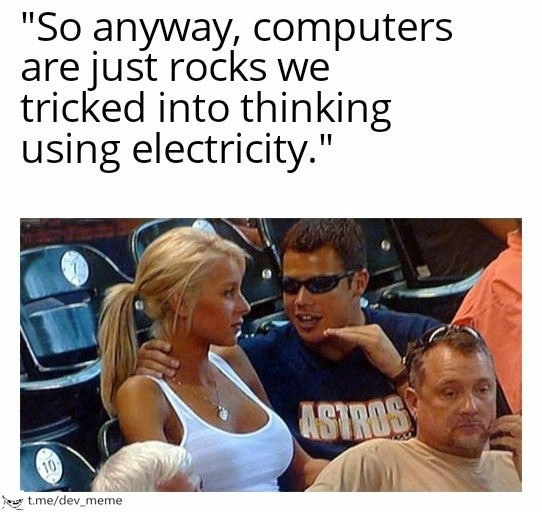
"So anyway, computers are just rocks we tricked into thinking using electricity."
This meme distills a deep technical reality into one disarmingly simple sentence. It’s a perfect hardware humor reality check. An excited developer (like our friend in the Astros shirt) might blurt out this line at a ballgame, trying to blow someone’s mind with a quirky factoid. It’s an absurd oversimplification of CS fundamentals that only a true tech nerd would come up with. And that’s exactly why it’s funny to those in the know: it’s basically tech philosophy delivered as a punchline. The guy enthusiastically explaining is every passionate engineer who can’t resist sharing the “Did you know…?” behind everyday technology, while the uninterested woman represents the rest of the world just trying to watch the game. The humor here comes from that relatability: we’ve either been the over-eager explainer or the trapped listener at some point (many of us in tech have been both!).
From a seasoned developer’s perspective, the phrase “just rocks we tricked into thinking” pokes fun at how deeply we abstract away the hardware in our daily work. We write high-level code in Python or JavaScript, deploy complex cloud applications, or train machine learning models, often without stopping to think that underneath all those layers of software abstraction, it’s still just simple electrical signals switching on and off on a chip. It’s both humbling and comical to reduce your top-of-the-line gaming PC or smartphone – which feels almost alive with intelligence – to nothing more than a slab of refined sand being zapped with electrons. This is classic computer-science humor: revealing the absurd truth that no matter how sophisticated our software becomes, at the end of the day it runs on physics.
The ballpark setting of the meme image enhances this contrast. Here we have a guy at a baseball game, but instead of discussing the score or the players, he’s gesturing wildly about computer architecture to someone who clearly isn’t asking for a lecture. The blonde woman’s neutral, forward-looking expression screams “I did NOT sign up for a Silicon 101 talk tonight,” which is hilarious because many of us have been in social situations where we accidentally unleashed our inner engineer on an unsuspecting friend. The fellow next to them looks away, possibly smirking because he finds the nerdy rant either amusing or secondhand embarrassing. It perfectly captures that nerd humor scenario: an enthused techie unloading trivia about hardware onto someone who probably just asked a casual question like “How’s work?” five minutes ago.
Technically speaking, the meme’s statement is pretty accurate in a fundamental sense. We really do “trick” computers into “thinking” by structuring millions of tiny on/off switches (transistors) to carry out logic. The electricity is the force that drives these switches. When the meme says “thinking,” it’s tongue-in-cheek – we know computers don’t genuinely ponder ideas or feel emotions. But we often anthropomorphize machines that way, saying things like “my phone knows me so well” or “the computer is trying to process something.” This meme yanks us back to reality: the computer isn’t a mind, it’s a machine. A really, really complex machine built from simple parts. It will only ever do exactly what its circuits and code tell it to do (nothing more, nothing less).
For veteran programmers and computer engineers, there’s also an inside joke about how literal this all is: we spend days debugging software, cursing that “the computer is being stupid.” But of course it’s “stupid” – it has the IQ of a rock! It’s just following instructions we gave it, moving electrons around. We’ve built elaborate castles of abstraction (operating systems, programming languages, fancy user interfaces) on top of this bedrock of transistors. Most of the time, developers live high up in those castles, far removed from the gritty hardware details. But occasionally – especially when things go wrong at the hardware level – we’re reminded that beneath all those layers it’s ultimately just stone and lightning making everything work. (Hardware geeks even joke that computers run on magic smoke – if a circuit fries and you see a puff of smoke escape, the “smart” rock instantly stops working, as if its magic left!) Realizing this truth can be both humbling and darkly comedic.
In essence, this meme tickles the inner engineer’s love for paradox. Computers are extremely advanced, world-changing devices – yet fundamentally, they’re made of very ordinary stuff (metal, silicon, electrons) doing very ordinary things (turning on and off). It’s like describing a gourmet five-course meal as “just a chemical reaction in your mouth” – technically true, but hilariously reductionist. The one-liner “rocks we tricked into thinking” is a hardware-abstraction reality check, a reminder not to mystify computers too much. And the scenario of the eager explainer and bored listener adds that extra layer of social comedy. We laugh because we tech folks can absolutely see ourselves blurting out something like this at an inappropriate time, proudly sharing our fascination with how computers really work, while everyone else just nods politely.
Level 4: Silicon Alchemy
In the wildly intricate reality behind this meme’s joke, our everyday computers truly are silicon crystals doing logical computations through electron flows. This is like a form of alchemy: we take an abundant element from sand (silicon, essentially refined rock) and dope it with tiny impurities to craft transistors. A transistor is a microscopic electronic switch, typically built from these doped silicon materials. By applying an electrical voltage to one part of a transistor, we control the flow of electrons through it—similar to how a faucet knob controls water. Millions of such transistors working in concert create complex circuits that execute instructions. It’s as if we carved an incredibly elaborate maze into a rock and then sent zillions of electrons rushing through that maze to carry out logical decisions.
This concept isn’t just fun imagery; it’s grounded in a rich history of computer science and hardware engineering. In 1938, Claude Shannon (later famous as the father of information theory) demonstrated that you could implement Boolean logic (the algebra of true/false values) using electrical circuits. He basically showed mathematically that networks of switches can perform any logical calculation. Fast forward to 1947: the invention of the transistor at Bell Labs meant those “switches” could be made from solid silicon rather than bulky vacuum tubes. Transistors could flick on/off billions of times per second, which suddenly made Shannon’s idea explosively practical. We had found a way to trick a piece of rock (silicon) into acting as a lightning-fast on/off switch that obeys logic rules. This is the foundational sorcery behind all modern computing hardware – turning geology and physics into “thinking” machines.
At a theoretical level, every single operation a computer performs breaks down into combinations of simple logical functions like AND, OR, and NOT (the basic Boolean operations). Astonishingly, there’s even a single type of circuit called NAND (NOT-AND) from which you can build any other logic or arithmetic operation – meaning NAND is logically universal. Engineers physically wire up transistors to create these logic gates. For example, a NAND gate in code might look like:
# A simple representation of a NAND logic gate in Python:
def NAND(x, y):
return not (x and y)
# (True and True) yields False; any other combo yields True.
In a real chip, that logic isn’t done by high-level code, but by electrons zooming through a tiny transistor arrangement that produces the same truth table. It’s mind-blowing: by wiring up enough tiny switching elements (transistors) into NAND gates and beyond, we get adders, flip-flops, multiplexers – the LEGO blocks of a CPU’s brain. Layer by layer, these form arithmetic units, registers, caches, and the entire microprocessor architecture. The emergent result is a machine that can execute billions of instructions per second, simulating “thinking” by crunching numbers and manipulating symbols.
What’s wild is how fundamental physics both limits and enables this. We’re literally manipulating quantum-level phenomena – doping introduces free electrons or holes in the silicon lattice, and toggling a transistor’s gate causes those electrons to flow or stop. Each transistor’s ON/OFF state represents a bit (0 or 1), and by orchestrating billions of bits with a clock ticking gigahertz-fast, we achieve everything from displaying a cat video to running neural networks. Yet, no matter how advanced the algorithm, at the lowest level it's just electrons dancing through a crystalline grid. The “thinking rock” quip isn’t just humor; it’s a concise acknowledgment of the elegant physics-forged illusion beneath high tech. We have effectively kidnapped the laws of electricity to perform abstract computations – true silicon alchemy!
Description
The image uses the 'Bro Explaining' or 'Mansplaining' meme format. A young man wearing a blue 'ASTROS' t-shirt and sunglasses is leaning in and talking animatedly to a blonde woman in a white tank top, who looks unimpressed and slightly bored. In the foreground, another man looks away with an uncomfortable expression. The text at the top reads, "So anyway, computers are just rocks we tricked into thinking using electricity." The humor comes from the profound oversimplification of computer science and electrical engineering. It reduces the entire field - from semiconductor physics and logic gates to complex architectures and software - into a simple, almost comically primitive concept. This is a classic shower thought that resonates with tech professionals because, at a fundamental level, CPUs are made from silicon (a rock) that has been manipulated (doped) to control the flow of electricity to perform calculations

Comments
7Comment deleted
And we've spent the last 50 years teaching that rock to think, only for it to spend most of its time arguing about JavaScript frameworks
They’re just electrified sand, yet every QBR someone asks why our rocks won’t deliver five nines on spot instances priced like playground gravel
After 20 years of building abstractions on abstractions, I still occasionally remember that my entire career is just rearranging sand crystals' electron states and have a mild existential crisis during sprint planning
This meme perfectly captures the beautiful absurdity of our profession: we've spent decades building increasingly sophisticated abstraction layers - from transistors to assembly to high-level languages to frameworks - all so we can forget that we're ultimately just convincing some very precisely arranged sand to flip bits at 3+ GHz. It's like we're all collectively gaslighting rocks into consciousness, one clock cycle at a time
Tricked rocks into sentience, yet they still hallucinate in floating-point arithmetic
Most postmortems translate to: a billion doped sand grains disagreed on a boolean - ECC caught most, PagerDuty caught you
Senior engineer: a geologist who convinces electrified sand to emit the same JSON twice in production - despite caches, GC pauses, and the occasional cosmic ray