Skip to content
DevMeme
1110 of 7435
The Universal Horror of Legacy Code
TechDebt Post #1244, on Apr 3, 2020 in TG

The Universal Horror of Legacy Code

Why is this TechDebt meme funny?

Level 1: Embarrassing Homework Moment

Imagine you have a big school project notebook that you’ve been scribbling in for a long time. It’s super messy – there are doodles in the margins, erased bits, and notes only you understand. You get a good grade using it, but then the teacher asks if she can share your notebook with the class so everyone can learn from it. Uh-oh! You suddenly feel nervous, because you know it’s a jumbled mess inside. You’d almost rather hide it than let others see all the confusing parts.

That’s exactly what happened here, but with computer code. A scientist had a really old and messy program that worked for him to predict how COVID-19 might spread. When other people asked to see this program (to check it and learn from it), he was like the nervous monkey puppet in the picture – looking off to the side, awkwardly thinking “umm… maybe not.” The funny part is every programmer has felt this way. It’s like when you don’t want to show your messy room to guests. We laugh because we all understand that embarrassed feeling: sometimes things work well, but behind the scenes it’s pretty chaotic!

Level 2: Legacy Code Woes

Let’s break down why every programmer found this meme painfully relatable. The issue at hand is LegacyCode and the mountain of problems that often come with it. Legacy code is essentially old code – stuff written years ago that is still in use. Think of code from 13 years back (circa 2007): it might be written in an outdated style or language, possibly by someone who’s long moved on. Often it wasn’t designed with today’s needs in mind. Here, Prof. Ferguson’s COVID-19 scientific_software began as a 13-year-old program for disease outbreak modeling. That makes it a prime example of a LegacySystem: software that keeps working (so it stays in service), but over time becomes hard for anyone new to understand or modify.

One big reason legacy code gets hard to work with is TechnicalDebt. This is a term we use to compare messy code to financial debt. Imagine you take a shortcut in coding (like not cleaning up a hack or skipping documentation) to “save time” in the moment. That’s like borrowing time from the future – a debt. It “accrues interest” because the longer you wait to fix it properly, the more problems it causes later. After 13 years of quick fixes and minimal cleanup, the technical debt on Ferguson’s model code was through the roof. Lots of SpaghettiCode builds up in such projects. Spaghetti code means code with a logic flow as tangled as a bowl of spaghetti. Without a clear structure, the execution jumps around unpredictably, just like trying to follow one noodle through a pile – it’s easy to get lost. In practice, spaghetti code might have giant functions thousands of lines long, deeply nested loops, or variables that change meaning depending on where you are in the code. It works (perhaps only the original author truly knows why), but it’s very hard for someone else to read or update.

Now add the next ingredient: Documentation (or the lack thereof). Documentation can be comments in the code, README files, or manuals that explain what the code does and how. In well-kept projects, you might see something like:

# This function calculates the infection spread based on the SIR model.
def simulate_spread(population, initial_infected, days, transmission_rate):
    # ... code implementing disease spread simulation ...

But in Ferguson’s case, by his own admission, there were “thousands of lines of undocumented code.” That likely means very few comments or explanations like the above. For a developer, that’s like reading a dense textbook with no chapter headings and no index – you can get through it, but it’s going to take a ton of effort to figure out what’s going on. DocumentationWoes are a common pain: when you revisit your own code months later and think, “Why on earth did I do it this way?” Comments and docs are the breadcrumbs that help us (and others) navigate code, and without them, understanding legacy code becomes a detective mission.

So picture what happened: People asked for Prof. Ferguson’s code to review it (in science, sharing code helps others verify results, which is akin to peer_review in academia or a code review in software teams). Now, the code_transparency request put him on the spot. If he released the code as-is, other scientists and developers would see all the messy internals. They might struggle to even run it, let alone understand it. That’s embarrassing and could undermine confidence in the results. This situation is something “every other person who writes code” can empathize with. We’ve all had a moment where a colleague says, “Hey, can I see that script you wrote?” and internally we freeze, remembering the script is held together by chewing gum and string. It’s code_sharing_anxiety 101 – the fear that others will judge your code’s quality.

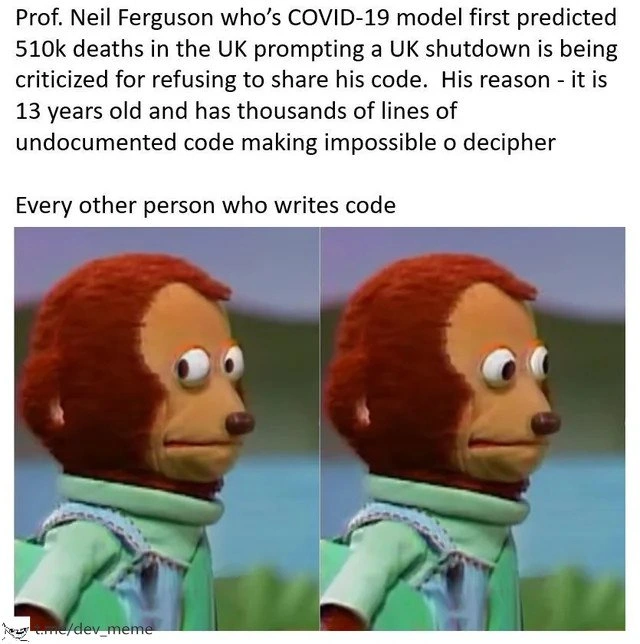
The meme uses the Awkward Look Monkey Puppet images to convey that exact feeling. If you haven’t seen this meme before, it’s a brown monkey puppet from a children’s show, shown in two frames. In the first frame, the puppet stares straight ahead with a neutral expression. In the second frame, its eyes cut to the side and it looks nervously startled. It’s a popular meme format to depict the “quiet panic” when someone is caught off guard or subtly called out. The caption “Every other person who writes code” suggests that all programmers are like that puppet in this scenario: first acting like everything’s fine, then doing a sideways “uh-oh” glance when realizing we’re guilty of the same thing being criticized. It’s the relatable developer experience that makes the meme funny.

Let’s decode some terms and why they fit this meme:

  • LegacySystems / LegacyCode: This code is old (13 years!). In tech, that’s legacy. It often implies the code might not follow current standards or could depend on old technology. Many developers inherit legacy code from predecessors and know it’s not easy to modernize.
  • TechnicalDebt: All the short-term expedients in code (quick fixes, poor design choices, skipped tests) that accumulate into long-term burdens. In this code, years of academic tweaks with no cleanup meant a huge backlog of fixes was “owed.” The code works, but maintaining or explaining it costs extra effort now (that’s the “interest” on the debt).
  • SpaghettiCode: Code so tangled and unstructured that it’s like a plate of spaghetti. You might go in thinking you’ll trace one logical path, but it weaves in and out unpredictably. This happens when code grows without a clear plan. A telltale sign is functions that are super long and do too many things, or variables that get reused in confusing ways.
  • DocumentationWoes: The misery of missing documentation. It’s a common joke that developers hate writing docs. Here it bites back: without documentation, the code is “impossible to decipher,” as the meme text says. That’s a woe indeed, especially under peer review.
  • DataScience angle: In fields like data science or scientific research, code is often written by subject matter experts who may not be trained in software engineering best practices. The focus is on getting results (e.g., a working pandemic model) quickly to advise decision-makers, rather than polishing the code. This gap can lead to exactly the scenario in the meme: important code that isn’t production-quality.

For a junior developer or someone new to coding, the key takeaway is: you’re not alone in writing imperfect code. In fact, even famous scientists sometimes write code that’s more of a rough draft than a pristine final product. The meme humorously validates the experience of feeling shy about your code. It also highlights why things like code comments and refactoring (rewriting code more cleanly) are worth the effort before your project becomes mission-critical. After all, you never know when your quick script might end up running something important – or getting plastered in the news! And if that day comes, you don’t want to be the wide-eyed monkey puppet, caught with a codebase that’s indecipherable to everyone else.

Level 3: Outbreak of Technical Debt

In early 2020, a notorious LegacyCodebase suddenly took center stage: Prof. Neil Ferguson’s epidemiological_model for COVID-19. This was no shiny new microservice or well-documented library – it was a 13-year-old research script with “thousands of lines of undocumented code.” When Ferguson balked at immediate code sharing, veteran developers gave a collective nod (and a chuckle). The top of the meme spells out his situation: he’s under fire for not releasing the model’s source, citing its ancient, indecipherable state. The bottom shows the famous Awkward Look Monkey Puppet doing a double-take. Caption: “Every other person who writes code.” Why? Because we’ve all been there.

This meme lands squarely in the realm of TechnicalDebt and LegacySystems humor. It satirizes the universal shame of spaghetti code that hasn’t seen the light of refactoring in ages. Ferguson’s COVID-19 model code famously started off as a pandemic scientific_software tool from 13 years prior (originally written to model earlier disease outbreaks). Over a decade, it likely ballooned with quick fixes, one-off tweaks, and “temporary” patches that became permanent. In software terms, it turned into classic SpaghettiCode: a tangle of loops, conditions, and mysterious variables that only the original author (on a good day) might fully grasp. The result? CodeQuality nightmares – and deep code_sharing_anxiety when outsiders demand a peek under the hood.

The humor here is half technical, half psychological. The monkey puppet’s side-eye perfectly captures a programmer’s guilty reaction when someone says, “Can I see your code?” In the left image, the puppet stares blankly ahead (playing it cool), but in the right image its eyes dart sideways in panic – as if caught red-handed. That’s every developer with an old script full of // TODO: fix later comments and zero docs. We laugh because we recognize the scenario: a world-class scientist scrambles to explain “it’s messy, trust me”, and all the devs reading the news smirk and think, “Same, professor, same.” It’s a form of commiseration. The meme essentially whispers a truth in the dev community: DocumentationWoes and quick-and-dirty code aren’t the exception; they’re the rule hiding in all of our repositories.

From a senior engineer’s perspective, this situation also highlights the friction between research code and production code. In academia and DataScience, deadlines and breakthroughs often matter more than tidy architecture. You hack together a working model in MATLAB or Python (or even ancient Fortran or C) to get results. You might hard-code parameters, use globals, or ignore edge cases – because the goal is a published paper or a policy recommendation, not a scalable app. Over 13 years, such code accumulates TechnicalDebt the way a neglected attic gathers dust. There’s no comprehensive test suite, variables might have names like a,b,c (because hey, it made sense at 2 AM in 2007), and crucial formulas might be hidden in 5-level-deep nested loops. By 2020, handing this code to another developer is like handing them a mystery novel with half the pages missing. No wonder Ferguson hesitated to share it! It’s not that he wanted secrecy per se – it’s that the code was impossible to decipher without a guide (and probably a few prayers).

The meme’s punchline, “Every other person who writes code,” implicates all developers in this comedy of errors. We’ve all written something held together by duct tape and hope, then cringed at the idea of a PeerReview. It’s pointing out an uncomfortable truth: even critical software (like a pandemic covid19_model) can live as a messy, undocumented beast for years until a crisis shines a spotlight on it. And when that happens, the author’s reaction – embarrassment and nervous excuses – is hilariously relatable. In the development world, we often joke that “if it works, don’t touch it.” That mentality produces systems that work... until someone new has to read them. Ferguson’s code “worked” for his team’s simulations, so it was never rewritten from scratch. But when UK policymakers and other scientists wanted transparency (to validate those alarming 510k deaths predictions), the code wasn’t ready for prime time.

LegacySystems like this often run critical processes in the wild. Seasoned devs know of banks still running 1970s COBOL, or space agencies using software written before the interns analyzing it were even born. We also know the sinking feeling when that legacy logic needs an update or an audit. It’s usually “no-comments, loads of global state, only runs on Windows 7 with Python 2.5” – in short, a maintenance nightmare. This meme cleverly connects that broad industry pain to a specific event: a top scientist too embarrassed to share code that underpins life-and-death forecasts. It’s both tragic and comic. The tragedy is that code transparency in science is crucial (reproducibility, trust, collaboration), yet many scientific codes are simply not prepared for open scrutiny. The comedy is that developers on Reddit and Twitter responded not with outrage but with a knowing laugh, effectively saying, “Don’t worry professor, we’ve got closets full of skeleton code too.”

On a deeper level, this highlights why CodeQuality and Documentation matter. One could argue that if the model’s code had been refactored and documented over the years (or open-sourced earlier), peer review would be a non-issue. But reality is messy. Writing clean code takes time – time that researchers racing against a pandemic might not have had. Ferguson’s frank admission (“thousands of lines of undocumented code, impossible to decipher”) is like every developer’s worst self-assessment made public. The meme strikes a chord because it exposes an open secret in tech and science: brilliant results can come from ugly code. And when you’re asked to reveal that code… cue the sweating puppet face.

In sum, the meme uses the awkward_monkey_puppet to encapsulate collective developer embarrassment. It juxtapositions a real-world drama about code transparency with the everyday developer’s internal scream of “please don’t make me show them my messy project!” It’s a senior-level wink to all the painful lessons about TechnicalDebt: pay a little as you go (write docs, refactor, add comments), or you might face a huge bill at the worst possible time. And if you don’t pay up? Well, you might end up like that puppet – eyes darting, hoping nobody notices the pile of spaghetti behind you.

Description

A meme composed of two parts. The top section contains text: "Prof. Neil Ferguson who's COVID-19 model first predicted 510k deaths in the UK prompting a UK shutdown is being criticized for refusing to share his code. His reason - it is 13 years old and has thousands of lines of undocumented code making impossible o decipher". Below this text, there is a caption, "Every other person who writes code", followed by the Monkey Puppet (or Awkward Look) meme. The meme itself is a two-panel image showing a puppet character looking forward in the first panel and then nervously darting its eyes to the side in the second, a classic reaction of guilt or anxiety. This meme taps into the universal developer experience of having old, messy, and poorly documented code that they would be ashamed to share. It humorously connects a high-stakes, real-world event about scientific modeling to the common feeling of 'code shame' and the ever-present reality of technical debt
Comments

7
Anonymous ★ Top Pick Every senior dev has a 'do not open under any circumstances' project folder. It's not a secret project; it's just the first one
  1. Anonymous ★ Top Pick

    Every senior dev has a 'do not open under any circumstances' project folder. It's not a secret project; it's just the first one

  2. Anonymous

    I’ll gladly open-source the 13-year-old pandemic model - right after someone figures out how to containerize its Makefile → Perl → MATLAB → Fortran build chain that only compiles on a 32-bit Ubuntu 10.04 VM named “do_not_touch”

  3. Anonymous

    The only difference between academic code and enterprise code is that one influenced global lockdown policy and the other just processes your credit card payments

  4. Anonymous

    Every senior engineer has that one critical system running in production that's held together by prayers, undocumented assumptions, and a README that just says 'good luck.' The real pandemic is the legacy code we created along the way - and unlike COVID, there's no vaccine for 13-year-old codebases with zero comments and variable names like 'temp2_final_ACTUAL_USE_THIS'

  5. Anonymous

    Undocumented 13-year-old epidemiology code steering policy? That’s just a monolith with a PhD - bus factor 1, magic numbers, no tests, README: “see paper”, and data in final_final_v7.csv. Tell me your pricing engine isn’t exactly that

  6. Anonymous

    Ferguson's code: the SIR model where R₀ for readability is firmly 0.01

  7. Anonymous

    Nothing ages a prototype faster than a policy briefing - one day it’s “refactor later,” the next it’s a FOIA request for your TODOs

Use J and K for navigation