Skip to content
DevMeme
591 of 7435
The Compiler's Pedantic Refusal to 'Just Try'
Languages Post #675, on Sep 19, 2019 in TG

The Compiler's Pedantic Refusal to 'Just Try'

Why is this Languages meme funny?

Level 1: Could You Just Try?

Imagine you’re sorting your toy bricks by color. You ask your helper robot to pick out all the red bricks. You say “Hey robot, give me the Red bricks.” But the robot looks in its inventory and says, “Error: cannot convert from 'red' to 'Red'.” You look at the robot, and it’s basically telling you it won’t give you the bricks because you said "Red" with a capital R instead of "red" with a lowercase r. 🙄 You’d probably stomp your foot and say, “Alright, but you could, like, try!”

This meme is just like that. The developer is frustrated because the computer is being super literal and picky. It’s treating the word “string” with a lowercase s as something completely different from “String” with an uppercase S. To us humans, that’s the same word just with one letter capitalized – we know they mean the same kind of thing (a piece of text). But the computer is stubborn like a toddler who only responds to the exact right phrasing. The joke is in the developer’s reply: “Alright but you could, like, try.” It’s basically them pleading with the computer, “C’mon, you know what I mean... can’t you just do it anyway?”

It’s funny because we all know computers don’t work like that – they’re precise machines. It won’t try a solution on its own if you don’t give the exact instructions. In simple terms, the developer wanted the computer to be a bit flexible, and the computer said “Nope, not doing that.” This little interaction captures how coding can sometimes feel like arguing with a very literal-minded friend. You have to say everything just right, or they act like they have no clue what you want. The humor (and frustration) comes from that moment we’ve all had: wishing the machine would just understand what we meant, even if we didn’t say it perfectly.

Level 2: Little s vs Big S

At its core, this meme is about a compiler error message involving the word "string" with different capitalization, and it’s poking fun at how picky code can be. In C# (a programming language), string (with a lowercase 's') and String (with an uppercase 'S') actually refer to the same thing in most cases: the data type for text, i.e., a sequence of characters. Think of string as a keyword – a special word in the language – that is a convenient alias for the real class named System.String. When you write:

string message = "Hello";
String greeting = message;  // This works fine: 'string' and 'String' are the same type here

Both message and greeting are of the same type under the hood: a string of text. So normally, you would not get an error converting one to the other because there’s nothing to convert – they’re literally the identical type. That’s why the screenshot of a compiler tooltip saying “cannot convert from 'string' to 'String'” appears so absurd and funny. It’s as if the computer is saying, “I can’t change this thing into the same thing.” Huh? 😕

So what’s going on? The humor comes from a couple of language quirks and strict rules. First, C# is case-sensitive. That means it treats lowercase and uppercase letters as different symbols. myData is not the same as MyData. So, if you had something weird like a custom-defined class named String in your code (imagine someone made their own class called String for some reason), then string (the normal text type) and String (that custom class) would actually be different. The compiler would then absolutely give an error if you try to use one in place of the other, because it sees two distinct types. The error message format is generic: "cannot convert from 'X' to 'Y'" means “you gave me X, but I needed Y, and I can’t automatically change X into Y.” In our meme’s case, X is 'string' and Y is 'String', which out of context looks hysterical because we humans read that and think, “X and Y look identical!”.

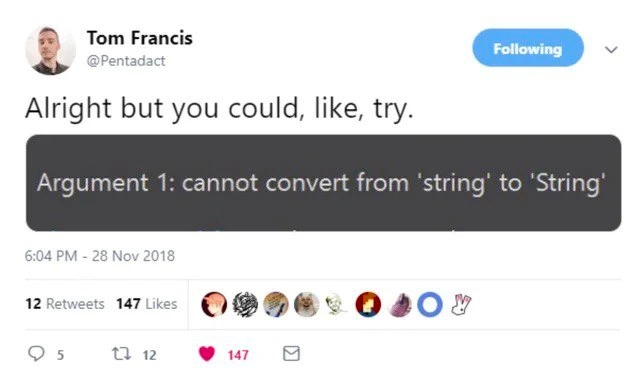
The tweet text above the error, "Alright but you could, like, try.", is the developer basically talking back to the compiler. They’re saying, “Okay, I see that you think those are different, but couldn’t you at least make an attempt to convert it? It’s obviously just a string of text, and you need a string of text, so why not just go for it?” This is something you might find yourself saying in a moment of frustration after staring at a stubborn error message. It’s like when you have two puzzle pieces that look like they should fit – you just wish the puzzle would accept it even if you haven’t aligned it exactly right.

Now, contrast this with a language like JavaScript (often the butt of jokes about being too loosey-goosey with types). In JavaScript, the language often will try to make things work, sometimes in unpredictable ways. For example, if you have "123" (a string) and you need it as a number, JavaScript might automatically convert it to the number 123 if you use it in a numeric context. This is called type coercion. Sometimes it’s handy, but other times it leads to bizarre behavior (like "5" + 1 resulting in "51" because it decides to treat 1 as text and concatenate). C# and other static languages avoid this kind of surprise by simply not doing any conversion unless you explicitly tell them to. They have a “you get exactly what you ask for” policy.

So the meme is really laughing at the extremes of that policy. The compiler is so strict about types that it won’t budge even when it seems like common sense that the types are the same. This is a classic debugging frustration moment: the developer (Tom Francis, via the tweet) is humorously imploring the tool to be a bit smarter or more flexible. Of course, the compiler won’t— it literally can’t "try" a conversion that isn’t defined. But it’s funny to imagine the compiler as this obstinate entity that could help out but just refuses. We often anthropomorphize our tools when debugging, saying things like “My code is being stupid” or “The compiler doesn’t like me today.” Here, it’s “Alright, compiler, but you could at least attempt to figure out what I mean!”

For those not deeply familiar with C#, it might help to clarify: string vs String is a bit of an oddball, because in everyday C# coding they are interchangeable. You could write String title = "Mr."; or string title = "Mr."; and both are fine (assuming you have using System; at the top for the String to be recognized). Many style guides in C# actually prefer the lowercase string for consistency, but that’s just convention. The compiler itself treats them the same internally. That’s why an error reading cannot convert from string to String is not something you typically see. It likely resulted from a unique situation (like a conflict with a different String or maybe even a mono compiler quirk), but the meme’s impact doesn’t depend on that exact scenario. It’s funny because it looks like the compiler is being insanely literal about a one-letter case difference.

And speaking of one-letter differences, anyone who’s tried programming learns quickly that one character out of place can break everything. Forget a semicolon, and the whole program might fail to compile. Put an uppercase letter instead of lowercase, and you might be referring to an entirely different thing. Computers don’t do nuance; they follow exact rules. This is why debugging can be tedious: you’re essentially searching for that one character or line that doesn’t match the expected pattern. The upside is, once it compiles, you have confidence (in languages like C#) that the types and calls are correct. The downside is, until it compiles, you might be tearing your hair out over something that feels trivial.

In summary, little s vs big S here is a stand-in for any small technical detail that a strict system refuses to overlook. It highlights a common developer humor theme: the contrast between human intuition (“it’s obviously the same thing!”) and machine logic (“these are different identifiers, I cannot proceed”). The tweet and the error message together deliver a punchline that every coder understands – sometimes you wish your code would just “try” to do what you mean, but alas, computers only do exactly what you specify, nothing more. And as annoying as that can be on a late night coding session, it’s also what keeps our software from descending into chaos!

Level 3: Compiler says No

To an experienced developer, this meme is a tongue-in-cheek jab at the strictness of strongly typed languages and their sometimes obtuse error messages. The tweet "Alright but you could, like, try." perfectly captures that exasperated developer frustration we’ve all felt when a compiler or IDE error seems overly nitpicky. We have a function call with an argument type mismatch, and the compiler emphatically responds with "Argument 1: cannot convert from 'string' to 'String'." On the surface, this looks ridiculous – aren’t string and String the same thing in C#? In fact, yes: in C#, lowercase string is just an alias (a built-in shorthand) for the System.String class (capital S). Normally, you can use them interchangeably without any trouble. That’s exactly why the error message is so comedic: the compiler is essentially refusing to convert a string to itself (or so it appears), and the developer is facetiously begging it, "You know these are the same thing… you could at least try to help me out here!"

This scenario pokes fun at a classic language quirk. C# (and many languages like Java, C++, etc.) is case-sensitive. That means myVariable is different from MyVariable, and likewise string is treated differently from String when parsing code. Even though the compiled result for both ends up as System.String, the compiler’s checking process distinguishes keyword vs identifier. Seasoned programmers have been bitten by case sensitivity many times – call a function GetResult() but accidentally type getResult() somewhere, and you’ll face a friendly red underline or a compiler error. The compiler isn’t trying to be mean; it just literally doesn’t recognize getResult as the same name as GetResult. Computers are literal machines. They don’t do fuzzy matching or “close enough” by default (unless explicitly programmed to, which most compilers are not, for good reason!). This meme exaggerates that literal rigidity to the point of absurdity: one capital letter difference, and the compiler acts completely confused.

Senior developers chuckle at this because it resonates with real-world debugging experiences. We’ve all spent an embarrassing amount of time on a bug that turned out to be a typo or a case mismatch. The error messages can sometimes feel unhelpful. Here, the message reads like the compiler is almost mocking us: cannot convert 'string' to 'String'. It might as well say, “I refuse to do this obvious thing because you didn’t do it exactly how I expected.” There's an unspoken rule in strict languages: “If it’s not a perfect match, I won’t compile.” This contrasts with how humans communicate – we can understand context, we fill in missing information, we try interpretations. The compiler, on the other hand, is like that one friend who, when you ask for "Sugar" instead of "sugar", retorts "I don’t know what 'Sugar' with a capital S is." 🙄

The tweet also slyly hints at the double-edged sword of such strictness. On one hand, we gripe about how the compiler won’t do an obvious type coercion for us. On the other hand, many of these same developers (myself included) have probably ranted about languages that do automatically convert types. The poster’s comment “And later the same people screaming something about JS 😕” alludes to this irony. In JavaScript, for example, the language will happily “try” to convert types for you in certain situations – often with wacky results. JavaScript might take a string like "5" and when you add a number to it, it coerces the string into a number (or sometimes the number into a string!) in an effort to make sense of the operation. That can lead to results like "5" + 1 becoming "51" (string concatenation) or "5" - 1 becoming 4 (since it guesses you wanted a numeric subtraction). Those language quirks are the stuff of countless coding humor memes themselves, and many C# or Java devs love to poke fun at them, saying “Ugh, JavaScript will do anything without complaining!”

Yet here we are, looking at a C# error and essentially wishing, just for a second, that the compiler was a tad more like JavaScript – “Come on, just this once, couldn’t you automatically figure it out?” 😂 It’s a shared pain: you know why the compiler is strict (it’s for your own good™, catching real bugs), but at that moment of frustration you can’t help but roll your eyes. Every seasoned programmer recognizes that mix of annoyance and admiration for the compiler. We admire the type safety – that strictness prevents a lot of runtime errors and enforces clarity. But we get annoyed when the strictness feels like it’s fighting us over something trivial. It’s like a safety belt that occasionally hugs you too tight.

In practice, seeing “cannot convert from 'string' to 'String'” might indicate a subtle bug: perhaps a misused namespace, or a custom class named String overshadowing the real System.String. A senior engineer knows that if you actually encounter this error, you’ve probably got a naming conflict or missing reference. The compiler isn’t actually confused by its own alias; it’s warning you that you’re mixing up two different things that both happen to be spelled “String”. The humor comes from taking the error message at face value, as if the compiler is just being a stick-in-the-mud. It’s funny because we personify the compiler: we imagine it could “just try” but is choosing not to out of stubbornness.

This meme is relatable in the debugging & troubleshooting realm too. Often when stuck on a compile error, a dev might mutter, “Why won’t you just work?!” at the code. The tweet captures that human moment of pleading with an inanimate compiler. It also tickles the part of a programmer’s brain that deals with language quirks daily – reminding us that sometimes the only difference between smooth sailing and a maddening error is one letter or one line of code in the wrong place. And honestly, the best part is how this scenario flips perspectives: after fighting such strict compiler errors, one might be tempted to say, “Dynamic languages aren’t so bad, they’d just handle this.” But go too far down that road and you’ll quickly remember why we cherish our compilers! (There’s a reason those same C# devs scream about JS doing implicit conversions and loose typing – each approach has its own nightmares). In short, this meme hits on the classic programmer paradox: we want the compiler to be smart but not too smart, strict but not too strict. We laugh because we’ve all been there, bargaining with the coding gods over something that, in hindsight, was entirely our own doing (yes, it was our fault the S was capitalized wrong—but in the moment, it’s easier to blame the pedantic compiler).

Level 4: Deterministic to a Fault

At the compiler internals level, this meme highlights the uncompromising nature of static type systems. In a language like C#, the compiler's semantic analysis phase treats string and String as symbolic references that must exactly match expected types – there's no magical inference beyond what the language rules allow. Under the hood, C# has a reserved keyword string that the compiler directly maps to the System.String class (note the capital S). Meanwhile, String (capitalized) is typically just an alias for the same System.String if you have using System; at the top. In theory, they’re the exact same data type, simply two names for the same .NET String class. So why would the compiler ever complain about converting 'string' to 'String'?

It comes down to how the compiler’s symbol table and type resolver work with identifiers. The C# compiler is deterministic to a fault: it won’t assume two identifiers are the same type unless it’s 100% certain. If there's any ambiguity – say a custom class named String in a different namespace or an assembly mismatch – the compiler treats lowercase string and capitalized String as distinct symbols. The error message, "cannot convert from 'string' to 'String'", is generated by the compiler’s strict type checker which faithfully prints the symbol names as it knows them. The result is an unintentionally hilarious error: to a human, it looks like it’s refusing to convert a thing to…the same thing, just with a capital letter. The language quirk here is that one is a language keyword and the other is an identifier (often pointing to the same alias). The compiler isn’t trying to be funny or pedantic; it’s following a rigid set of rules defined by the C# language specification.

This rigidity is by design. Statically typed languages enforce type safety at compile time to prevent undefined or bizarre behavior at runtime. The compiler must be absolutely sure about types – it’s performing a formal verification of sorts, ensuring your program doesn’t try to, say, call string methods on an integer. In type theory terms, the compiler is maintaining a strict 1:1 mapping of expected types (like function parameter types) to the arguments you provide. If there’s any discrepancy, even one as trivial as an alias vs. class name, it errs on the side of safety with a compile error. Implicit conversions (automatic type changes) only occur if they are explicitly defined by the language or the types involved (for example, converting an int to a long in C# is allowed because it’s unambiguous and safe). But converting a string to some user-defined String class? The compiler won’t guess that for you – that would violate determinism and potentially yield incorrect behavior. The motto here is “no guesswork allowed” in a strong, statically-typed compiler.

From a compiler-engineering perspective, imagine the chaos if the compiler did “try” random conversions. The code analysis would become undecidably complex – the compiler would have to consider myriad possibilities (should '5' become the number 5? should "true" become a boolean? what about 'string' to String? Are they the same type or not?). This veers into the realm of formal language theory: a compiler operates like a strict grammar enforcer, not an AI with common sense. In fact, languages like C# are designed so that the AST (Abstract Syntax Tree) and type annotations are unambiguous. Each identifier has a clear definition in the current context (namespace or scope). The error arises precisely because the compiler found two different definitions (or at least it doesn’t consider them identical in that context) and, being a machine of logic, it refuses to assume the developer’s intent. No amount of pleading (or tweet sass) will change the compiler’s mind – it’s as uncompromising as a mathematician sticking to the axioms. It’s a little reminiscent of Gödel’s completeness in logic: if something isn’t provable within the rules, the system simply can’t produce an answer. Here, if a type conversion isn’t defined, the compiler can’t proceed.

So, at the deepest level, this meme exposes a bit of compiler pedantry grounded in very sound principles. The humor is that the inflexibility of formal systems (like a compiler’s type checker) clashes with the flexibility of human intuition. We humans see 'string' vs 'String' and think, "C’mon, obviously you know what I mean!" But the compiler’s mindset is closer to, "I only know what you tell me explicitly." It’s a classic case of a strict language rule (case-sensitive exact type matching) leading to a seemingly absurd situation. And yet, that strictness is what saves us from a whole class of bugs. The developer’s plea – “Alright but you could, like, try.” – is a tongue-in-cheek way to say, "Just this once, be a bit smarter, please?" But the compiler will have none of it. In the world of compilers and type theory, being smart often means being unsympathetically strict. The result is a compiler error that is equal parts frustrating and comical, a perfect storm for coding humor.

Description

This image is a screenshot of a tweet by Tom Francis (@Pentadact). The tweet's text says, 'Alright but you could, like, try.' Below this is a dark grey box containing a compiler error message: 'Argument 1: cannot convert from 'string' to 'String''. The post's original caption adds another layer of commentary: 'And later same people screaming something about JS 😕'. The humor stems from a common frustration in strongly-typed, case-sensitive languages like C# or Java, where a primitive type (`string`) is technically distinct from its object wrapper class (`String`). The compiler, being pedantically literal, refuses to perform what seems like an obvious conversion. The developer's exasperated response, 'Alright but you could, like, try,' personifies the compiler as a stubbornly unhelpful entity. For senior developers, this is a deeply relatable moment of friction where the strictness of a language's type system feels more like an obstacle than a safeguard. The added caption points out the irony that developers who get frustrated by this level of strictness often also complain about the opposite problem - the unpredictable, loose type coercion found in languages like JavaScript
Comments

7
Anonymous ★ Top Pick The compiler is that one team member who, during a production fire, points out that your hotfix pull request title doesn't adhere to the semantic commit message convention
  1. Anonymous ★ Top Pick

    The compiler is that one team member who, during a production fire, points out that your hotfix pull request title doesn't adhere to the semantic commit message convention

  2. Anonymous

    C# will build an async state machine from a lambda without blinking, but lowercase ‘string’ meets uppercase ‘String’ and suddenly the compiler needs a fainting couch

  3. Anonymous

    After 20 years in this industry, I've learned that compilers are like that one architect who refuses to approve your PR because you used 'userId' instead of 'userID' - technically correct, practically useless, and somehow still employed

  4. Anonymous

    Ah yes, the classic 'string' vs 'String' debate - where your compiler becomes a pedantic type theorist who refuses to acknowledge that System.String and the 'string' keyword are literally the same thing, just wearing different hats. It's like being rejected from a party because you wrote 'casual attire' on the invitation but showed up in 'Casual Attire' - technically correct, but the bouncer (compiler) insists there's a difference. The real kicker? In C#, they're aliases of each other, yet here we are, debugging capitalization like it's 1995 and we're fighting with case-sensitive file systems. The compiler's smug 'cannot convert' message is the technical equivalent of 'I know what you meant, but I'm choosing violence today.'

  5. Anonymous

    Compiler: cannot convert 'string' to 'String' - we banned that after new String('') evaluated as truthy and caused an incident

  6. Anonymous

    C# compiler to devs: 'string? Cute alias, but I need the full String pedigree or it's a no-go.'

  7. Anonymous

    Our fleet does multi‑region blue/green without a blip, but the type checker still refuses to autobox 'string' into 'String' without a bespoke converter and a design review

Use J and K for navigation