Skip to content
DevMeme
4488 of 7435
Toxic code review: reviewer personalizes insults and calls it helpful feedback
CodeReviews Post #4926, on Oct 11, 2022 in TG

Toxic code review: reviewer personalizes insults and calls it helpful feedback

Why is this CodeReviews meme funny?

Level 1: Helpful or Hurtful?

Imagine you show your homework to a teacher, and instead of pointing out the mistakes kindly, the teacher says: “This is so bad that your mom would be ashamed of you if she saw it.” You’d feel pretty terrible, right? That’s basically what’s happening in this meme, but in a programming team. The person giving feedback on the code isn’t just saying “there’s a mistake”; he’s being mean and making it personal. It’s like a coach yelling, “Your grandma would cry if she saw you play like that!” when you miss a goal. He claims this meanness is to help you improve, but really it just hurts your feelings and doesn’t teach you much. We find it funny in the meme because it’s so over-the-top and ridiculous – everyone knows a good teacher or coach should help you do better, not make you cry. The joke reminds us that feedback is supposed to help, not hurt.

Level 2: When Code Reviews Attack

A code review is supposed to be a collaborative process where developers examine each other’s code changes (often through a pull request on platforms like GitHub or GitLab) and provide feedback. The goal is to catch bugs, improve code quality, and share knowledge. Constructive code review comments might point out a mistake, suggest a better approach, or ask a clarifying question. For example, if a piece of code is inefficient, a helpful comment could be: “This function runs in O(n^2) time — for large inputs it might slow things down. Maybe we can use a different data structure to optimize it?” Notice how that focuses on the code and the solution. It doesn’t attack the person who wrote it.

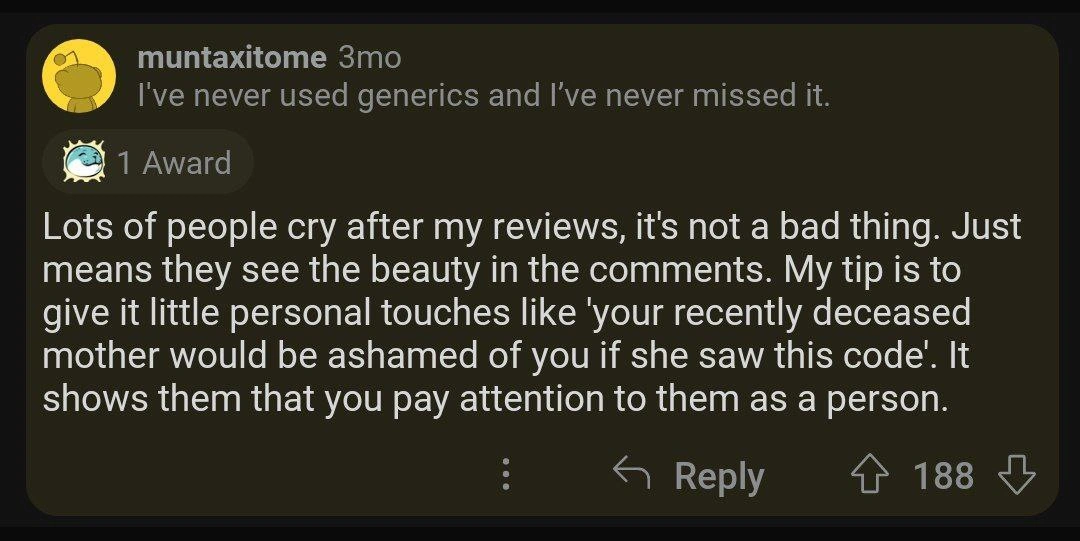
Now, in this meme, we see the exact opposite: a reviewer giving destructive feedback. The comment in the screenshot is a masterclass in what not to do. It’s full of sarcasm and personal jabs. The reviewer even suggests writing something as horrid as “your recently deceased mother would be ashamed of you if she saw this code.” This isn’t just unprofessional – it’s outright cruel. Instead of focusing on the code or the issue, it’s attacking the developer’s personal life (personal_insults_in_reviews). It’s hard to imagine a more extreme example of toxic_feedback in a code review. The meme is exaggerating to make a point: no matter how bad someone’s code is, you never drag their family or personal tragedy into a code discussion.

Let’s clarify a few terms and concepts that show up in this meme’s context:

  • Generics: At the top, the user says “I’ve never used generics and I’ve never missed it.” Generics are a programming feature (in languages like Java, C#, C++ templates, etc.) that let you write functions and classes that work with any data type in a type-safe way. Saying you’ve never used generics (and never needed them) is a bit like saying you’ve only ever used one size of screw for every job and it’s always fine. It signals to other developers that this person might have a limited understanding of modern coding practices. It’s an odd flex – an experienced developer usually values generics because they reduce bugs by catching type errors. So this line hints the commenter is a bit old-school (or stubborn) and proud of it. In meme context, it adds to the DeveloperCynicism: the guy acting superior is ironically ignorant about a common tool, which seasoned readers find amusing.
  • Code Review Etiquette: In a healthy code review culture, reviewers stick to the issue at hand. They might say things like, “This function is doing a lot; maybe we should break it into smaller functions for clarity,” or “I think there’s a bug if the input is null – could you add a check?” The tone is respectful and the critique is specific to the code. A reviewer shouldn’t be saying “What kind of idiot wrote this?” or making it personal (“Were you asleep when writing this? My cat could code this better.”) Those are examples of toxic code reviews that we often hear about in CodeReviewPainPoints stories. They provide no guidance, just insults. The meme blows this up to an extreme level by involving a deceased parent – which is shockingly beyond the pale. It highlights the concept of code_review_bullying, where the reviewer uses their power or seniority to demean others.
  • Psychological Safety: This term means team members feel safe to take risks and be vulnerable in front of each other. In practical terms, it means a programmer isn’t afraid to say “I don’t understand this” or “I made a mistake” because they know they won’t be mocked or punished for it. In a code review, if there’s psychological safety, the person whose code is being reviewed trusts that comments will be aimed at the code (not them personally) and that even if they messed up, it’ll be treated as a learning opportunity, not a firing offense. The meme’s scenario is a demonstration of zero psychological safety. If someone in your team actually said things like “your dead mother would be ashamed of your code,” you’d probably never want to ask them for help again. You’d be terrified to submit code for review, worried you’ll be ridiculed. This kills team communication and learning. That’s why Communication and CorporateCulture are tagged: it’s pointing out how badly this behavior would damage a team’s culture. Companies today emphasize that feedback must be respectful and about the work, precisely because of experiences where toxic reviewers drove people out or created a culture of fear. No one does their best work walking on eggshells.

The user interface elements in the screenshot (the avatar, username, timestamp “3mo”, and the upvote count “188”) tell us this is likely a Reddit comment or a similar forum post. The fact it has 188 upvotes and even an award suggests people found the comment notable – probably as a piece of dark humor. On the internet, developers often share outrageous anecdotes or sarcastic takes on their work life. This comment reads like a tongue-in-cheek parody of an awful code reviewer. It’s so on-the-nose that we suspect the author is joking (nobody sane would actually advise “add a personal touch” involving a deceased parent in real life… we hope!). On Reddit and other dev forums, sarcasm like this is a way to cope with real CodeReviewPainPoints. Many have experienced a milder form of this – a reviewer who’s overly harsh or who makes it personal – so seeing it exaggerated helps us laugh at the issue.

To visualize the difference between a toxic comment and a constructive one, consider a sample code review comment style. Here’s a comparison in pseudo-code form:

 // Code snippet: Calculate average of an array
 function average(arr) {
-   // Toxic review comment: 
-   // "Did you even test this? It's a miracle this function works at all. 
-   //  My pet monkey codes better than this."
+   // Constructive review comment: 
+   // "Potential issue: if arr is empty, this will divide by zero. 
+   //  Maybe add a check to handle an empty array case."
 }

In the toxic comment (marked with -), the reviewer is insulting the coder (“my pet monkey codes better”) and being sarcastic about the code working at all. It gives no clear direction on what’s wrong or how to improve. In the constructive comment (marked with +), the reviewer points out a specific problem (dividing by zero when the array is empty) and politely suggests a solution (add a check). The difference is huge. The first would make a newbie developer feel attacked and clueless, possibly discouraging them. The second, while pointing out a mistake, treats it as a normal part of coding and offers help on fixing it.

What the meme highlights in a tongue-in-cheek way is basically how NOT to do code reviews. It’s a cautionary tale. Younger developers reading this should learn that no matter how experienced you become, there’s no excuse for belittling others in reviews. Great developers lift their teammates up; they don’t tear them down. If you ever encounter someone who writes comments like the one in this meme, know that the problem is with them, not with you or your code. Good teams will have processes (like codes of conduct or review guidelines) to prevent this kind of scenario. And if you find yourself in a team that doesn’t, it might be worth bringing it up to a manager or even moving on – because a culture that tolerates such CommunicationBreakdown will stunt your growth and happiness as a developer. In short, code reviews should catch bugs in the code, not crush the spirit of the coder.

Level 3: Beauty in Brutality

This meme hits on a CodeReviewHorrorStory that veteran developers sadly recognize: the toxic code reviewer who thinks brutal honesty is a virtue. In the screenshot, a user boasts that making colleagues cry during code reviews is a sign of “beauty in the comments.” It’s a darkly ironic take on communication breakdown in engineering teams. The reviewer has completely conflated helpful feedback with personal attacks, crossing every line of professional CodeReviews etiquette. The humor (and horror) comes from how over-the-top the cruelty is: referencing a “recently deceased mother” to shame a coder is so outrageous that it’s (uncomfortably) funny. It’s as if this reviewer sees themselves as a Gordon Ramsay of code, dishing out insults and calling it mentorship.

Let’s break down why this scenario is a nightmare in any CorporateCulture:

  • Personal Attacks vs. Code Critique: A good review focuses on the code, not the coder. Here the reviewer drags the developer’s late mother into it – the epitome of personal_insults_in_reviews. That’s not constructive feedback; it’s character assassination.
  • Toxic “Feedback” Loops: The commenter actually brags “lots of people cry after my reviews” as if emotional breakdowns are a KPI. In reality, this is classic code_review_bullying. It creates fear and resentment, not improvements.
  • Delusion of Helpfulness: The punchline is the reviewer claiming these “little personal touches” prove he pays attention to the person. It’s a twisted inversion of mentorship. In a healthy team, paying attention means understanding a teammate’s challenges and helping them grow – not digging into their personal pain for a cheap shot.
  • Proud of Ignorance: Notice the header: "I've never used generics and I've never missed it." Generics (parametrized types in languages like Java, C#, Go) are a staple tool for writing flexible, type-safe code. Bragging about never using them is like a mechanic proudly saying, “I never use torque wrenches.” It hints that this reviewer might not be as technologically advanced as his ego suggests. This adds an extra layer of DeveloperHumor – the know-it-all reviewer who actually doesn’t know modern best practices, a classic ingredient in DeveloperCynicism jokes.

For experienced devs, this meme elicits a mix of laughter and PTSD-esque flashbacks. We’ve all heard tales (or lived them) of “rockstar” engineers or open-source maintainers giving blistering critiques that cross into humiliation. Historically, some programming communities tolerated or even encouraged a tough love approach – think of the notorious Linux kernel mailing list culture where Linus Torvalds once lambasted contributors with lines that became CodeReviewPainPoints legends. But over time, the industry realized that this Communication style is less “tough love” and more just toxic_feedback. It drives talent away and crushes creativity. Modern engineering leadership talks a lot about psychological safety – the idea that team members should feel safe to admit mistakes and ask questions without being ridiculed. The meme’s scenario is basically the absence of psychological safety: it’s a team environment from hell.

The upvotes (188 and even an award) on this comment suggest that many readers found it either darkly hilarious or uncomfortably relatable. It’s sarcasm dialed up to 11 – an exaggeration of every bad code review experience rolled into one. As a senior dev reading this, you cringe and chuckle at the same time. Cringe, because you know real lives and careers have been derailed by similar cruelty. Chuckle, because it’s a satirical reminder that CommunicationBreakdown in code reviews can reach absurd extremes. It reinforces an unwritten rule among seasoned engineers: feedback should never look like this. If your code reviews read like a roast at someone’s funeral, you’ve gone horribly off track.

Description

Dark-theme screenshot of a social media comment box. Heading shows a yellow avatar and the username “muntaxitome” followed by “3mo” and a grey subtitle that reads, “I've never used generics and I've never missed it.” Beneath an award badge, the white comment text says: “Lots of people cry after my reviews, it's not a bad thing. Just means they see the beauty in the comments. My tip is to give it little personal touches like 'your recently deceased mother would be ashamed of you if she saw this code'. It shows them that you pay attention to them as a person.” At the bottom are UI elements: a kebab menu, back-arrow “Reply,” an up-arrow, the number “188,” and a down-arrow. The meme satirizes brutally negative code-review culture, highlighting poor communication practices and the importance of psychological safety in engineering teams

Comments

6
Anonymous ★ Top Pick After the reviewer who “never needed generics” started annotating PRs with family-grade insults, we swapped him for a linter - same pedantry, no HR escalations, and it actually knows how type parameters work
  1. Anonymous ★ Top Pick

    After the reviewer who “never needed generics” started annotating PRs with family-grade insults, we swapped him for a linter - same pedantry, no HR escalations, and it actually knows how type parameters work

  2. Anonymous

    "I've never used generics" is the new "we've always done it this way" - except now it comes with a side of emotional damage and a mandatory HR meeting

  3. Anonymous

    Ah yes, the classic 'I've never used generics' take - the type system equivalent of 'I've never used version control and my code works fine.' But the real gem here is the code review philosophy: why settle for pointing out a null pointer exception when you can also point out the existential void in someone's life? Remember folks, the best code reviews don't just catch bugs - they catch feelings. Nothing says 'senior engineer' quite like making junior devs question both their career choices AND their life choices in a single PR comment. This is what happens when you confuse 'strong typing' with 'strongly worded feedback.'

  4. Anonymous

    Code review tip: prefer parametric polymorphism over personal attacks - declare T extends Respect; it scales better and avoids HR rollbacks

  5. Anonymous

    Shame-driven code reviews are great - if your SLO is 'increase cycle time' and your error budget is team trust

  6. Anonymous

    Never missed generics? Enjoy hand-casting Objects until your monolith's type erasure buries you alive

Use J and K for navigation