The Definitive Guide to Inebriated Development
Why is this DevCommunities meme funny?
Level 1: Dizzy LEGO Building
Imagine you’re trying to build a complicated LEGO castle after spinning around in circles until you’re really dizzy. Sounds goofy, right? You might put the pieces in all the wrong places, or the tower might end up super wobbly. Basically, you wouldn’t trust that castle to stand for long! This meme is joking about the same kind of situation, but with computer programming. Writing computer code is like solving a puzzle or building with blocks in your mind – it needs concentration. Being drunk is like being dizzy or fuzzy-headed. So the meme pretends there’s a serious book saying “it’s a great idea to code while drunk” to make it more fun. That’s as silly as saying “build LEGO while you’re dizzy for extra fun.” The reason it’s funny is because everyone knows you usually do a worse job when you’re not clear-headed. It’s poking fun at the idea that doing something the wrong way (drunk or dizzy) would ever be recommended in a serious book. The emotional core here is the relief and laughter we get from stress – programmers sometimes feel so frustrated or bored that they joke about doing things in a crazy way just to lighten the mood. So, even if you’re not a programmer, you can relate: it’s like a student saying “I’ll do my homework after three sodas!” – we all know the homework would turn out pretty messy. The meme exaggerates a bad idea to make us laugh, reminding us that coding (or any hard task) is best done with a clear mind – and that sometimes, when we’re stressed, we jokingly imagine doing the ridiculous just to “make it fun again.”
Level 2: Beer Goggles for Code
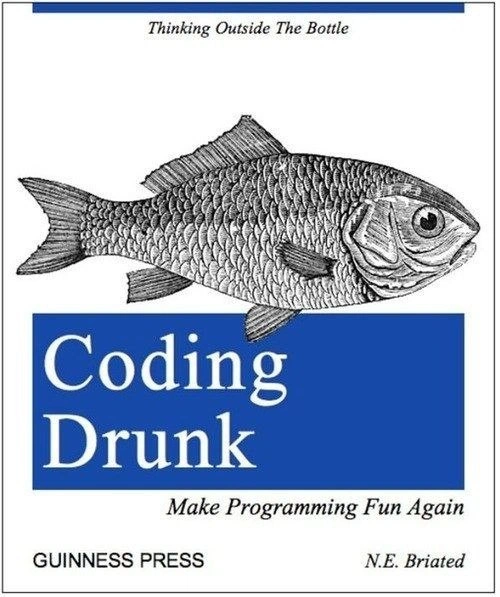
This meme is styled as a parody of a classic O’Reilly Media programming book cover. O’Reilly’s real books are iconic in developer culture – they have clean white covers, a bold title, and a detailed woodcut-style animal illustration (often an unrelated animal, purely for visual charm). Here, the animal is a large fish illustration, which immediately signals “Hey, this looks like a tech book!” to anyone familiar with O’Reilly. (It might even be a cod – a sly nod to “code” – or just a random fish to complete the joke.) The title “Coding Drunk” is splashed in the usual O’Reilly cover layout, but obviously no legitimate publisher would endorse coding under the influence as a methodology. That’s where the humor lies: it’s presenting a totally absurd idea with a completely straight face. The tagline “Thinking Outside The Bottle” is a pun on the phrase “thinking outside the box,” implying an unconventional approach to programming – except here the “box” is swapped with “bottle” (of alcohol). The subtitle “Make Programming Fun Again” echoes the feeling that maybe programming has become too serious or joyless in real life, and suggests (jokingly) that drinking could bring back the fun. It also parodies grand slogans (“Make X Great Again”) to give the cover a satirical “manifesto” vibe. On the bottom, the publisher name “GUINNESS PRESS” replaces the real publisher (O’Reilly) with the name of a famous Irish beer (Guinness). And the author name N.E. Briated is not a real person – say it out loud: “inebriated” – meaning drunk. Every element of the cover is a clever spoof, blending tech professionalism with pub culture.
In terms of developer life, this relates to a well-known facet of DeveloperLifestyle and DeveloperCulture: the joking notion of “beer-driven development.” Real development methodologies like Test-Driven Development (TDD) or Behavior-Driven Development (the other BDD) are structured, sober practices aimed at reducing bugs. By contrast, “beer-driven development” is an ironic phrase suggesting that instead of writing tests or documentation, a programmer might chug a beer and just wing it. Of course, in reality, alcohol and programming don’t mix well – being drunk impairs concentration, memory, and judgment, which are critical for writing code. The meme exaggerates a scenario we sometimes half-joke about: a frustrated developer might say “I code better after a beer” or during a crunch might have a drink to relax, but everyone knows it’s not actually a productive strategy. The phrase “coding drunk” literally means writing software while inebriated. The meme highlights how that would undoubtedly make bugs (errors or flaws in the code) multiply. Imagine trying to solve a complex bug sober – now imagine adding blurry vision and slow reaction time; you’d probably introduce ten new bugs while attempting to fix one. The humor is relatable: many programmers have experienced late-night coding sessions fueled by caffeine, and maybe the occasional beer at an office pizza party or hackathon. It taps into the shared knowledge that some developers joke about “compiling with beer goggles on” – referencing the concept of “beer goggles” where one’s perception gets distorted after drinking. In coding terms, “beer goggles” mean the code might look fine when you’re tipsy, but in the sober light of morning you see how messy it truly is.
Let’s break down a few key terms and references:
- Developer Experience (DX): This refers to the overall experience of being a developer – from the tools you use, to work culture, to how enjoyable or painful the daily coding grind is. The meme hints that DX has gotten bad enough that someone’s proposing alcohol as a fix for morale. That’s a dark joke about burnout: if programming has stopped being fun, “maybe a beer will make it fun again” – obviously not a healthy solution, but it captures the DeveloperFrustration.
- Developer Productivity: Normally, productivity means writing quality code efficiently. Here, “Coding Drunk” suggests a fake productivity hack – as if drinking could boost creativity or speed (spoiler: it won’t). In fact, any short-term “creative looseness” a beer might provide is vastly outweighed by the drop in precision. The meme winks at the fact that real productivity tricks are things like taking breaks, pair programming, or using better dev tools – not popping open a Guinness at your desk.
- Bugs: These are mistakes or flaws in software that cause it to behave unexpectedly or crash. The meme explicitly warns of “the inevitable bugs such practices invite.” A big part of a programmer’s job is preventing and fixing bugs. Writing code while drunk is almost guaranteed to create more bugs, because you might mis-type, forget edge cases, or use bad logic. The next day, sober-you (or worse, your teammates) would be debugging code that “seemed like a good idea last night.” It’s the software equivalent of waking up to a mess you don’t remember making.
- LateNightCoding and burnout: Many developers are all too familiar with coding late at night, whether due to tight deadlines, inspiration streaks, or production emergencies. Being extremely tired can feel almost like being drunk – your brain is foggy. Some might jokingly say, “I was practically drunk I was so tired.” This meme plays on that overlap: if late-night, exhausted coding leads to bugs, what would actually-drunk coding do? Probably disaster, but it’s presented as a “fun” idea because many have been there in a lighter sense (like fixing a server at 2 AM with bleary eyes).
- O’Reilly animal covers: Just to clarify this reference for newcomers – O’Reilly Media’s programming books (covering everything from learning a programming language to advanced technical topics) traditionally feature an old-style engraving of an animal on the cover. The animals are sometimes loosely connected to the topic (for example, a camel for Perl because Perl’s nickname was the Camel book, or an elephant for PostgreSQL), but often it’s just a quirky tradition. Developers often recognize an O’Reilly book on a shelf at a glance because of this distinctive design. This meme mimics that perfectly – the font, layout, and that random fish. By doing so, it tricks our brain for a second: “Is this a real book? It looks legit... oh wait, Coding Drunk?” The incongruity is what makes it funny. It’s an oreilly_style_parody — a loving homage and a satire rolled into one.
In summary, to a junior developer or someone new to tech culture, the meme is saying: imagine if someone wrote a serious tech book advocating that you should write code while drunk. It uses the authoritative style of a famous publisher to sell a completely ridiculous idea. This exaggeration highlights real issues (like developers feeling burnt out or trying wacky things to make work fun) and laughs at them. It’s a form of relatable developer humor – you don’t actually have to try inebriated_coding yourself (please don’t!) to get the joke. Just understanding that programming requires focus, and that alcohol destroys focus, is enough to see the irony. The result of mixing the two as a “methodology” would be chaos – and that’s exactly why it’s funny to seasoned devs and novices alike.
# Pseudo-code illustrating Beer-Driven Development (not recommended!)
beers = 0
bugs = 0
def code_feature(feature):
global bugs
print(f"Implementing {feature} after {beers} beers... 🍺")
# Every beer lowers judgment, increasing bugs
bugs += beers * 5 # bug rate skyrockets with more beers
# Start coding "drunk"
beers += 1
code_feature("Login Module") # first feature attempt
beers += 2
code_feature("Payment Gateway") # confidence grows as beers flow
print(f"Total bugs introduced: {bugs}")
# Output might be: "Total bugs introduced: 15" (oops!)
In the code above: We simulate a developer drinking beer and coding. With each beer, the number of bugs introduced multiplies (because mistakes happen more often). By the time they’ve had a few, the code’s probably full of errors. This tongue-in-cheek example shows that alcohol_in_programming leads to sloppy results. In reality, no one in their right mind writes code this way on purpose – it’s just a joke. The meme’s point is to laugh at the “plan” of coding_drunk, because it’d be like sabotaging your own project.
Level 3: Undefined Behavior On Tap
"Thinking Outside The Bottle" – the meme’s tagline sets the tone by proposing Inebriation-Driven Development (IDD) as if it were a serious practice. Of course, any senior engineer immediately recognizes this as a tongue-in-cheek jab at our industry’s obsession with methodologies. We’ve had Agile, Scrum, TDD (Test-Driven Development), BDD (Behavior-Driven Development)… so why not add BDD again, this time as Beer-Driven Development? The O’Reilly-style cover gives it a veneer of legitimacy – those covers usually promise intellectual rigor – but here it’s hawking the polar opposite: coding under the influence. It’s a perfect developer humor cocktail: mixing something as scholarly as an O’Reilly programming book with the frat-boy absurdity of coding drunk. And the details are deliciously sarcastic: Guinness Press instead of O’Reilly, an author named “N.E. Briated” (read: inebriated), and the cheeky slogan “Make Programming Fun Again.” This parody pokes at the reality that for many devs, coding has lost its spark – crushed by burnout, endless Jira tickets, and 2 AM production outages – so the DeveloperExperience sometimes indeed feels like it could use a shot of something stronger. The humor cuts close to home: we joke about needing a beer after a long day of wrestling with legacy code from 2008 (that one ancient fish in the codebase that keeps resurfacing, much like the meme’s giant fish illustration). Seasoned devs have all encountered code that looks like it was written during a late-night coding session after “one too many.” “Hold my beer, I’m deploying!” is the unspoken horror scenario this meme evokes. Everyone laughs because we all know that Developer Productivity doesn’t actually improve with intoxication – in fact, quality sinks faster than a lead weight (or a drunk developer’s forehead onto the keyboard). The inevitable outcome? Bugs. So many bugs. Whole swarms of weird, elusive bugs that sober you will have to debug at dawn with a splitting headache, wondering which gremlin wrote this garbage. In truth, this meme is a release valve for our frustration: it satirizes the desperate coping mechanisms devs joke about, while warning of the “undefined behavior” that enters the code when you’re a six-pack deep. (The only “Ballmer Peak” you hit – that mythical sweet spot where a little alcohol supposedly boosts coding ability – tends to be as real as unicorns in unit tests.) By couching the joke as an O’Reilly book, the meme speaks to experienced developers’ shared war stories: we chuckle darkly and think, “Heh, seen that codebase, fixed that hangover.” It’s a cautionary tale wrapped in parody: beer-driven development might sound fun in theory, but in practice it’s like merging a pull request from an unpredictable, inebriated coworker – one who commits
// YOLOcomments and leaves you to clean up the deploy at 3 AM. The senior perspective recognizes the irony: we strive for clean code and best practices, yet here’s a faux “best practice” that would guarantee chaos. It’s funny because it’s relatable developer experience taken to a ridiculous extreme – a nod to every on-call engineer who ever joked “I need a drink” and to the collective understanding that “Thinking Outside The Bottle” is best left as a joke, not an actual policy.
Description
This image is a parody of an O'Reilly programming book cover, known for their iconic animal illustrations. At the top, a thin blue line is above the text 'Thinking Outside The Bottle'. The main visual is a detailed, woodcut-style illustration of a fish. Below the fish, a large blue rectangle contains the title in white, 'Coding Drunk'. Underneath this, the subtitle reads 'Make Programming Fun Again'. At the bottom, 'GUINNESS PRESS' is on the left and the author's name, 'N.E. Briated', is on the right. The humor is layered: it perfectly mimics a well-known publisher's style, while the title and puns ('N.E. Briated' for 'inebriated', 'Guinness Press' for the beer) point to the dangerous but culturally joked-about practice of coding under the influence. It references the mythical 'Ballmer Peak', a supposed sweet spot of drunkenness for optimal coding ability, while also implicitly mocking the terrible code quality that would result
Comments
7Comment deleted
The 'Coding Drunk' pattern: you achieve the Ballmer Peak and write beautifully obscure code, then spend the next day sober, treating your own repository like a legacy system with no documentation
“Skimming ‘Coding Drunk’: it redefines ACID as Atomicity, Consistency, Intoxication, Day-after regression - suddenly our microservice mesh and the unit tests that only pass at 2 AM make perfect sense.”
The only code review where "it works on my machine" actually means "after three pints, the race conditions started making sense and I finally understood why our distributed locks were fighting each other."
This parody perfectly captures the O'Reilly technical book aesthetic - right down to the meticulously detailed animal illustration - while highlighting a universal developer truth: some of our most 'creative' architectural decisions were probably made after hours when our judgment was as impaired as our commit messages. The author name 'N.E. Briated' is chef's kiss, and 'Thinking Outside The Bottle' suggests a level of innovation that's either brilliant or should never make it to production. It's the kind of book that would pair well with a rubber duck debugger and a strong cup of regret the next morning
Coding drunk is just Raft without a leader - logs replicate, nothing reaches consensus, and Monday starts a new term with a rollback
We tried BDD - Beer‑Driven Development - velocity doubled, MTTR tripled; postmortem action item: add a pre‑commit breathalyzer and schedule happy hour after the prod freeze
Sober architects monoliths; drunk ones birth microservices - one loosely coupled pint at a time