Skip to content
DevMeme
1521 of 7435
The Anxious Final Git Merge
VersionControl Post #1701, on Jun 14, 2020 in TG

The Anxious Final Git Merge

Why is this VersionControl meme funny?

Level 1: Last to Clean Up

Imagine you and a bunch of friends are all drawing on the same big poster at the same time. Each friend is working on a different corner of the poster. No one is checking if the drawings line up in the middle where they meet. Now the teacher says you have to be the last one to finish the poster by connecting everyone’s drawings. You walk up to the poster and see that some of the drawings clash – maybe two friends drew different parts of a single figure that don’t match, or someone scribbled over where another was drawing. You’re the one who has to fix it all so the poster looks nice. That’s a lot of pressure, right? You’d be standing there with sweat on your forehead, trying to figure out how to make all these mismatched pieces work together. It feels unfair because everyone else got to just do their part, and now you’re dealing with all the problems at the end. The meme is funny because it shows a really nervous, sweaty guy – just how you might feel in that spot – and we laugh a bit because we know exactly how stressful being “last to clean up” can be. It’s like being the last kid left in the classroom having to tidy up everyone else’s mess: not fun for that kid, but a familiar story that makes us shake our heads and smile.

Level 2: When Code Collides

Let’s unpack this in simpler terms. Git is a popular tool (a version control system) that developers use to manage and combine code. Think of Git as a timeline of code changes with branches that devs can work on separately. A branch in Git is like a separate workspace for code – for example, Alice works on the login-feature branch while Bob works on the payment-feature branch. Eventually, all branches need to join back together into a main line of code so the software can include everyone’s work. This joining process is called merging. Normally, developers merge changes regularly or open pull requests to review and integrate code piece by piece.

Now, a merge conflict happens when two people change the same part of a file in different ways. Git tries to combine everyone’s code automatically when you run git pull (which is basically “get everyone else’s changes and merge them into mine”). If two changes don’t agree – for example, Alice and Bob both edited the same line of app.js – Git gets confused and says, “Hey, I don’t know which version to keep.” It then marks the conflict in the code and asks a developer to decide. The developer must manually open the file, see both versions, and choose or rewrite the correct code. Here’s what a simple conflict might look like in code:

<<<<<<< HEAD   (Your version)
welcome_message = "Hello, user!";
=======
welcome_message = "Welcome, user!";
>>>>>>> origin/main   (Other version)

In the snippet above, Git is showing two different edits to the welcome_message line. The <<<<<<< HEAD section is your version, and the ======= to >>>>>>> origin/main section is the other developer’s version. Resolving the conflict means editing this to a single, correct welcome_message line and then saving the file. Imagine doing this not just for one line, but for dozens of conflicts across many files – that can be very tedious and error-prone.

In the meme’s scenario, the boss specifically instructed one developer to “pull the branch last.” This means everyone else on the team has already pushed (uploaded) their code changes to the shared branch, and only after all of them are done, this last developer updates their copy. The idea (probably) was to avoid bothering other developers with conflicts – essentially, let everyone do their work and have one person deal with any merging issues at the end. But this GitWorkflow approach is backwards from best practices. Instead of small, frequent merges, it creates one giant merge with all the accumulated differences. The result? That last developer’s computer lights up with conflict markers everywhere. They now have to solve every discrepancy between all their teammates’ code and their own.

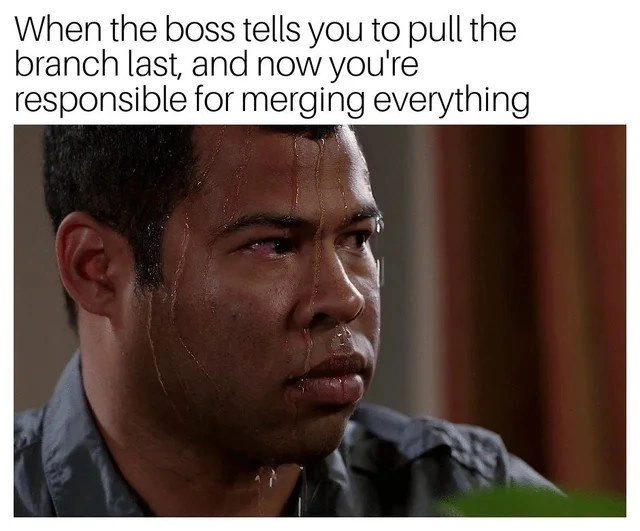
For a newer developer or junior team member, this is like walking into a room where five people have been editing the same document at once – lines are crossed out, notes in the margins conflict, and it’s your job to combine it into one clean copy. No wonder the man in the image is sweating! In the meme, the man’s face (comedian Jordan Peele in a famous sketch) is drenched in sweat and he looks extremely nervous. That image is widely used in internet culture to represent someone under intense pressure or stress. Here it perfectly represents the anxiety of the lone developer who must merge everyone’s code: he’s afraid of messing up, aware that any mistake in handling these conflicts could break the project or upset coworkers.

The humor of this meme comes from recognition. DeveloperHumor often highlights painful situations in a funny way. If you’ve ever had to resolve a nasty set of merge conflicts, you know it’s not actually fun – it’s frustrating and stressful. But seeing it exaggerated in a meme makes you grin (or grimace) because you relate to it. It’s basically saying, “We’ve all been here – the boss made a silly decision, and now one developer has to clean up the mess.” The categories here are VersionControl (because it’s about Git and code merging) and Management_PMs (because a manager’s directive caused the situation). That mix is key: it’s poking fun at how non-technical management decisions can create big headaches in technical work. A junior developer reading this should take away a lesson: merging code is easiest when everyone does it frequently and shares the load. If you ever hear “let’s have one person do all the merging at the end,” expect some sweaty-palms moments ahead!

Level 3: Mandated Merge Mayhem

Ah, the classic Git nightmare scenario: the boss imposes a “pull-last” strategy, effectively volunteering one poor developer as the merge conflict scapegoat. The humor here is painfully real – it’s a satire of VersionControl anti-patterns and clueless ManagerExpectations. The boss thinks they’re being strategic: “Let everyone push their code, then have one person git pull at the end to integrate it all.” Sure, boss, what could go wrong? In reality, this edict creates a perfect storm of MergeConflicts that DeveloperHumor has memorialized in sweaty memes like this one. The top caption spells out the predicament plainly: “pull the branch last, now you’re responsible for merging everything.” It’s practically a horror story in plaintext. And beneath it, Jordan Peele’s infamous sweating reaction meme face says it all — wide-eyed panic, beads of sweat, absolute dread. Every senior dev who’s been the “last one in” on a big merge can physically feel that image.

This situation arises from a combination of mismanagement and flawed GitWorkflow. Instead of practicing continuous integration (merging changes frequently to catch issues early), some manager has orchestrated a one-time “big bang” integration. It’s an outdated approach reminiscent of waterfall-era “integration phases” – something we thought agile development buried long ago. By telling one dev to be the last to update the shared GitBranching branch, they’ve essentially designated a merge martyr. This unlucky soul must combine days or weeks of everybody’s work in one go, dealing with all the conflicts others avoided. The result? DeveloperFrustration off the charts, and a codebase that breaks in new and exciting ways.

The meme’s punchline is amplified by the visual: a guy literally sweating bullets. Why sweat? Because being the last to merge is like disarming a bomb – cut one wrong wire (resolve a conflict incorrectly) and the whole build might explode. The strong contrast between the bright, matter-of-fact caption and the dark, anxious close-up image highlights how management’s simple request leads to the developer’s extreme stress. It’s funny in that dark humor way: if you don’t laugh, you might cry. We’ve all been that coder at 5 PM on a Friday, hands trembling above the keyboard, thinking “please let this merge succeed… please…” as we resolve conflict markers line by painstaking line.

To seasoned engineers, this meme also recalls systemic issues. Why did all those conflicts pile up? Likely because everyone worked in isolation on the same files and none of the PullRequest reviews caught integration issues. Perhaps each developer said “well, it builds on my machine” – but nobody checked if it builds together. The boss’s big-brain plan didn’t eliminate integration risk; it just dumped all that risk onto one person. It’s management blamestorming in action: if everything breaks, guess who’s holding the bag? The last dev to touch the code – now conveniently responsible for everything. In Git terms, that poor last integrator becomes the one with their name on the final commit, basically a human git blame magnet. As the Cynical Veteran crowd knows, when the deployment goes sideways, the question is “Who merged this?” and not “Why did we set things up for failure?”.

Let’s break down the expectation vs reality of this git_pull_last_strategy:

What the Boss Expects What Actually Happens
One dev pulls last and magically “fixes” everything One dev encounters a cascade of merge conflicts 💥
Integration done in one quick step Integration becomes an hours-long merge hell marathon
Clear ownership (so they know who to blame) One terrified developer sweating through their shirt 😰
“Less hassle” for the team overall Whole project at risk if the exhausted last dev slips up

In short, the humor hits on an “if it weren’t so true, it wouldn’t be funny” situation. The meme resonates with developers because it dramatizes a real anti-pattern: Management_PMs trying to simplify process in the wrong way and a lone dev absorbing the complexity. It’s a tongue-in-cheek cautionary tale: Git is a distributed version control designed for collaboration, but misuse it with poor GitWorkflow and you end up with one frazzled engineer and a repository full of conflict markers. The audience of experienced devs is laughing (and groaning) because they’ve lived this story – sweating through a high-stakes merge while everyone else who already pushed their code has (conveniently) left for lunch. This meme is an initiation scar we all share, wrapped in a joke.

Description

This meme uses the popular image of actor Jordan Peele sweating nervously. The text overlay reads, 'When the boss tells you to pull the branch last, and now you're responsible for merging everything'. This captures a moment of high anxiety for software developers using version control systems like Git. In a collaborative environment, if a developer is the last to integrate their code (pull the branch), they are often faced with resolving numerous merge conflicts from all the changes made by their colleagues. This process can be complicated, risky, and time-consuming, as they have to untangle everyone else's work before incorporating their own. The developer essentially becomes the integration point for the entire team's recent efforts, and any resulting bugs or issues will likely be attributed to them, hence the profuse sweating
Comments

7
Anonymous ★ Top Pick The final merger inherits the technical debt of a dozen developers. It's less of a 'git merge' and more of a 'git exorcism'
  1. Anonymous ★ Top Pick

    The final merger inherits the technical debt of a dozen developers. It's less of a 'git merge' and more of a 'git exorcism'

  2. Anonymous

    Pulling last turns “git merge” into forensic archaeology - brushing away conflicts to uncover which decade-old design decision everyone just resurrected

  3. Anonymous

    The boss who suggests "pull last to avoid conflicts" is the same one who thinks microservices solve all problems and wonders why the build takes 45 minutes now

  4. Anonymous

    The real tragedy isn't the merge conflicts themselves - it's that moment when you realize your teammates have been committing directly to develop all week, your feature branch is 47 commits behind, and the conflicts span files you've never even heard of. Now you're archaeologically reconstructing three different architectural visions while your CI/CD pipeline mocks you with 'Cannot automatically merge.' At least you'll finally understand what that mysterious service layer refactor was about... by manually resolving it line by line

  5. Anonymous

    If your release process is “whoever pulls last owns prod,” that’s not a branching strategy - that’s the integration‑manager anti‑pattern with git blame as governance

  6. Anonymous

    “Pull the branch last” is management-speak for: congrats, you’re the monorepo’s unpaid integrator - CI will blame you for every flaky test you didn’t write

  7. Anonymous

    Git blame was invented the day after this merge

Use J and K for navigation