Skip to content
DevMeme
7242 of 7435
Coding Agent Stuck in the Sand While Leadership Spectates
AI ML Post #7940, on Apr 23, 2026 in TG

Coding Agent Stuck in the Sand While Leadership Spectates

Why is this AI ML meme funny?

Level 1: Watching the Car Get Stuck

Imagine handing your car keys to a very enthusiastic robot driver and saying "take us to the beach." The robot floors it straight into the soft sand, and instead of slowing down, it presses the gas harder and harder until the wheels are buried up to the axles. Meanwhile, the three grown-ups who told everyone "the robot can drive now" are standing on solid ground, arms crossed, with one of them filming it on his phone to show the boss later. Nobody grabs a shovel. The joke is that everyone is so busy proving the robot can drive itself that they forgot somebody still needs to know how to get the car out of the sand.

Level 2: What "Agentic" Actually Means

A few definitions ground the humor. An agentic coding tool is an AI that doesn't just autocomplete a line — it takes a goal and autonomously executes a sequence of actions: reading files, running commands, editing code, checking results, and iterating. That autonomy is its power and its risk. The more steps it can take without asking, the further it can get from where you wanted it to go before anyone checks.

Human-in-the-loop means a person reviews or approves the agent's actions at checkpoints rather than letting it run unsupervised. Vibe coding is the casual style of letting the AI drive while you loosely steer on feel — fine for a prototype, dangerous when the stakes are real and nobody's verifying. Failure modes are the characteristic ways a system breaks; an agent's worst one is confident wrongness, because confidence suppresses the human instinct to intervene.

The relatable early-career version: trusting an autocomplete or a generated solution wholesale, watching it confidently produce something that looks right, and only later discovering it drove your codebase into the sand while you weren't watching the wheels.

Level 3: Confidently Off the Track

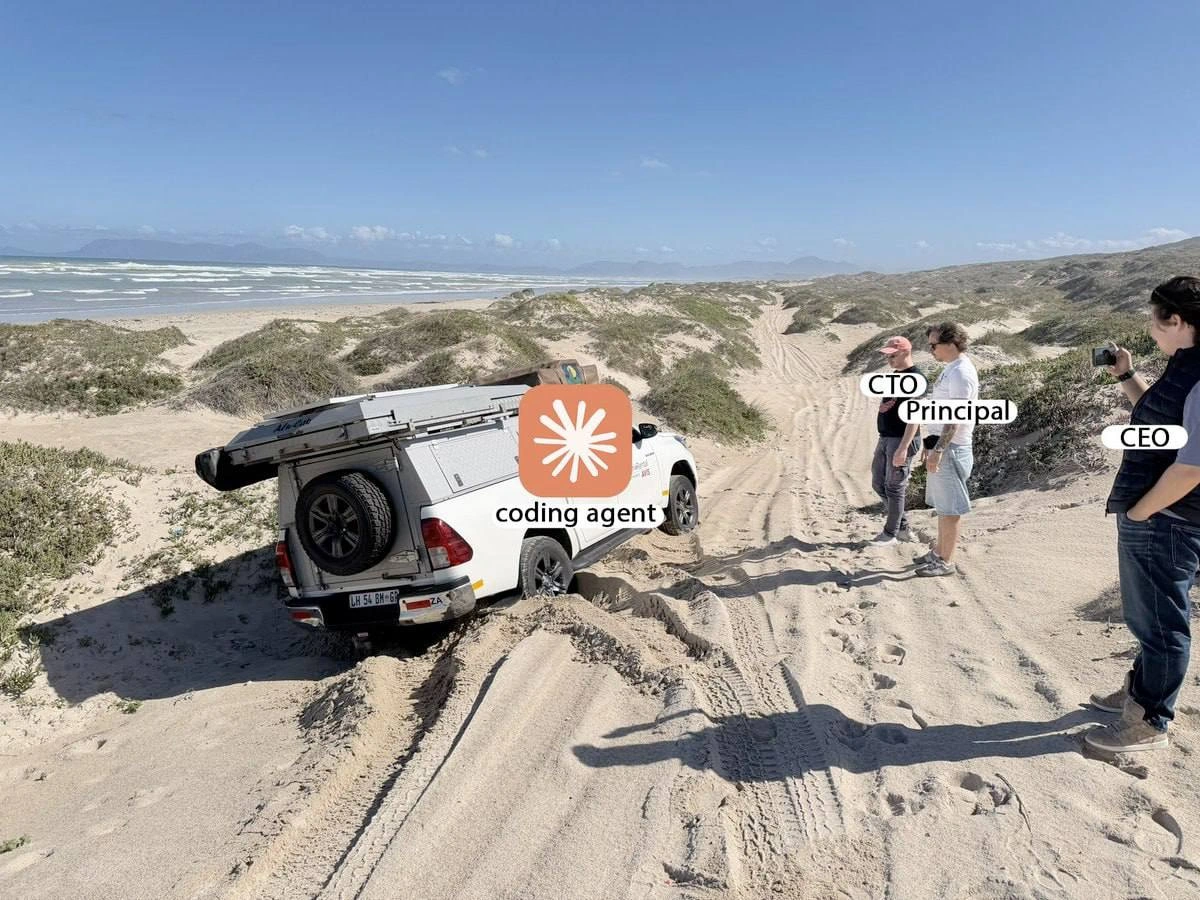
The photo is a white 4x4 pickup with a rooftop tent, bogged sideways into deep sand ruts on a beach dune track, ocean breaking in the background. The agent's icon — the orange starburst styled after Claude Code's logo — sits pasted on the truck, labeled coding agent. Off to the right, on firm ground, stand three figures labeled CTO, Principal, and CEO, the CEO holding up a phone to film the disaster. Nobody is touching the truck. That tableau is the entire thesis of agentic coding's current moment.

The senior-level insight is about failure modes of autonomy, and the meme picks the most accurate metaphor available. A capable coding agent doesn't fail like a dumb tool that simply won't run; it fails like an overconfident driver. It engages the problem with total conviction, makes a series of locally-plausible decisions, and drives itself progressively deeper into a hole that a more cautious operator would have avoided entirely. Sand is the perfect substrate for this analogy: the failure isn't sudden, it's accretive. Each spin of the wheels — each additional tool call, each "let me just refactor this too," each confident-but-wrong assumption — digs the ruts deeper. By the time it's obviously stuck, you can't simply reverse out; the agent has reshaped the terrain around itself. Anyone who has watched an agent confidently git reset the wrong thing, invent an API that doesn't exist, or "fix" a failing test by deleting the assertion recognizes the truck's exact predicament. The classification's joke lands here: "it's just doing 400 more tool calls to confirm the sand is, in fact, sand."

But the truck is only half the meme. The other half — the real target — is the leadership chain spectating instead of intervening. The CTO, Principal, and CEO are the technical decision-makers who mandated the agent, and their posture is pure organizational comedy: arms folded, watching, the CEO recording for what the description aptly calls "the all-hands deck." This skewers a genuine dysfunction in how agentic tooling gets adopted. Leadership buys the ai_replacing_engineers_narrative wholesale, deploys agents with the expectation of autonomy, and then — when the autonomy produces a confident mess — treats the failure as content rather than a signal to put a human back in the loop. The principal engineer, the one person standing there who could actually grab a shovel and recovery boards, is instead included in the audience. The deep-cut tragedy is that the expertise needed to un-stick the situation is physically present and being wasted on spectating.

The systemic point experienced engineers nod at: agents amplify the operator, they don't replace the operator. An expert with an agent is a force multiplier; an organization that removes the expert and expects the agent to drive solo gets exactly this picture. The human_in_the_loop isn't bureaucratic friction — it's the person who knows you air down the tires before the dune, who recognizes the ruts forming three decisions ago, who knows when to stop spinning the wheels because spinning only digs deeper. Removing that person and filming the consequences for the quarterly hype deck is the actual joke, and it's funnier because it's the documented reality of how a lot of "AI transformation" initiatives are being run.

Description

A photo of a white 4x4 pickup with a rooftop tent bogged down sideways in deep sand ruts on a beach dune track, ocean and surf in the background. The truck is overlaid with an orange starburst app icon labeled "coding agent" (styled after Claude Code's logo). Standing safely on the track watching are three people labeled "CTO", "Principal", and "CEO" - the CEO is filming the scene on a phone, nobody is helping. The meme captures the current reality of agentic coding: the autonomous agent confidently drove off-road, dug itself into a hole, and the entire technical leadership chain is now spectating (and recording for the all-hands deck) instead of taking the wheel

Comments

1
Anonymous ★ Top Pick The agent isn't stuck - it's just doing 400 more tool calls to confirm the sand is, in fact, sand
  1. Anonymous ★ Top Pick

    The agent isn't stuck - it's just doing 400 more tool calls to confirm the sand is, in fact, sand

Use J and K for navigation