Skip to content
DevMeme
1352 of 7435
Task Failed Successfully: The Code Works, Somehow
Bugs Post #1521, on May 8, 2020 in TG

Task Failed Successfully: The Code Works, Somehow

Why is this Bugs meme funny?

Level 1: Square Peg, Round Hole

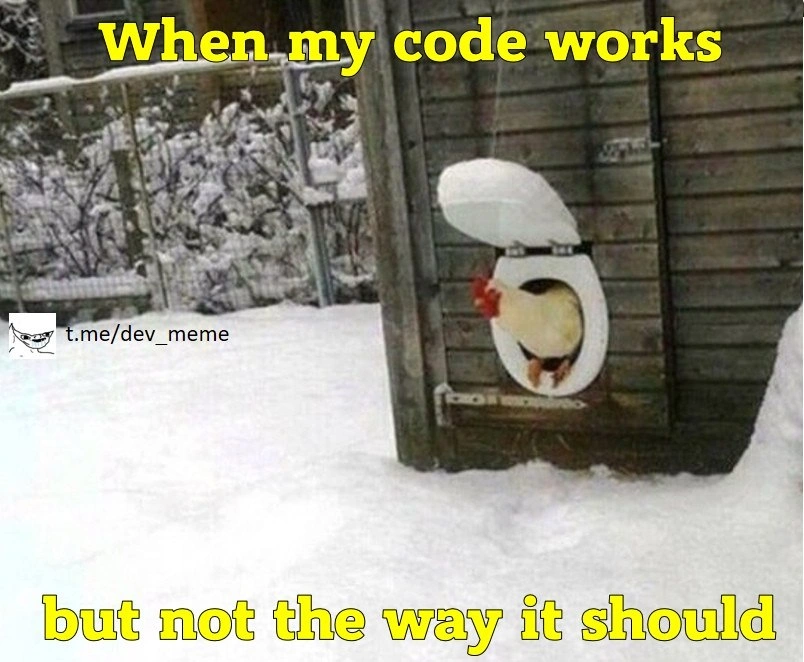
Imagine you’re doing a jigsaw puzzle and a piece is missing. You really want to finish it, so you grab a random puzzle piece from a different box that almost fits the shape. You push it into the gap and hey, now there’s no hole in the puzzle! The puzzle is “complete,” but the picture looks funny because that piece doesn’t belong there. You achieved the goal (no missing pieces), but not in the right way. This meme is laughing about the same idea. The chicken got out of the coop, but it had to squeeze through something silly (a toilet seat door) because the proper door wasn’t there. In simple terms: the result is right, but the way it happened is all wrong. It’s like using a wrong tool to do the right job – it might work, but everyone can see it’s a bit absurd. That’s why it’s funny and a little bit embarrassing, all at once.

Level 2: Accidental Feature

This meme highlights what happens when code works in an unexpected way. In software, we often talk about bugs (mistakes or errors in code) and features (intended functionalities). Here the joke is that the program’s result is correct only by coincidence or through a weird method – basically an accidental feature. The image of a chicken using a toilet seat as a door is a funny visual metaphor: the chicken did get out (the program produced output as hoped), but the method was completely wrong (going through a toilet-seat hole instead of a normal door).

In programming terms, this is like writing a function that returns the right answer, but only because of a flaw in the code. The structure or code quality is poor, but somehow you still get the output you wanted. Developers call such messy, tangled code “spaghetti code.” Imagine a bowl of spaghetti: noodles twisting and crossing everywhere. Spaghetti code is similar – the program’s logic flow is all over the place, making it hard to follow. In such a mess, sometimes a change in one part affects another part in unpredictable ways. Every junior developer eventually encounters this: you might hack something together and it seems to work, but you’re not entirely sure why it works (and that uncertainty is scary).

Let’s break down the scene as if it were a program. The shed is like your application, the door with a toilet seat is like a part of your code (a module or function) being used incorrectly, and the chicken is the output or data passing through. A proper design would have a real door (correct code logic) for the chicken. If you forgot to create that, you might cut a quick hole with whatever is on hand – that’s the programming equivalent of a hack or workaround. It’s something you do during debugging & troubleshooting, often late at night when a feature needs to work right now. The result does the job, but it’s clearly not how things were supposed to be.

For example, consider this Python-like pseudocode of a function that sums a list of prices:

def calculate_total(prices):
    total = 0
    for price in prices:
        total = price  # BUG: using assignment instead of addition
    return total

# Testing the function:
print(calculate_total([5]))       # Output: 5   (works for one item)
print(calculate_total([5, 3]))    # Output: 3   (wrong result for multiple items)

In the code above, we intended to add up all prices, but due to a bug we only ever keep the last price. For a single item [5], it works (we get 5, which is correct in that one case). But add another item and the total is wrong. The code’s logic is flawed, even though it gave a correct result in one scenario. This is like the chicken finding its way out once – it technically works in a specific situation, but it’s not a reliable or correct solution. If we only tested the one-item case, we might think our code is fine. That false sense of success is exactly what the meme jokes about.

Key concepts at play here: software architecture means the way we design our program’s structure (like planning out a building). An architectural mistake might mean we didn’t plan for a certain use-case, and we end up adding a hasty solution later. Refactoring is when developers go back into that messy code and reorganize or rewrite it properly without changing what it does. It’s like renovating the shed to install a proper door for the chicken. Early-career developers learn that just because the program outputs the expected result doesn’t always mean your approach was correct. It’s important to look under the hood and see how the code produced that result. If it involved a proverbial toilet seat hack, it might be a code smell (a hint that code design isn’t right) that should be cleaned up.

The meme feels so relatable because many of us have fixed a bug by doing something unconventional and then nervously said, “It works… but it probably shouldn’t work like this.” It captures that mix of pride and embarrassment. In daily coding, if you ever catch yourself calling a weird workaround a “feature” with a grin, you know exactly what this meme is talking about. It’s a reminder that an unexpected output that happens to be right is still unexpected – and likely a sign to review the code before it lays an egg 🍳 (or, in this case, before the chicken gets stuck!).

Level 3: Loophole Architecture

Sometimes a system’s architecture becomes a wild improvisation, like someone cut a hole in a shed and stuck a toilet seat on it to make a door. That’s exactly the vibe here. The meme shows a chicken poking out of a sideways toilet seat hatch, captioned “When my code works, but not the way it should.” It’s poking fun at those quick-and-dirty code fixes that get the job done by exploiting a loophole rather than following the intended design. Every senior developer has seen this: the code technically produces the right output (the chicken makes it outside), but only because of an absurd workaround deep in the codebase. This is a prime example of a kludge – a clumsy, patched-together solution born from desperation or time pressure.

In a robust design, you’d have a proper chicken-sized door planned in the shed (i.e., a well-thought-out software module or API). But in our spaghetti code reality, someone forgot to plan for a certain requirement, and a last-minute hack was bolted on. The result “works,” yet it reveals an architectural mistake: a component being used in a way it was never intended (a toilet seat as a door, or say, a function written for one purpose now awkwardly repurposed for another). Seasoned devs recognize the smell of such technical debt immediately – it’s the kind of code that makes you raise an eyebrow and mutter, “Well, that’s one way to solve it…” with equal parts amusement and dread.

The humor here taps into a relatable developer experience: you’re happy your fix solved the bug, but you’re also cringing because you know it’s held together with duct tape and hope. Perhaps you’ve seen a critical feature working only because some global variable was set three modules over (hey, it works, don’t ask why!). Or maybe the system “succeeds” by relying on an unintended side effect – the digital equivalent of a chicken accidentally finding the only weird exit. This meme is basically a code-quality cautionary tale wearing a clown nose. It highlights the kind of bug that doesn’t crash the program, but exposes a design flaw so glaring you can’t help but laugh.

Every experienced developer has a war story: a piece of code that technically fulfills the requirements while violating every principle of good design. We joke about “temporary permanent fixes” because once a hack like this slips into production, it tends to live on forever (“if it ain’t broke, no one has time to fix it”). The shed will never get a proper door because the chicken is, well, getting through somehow. This meme resonates precisely because we’ve all been there – simultaneously celebrating that our code runs at all and nervously side-eyeing the monstrosity we just created. It’s both funny and horrifying to realize your solution is basically a chicken crawling through a toilet seat: undeniably effective, undeniably wrong. The lesson for the jaded senior dev? That uneasy laughter is a sign – you’ve got a “works by accident” scenario on your hands, and a refactor might be long overdue. But until then, at least the chicken’s getting out… right? 🙃

Description

A surreal and absurd meme featuring a chicken inside a toilet bowl. The toilet is strangely mounted on the exterior wooden wall of a shed, surrounded by a snowy landscape. The toilet lid is open, and the chicken is nestled inside, looking out. Large, bright yellow text is overlaid on the image, with "When my code works" at the top and "but not the way it should" at the bottom. A watermark for "t.me/dev_meme" is present in the lower left corner. This meme visually captures the common developer experience of creating a solution that produces the correct output through an entirely incorrect, illogical, or inexplicable process. It's the epitome of 'task failed successfully.' For experienced engineers, this resonates as a classic symptom of hidden bugs, accumulating technical debt, or the fragile nature of a complex system where a fix in one place has unintended, yet strangely functional, consequences elsewhere

Comments

7
Anonymous ★ Top Pick It's not a bug, it's an emergent feature of a legacy system. We'll just add a comment: `// DO NOT TOUCH - Structural integrity of the application depends on this chicken.`
  1. Anonymous ★ Top Pick

    It's not a bug, it's an emergent feature of a legacy system. We'll just add a comment: `// DO NOT TOUCH - Structural integrity of the application depends on this chicken.`

  2. Anonymous

    CI just went green after I wrapped the legacy PL/SQL trigger in a “temporary” Node.js Lambda - sure, the chicken makes it through, but someday someone’s going to ask why there’s a toilet seat in our architecture diagram

  3. Anonymous

    After 20 years in tech, I've learned that the difference between a senior engineer and a junior isn't avoiding these situations - it's knowing exactly how many abstraction layers to add before anyone notices the chicken is still in the toilet

  4. Anonymous

    This is the architectural equivalent of implementing a microservice when a function call would suffice - technically functional, passes all unit tests, but anyone with 15+ years of experience takes one look and asks 'why is the chicken using the cat door?' The real tragedy is when this makes it to production, gets documented as 'working as designed,' and becomes tribal knowledge that new engineers must learn to work around. Classic case of solving the wrong problem correctly, or as we call it in enterprise: 'meeting the acceptance criteria.'

  5. Anonymous

    Adapter Pattern: toilet seat -> chicken door. Tests green; domain invariants and UX filed P1s

  6. Anonymous

    Our contract tests said “supports egress”; we never specified “door,” so the Adapter pattern shipped a chicken-sized toilet seat - 200 OK, wrong semantics

  7. Anonymous

    Zero runtime panics, infinite semantic drift - like a monolith achieving liveness but zero safety guarantees

Use J and K for navigation