Skip to content
DevMeme
1353 of 7435
Junior Dev 'Reviewing' a Senior's Critical Hotfix
CodeReviews Post #1523, on May 8, 2020 in TG

Junior Dev 'Reviewing' a Senior's Critical Hotfix

Why is this CodeReviews meme funny?

Level 1: Stamp of Trust

Imagine your friend is an expert at fixing bikes, and during a big race your bike’s chain suddenly breaks. There’s no time to spare. Your friend quickly says, “I can fix this right now, but we gotta do it fast.” Normally, you might want to double-check the fix or think about the best solution, but the race is about to start. So you just nod and say, “Yeah, go for it, it looks good!” without really inspecting what they did. In the end, you trust them because they know what they’re doing and you really need that bike fixed immediately.

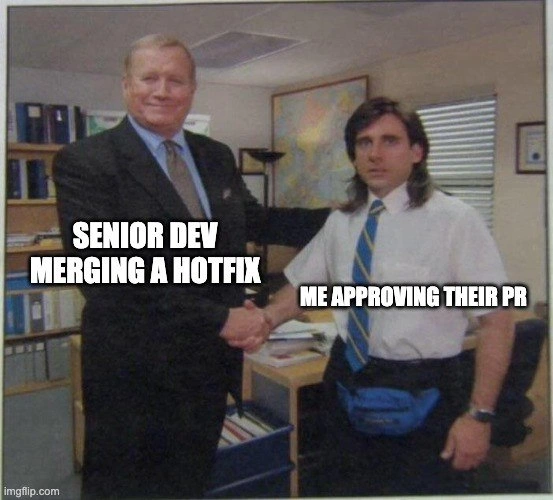
This meme is joking about a very similar feeling in the programmer world. The older person in the suit is like the expert friend who confidently applies a fix (that’s the senior developer deploying a quick bug fix). The younger person (with the funny blue fanny pack) is like you, just quickly agreeing and giving a thumbs-up (that’s me approving the code change). They’re shaking hands in the picture, which is a very formal way of showing agreement, but the joke is that my approval was basically automatic and super casual.

So why is it funny? Because normally fixing code and checking it is a careful process (kind of like usually you’d carefully fix a bike and test it). But in an emergency, everyone just rushes and trusts the experienced person. The handshake in the picture is like saying “Deal, let’s do it!” really quickly. It’s a stamp of trust. I didn’t really review anything deeply; I just trusted the senior person and approved so the fix could go out immediately.

Even if you’re not a programmer, you can relate: it’s that moment when you skip the usual careful steps because something urgent is happening, and you trust the expert to handle it. The meme is funny to developers because it reminds them of those high-pressure moments where rules get bent and all you can do is shrug and say, “Looks good, let’s just get it done!”

Level 2: Hotfix Hustle

Let’s break down what’s happening in simpler terms, and explain some jargon:

  • Hotfix: A hotfix is a quick repair for a software bug that’s causing big problems in production (the live product). It’s “hot” because it’s done right away, outside the normal schedule. Think of it as an emergency patch. In this meme, the senior developer is merging a hotfix, meaning they are quickly pushing a change to the code to fix an urgent issue (like a bug affecting users right now). Hotfixes often happen when something is on fire in the system and can’t wait for the usual slow release process. They might even be done directly on the main branch that goes to production, because speed matters more than procedure at that moment.

  • Pull Request (PR) Approval: In modern software development with systems like GitHub or GitLab, when you want to merge code changes, you open a Pull Request. That’s basically a request saying “I have some new code, can we pull it into the main codebase?” Other developers are supposed to review that PR: they check the code, discuss it, and eventually approve it if it looks good. Usually, the rule is that you cannot merge your own code without at least one other person approving (this helps catch mistakes). In the meme, the senior dev has opened a PR for the hotfix. Now someone else (me, in this case) has to approve it so it can be merged.

  • Rubber-stamp review: The term “rubber stamp” refers to giving approval without real inspection – like stamping “approved” on paperwork without reading it. A rubber-stamp code review means you glance at the changes, assume it’s fine (or you don’t feel you can really critique it), and you click “Approve” almost automatically. The meme is exactly about that! The text “ME APPROVING THEIR PR” shows I’m the one clicking approve on the senior dev’s pull request. But am I doing a deep dive into the code? Nope. I’m basically trusting them and just quickly giving the green light. It’s a bit tongue-in-cheek because doing this defeats the purpose of code review – yet it happens often, especially with urgent fixes or when a junior dev is reviewing a much more experienced dev’s code.

  • LGTM: Developers often comment “LGTM” on a pull request when they approve it. It stands for “Looks Good To Me.” It’s a short, somewhat informal way to say “I’ve reviewed this (at least superficially) and I’m okay with it.” In many cases, saying LGTM is accompanied by actually looking at the code changes. But in rushed situations, it can be a polite fiction – you might not have thoroughly checked everything, but you trust the author or you know it’s an emergency. The post’s message “LGTM” is exactly that: me giving the go-ahead without fuss. It’s basically the textual equivalent of that handshake in the picture – a quick “yep, go for it.”

  • Senior vs. Junior dynamic: The meme shows an older, authoritative-looking man (senior dev) and a younger, more casually dressed man (me, presumably a junior or mid-level dev). This highlights a common dynamic in tech teams. A Senior Developer is someone with a lot of experience and knowledge of the system. If something breaks, they often take charge to fix it because they know the ins and outs. A junior developer (less experienced) might not even fully understand the issue or the fix, but they can still help by being the required second pair of eyes—even if those eyes are basically just blinking and clicking “approve.” 😅 The younger guy’s somewhat goofy appearance (short-sleeve white shirt, striped tie, and that bright blue fanny pack) makes the situation comical: it’s like he’s clearly not the one in power in this situation, yet he’s the one officially “approving.” In reality, he’s probably not going to question the senior dev – he’s just happy (or relieved) that the senior dev has a solution.

  • CodeReview in emergencies: Normally, a code review involves looking over the code changes carefully: checking for bugs, ensuring it follows style guidelines, making sure it has tests, etc. It’s a quality control step. But during an emergency (production bug impacting users or the business), teams sometimes do what this meme shows – they speed through the review. For example, the reviewer might literally only spend 1 minute to glance at the diff of the code, say “looks good,” and that’s it. The usual comments and nitpicks (“Hmm, could we refactor this? Can we rename this variable for clarity? Is there a unit test for this case?”) are skipped. The attitude is: “We’ll deal with that later, just get the fix out now.” This is not ideal practice, but it’s often the reality when every minute of downtime counts. The humor here is acknowledging that, yes, even though we know we’re supposed to do careful reviews, sometimes we just don’t because the situation demands speed.

  • Version control and merging: In VersionControlHumor, there’s often talk about merging and MergeConflicts. In this scenario, the senior dev merging a hotfix implies they are integrating their code into the main line of code that goes to production. Usually, merging is done after approval. If the senior dev is also the one merging, it means as soon as I (the reviewer) give the thumbs up, they hit the merge button and deploy to production. There might be a continuous deployment pipeline that automatically deploys the merged code, or they might manually deploy it. The key point is, this is likely outside the normal deployment schedule. Later on, this hotfix code will probably need to be merged back into other branches (like the development branch) so that everything stays in sync. Sometimes these hurried changes can cause merge conflicts later (when the same part of the code was changed elsewhere), adding to the technical mess. But again, when doing the hotfix, nobody is worrying about that; they’ll resolve those conflicts the next day if needed. The meme doesn’t explicitly mention merge conflicts, but any experienced dev knows that a quick patch might cause headaches in the repo later. It’s part of the trade-off.

To put it simply, the meme is funny to developers because it’s true to life. If you’re new to development, imagine you joined a team and they told you “we always review code before it goes live.” You’d think reviews are serious, right? Now picture your first big production outage: something is broken, everyone’s panicking a bit. A senior person says “I’ve fixed the bug, here’s the change.” They ping you to review it. You open it, and maybe you don’t fully understand the code (it could be complex), but you know this fix is needed, like, 5 minutes ago. So you basically say “looks good” and let them merge it. Later you might chuckle and think, “wow, I was basically a rubber stamp.” Don’t worry – this happens to everyone! Teams try to minimize it, but emergencies are special cases.

The handshake photo used in the meme is also a known handshake meme format, often used to show two parties formally agreeing on something. Here it’s used ironically: the formality of a handshake vs. the informality of how that approval really feels. Rushed_reviews and pr_approval are exactly what’s going on: a hurried review approval for a PR. The senior vs. junior contrast is exaggerated by the characters’ looks. It drives home the point that the approval is just a token gesture. The junior guy isn’t going to challenge the senior guy during a crisis; he’s just there to say “Approved!”

In summary, at this level: A senior dev is urgently fixing a bug in production with a quick code change (hotfix). I, as the junior dev or colleague, am officially reviewing it, but in reality I’m not giving any real critique – I’m just approving it instantly because we need that fix now (and I trust the senior dev). The meme uses a formal handshake image to poke fun at how this “approval” is basically a casual rubber stamp. It’s a scenario many developers find humorous because they’ve lived through that rushed, somewhat absurd approval process during a high-pressure moment.

Level 3: Rubber Stamp Ritual

In this meme, we see the senior dev (in a suit and tie) firmly shaking hands with "me" (the casually dressed guy with a fanny pack). The text labels make it clear: the suited figure is “Senior Dev merging a hotfix” and the casual figure is “Me approving their PR.” This humorously captures a familiar CodeReview scenario in software teams: an urgent hotfix is needed in production, and the senior engineer has rushed a fix. The normal peer review process still technically happens – there’s a Pull Request (PR) that needs approval – but it becomes a mere formality, a quick handshake of approval. It’s the ultimate rubber stamp code review. The image exaggerates the formality (that handshake and suit) versus how informal the actual review is (a stressed-out dev in a goofy fanny pack just saying “LGTM, ship it”).

Why is this combination funny? Because it’s a role reversal wrapped in urgency. Normally, a reviewer might scrutinize code, leave comments, request changes, and there’s a certain seriousness to approving code for production. But here, the power dynamic is flipped: the senior dev (the one usually reviewing others) is introducing the change, and the less experienced dev is technically the reviewer — yet that reviewer is essentially just a bystander giving a quick thumbs-up. It pokes fun at the idea that sometimes code reviews are treated like a ceremonial rubber-stamp, especially when the person who wrote the code outranks the reviewer or when time is of the essence. There’s an implicit understanding: “Don’t worry, I got this. Just approve it.” The handshake symbolizes that unspoken agreement and trust. Meanwhile, the contrast in attire (suit vs. fanny pack) emphasizes who’s really in control; the senior dev is all business addressing a ProductionBug, and the junior is just casually sanctioning it without the usual authority or scrutiny.

Real-world reflection: In practice, when something is on fire in production (say the website is down or a critical bug is hitting users), teams often enter “firefighting” mode. All those best practices like comprehensive code reviews, extensive testing, and careful VersionControl procedures suddenly loosen up. The priority is "fix it now, we’ll review later." Many engineering orgs have rules like “you can’t merge your own PR without at least one approval” and require checks to pass. But in a hotfix situation, that process is expedited or bent. If the senior dev has pushed a quick fix to a branch (often named something like hotfix/urgent-patch), everyone knows this isn’t the time for nitpicking variable names or minor style issues. The team might still go through the motions of a PR to satisfy branch protection rules or to document the change, but the review is lightning-fast. The reviewer – maybe the on-call buddy or a junior dev still awake – basically skims it, thinks “well, it’s coming from Alice who’s super experienced, so it’s probably fine”, and hits Approve. They might even just comment “LGTM” (short for Looks Good To Me) without suggesting any changes. In other words, they become a human rubber stamp.

This meme hits home for seasoned developers because it satirizes an anti-pattern that we’ve all reluctantly performed. We preach that “every change must be reviewed carefully to maintain quality”, but when the database is crashing or customers are complaining, even the most process-driven teams can end up merging code with only the most cursory review. It’s funny in a dark humor way: we recognize the gap between our ideal process and the reality under pressure. The formal handshake in the image perfectly parodies this – it’s like we’re saying “Yes sir, approved immediately!” with a salute, when normally we’d have a thoughtful code critique.

Let’s break down a typical scenario being referenced:

  • Critical bug in production: Something has gone very wrong (e.g., users can’t log in, or an overnight batch job failed and is impacting today’s data). The team labels this a P0 (highest priority issue). The senior dev responsible (or on call) quickly identifies a one-line fix or a quick patch.
  • Hotfix branch & PR: Instead of going through the usual feature branch -> QA -> staging -> production pipeline (which could take hours or days), the senior dev creates a dedicated hotfix PR targeting the main branch (or whatever is deployed). The PR title might be “Hotfix: patch login null pointer exception,” and it contains minimal changes. They bypass some of the usual checks if possible – maybe CI tests are still run, but they’re confident and maybe even selectively ran the relevant tests locally.
  • Reviewer rubber-stamps: Company policy says you need at least one approval. So the on-call teammate or nearest available developer (perhaps a junior dev who isn’t as familiar with this part of the system) is pinged: “Hey, can you review this real quick? Prod is down.” That person opens the PR, sees perhaps 5 lines of code changed by the staff engineer who basically owns that part of the code. This reviewer is in no position (or mood) to critique the solution’s elegance. They’re thinking, “If this fixes the outage, I’m all for it. I’m certainly not going to hold it up.” They may leave an approving comment like LGTM, let's get this out ASAP 🚀 and click Merge. (Yes, we even have a 🚀 emoji for “ship it now”).
  • Post-merge relief: The fix goes live, the incident is resolved, and everyone breathes a sigh of relief. Only later might someone say, “We merged that without a real review… maybe we should double-check it posthumously.” Often, the code that was hotfixed will get a more thorough look in the daylight, or a refactor later if it was a hacky patch. But sometimes if it works, it just stays in the codebase forever, a scar from the battle that no one dared to revisit.

This all-too-common tale is why developers find the meme “relatable.” It encapsulates that mix of urgency, trust, and bending of rules. The senior dev in the meme has the confident smile of someone who’s solved the prod issue (he knows his fix is going in), and the handshake illustrates that the PR approval is basically assured. Meanwhile, “me” (the one approving) looks a bit awkward – mirroring how a junior might feel giving a thumbs-up to a senior’s code without the usual diligence, kind of thinking “Hope this is okay… well, they know what they’re doing.”

There’s also a subtle commentary on responsibility and authority. The formal suit suggests authority – normally, authority in code review lies with the reviewer to block a bad change. But here the authority really lies with the senior author. The junior’s Approval is a foregone conclusion. The humor is in that pretense: we act like we’re doing a proper code review (hence the formal handshake symbolizing an official approval), but we all know it’s just for show in this scenario. It’s essentially “I won’t be the one to question this fix right now.”

From an engineering culture perspective, this meme touches on the balance between process and pragmatism. Modern development methodologies (Agile, DevOps) encourage fast iteration, but also emphasize automation and peer reviews to maintain quality. Yet, in a crisis, even the best teams revert to a bit of cowboy coding – as long as someone rubber stamps it, it’s considered okay. We’ve created systems (like required reviewers in Git workflows) to prevent reckless changes, but we’ve also empowered senior engineers with trust so that when they say jump, we jump. The “casual rubber stamp” is a humorous nod to that reality: sometimes the process is just one click saying “Yes, fine.”

Additionally, there’s an element of mentor-mentee or hierarchical respect at play. If you’re the junior dev approving your tech lead’s hotfix, you might actually learn something from skimming their code – “Oh, that’s how they solved it so quickly.” But more likely, you don’t even fully grasp the code in that rushed moment; you’re relying on their expertise. It’s a bit like being an apprentice who’s asked to sign the inspection form after the master craftsman fixed the machine – you sign off because who are you to question it? The fanny pack fashion on the “me” character underscores that slightly comic power imbalance: one person is clearly in charge, the other is just along for the ride, doing what needs to be done.

Finally, consider the emotional rollercoaster: There’s the stress of the bug, the adrenaline of deploying a fix quickly, and then the relief/celebration when it’s fixed. In those moments, teammates often just high-five (or handshake) and say “Good job, fix is out!” The meme freeze-frames that handshake moment, but with a twist on roles, making it amusing. It’s also a gentle poke at ourselves as developers: we love to insist on code quality, but when push comes to shove, we might basically say "approved 👍" without even fully reading the code, if circumstances demand. RelatableDeveloperExperience indeed!

Description

A popular meme format featuring a handshake between two characters from the TV show 'The Office.' On the left, a confident, professionally dressed man (Ed Truck) is labeled "SENIOR DEV MERGING A HOTFIX." On the right, an awkward-looking man with a mullet and a fanny pack (Michael Scott) is labeled "ME APPROVING THEIR PR." An `imgflip.com` watermark is visible in the bottom left corner. This meme perfectly captures the power dynamic and sense of impostor syndrome common in code reviews, especially during high-pressure situations. The joke is that the junior developer's approval is merely a formality to satisfy CI/CD checks or branch protection rules, rather than a genuine technical review. The senior needs to merge an urgent fix, and the junior provides a rubber-stamp 'LGTM' ('Looks Good To Me,' as the original post caption implies) without truly understanding or questioning the changes. Experienced engineers recognize this scenario as a pragmatic, if slightly dysfunctional, part of team workflows
Comments

7
Anonymous ★ Top Pick My main contribution to a senior's hotfix PR is lowering the team's 'time to approve' metric. I'm not a reviewer; I'm a performance optimization
  1. Anonymous ★ Top Pick

    My main contribution to a senior's hotfix PR is lowering the team's 'time to approve' metric. I'm not a reviewer; I'm a performance optimization

  2. Anonymous

    That handshake is our entire compliance workflow: senior dev force-pushes a three-line prod hotfix, I skim the diffstat, hit “LGTM,” and Legal calls it “dual-control governance.”

  3. Anonymous

    The senior dev's hotfix bypassed three layers of CI/CD, ignored the feature freeze, and somehow fixed production while introducing two new race conditions that won't surface until Q3 - and you still approved it because their last "quick fix" is the only reason the payment service survived Black Friday

  4. Anonymous

    The beautiful fiction of code review democracy: where a junior dev with 2 YoE ceremonially 'approves' a senior architect's emergency hotfix that's already been deployed to prod, tested in production, and is currently preventing a P0 incident. The PR exists purely for audit compliance and to maintain the illusion that our branching strategy isn't just 'senior devs have force-push rights and everyone else gets to watch.' At least the junior dev gets to add 'Reviewed critical production code' to their performance review

  5. Anonymous

    Sev1 code review policy: downgrade from two-phase commit to 'handshake and hope', with rollback defined as 'git revert' after the status page update

  6. Anonymous

    Senior's hotfix PR: One commit seniors trust more than juniors' entire test suite ever will

  7. Anonymous

    Hotfix PRs turn code review into TCP: their SYN is “merge now,” my ACK is “LGTM,” and prod decides whether to send RST

Use J and K for navigation