
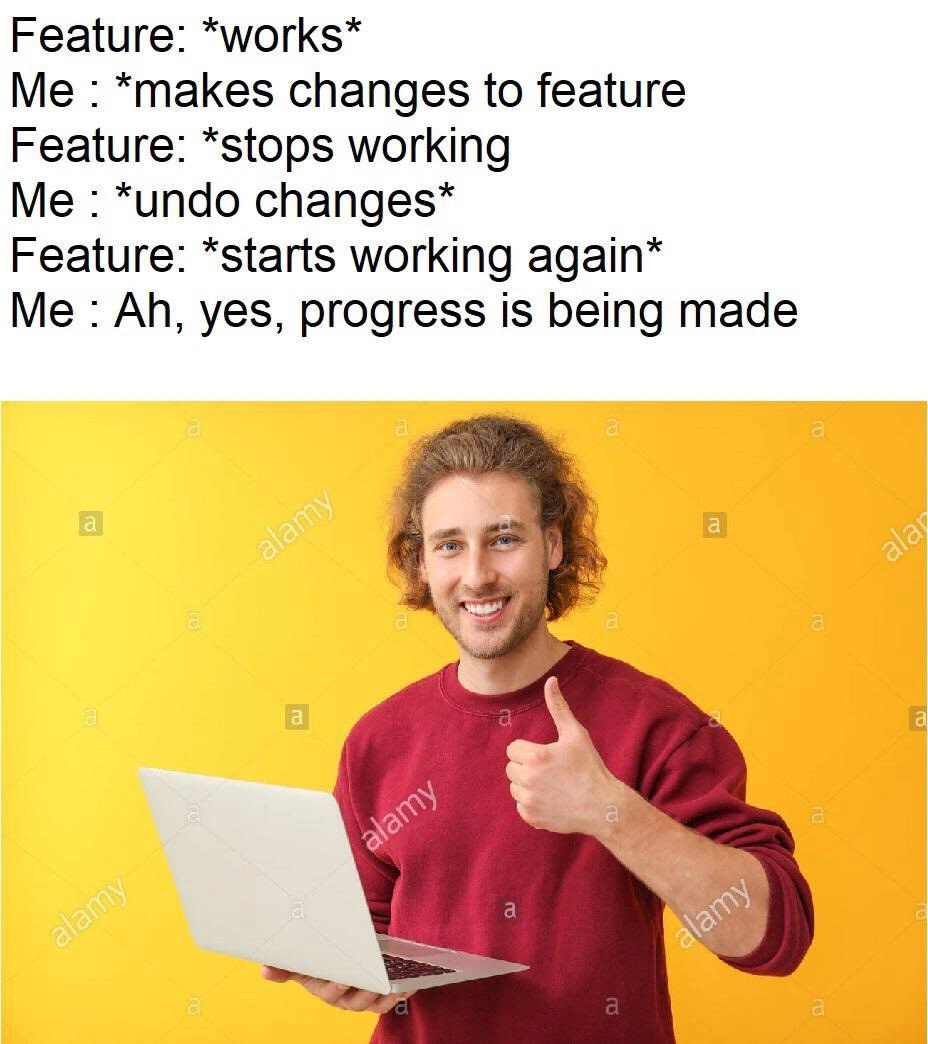
The Developer's Definition of Progress
Description
A two-part meme about the cyclical nature of software development. The top half features six lines of text describing a workflow: 'Feature: *works*', 'Me: *makes changes to feature*', 'Feature: *stops working*', 'Me: *undo changes*', 'Feature: *starts working again*', and finally, 'Me: Ah, yes, progress is being made'. The bottom half is a stock photo of a young man with curly hair in a red sweatshirt, smiling and giving a thumbs-up while holding a laptop, set against a bright yellow background. The photo is watermarked with the word 'alamy'. The humor lies in the sarcastic satisfaction of returning to the initial working state after a failed attempt at modification, a universally relatable experience for developers where 'not breaking things' is considered a form of progress


Comments
7Comment deleted
The junior dev sees this as a failed day. The senior dev sees this as successfully defending the main branch from a bad merge. 'Progress' is just the absence of a new disaster
Stand-up update: yesterday I shipped the feature, today I shipped the revert - Scrum sees two completed tasks, Git shows net-zero diff, and I call it rollback-driven development
Twenty years in and I've finally mastered the art of billable debugging: spending three hours to discover the fix was reverting my fix to someone else's fix that was fixing what wasn't broken until we fixed it
Ah yes, the ancient art of 'git revert' driven development - where your commit history reads like a choose-your-own-adventure book that always ends with 'maybe the original implementation wasn't so bad after all.' Senior engineers know this dance well: you spend three hours refactoring a perfectly functional method, introduce a subtle race condition that only manifests in production under load, revert the changes at 2 AM during an incident, and then confidently tell the team in standup that you've 'validated the current architecture's robustness.' It's not technical debt - it's empirical evidence that the previous developer actually knew what they were doing, even if their variable names were atrocious
Revert-driven development: break it, git revert, and call it MTTR optimization - DORA is green, and the codebase hasn’t moved an inch
New team KPI: time‑to‑git revert HEAD~1; anything under five minutes counts as continuous improvement
Senior dev wisdom: progress isn't new features, it's the revert that restores sanity to your monolith