Skip to content
DevMeme
2489 of 7435
When the latest audio-only app is basically 1920s radio all over again
IndustryTrends Hype Post #2763, on Feb 17, 2021 in TG

When the latest audio-only app is basically 1920s radio all over again

Why is this IndustryTrends Hype meme funny?

Level 1: New Paint on Old Toy

Think of it like this: a long time ago, your great-grandparents sat around a big box that played voices and stories (that was the radio). Now, we have a fancy phone app where people gather to talk and listen to voices. It’s really the same idea, just dressed up with new technology. Imagine taking an old toy, repainting it, and telling everyone it’s the hottest new toy – those who know the old toy would smile, because nothing really changed. That’s what’s happening here. We’re calling an old way of chatting new again. The meme is funny because it shows that sometimes the “latest and greatest” gadget is just an old trick in a shiny new box.

Level 2: Old Tech, New App

In plain terms, Clubhouse is a modern mobile social media platform focused on voice chat. You open the app and join virtual “rooms” where people are talking live – it could be a discussion, a casual hangout, or someone hosting a mini talk show. It’s audio-only, meaning there’s no video and minimal text – you just hear people’s voices (often while you multitask). When Clubhouse launched around early 2021, it was invite-only and only available on iPhones, so it felt exclusive and trendy. Tech enthusiasts and media were buzzing about this “new way to communicate” in real time. The idea was that you could jump into conversations with famous entrepreneurs, artists, or just groups of friends, all using voice. This excitement around live audio chat was the hot tech thing for a while.

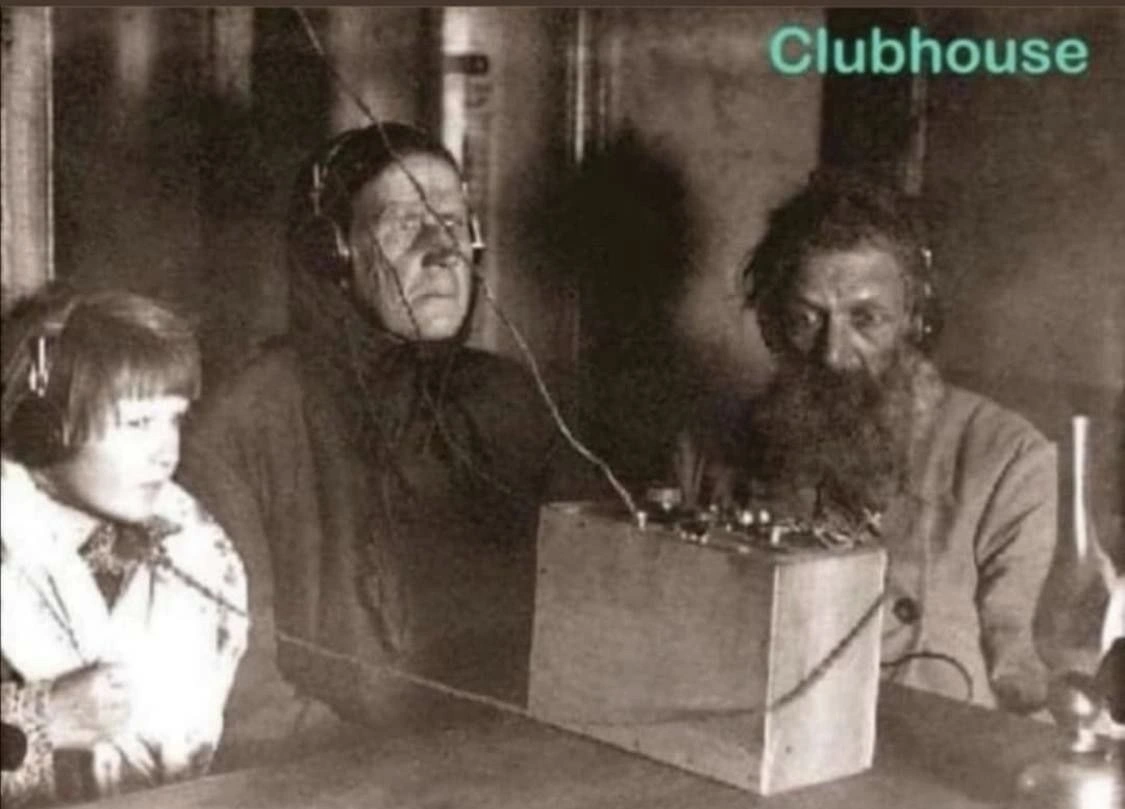
Now, the funny part: the meme points out that this “new” app experience is basically the same as how people communicated about 100 years ago. The meme literally uses a sepia-toned vintage radio photo of people gathered around an old-fashioned radio set, each wearing bulky early headphones. Back in the 1920s, families or friends would sit together and listen to the radio for entertainment – hearing news broadcasts, music, and stories. Also, hobbyists with ham radio (amateur radio) sets would actually chat with each other using Morse code or voice over long distances. That was essentially the original voice chat social network! They didn’t have the internet or smartphones, but they had radio waves and electrical equipment to carry voices through the air. Everyone in that era used big headphones and turned knob dials to tune in the right frequency – kind of like how today we put on AirPods and scroll through an app to find a conversation room.

So the meme is comparing Clubhouse to that old radio experience. By plastering the word “Clubhouse” in a modern font onto a 1920s scene, it jokingly says: this fancy new platform is really no different from what our great-grandparents did. It’s highlighting a recurring theme in tech: we often reinvent or repackage old ideas in new forms. In this case, talking to people remotely by voice isn’t a 2020s invention at all – it’s just come back into fashion with a smartphone twist. This ties into the notion of a tech hype cycle, where every so often an old idea gets a new spin and lots of buzz. Many experienced folks found it amusing (and a bit nostalgic) that a basic form of communication from a century ago was trending again as if it were cutting-edge. Essentially, the meme is a lighthearted lesson in TechHistory: even in an industry that’s always chasing the “next big thing,” sometimes we end up circling back to ideas from the past, just with shinier packaging.

Level 3: Hype Cycle Déjà Vu

The year is 2021 and the tech world is raving about an invite-only, audio-only app called Clubhouse – it’s billed as a revolutionary new way to connect. To seasoned developers and tech historians, this scenario triggers serious déjà vu. We’ve seen this pattern in the tech world before: a “brand-new” communication platform that’s really a revival of a very old idea. The meme aptly points out that the latest social audio craze is basically a return to the 1920s radio experience, just dressed up with modern jargon and smartphones. It’s a classic case of industry hype – what’s old is new again, rebranded as the next big disruptive platform. In fact, for all the audio chat hype surrounding it, seasoned observers recognized it was basically old wine in a new bottle.

Why is this funny (and painfully familiar) to experienced folks? Because we’ve watched tech hype cycles churn through these “innovations” time and time again. Today’s young entrepreneurs excitedly pitch “live drop-in audio chats” on Clubhouse, while grey-bearded engineers smirk, recalling that their grandparents literally did the same thing on ham radios and early broadcast stations. It’s as if someone rediscovered the wheel and called it Mobility-as-a-Service. In the 1920s, families would huddle around a crackling radio set to communicate or be entertained by voice. In the 2020s, people huddle around smartphones with earbuds, tuning into chat rooms. The medium and scale have evolved – packet-switched networks instead of crackling AM signals – but the core idea (real-time audio conversations) is virtually identical. Even the exclusivity has made a comeback: Clubhouse launched as invite-only on iPhones, echoing how early radio enthusiasts needed special equipment (and sometimes a government license) to transmit on the airwaves. History doesn’t just rhyme here; it’s doing a full replay in high fidelity.

This meme cleverly satirizes that TechHistory often repeats itself in InternetCulture. It highlights a sort of generation gap in perception. For younger users, live audio chat on a social network feels novel and exciting. For veteran devs, it’s a remix of communication methods that have been around for ages – from CB radios and telephone party lines, to early internet voice chat (VoIP calls on Skype in the 2000s), to voice channels in today’s apps (like Discord). Each iteration was hyped as the future of communication. And each time, once the novelty wore off, we realized we were just rediscovering old ground with a fresh coat of jargon and TechBuzzwords. The meme resonates because it calls out this cycle with a single sepia photo: essentially saying, "We’ve done this before – about a hundred years ago!" It’s a playful poke at our industry’s tendency to suffer from collective amnesia whenever something gets packaged with a shiny new app and a big VC funding round.

To drive home the parallel (with a wink), consider a side-by-side comparison of vintage radio vs. modern Clubhouse:

1920s Radio Era 2021 Clubhouse Era
Big wooden radio box with knobs and wires. Smartphone app with a slick UI.
Bulky wired headphones (as seen in old photos). Wireless earbuds or light headphones.
Tune a dial to a frequency to hear who’s on. Scroll a list of “rooms” to hear who’s talking.
Live voice broadcasts (news, stories, chat). Live voice chats (panels, discussions, casual talk).
One-to-many format (one station, many listeners). Many-to-many format (multiple speakers & listeners).
Early adopters needed technical skills or licenses (ham operators). Early adopters needed an invite (exclusive early access).
Called “wireless telegraphy” or simply radio. Called “social audio” (buzzword for an old concept).
Hyped as a world-changing invention. Hyped as a tech unicorn revolutionizing communication.

As the table shows, the form factors and lingo have changed – vacuum tubes to internet packets, dials to swipe gestures – but the underlying experience is strikingly similar. The meme uses that aquamarine Clubhouse label on the sepia image to ironically rebrand those 1920s folks as if they’re using the latest app. It’s a witty reminder that our fancy modern platform is basically Radio-as-a-Service running on a pocket computer. The humor hits home for developers who’ve witnessed countless “innovations” like this: we can’t help but chuckle and think, “Didn’t we solve this decades ago?” or “Every generation reinvents the same wheel with more RAM.” In short, the meme nods to tech’s recurring habit of repackaging old communication methods as new — and it gently reminds us that maybe this is just another overhyped social audio trend, rather than a truly ground-breaking innovation.

Description

Sepia-toned photo shows three people in early-20th-century clothing, each wearing bulky wired headphones and huddled around a wooden tabletop radio with exposed dials and wires. Their faces are blurred for privacy. In the upper-right corner, aquamarine text reads "Clubhouse," framing the scene as a tongue-in-cheek comparison between the modern invite-only audio social network and antiquated ham-radio chat rooms. The meme pokes fun at recurring industry hype cycles - repackaging decades-old communication tech as the next big disruptive platform - and resonates with developers who’ve witnessed countless "new" ideas that are really historical retreads

Comments

10
Anonymous ★ Top Pick Clubhouse: we containerized a 1920s ham-radio, bolted on OAuth, called the 300 ms jitter “thoughtful conversation,” and magically turned vacuum tubes into a $4 B valuation
  1. Anonymous ★ Top Pick

    Clubhouse: we containerized a 1920s ham-radio, bolted on OAuth, called the 300 ms jitter “thoughtful conversation,” and magically turned vacuum tubes into a $4 B valuation

  2. Anonymous

    Remember when VCs valued Clubhouse at $4 billion and we all pretended synchronous audio was the future of social media? Now it's got the same DAU as your company's abandoned Slack channels from 2020 - technically still alive, but only the bots are listening

  3. Anonymous

    Turns out Clubhouse wasn't disrupting social media with revolutionary audio-only rooms - they were just implementing a 100-year-old protocol with better VC funding and a waitlist. At least the original version had the decency to work without requiring iOS 14 and an invite from someone who got an invite from someone who knew a founder

  4. Anonymous

    Clubhouse, circa 1922: pub/sub over copper, single-threaded room, zero retention by design, and the moderator is whoever owns the plug

  5. Anonymous

    Clubhouse scaling: single operator node, manual sharding via grandma's switchboard - no Kubernetes needed

  6. Anonymous

    Clubhouse: reimplementing ham radio as a centralized SaaS - less federation, more valuation

  7. Deleted Account 5y

    But Y

  8. Deleted Account 5y

    Yea.. again

  9. @NiKryukov 5y

    Welcome to the club buddy

  10. Сифуд Кстолу 5y

    Это не заело. Это хаус. В моем противоречивом прошлом — молодёжная эстрада.

Use J and K for navigation