Skip to content
DevMeme
4873 of 7435
When Programmers Choose Gloriously Wrong Tools for the Job
Languages Post #5334, on Aug 6, 2023 in TG

When Programmers Choose Gloriously Wrong Tools for the Job

Why is this Languages meme funny?

Level 1: Silly Tool Swap

Imagine you have two friends who are doing something completely goofy. One friend says, “I’m going to cut a huge steak with a spoon,” and the other one chimes in, “Oh yeah? Well, I’m going to eat soup with a fork!” Now, both tasks – cutting a steak and eating soup – can be done, but each friend has picked a tool that makes the task almost impossible (and definitely ridiculous). Instead of telling each other, “Hey, that’s not a good idea,” they both nod and smile like they’ve come up with brilliant plans. You’d probably laugh because it’s obvious to anyone watching that neither plan is going to work well; they’re just being silly together.

That’s basically what this meme is saying, but with programming. The two “clowns” in the picture represent two programmers making laughably poor tool choices: one wants to do something very brainy and data-heavy (like an AI project) with a super low-level coding language that’s not meant for that ease of use, and the other wants to do something that needs a lot of precise control (like running a computer’s core system) with a high-level easy scripting language. It’s like both of them swapped the proper tools and are now patting each other on the back for it. Just as using a spoon to cut or a fork to sip would make you giggle, seeing someone use the completely wrong programming language for a job makes developers chuckle. The meme uses clowns connecting minds to show that these two folks are basically sharing a moment of foolishness together. The core humor is simple: they’ve each chosen the wrong tool for their task, and they’re both too clueless (or proud) to realize it, so it’s double the silliness!

Level 2: Square Peg, Round Hole

Now let’s break this down in simpler terms for someone new to programming or these concepts. This meme is highlighting a situation where two developers are choosing programming languages that are very unsuitable for the tasks they want to do – basically jamming a square peg into a round hole. The first programmer wants to use C (a low-level, older language) to do AI and Data Science, and the second wants to write a real-time Operating System using Python (a high-level scripting language). To understand why this is humorous to developers, we need to know a bit about these languages and tasks:

  • C Programming Language: C is a powerful language that has been around since the 1970s. It’s often used for systems programming – things like writing parts of operating systems, embedded systems, device drivers, or anything that needs direct interaction with hardware and very high performance. C gives you a lot of control (you manage memory manually, use pointers to directly manipulate data, etc.), but with that power comes complexity. It’s a bit like a sharp knife: very useful in skilled hands, but easy to cut yourself. For AI and data science, raw C is rarely used by practitioners because those fields are about high-level math, experimenting with data, and quickly trying new ideas – tasks where writing lots of low-level code by hand would slow you down and introduce bugs. While the MachineLearning algorithms might ultimately run on C/C++ under the hood for speed (for example, the heavy number crunching parts of Python libraries are written in C/C++), the data scientist usually writes in a higher-level language and lets those optimized low-level bits do their work behind the scenes. So, using C for AI is like deciding to build a house starting by mining your own iron ore to make nails – theoretically you could, but why on earth would you when Home Depot sells nails cheaply? It’s overkill and inefficient for someone who just wants to assemble things and see results.

  • Python Language: Python is a very popular language, especially for things like data science, web development, automation scripts, and quick prototypes. People love Python because its syntax is simple (closer to English), it manages memory for you (no need to worry about allocating and freeing memory as in C), and it has a huge collection of libraries (packages) that let you do complex tasks with just a few lines of code. However, Python is interpreted and generally much slower than C for heavy computations. It’s also not designed for extremely low-level tasks – it doesn’t let you talk directly to hardware easily, and it can’t guarantee that your program will run in the same amount of time every time (which is something you often need in an operating system’s core). A real-time OS is a special kind of operating system that’s supposed to reliably handle tasks in a very tight time frame (for example, reading a sensor and responding within 0.001 seconds, every single time). These systems are usually written in C or similar languages because the code needs to run fast and predictably, without a lot of extra stuff happening under the hood. Python, by contrast, has a lot going on under the hood (it’s doing things for you automatically, like garbage collection, which can pause the program unpredictably for a tiny bit) and it sits on top of an OS itself (you normally run Python on an operating system like Windows or Linux; it’s not meant to be the thing running below and controlling the hardware directly). So saying “I’m writing a real-time OS in Python” is kind of like saying you want to build a car’s engine out of marshmallows – the material just isn’t suited for that job. Python code can’t ensure the strict timing and low-level control that a real-time OS requires. It’d be slow and unpredictable in that context.

Now, the meme calls this scenario “Clown To Clown Communication” with an image of two clowns connecting minds. This phrase has become an internet joke for when two people are enthusiastically agreeing on something that’s silly or foolish. It’s like saying “one clown is telling another clown an idea, and they both think it’s great.” In the picture, each clown represents one of the programmers with their wacky idea (C for AI, Python for OS), and the beam between them is them sharing this mutual misunderstanding. The caption at the top (the programmers’ quotes) sets up the situation, and the clown image delivers the punchline: these two are basically clowning around, encouraging each other’s bad idea.

In simpler terms, the meme is poking fun at using the wrong tool for the job in a very exaggerated way. There’s a common saying in programming, “use the right tool for the right task,” because different programming languages are designed with different strengths. Here:

  • AI/Data Science tasks usually need tools that let you work with data easily and quickly (that’s why languages like Python are preferred, since they have things like pandas for data frames, numpy for numerical arrays, etc., all readily available and easy to use).
  • Operating Systems (especially real-time ones) need tools that give you control over timing and hardware (that’s why languages like C or C++ are typically used, as they compile down to machine code that runs very fast and predictably on the hardware).

The humor (and the reason developers find this meme funny) is because these two programmers are each completely ignoring these norms: one is taking a low-level tool (C), known for being complex but fast, and trying to apply it to a field that values ease and high-level thinking (AI). The other is taking a high-level easy tool (Python) and trying to apply it to a field that demands low-level efficiency and control (OS development). It’s a language_task_mismatch to the extreme. Think of it as someone trying to drive screws into a piece of wood using a jackhammer, while someone else is trying to break up concrete with a handheld screwdriver – both folks are going to have a really hard time, and it looks pretty silly to everyone watching.

For a junior developer or someone new to coding, the takeaway here is understanding that programming languages are like tools in a toolbox. Each has things it’s really good at and things it’s not. You can technically force a tool to do something it wasn’t meant for, but you’re going to have a rough time. The meme exaggerates this to make you laugh and remember: picking the right language for your project matters! If you pick the wrong one, you might end up looking like a clown 😜 (and more importantly, you’ll struggle a lot).

Level 3: Mutually Assured Clownery

This meme strikes a chord with experienced developers by showcasing a language swap folly that we’ve all seen in one form or another. The humor comes from taking the idea of “using the wrong tool for the job” to such an extreme that it becomes a clownish spectacle. Let’s break down the scene:

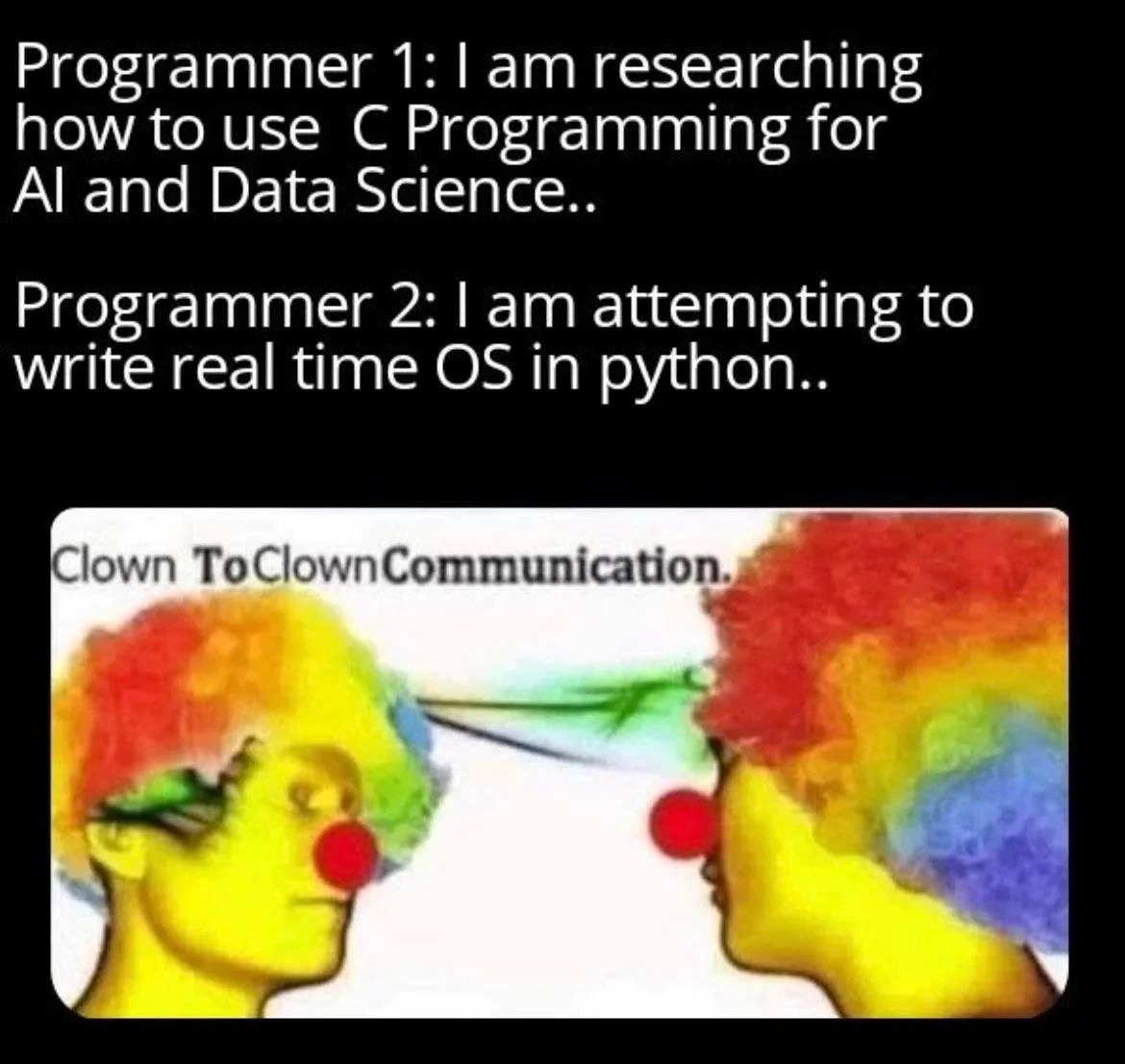
Programmer 1: “I am researching how to use C Programming for AI and Data Science..”
Programmer 2: “I am attempting to write real time OS in Python..”

Below this dialogue, the meme shows two clowns facing each other, rainbow wigs and red noses on full display, with a neon green beam labeled "Clown To Clown Communication" linking their foreheads. In other words, each programmer is proudly espousing a dubious idea, and they’re validating each other in a telepathic clown conference. Clown-level synergy at its finest.

From a seasoned developer’s perspective, each of these proposals on its own is a red nose-worthy idea. Together, they form a perfect feedback loop of folly – mutually assured clownery. The first programmer’s plan to tackle AI and Data Science with C language betrays a naiveté about the ecosystem and developer ergonomics needed for those fields. AI/ML work typically thrives on languages like Python (and R, Julia, etc.) precisely because they let you work at a high level of abstraction, with interactive environments (Jupyter notebooks), and have rich libraries to handle the heavy lifting. Suggesting C for data science is almost a trope on tech forums – it usually sparks debate in the vein of LanguageWars. Yes, C is blazingly fast and LowLevelProgramming offers control, but the developer sanity cost is huge. We’ve learned (often the hard way) that writing a thousand-line program in C to do what a three-line pandas or numpy call can do is not time well spent, unless you really need that extra micro-optimization or you’re coding for an embedded system with no high-level runtime available. The meme exaggerates this mismatch to make us chuckle: it’s picturing someone poring over pointer arithmetic and manual memory allocation to implement something like a linear regression or a neural network – essentially reinventing decades of optimized math libraries because “hey, I can make it faster in pure C!” It’s the classic over-engineering or misplaced optimization we’ve seen at jobs: someone picks a tool that’s technically powerful but wrong for the task, perhaps out of overconfidence or hype.

Meanwhile, the second programmer is on the opposite side of the same circus ring. Writing a real-time operating system in Python is an idea that immediately triggers disbelief in anyone who knows how both Operating Systems and Python work. Real-time OS development is as low-level as it gets in software – you’re dealing with CPU scheduling, direct hardware interrupts, memory management, and timing loops that often must guarantee responses in microseconds or less. Traditionally, this domain belongs to C, C++ or even specialized languages like Ada (designed for reliability and real-time systems). Python, conversely, is a high-level, interpreted language known for ease of use, string manipulation, rapid prototyping, and of course, being the darling of data analysis and scripting. Using Python to implement an OS kernel isn’t just an unconventional choice, it borders on absurd. It’s the kind of idea that might pop up as a joke on an online forum or a thought experiment: “Could I write an OS in Python?” The answer from any seasoned dev is a smirk and a “I’d love to see you try,” because the pitfalls are obvious and innumerable. The meme capitalizes on this by directly juxtaposing it with the other misguided project. Both developers are essentially engaging in a wrong_tool_for_job endeavor. And importantly, they’re doing it simultaneously, seemingly encouraging each other. It’s like two newcomers at a hackathon who, after reading a few sensational blog posts, decide to undertake each other’s worst idea and then congratulate one another on being visionaries.

The phrase “Clown To Clown Communication” hovering above the image nails the joke: it’s a play on “peer-to-peer communication,” except our peers here are clowns exchanging nonsense. In developer culture, calling something “clown behavior” is a tongue-in-cheek way to say it’s foolish or not serious. Here we have a LanguageComparison swapped to the point of ridicule – a bit of a satirical take on how sometimes developers get hype for a language and try to use it everywhere. We’ve all met that one developer who insists Python can do everything (“Why not write the whole mobile app backend in Python? It’s easy!”) or the one who insists everything needs to be in a super performant low-level language (“This HTML generation would be faster in C!”). This meme cranks that trait up to 11, giving us two such developers who have effectively lost the plot.

Real-world scenarios echo this humor. Think of a time a team chose the shiny trending language for a project without considering fit: maybe someone tried to write a high-performance graphics engine in pure Python (spoiler: it crawls), or someone attempted a quick data science script in C (spoiler: it took 10x longer to write than if done in Python). The result is usually a lot of pain, late nights, and eventual refactoring or abandonment – experiences that turn young optimists into cynical veterans. We chuckle because we recognize the pattern: great enthusiasm, poor alignment with reality. The meme’s clown imagery suggests that both “Programmer 1” and “Programmer 2” are equally silly, and the green beam shows them effectively high-fiving over their shared lapse in judgment. It’s a comedic reminder that technology hype can lead otherwise smart people into pretty ridiculous decisions.

Another layer of industry commentary here is on over-engineering vs. inappropriate abstraction. C for AI is over-engineering in the sense of going too low-level unnecessarily, whereas Python for an OS is using an inappropriate high-level abstraction where low-level is needed. Seasoned devs have learned that both extremes lead to trouble. Too low-level, and you’re reinventing the wheel (square wheels, at that) with huge effort. Too high-level in the wrong place, and the abstraction leaks or collapses entirely (like trying to build a skyscraper on a foundation of Jello). This “Clown to Clown” exchange effectively captures both mistakes at once. It’s DeveloperHumor with a dash of schadenfreude – we laugh at the clowns, and perhaps a bit at our past selves if we ever made a smaller-scale version of these mistakes. After all, who hasn’t at some point been a little overconfident with a tool they just learned? The meme just scales it up to a hilarious extreme.

In summary, the senior-perspective joke is that these two programmers have each chosen exactly the wrong language for their respective goals, and they’re treating it like a brilliant endeavor. It’s a satirical snapshot of language-task mismatch: a low-level systems language being shoehorned into high-level AI work, and a high-level scripting language being tortured into low-level OS development. The result is guaranteed inefficiency, unpredictability, and probably a lot of head-slapping moments – a fact so evident that only clowns would proceed merrily down these paths. We, the experienced onlookers, can’t help but laugh because we’ve seen this movie before. And just like a clown act, it’s funny until you realize someone might actually get hurt (or at least their project and schedule will). The meme delivers that punchline with the clown imagery: two fools in perfect synergy, blissfully ignorant of the disaster ahead. 🤦‍♂️🤡🤦‍♀️

Level 4: Turing Tarpit Circus

At the deep systems level, this meme highlights a fundamental mismatch between programming languages and the domains they're (mis)applied to, almost like a computational circus act. On one side, we have a developer trying to use C for high-level AI and Data Science tasks. On the other, another dev is attempting to build a real-time OS kernel in Python. Both ideas are theoretically possible (all Turing-complete languages can compute the same things given enough resources), but they collide with very real computer science constraints.

Real-Time OS in Python: Real-time operating systems demand deterministic timing and minimal latency. Hard real-time systems have strict deadlines – if a task exceeds its deadline even by a millisecond, the system could fail catastrophically (think of an aircraft control system or a pacemaker). These systems are typically implemented in low-level languages like C or even assembly, where direct control over memory, interrupts, and CPU instructions allows engineers to calculate a predictable Worst-Case Execution Time (WCET) for critical routines. Python, however, is an interpreted language with a heavy runtime, automatic garbage collection, and a notorious Global Interpreter Lock (GIL) in its main implementation (CPython). The GIL ensures only one thread executes Python bytecode at a time, effectively bottlenecking CPU-bound concurrency. In a real-time context, Python's interpreter introduces non-deterministic delays – from bytecode interpretation overhead to occasional garbage collection pauses (even if Python primarily uses reference counting, it still has to occasionally clean up cyclical references which can halt execution momentarily). There’s also the issue of interrupt handling and low-level hardware access: writing an OS means handling interrupts (asynchronous hardware signals) and context switches at the CPU level. Python code cannot run without an underlying runtime and OS services – it’s two abstractions too high above the metal. At best, one could write some kind of microkernel in C and run a Python interpreter in ring 0 (kernel mode) – which is exactly as absurd (and unsafe) as it sounds. You’d spend enormous effort wrapping low-level C routines with Python hooks, only to achieve a far slower, less predictable kernel. In short, expecting a Python-based OS to meet hard real-time deadlines is like expecting a clown car to win a Formula 1 race: the timing just won’t work out. The very concept triggers a mental kernel panic for seasoned OS engineers, because it violates the core assumptions of real-time computing (precise timing, direct hardware control, zero extraneous overhead).

AI/Data Science in C: On the flip side of this clownish communication, using C for AI and data science is technically feasible but flies in the face of decades of high-level abstraction benefits. Modern AI and data analysis involve operations on huge matrices, tensors, and complex algorithms (like training a neural network with millions of parameters). C is a procedural, low-level language with manual memory management and no built-in support for big data structures or linear algebra operations beyond raw loops and pointers. While C is prized for its speed and close-to-the-metal optimization, those performance gains come at the cost of developer productivity and higher likelihood of bugs (buffer overflows, memory leaks, off-by-one errors in array indexing – the stuff of nightmares in a 3 AM training run). In practice, high-performance numeric computing in C requires leveraging specialized libraries (BLAS, LAPACK, or even writing SIMD intrinsics for vectorization) to approach the efficiency of, say, NumPy (which is itself a CPython library written in C for heavy lifting). The irony is that the Python-based data science stack exists because writing all those routines in C (or even low-level C++ and Fortran) every time is prohibitively complex for end-users. Libraries like TensorFlow or PyTorch have massive C++ backends to handle math, but they expose a friendly Python interface for rapid development. A lone programmer “researching” AI in pure C is essentially re-deriving these decades of work from scratch – a bit like attempting to manually compute gradients and perform backpropagation with pointer arithmetic. Sure, you can do it, and the resulting program might even be extremely fast for one specific task, but any change in model architecture or data shape becomes a laborious exercise in recompiling and possibly rewriting chunks of code. There’s a reason even hardcore performance-focused domains (HPC, scientific computing) often use higher-level interfaces: the algorithmic complexity and rapid experimentation in AI/ML demand flexibility. C offers speed at runtime but slows you down at dev time – and in AI research, iteration speed is gold. Using C for AI is thus like constructing an intricate circus apparatus from scratch for each new trick; it’s powerful but painfully low-level for the kind of exploratory, high-abstraction work AI folks do daily.

In both cases, these developers are venturing far outside the natural domains of their tools. It's reminiscent of the classic concept of a “Turing tarpit”: a Turing-complete language in which “everything is possible but nothing of interest is easy.” Here we have a double-feature tarpit circus. Python and C are both Turing-complete and powerful in their realms, but when dragged into each other’s territory, they become tar pits of difficulty and inefficiency. The result? A comedy of technical errors – two clowns in a standoff, linked by a beam of mutual misunderstanding. The meme’s Clown To Clown Communication graphic perfectly encapsulates this: it’s a meeting of minds that should know better, exchanging equally outlandish ideas. For seasoned engineers, this level of absurdity is both amusing and painful: it’s humor grounded in the immutable laws of computing (and the scars of those who’ve violated them). By highlighting such an extreme language-task mismatch, the meme implicitly teaches a lesson in computing theory: choosing the right abstraction level is crucial, and ignoring that is an invitation to a very colorful failure. 🤡🤝🤡

Description

A two-part meme against a black background. The top section contains white text describing a conversation: "Programmer 1: I am researching how to use C Programming for AI and Data Science.." followed by "Programmer 2: I am attempting to write real time OS in python..". The bottom section features the 'Clown To Clown Communication' meme format, which shows two stylized figures with yellow skin, red clown noses, and rainbow wigs staring at each other as green beams of light connect their eyes. The text 'Clown To Clown Communication.' is written above them. The humor lies in the profound technical absurdity of both programmers' goals. Using C for AI/Data Science is an incredibly inefficient choice, ignoring the massive ecosystem of Python libraries that are standard for these tasks. Conversely, writing a Real-Time Operating System (RTOS) in Python is fundamentally unworkable due to Python's interpreted nature, garbage collection, and Global Interpreter Lock, which make it impossible to guarantee the deterministic, low-latency performance required for real-time applications. The meme portrays their shared enthusiasm for these misguided projects as a form of mutual, clownish delusion

Comments

16
Anonymous ★ Top Pick The C-based data science model will finish its first epoch of training shortly after the heat death of the universe, right as the Python RTOS finally decides to garbage collect during a critical interrupt
  1. Anonymous ★ Top Pick

    The C-based data science model will finish its first epoch of training shortly after the heat death of the universe, right as the Python RTOS finally decides to garbage collect during a critical interrupt

  2. Anonymous

    He’s chasing nanosecond latencies through Python’s GIL while I’m hand-rolling backprop in C with malloc - all cores fully saturated, if not our sanity

  3. Anonymous

    One's fighting NumPy with pointer arithmetic while the other's waiting for garbage collection to finish before handling the next interrupt - both wondering why their résumés keep getting filtered out by the same ATS that probably runs on COBOL

  4. Anonymous

    Ah yes, the classic 'wrong tool for the job' Olympics: using C for AI/ML is like manually managing malloc() for your neural network weights when you could be iterating on model architecture, while writing an RTOS in Python is essentially asking the garbage collector to please pause mid-interrupt handler. Both are technically possible in the same way that eating soup with a fork is technically possible - you'll spend more time fighting your tooling than solving actual problems. Real talk: if your RTOS needs to respond to hardware interrupts in microseconds but Python's GIL is busy doing stop-the-world garbage collection, you're not building a real-time system, you're building a 'real-time-ish-when-the-stars-align' system

  5. Anonymous

    Hard real-time in Python is just “soft” plus hope; C for AI is reimplementing NumPy and BLAS - clown‑to‑clown RPC

  6. Anonymous

    AI in C and an RTOS in Python: one burns engineer time wrestling malloc; the other breaks real-time wrestling the GIL

  7. Anonymous

    C for data science: mallocing tensors one segfault at a time. Python RTOS: GIL'd to 'real-soon-now' latency

  8. @SamsonovAnton 2y

    What is wrong with C as AI and Data Science tool? I am not a specialist in the topic, but according to programming memes, AI is just a series of branching and/or matrix multiplication, both of which are perfect application for C.

    1. @Araalith 2y

      The script kiddies grew up and now they are proud python users. They still have no idea how things work but how it's "Data Science".

      1. @SamsonovAnton 2y

        Wow, I didn't realize those clowns are actually proud. 🤡🏳‍🌈🐍

    2. @qwnick 2y

      nothing, meme creator just stupid

  9. @doodguy1991 2y

    Programmer 2 will then tell me that a 30 second delay to answer an input is still "real time" because "real time does not refer to fast how it responds" or something retarded like that. I deadass had a professor who tried to convince me of this.

    1. @chupasaurus 2y

      A professor who doesn't know what real-time computing means? Strange times.

    2. @pwnzkk 2y

      Nothing wrong, it’s just that Python or Julia or even matlab has the right tooling and they are abstract enough for doing science. They are just more convenient and more efficient to use, like you don’t have to spend your time on low level stuff when you just need to multiply few matrices. C has its own advantages for certain situations, e.g mpi, when you have a lot of computations which could be parallelized between cpus over the network

  10. @aria_ua 2y

    I'm writting tg-bot using css

    1. @Bahashwan_Mohanad 2y

      Bro :/

Use J and K for navigation