The Ultimate Remote Work Paradox: Zoom Has an Office
Why is this RemoteWork meme funny?
Level 1: Practice What You Preach
Imagine your school says everyone can stay home and attend class on Zoom because learning online is the new thing. You’re all set up with your laptop at your kitchen table. But then you find out that your teacher still drives to the empty school building every single day to teach her Zoom classes from her classroom. She’s sitting in a big quiet school, talking to a screen, even though she could just teach from home like you. Wouldn’t that seem a little silly? If the whole point is to not go to school and still learn, why is the teacher going to school? That’s the funny bit here. Zoom is like that teacher – it’s a company that made it easy for everyone not to go into the office and still get work done, yet Zoom built a big shiny office for itself and wants people to come in. It’s a bit like saying one thing and doing another. People find it amusing because it’s a simple “wait a minute…” moment: the company that helps us work from home still thinks going to the office is important. It’s just a funny mismatch that makes us laugh and shake our heads, kind of like a chef who delivers pizza to others but then insists on eating at a fancy restaurant himself. Everyone gets the joke: if your whole deal is letting people work from anywhere, it’s pretty ironic to insist on working together in one place.
Level 2: Return to Office IRL
The meme is poking fun at the contrast between what Zoom stands for and what Zoom actually does. Zoom is a company best known for its video conferencing software – those Brady Bunch-style video calls that became a lifeline for workplaces during the pandemic. A Zoom meeting lets people have a discussion or a whole team meeting over the internet with webcams and screen-sharing, instead of gathering in a physical conference room. It’s the poster app of the WorkFromHome era. Remote work (or working from home) means you can do your job from your house, a coffee shop, or anywhere with an internet connection, rather than going into an office every day. Zoom’s product is a key enabler of that RemoteWorkCulture, because it tries to make virtual meetings as good as in-person ones (or at least good enough).
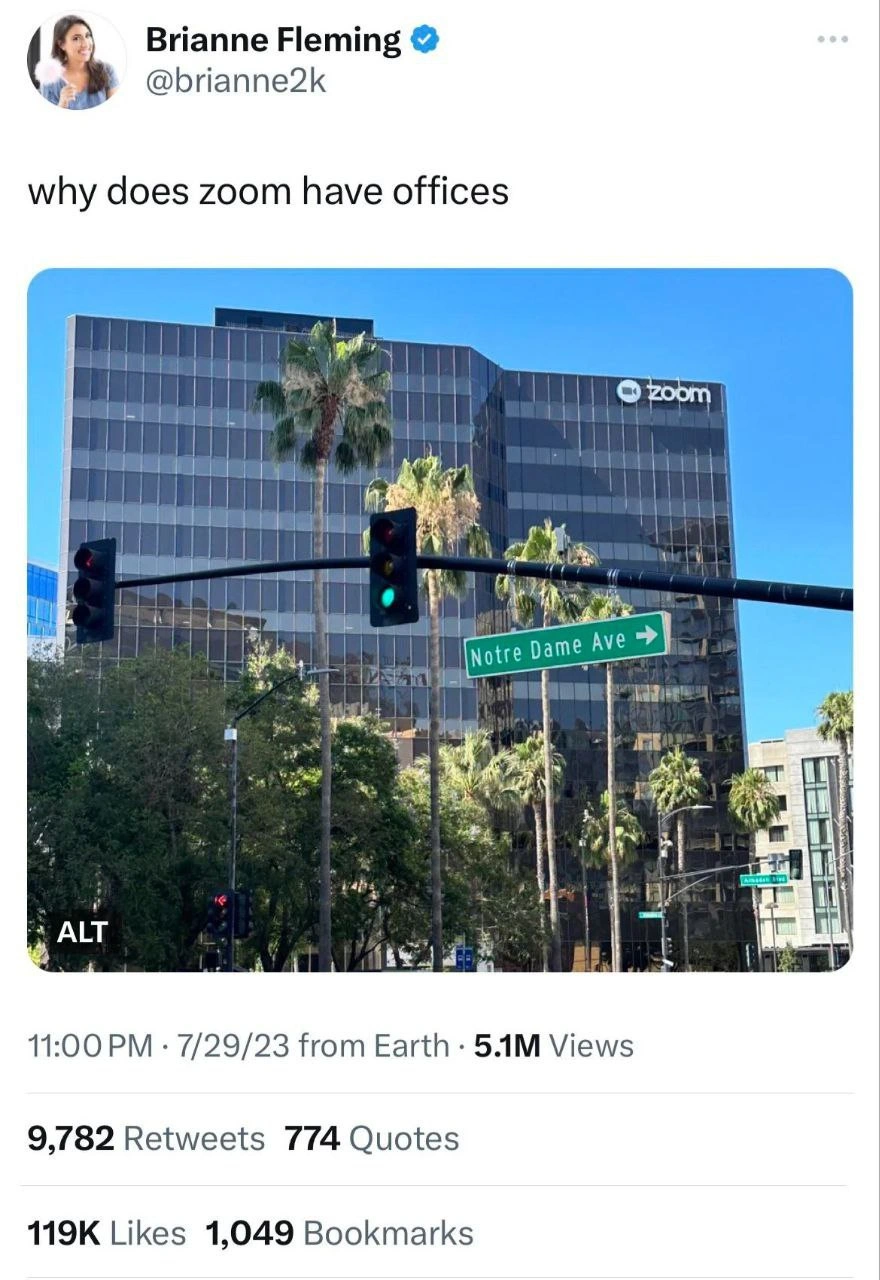
Now, the funny part is Zoom (the company) still has a real, physical office building – a headquarters (often abbreviated HQ). In the image, you see a multi-story, black-glass building with a big Zoom logo on it. That’s an actual Zoom office, likely their main headquarters in California. The tweet’s author is basically saying, “Hold on, isn’t it weird that Zoom, of all companies, has offices?” It’s ironic because you’d think a business that makes remote meeting software would itself be totally cool with everyone working remotely, maybe even have a fully distributed workforce with no central office at all. The reality is more complicated. Corporate culture influences these decisions: some companies, even if they build tools for remote work, still believe having an office is important. They might use those offices for things like team meet-ups, important client presentations, hardware labs, or just because that’s how they’ve always operated. A physical office can be a place for collaboration, social interaction, and company identity. In Zoom’s case, they started well before the pandemic and did have offices; they didn’t shut them all down even when their software made it possible to work from anywhere. So the Zoom HQ stayed open, and employees could still come in to work in person, at least some of the time.
A junior developer or someone new to the tech industry might be surprised by this. You might join a tech company thinking “Oh, they make an app for remote work, so everyone must be remote!” but then discover that the company still expects folks to come in a few days a week or has a big shiny office downtown. This meme touches on that surprise. It’s a bit of MeetingHumor and tech-world irony rolled into one. The tweet gained so much traction because a lot of people are currently debating “remote vs office” policies. Over the last few years, many companies that went remote during COVID have been announcing Return to Office policies – basically mandates that employees start coming back in person part-time or full-time. Zoom doing this is a perfect example of that trend, and it strikes people as funny and hypocritical.
Let’s break down some terms and context: “Remote work culture” refers to the norms and practices a company uses to support employees working from different locations. Zoom’s public image is very tied to remote work success; it became famous for letting millions of us have meetings, classes, and even birthday parties virtually. But having a physical office means Zoom as a company hasn’t gone fully remote itself. And indeed, in mid-2023 news broke that Zoom was asking employees who live near an office to return to the office at least two days a week. (Yes, the company that made it easy not to go to the office wanted its own staff in the office again on a hybrid schedule.) This policy is what we call a “return_to_office_mandate.” It’s not unique to Zoom – lots of big tech firms did the same, thinking that in-person teamwork might spark more creativity or that productivity was better with some face-to-face time. However, because Zoom sells the idea that you don’t need to be face-to-face thanks to their software, people found it especially rich and humorous that Zoom of all companies was emphasizing in-person work again.
The photo in the meme shows a typical modern tech HQ: a multi-story building with reflective glass windows (often jokingly called a “glass tower”), palm trees in front (hello, California vibe), and a street sign for Notre Dame Ave in the foreground (likely the street where the office is located). It’s broad daylight and you can see traffic lights, which tells us this is a real bustling office location in a city, not some tiny satellite office. All these details drive home the point: Zoom has a brick-and-mortar presence just like any other big company. The tweet is a screenshot of someone’s post on Twitter (now X) simply stating “why does zoom have offices”. That blunt question is funny because the answer seems obvious (most companies have offices) yet not obvious (Zoom’s entire selling point is you don’t need a physical office to meet). It’s a straightforward call-out of that contradiction.
For someone early in their career, the takeaway is that a company’s product doesn’t always dictate its internal policies. ZoomMeetings let people work from anywhere, but Zoom the employer might still call you into a meeting room sometimes. The RemoteWork revolution has certainly changed a lot, but many organizations are still figuring out a balance – even the ones who built the very tools that made remote work viable. So this meme resonates because it shows that even at the pinnacle of remote-work technology, there’s a bit of “back to the office” happening. And in plain terms, that’s just kinda funny and head-scratching at the same time.
Level 3: Virtual Company, Real Estate
For all the talk of being remote-first, seeing a giant Zoom logo atop a gleaming glass tower feels like a glitch in the matrix. Zoom became the poster child of RemoteWork during the pandemic – its Zoom Meetings kept businesses running from kitchen tables and spare bedrooms worldwide. Yet here we are, staring at a multi-story black-glass office building proudly branded with the Zoom logo. The tweet asks “why does zoom have offices” because on the surface it’s a laughable remote_first_irony: the very company that made working from home ubiquitous still maintains a classic corporate HQ, palm trees, traffic lights, Notre Dame Ave street sign and all. It’s the quintessential physical_offices_for_digital_product gag. The humor hits tech folks right in the irony bone: a virtual meeting vendor with a very real office. It’s like discovering the cloud computing company has a room full of filing cabinets, or the DevOps automation startup still deploys code by mailing USB drives.
But beneath the chuckles lies genuine commentary on CorporateCulture and industry reality. Of course Zoom has offices – most tech companies do. Why? Here are a few hard-earned insights from a battle-scarred engineer:
- Old Habits Die Hard: Decades of office-centric management don’t evaporate overnight. Many execs still believe real communication and innovation happen face-to-face by the espresso machine. The culture of “butts in seats” is deeply ingrained; some higher-ups equate seeing employees in a fancy HQ with productivity. A company can sell remote work enablement and still not fully trust it for themselves – a classic corporate double-think.
- Sales & Big Clients: Enterprise clients and investors still love an impressive boardroom. You bet the Zoom HQ has slick conference rooms (with Zoom Rooms, naturally) for wooing customers and press. There’s a certain theatrics to walking a client through your shiny lobby with that big logo on the wall. It’s hard to do a power handshake over a Zoom call.
- Team Logistics: Not every role at Zoom can be done in PJ’s from a home office. Think hardware testing labs, on-prem deployments, or just onboarding new hires. Some teams actually like popping into the office a few days for collaboration (or the free snacks). Hybrid work policies often spring up, even at a “remote” company, because one size doesn’t fit all.
- Real Estate ROI: Let’s be cynical: if you’ve signed a multi-year lease on a Silicon Valley glass castle, you’re going to use it. That Zoom logo on the skyline isn’t just decoration; it’s a status symbol. The CFO isn’t about to eat the cost of an empty building – might as well herd some employees back in. In corporate speak, that’s maximizing “utilization of assets” – cough justifying the rent cough. Plus, executives kinda love having a corner office with a view, even if they preach cloud liberation for everyone else.
This tweet went viral (5+ million views) because it spotlights the virtual_meeting_vendor_office paradox so perfectly. It dropped just as many companies were loudly canceling remote-work policies. In fact, around that time Zoom itself quietly instituted a return_to_office_mandate for employees living near an office: basically, “If you’re within 50 miles of this lovely HQ, we want to see you here two days a week.” Cue eye-rolls. The very platform that millions use to avoid commuting decided that its own people should start commuting again. It’s a “do as I say, not as I do” moment writ large. Tech veterans have seen this pattern before: the tool that promises to solve remote collaboration still can’t break free from traditional CorporateCulture internally. It’s equal parts amusing and exasperating for those of us who’ve sat through all-hands meetings where leadership extolled “flexibility” on a Zoom webinar, only to follow up with an email about new badge-in requirements at the office.
The MeetingHumor practically writes itself. Picture a scrum meeting where half the Zoom team is at HQ and the other half remote: everyone ends up joining a Zoom call from their desks just so the whole team can sync up. They might be in the same building, or even on the same floor, talking to each other through Zoom because it’s easier than all huddling around one speakerphone. It’s absurd, but it happens at hybrid offices everywhere – even at Zoom’s own office! We’ve reached a point where you could have two engineers sitting 30 feet apart in that gleaming HQ, typing “Can you hear me okay?” into a Zoom chat instead of walking over. The image of employees in a Zoom HQ conference room hopping on a Zoom call (to include remote colleagues) is peak 2020s irony. It’s the kind of TechHumor that makes developers smirk and sigh at the same time.
What we’re laughing at is the culture clash between distributed teams and a physical headquarters. It’s the incongruity of a company whose entire raison d’être is enabling remote communication, yet it still clings to brick-and-mortar traditions. There’s an unwritten rule in tech satire: the more a company evangelizes a future of virtual work, the funnier it is to see them fall back to old-school practices. This meme nails that juxtaposition. It highlights a truth seasoned devs know well: technology can evolve in leaps, but people and organizations change slowly. In the end, Zoom having offices isn’t actually shocking – it’s a tech industry reality check. The tweet just shines a light (a very bright, 119K-likes light) on the gap between the utopian RemoteWorkCulture we sell and the pragmatic habits we keep. And that gap, my friends, is where the comedy slips in through the Zoom-branded glass doors.
Description
A screenshot of a viral tweet from user Brianne Fleming (@brianne2k). The tweet's text simply asks, "why does zoom have offices". Below this question is a clear, sunny day photograph of a large, modern, multi-story office building with a facade made of dark glass panels. In the top right corner of the building, the corporate logo for 'zoom' is displayed in its signature white and blue. The building is located in a city environment, with tall palm trees in the foreground, and a green street sign for 'Notre Dame Ave' is visible. The humor is derived from the profound irony of Zoom, the company that became the global symbol for remote work and virtual meetings, having a large, physical corporate headquarters. The meme serves as a commentary on the ongoing 'return-to-office' debate and questions whether even the companies that enable remote work truly believe in a future without physical offices
Comments
11Comment deleted
The Zoom HQ is the world's most expensive collection of virtual backgrounds for their own all-hands meetings
Zoom’s HQ is the architectural equivalent of that “stateless” microservice with an NFS mount - cloud-native in the slide deck, hard-wired to the building in prod
Zoom's office building is essentially a $100M monument to the sunk cost fallacy - they signed that lease in 2019 and now it's harder to deprecate than a COBOL mainframe running critical banking infrastructure
The ultimate dogfooding failure: Zoom built a product so good at enabling remote work that it made their own office building obsolete. It's like AWS maintaining on-premise data centers or Slack employees communicating via email. Perhaps they're just keeping the building as a museum exhibit titled 'Remember When We Thought People Needed to Commute?' - a physical monument to the pre-pandemic architecture decisions that aged like milk in the California sun
Zoom having offices is like Kubernetes keeping a control plane - the meetings run on nodes everywhere, but the RTO API still needs a place to terminate TLS and pay rent
Of course Zoom has offices - where else do you A/B test echo cancellation against glass-box acoustics while attending a Zoom about the RTO policy?
Zoom scaled distributed video to billions, yet deploys a monolithic glass HQ - classic availability over partition tolerance fail
I had to have one too. Legally I cannot have a PO Box company lmao Comment deleted
Lmao why Comment deleted
"Sweeping up a Roomba store" Comment deleted
Room recently started forcing all their employees back to the office part time. Comment deleted