Skip to content
DevMeme
5203 of 7435
The Cyclical Fashion of Web Rendering
WebDev Post #5703, on Nov 24, 2023 in TG

The Cyclical Fashion of Web Rendering

Why is this WebDev meme funny?

Level 1: Back in Style

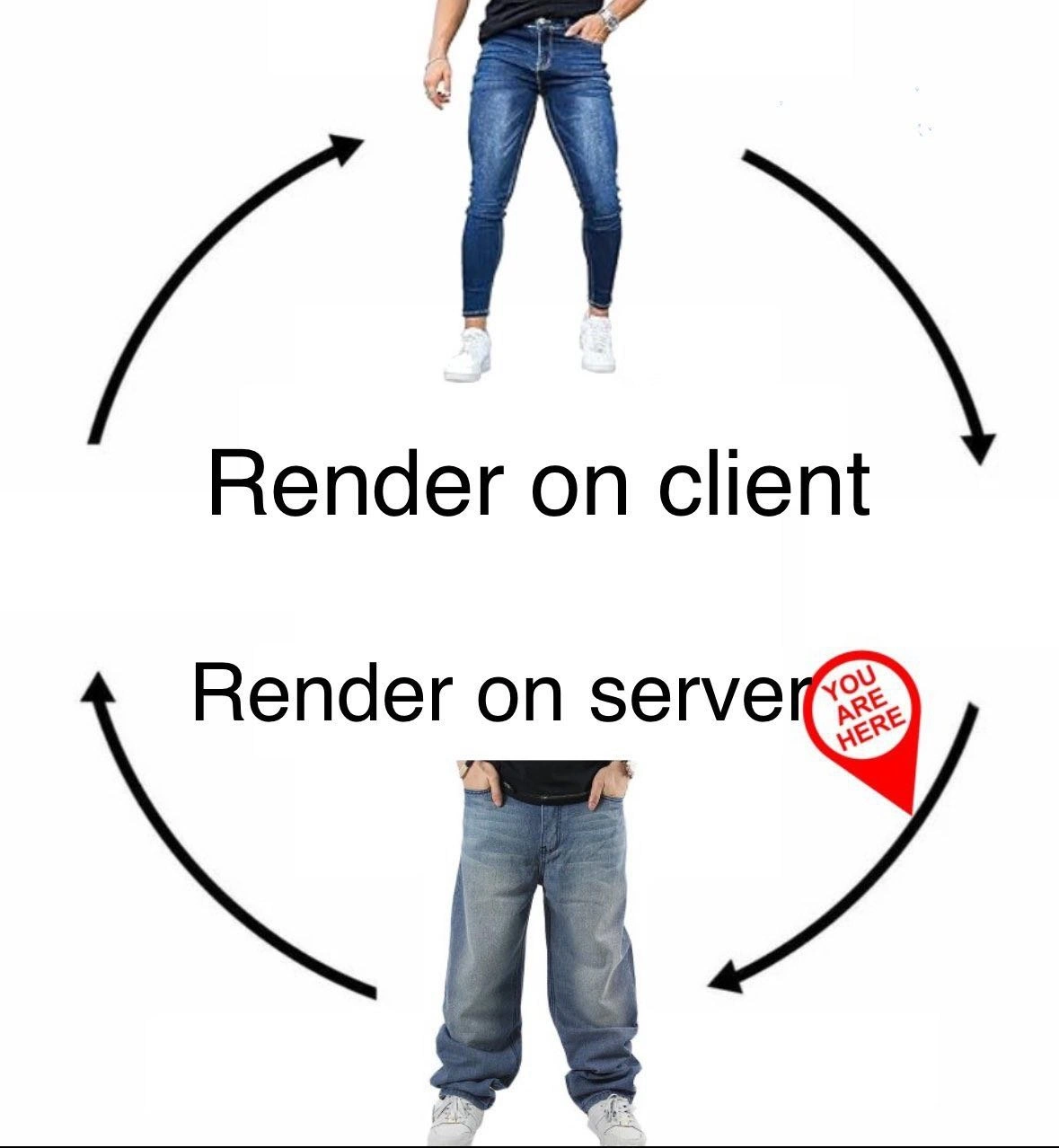
Think about how clothing fashions change: maybe one year everyone likes tight, skinny jeans, but a while later, loose baggy jeans become popular again. After some time, skinny jeans might come back in style. It just goes round and round. This meme is joking that building websites has a similar “fashion” cycle. Sometimes developers decide “Let’s do all the work in the browser” (that’s like the skinny jeans phase), and then later they say “No, let’s do it on the server instead” (the baggy jeans phase). They keep switching back and forth. The red “YOU ARE HERE” sign on the picture shows that right now the popular idea is doing more work on the server side (which is like the baggy style being in fashion again).

Why is this funny? Because it shows we kind of keep changing our minds and returning to old ideas, just like how old fashion trends come back. It’s saying building websites can be a bit like a pendulum or a merry-go-round – first swinging one way, then the other. Even though we use new tools and fancy names, in the end we often revisit past ideas. People who make websites find this relatable and humorous: today’s “cool way” to do something might just be yesterday’s way coming back into style. Essentially, the meme is a playful way to say, “What goes around, comes around,” both in jeans and in tech. It makes us smile because it’s true – in technology, just when you think an old method is gone for good, it often comes back, wearing a new outfit.

Level 2: SSR vs CSR 101

Let’s break down what “Render on client” vs “Render on server” means in more straightforward terms. In web development, “rendering” is how we produce the final HTML that a user’s browser displays as a web page. The big question is where that work happens: on the server (a remote computer that hosts the website) or on the client (the user’s browser on their device). This meme compares the two in a fun way (using skinny vs. baggy jeans as metaphors), but let’s explain the actual tech:

  • Server-Side Rendering (SSR): This means the server generates the complete HTML for a page before sending it to your browser. It’s like the web server assembles a finished meal in the kitchen and delivers it ready-to-eat. When you request a page (say you click a link or load a URL), the server will gather all the data, populate the HTML templates, and send down a fully-formed page. Your browser simply receives this HTML and displays it. For example, if you visit a news site using SSR, the HTML you get already contains all the article text and images in the proper layout. The browser doesn’t have to do much except paint that on the screen. This was how many traditional websites worked (and still work): think of sites built with PHP, ASP.NET, Django, or Ruby on Rails – those all typically render pages on the server. In the meme’s lingo, this is akin to a “skinny client, baggy server” scenario: the client (browser) is doing very little (skinny jeans = minimal work) and the server is doing the heavy lifting (baggy jeans = lots of work, bulked up with rendering logic).

  • Client-Side Rendering (CSR): This approach shifts the work to the browser (the client). Here, when you request a page, the server sends mostly an empty HTML shell along with some JavaScript files. The real rendering happens inside your browser via JS. Continuing the meal analogy, the server sends you a “meal kit” with ingredients and a recipe, and your browser does the cooking to serve up the final dish. In practice, you might get an HTML file with just a <div id="app"></div> and a big bundle of JavaScript. That JavaScript will run on your device, call APIs to fetch data from the server (often in JSON format), and then dynamically build the HTML content right in your browser (often by manipulating the DOM or using a framework’s virtual DOM). This is how Single-Page Applications work. If you’ve used React, Angular, or Vue to build a front-end, you’ve likely done CSR. The first load might show a loading spinner or nothing at all until the JS finishes running. In meme terms, this is a “baggy client, skinny server” situation: the client is now the heavy one doing most of the work (the browser running a lot of JS, i.e. wearing the metaphorical baggy pants loaded with gadgets), while the server mostly just supplies data and very basic HTML (server’s role is lighter, hence skinny).

Now, why do we care about these two methods? Because they have different strengths and weaknesses. Developers choose one or the other (or a mix) based on what they need for their site or app. Here’s a quick comparison of SSR vs CSR:

Server-Side Rendering (SSR) Client-Side Rendering (CSR)
Where is page HTML generated? – On the server, before it’s sent to the browser. The user gets a fully formed page. Where is page HTML generated? – In the browser (client side) using JavaScript after the initial page load.
Pros: The user sees content immediately (fast initial page load, since HTML arrives ready to go). Better for SEO because search engines find actual content in the HTML. Also, less heavy lifting for the user’s device initially (useful for low-power devices or slow connections). Pages can work even if user’s JS is off or fails. Pros: Once loaded, the site can feel very responsive and app-like (fewer full page reloads, more dynamic updates). Good for rich interactivity (e.g., updating one part of the page without reloading the whole thing). Can reduce server load for interactions because the client does more work (after the first load, clicking around might not hit the server as much).
Cons: Every page request puts load on the server (it has to compile the page for each user request), which can mean you need a beefier server or more servers to handle high traffic. Not as fluid for highly interactive apps unless you add client-side scripts anyway. If not optimized, can lead to more data being sent (since you might send a whole page even when a small part changes). Cons: Slower initial load – the user might see a blank page or spinner while all the JS loads and runs. If the user’s device is slow or they have a poor network, this can be frustrating. Also, content is not in the HTML by default, so SEO can suffer (web crawlers might not wait for or execute the JS, so they won’t see the content). You often have to implement data fetching and state management on the client which can get complex.

In short, SSR gives you a quick first page render and is search-engine friendly, while CSR gives you a smoother, app-like experience after that initial load. Many modern solutions actually mix the two to get the best of both worlds. For example, Next.js (a popular React framework on the current Next_js_bandwagon) will do SSR for the first page load (so you get HTML content upfront) and then send down the React code to hydrate the page, allowing it to behave like a dynamic React app from there on. This approach uses isomorphic JavaScript, meaning the same code can run on the server (to render the HTML) and later in the browser (to take over as a SPA). It’s a clever hybrid trick.

The meme humorously labels the cycle with fashion terms (“skinny” vs “baggy”) to imply that these choices go in and out of style. The YOU ARE HERE marker on “Render on server” suggests that, at this moment, the community is favoring server-side rendering again. If you’re a newcomer in web dev, you might notice lots of talk about returning to SSR, using static site generators, or frameworks like Next.js, after years of everyone pushing client-heavy single-page apps. It can be a bit confusing – like, “Didn’t we move away from server rendering before? Why is it back?” The reality is, in tech, strategies often come back around once the conditions change or we have new tools. Today’s smartphones and networks made heavy client apps viable in the 2010s, but then SEO and performance needs brought back SSR techniques (with improvements).

So the meme is basically saying: web dev approaches change like fashion trends. One era, everyone’s saying “Do all the rendering in the browser, that’s the modern way!” (skinny jeans era). The next era, folks say “Actually, render on the server again for speed and SEO!” (baggy jeans comeback). As a developer, you might find this relatable. One year you learn to build a React single-page app (CSR) because it’s all the rage, the next year you’re learning about server-rendering frameworks because those became cool again. The cycle can be a bit absurd, which is why it makes for a funny meme. It’s poking fun at our industry’s tendency to spin in circles with regard to architectural preferences.

Level 3: Rendering Runway

At the highest level, this meme skewers the cyclical nature of Frontend architecture trends. It shows a loop between two fashion extremes – skinny jeans and baggy jeans – labeled “Render on client” and “Render on server.” These correspond to the perpetual flip-flop between client-side rendering (CSR) and server-side rendering (SSR) in modern web development. The big curved arrows forming a circle emphasize that this isn’t a one-time switch but an endless back-and-forth. The red “YOU ARE HERE” pin planted next to “Render on server” wryly marks our current position in this cycle (circa late 2023): the industry hype has swung back toward SSR.

This is a classic architectural fashion cycle in tech. Seasoned developers have seen the pendulum swing before:

  • Early Web Era (1990s–2000s) – Almost everything was SSR. The server did the heavy lifting of generating HTML pages (think PHP, ASP.NET, Java Servlets/JSP). Browsers were relatively “dumb” thin clients that just rendered what the server sent. This was the original baggy server, skinny client phase (big heavy back-ends and very light front-ends).
  • Web 2.0 & Single-Page Apps (2010s) – The pendulum swung to CSR. With faster JavaScript engines and the rise of frameworks like AngularJS, React, and Vue, much of the rendering moved to the browser. We sent a minimal HTML shell and a hefty JS bundle to the client. The app would bootstrap on the client side, fetch data via AJAX/APIs, and render content dynamically. The browser became a thick client (lots of logic, hence “baggy” in the meme’s tongue-in-cheek fashion metaphor), while the server got “skinny” (mostly just delivering data JSON and static files). This era was all about SPAs (Single Page Applications) and felt very interactive and modern, but it introduced new issues (large bundles, slower first loads, SEO problems, etc.).
  • Resurgence of SSR (late 2010s–2020s) – Now the cycle has swung back. New frameworks and techniques made SSR cool again, but with a modern twist. Libraries like Next.js (React), Nuxt (Vue), Remix, and others enable rendering pages on the server (often Node.js) and then hydrating them on the client. We’ve coined fancy terms like “isomorphic JS” or “universal rendering,” which basically mean the same code runs on both server and client. This addresses some pain points of SPAs (like SEO and initial load performance) by sending down fully-formed HTML. In fashion terms, it’s the return of the baggy server style — heavier lifting on the server side once more. That red “YOU ARE HERE” marker in the meme points to Render on server, implying that today’s “in” style is server-side rendering (the equivalent of baggy jeans coming back into vogue).

Why is this funny to developers? It’s the irony and inevitability of the pendulum swing. Each approach (SSR or CSR) comes with trade-offs, and the industry tends to over-correct by completely embracing one, then later realizing the downsides and swinging back to the other. It feels like front-end developers are chasing IndustryTrends_Hype much like the fashion industry rotates styles. A few years ago everyone hyped client-heavy SPAs and declared the page-reload model dead; fast-forward and now SSR (plus static site generation and hydration) is the hot trend, conferences and blogs touting “the return of SSR” as if it’s a groundbreaking new idea. The meme nails this industry irony by equating thin client vs thick client architecture to skinny vs baggy jeans – what’s old becomes new again.

There’s also a dose of relatable developer experience (and a bit of exhaustion) reflected here. Many developers have lived through multiple iterations of this cycle. For example, you might have built a server-rendered app with Ruby on Rails or PHP (SSR), then a few years later rewritten a lot of it as a rich JavaScript SPA (CSR) to be “modern.” Now you’re being asked to move to something like Next.js to improve SEO and initial load – effectively putting more rendering back on the server. It’s déjà vu. The meme playfully says “frontend fashion cycle” because it feels like we’re redoing the same things with new tools, just as fashion trends from 20 years ago come back with a retro label. Experienced devs chuckle (or groan) at the you_are_here_indicator because we know we’re just at one point on a loop. Give it another few years, and who knows – maybe a new tech will swing the pendulum to some “skinny client” approach again.

In short, ModernWeb development often oscillates between these paradigms. The meme’s humor comes from recognizing that this endless SSR-CSR spin is less about finding the one true permanent solution and more about riding the trend cycle. Just like your closet might alternate between skinny and baggy jeans over the years, our frontend stacks alternate between lean clients & heavy servers and vice versa. The arrow circle in the image really says it all: what goes around, comes around – in fashion and in web architecture. Developers find this funny because it’s a tongue-in-cheek reminder that today’s best practice might just be yesterday’s old news wearing a flashy new jacket.

Description

A two-panel meme arranged vertically to illustrate a cycle. The top panel features the text 'Render on client' above an image of a person wearing modern, tight-fitting skinny jeans. The bottom panel displays the text 'Render on server' above a person in loose, baggy jeans reminiscent of 90s fashion. Two large, curved black arrows connect the panels, forming a circle to indicate a recurring cycle. A red map pin icon with the text 'YOU ARE HERE' points to the arrow leading from 'Render on server' back up to 'Render on client', signifying the current industry trend. The meme humorously compares the shifting paradigms of web rendering to fashion trends. Client-side rendering (CSR), popularized by frameworks like React and Angular, is depicted as the modern 'skinny jeans' style. The older method, server-side rendering (SSR), is equated with the 'outdated' baggy jeans. The joke, highlighted by the 'YOU ARE HERE' marker, is that the tech industry is currently cycling back to SSR for its performance and SEO benefits, making the old style fashionable once again


Comments

26
Anonymous ★ Top Pick We've finally completed the great circle of webdev: from server-rendered pages, to client-side monoliths, and back to server-rendered pages but this time with 500MB of node_modules to do it
  1. Anonymous ★ Top Pick

    We've finally completed the great circle of webdev: from server-rendered pages, to client-side monoliths, and back to server-rendered pages but this time with 500MB of node_modules to do it

  2. Anonymous

    I’m hanging on to my early-2000s JSP codebase - fashion says it’ll be avant-garde again by the next quarterly roadmap

  3. Anonymous

    After spending years migrating from server-rendered monoliths to SPAs for that 'modern feel', we're now back to SSR with Next.js and calling it innovation - just like how baggy jeans from 1995 are somehow trendy again, except this time we're pretending the extra bundle size is actually good for SEO

  4. Anonymous

    The eternal rendering debate visualized: client-side gives you that sleek, tailored SPA experience, while server-side delivers the entire wardrobe upfront - because nothing says 'optimized user experience' like shipping 2MB of hydrated HTML that makes your lighthouse score look like a fashion disaster from 2003. At least with SSR, your SEO crawlers can see you're wearing *something* before JavaScript decides to show up fashionably late

  5. Anonymous

    CSR: sleek SPA dreams until hydration bloats you into SSR dad jeans

  6. Anonymous

    After a decade migrating from SPAs to SSR and now RSC, I’ve learned rendering is just a fashion cycle - only the jeans change and the egress bill gets tighter

  7. Anonymous

    After a decade of SPAs, we rebranded PHP as edge‑rendered React - same HTML, new hydration tax and a larger platform team

  8. @Horace4815162342 2y

    could someone explain

    1. @disembowlement 2y

      +

  9. @DiireStraiits 2y

    Guys, on which side colors seams more naturally?

    1. @WaterCat73 2y

      right

    2. @callofvoid0 2y

      right

    3. @callofvoid0 2y

      there is a problem with your fps

      1. @callofvoid0 2y

        error in fps aside isn't that too low for just rendering this shader ?

        1. @DiireStraiits 2y

          It because two running applications

    4. @RiedleroD 2y

      right is more natural, left is more interesting

    5. @SamsonovAnton 2y

      Define "natural" and the intent of this picture. If this is about perceptionally uniform transitions between primary colors, then you must define viewing conditions — at least the source colorspace, like sRGB. 🧐

  10. @DiireStraiits 2y

    What problem?

    1. @callofvoid0 2y

      0.166 ms delta time is more like 6FPS

      1. @DiireStraiits 2y

        Dude in one second we have 1000 milliseconds. If we divide 1000 by 0.166, we will have about 6024

        1. @callofvoid0 2y

          oh shit my bad

        2. @callofvoid0 2y

          I was thinking about 60 fps and 0.116 seconds 💀

  11. @DiireStraiits 2y

    I have about 12000 fps, when one runs

  12. @DiireStraiits 2y

    I cannot get more due to high latency on present call

  13. Алексей 2y

    don't got it, explain please

  14. @DiireStraiits 2y

    On the left side there are unorm, on the right is sRGB. Both 32 bits and non linear

Use J and K for navigation