The Perils of Complaining About Legacy Code
Why is this TechHistory meme funny?
Level 1: Insulting the Chef
Imagine you take a bite of a cookie at a party and blurt out, “Ew, this cookie tastes awful!” Then the person standing next to you quietly says, “I actually baked those cookies… and I was just a teenager when I came up with the recipe.” Uh-oh. You’d suddenly feel really embarrassed, right? You just realized you were trash-talking the cookies right in front of the baker who made them. You’d probably stammer, “Oh! I…I didn’t know. They’re not that bad, really!” while turning red as a tomato.
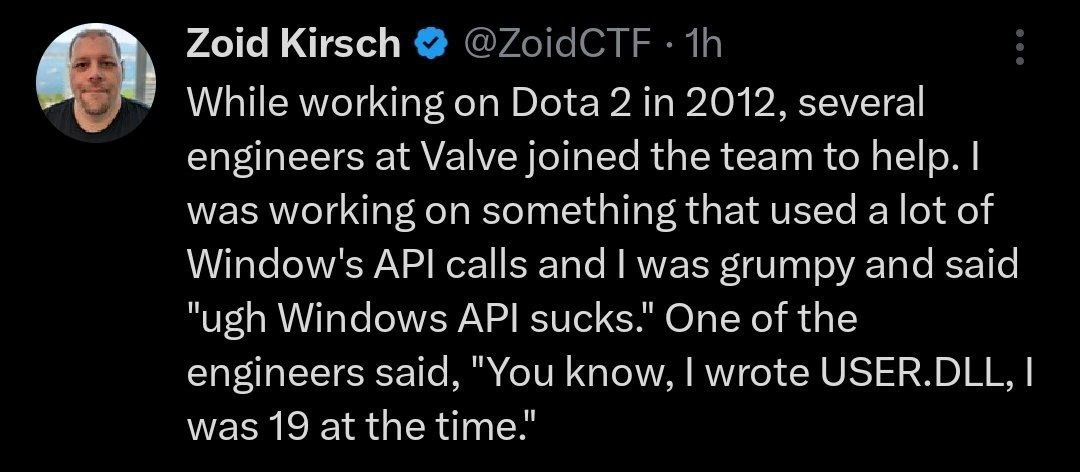
That’s exactly what happened in this meme, except with computer code instead of cookies. A programmer complained that something in Windows (basically some code that all Windows computers use) “sucks.” Turns out, one of the people listening was the very guy who wrote that part of Windows a long time ago when he was really young. Oops! The reason it’s funny is the shock and the oops factor – it’s a classic foot-in-mouth moment. One second you’re confidently griping, the next second you realize you accidentally disrespected a person’s proud creation to their face. The poor guy who complained felt embarrassed, but probably everyone ended up laughing about it. And I bet he learned a good lesson: be careful when you complain, because the person who built the thing might be standing right behind you (and might just be cool enough to only gently tease you about it). In the end, it’s a lighthearted reminder to have a bit of humility – whether we’re talking about cookies or code, there’s often more history (and human effort) behind things than we realize.
Level 2: Old API, New Dev
Let’s break down what’s going on in this meme in simple terms. The story is about a programmer getting a surprise history lesson in the middle of a work call. The key pieces here are the Windows API, the file USER.DLL, and a game development scenario involving Valve and Dota 2. If those sound like jargon, don’t worry – here’s what they mean:
Windows API: API stands for Application Programming Interface. It’s a collection of pre-made code routines that Windows provides so programmers can do common things. Think of the Windows API as a big toolbox for anyone writing software on Windows. Need to open a window on the screen? There’s a Windows API function for that. Want to read a file from disk? There’s a function for that too. The Windows API (specifically the classic version often called Win32 for 32-bit Windows) has been around for a long time. It’s what programs used back in the 90s on Windows 95, and a large part of it is still used today under the hood of modern Windows 10/11. It’s powerful, but it’s also pretty old-school in how you use it. Developers sometimes find it tricky or tedious because you have to manage a lot of details yourself, like handles and memory and long lists of flags.
USER.DLL: This is the name of a system library (a .dll file) in older versions of Windows. In slightly newer Windows, it’s known as user32.dll, but you can think of it as “the user interface library.” It contains code that handles things like creating and managing windows (the rectangular UI kind of window), processing user input (keyboard, mouse events), and showing basic UI elements. Essentially,
USER.DLLis one of the important pieces of Windows that every program indirectly talks to whenever it opens a window or a message box. If you’ve ever clicked the “Start” menu or moved a dialog box, user32.dll was doing work behind the scenes. So it’s a core part of the Operating System’s GUI.Legacy code: This term means old code that’s still in use. It might not follow modern practices or may seem clunky, but it remains important because other systems depend on it. The Windows API (and
USER.DLLby extension) is definitely legacy code. Parts of it were written many decades ago (think early 1990s or late 1980s) but are still running today because Windows needs to stay compatible with old applications. Developers often have a love-hate relationship with legacy code: they appreciate that it works, but they get frustrated with its outdated style or limitations.
Now the scenario: A developer named Zoid was working on Dota 2, a popular video game, in 2012. Valve, the company behind Dota 2 (and other games like Half-Life and the Steam platform), had some of their engineers joining the project to help out. Game development at this level often means you’re pushing a computer to its limits — high-performance graphics, networking, input, etc. Even though games use their own engines, those engines still rely on the operating system for a lot of things. For example, showing the game window on the screen or capturing keyboard and mouse input will involve calling the operating system’s API. So Zoid was writing code that made a lot of calls to the Windows API to get certain things done for the game.
Using the Windows API can be downright tedious. For instance, to create a simple window for a game, you have to fill in a structure with window details, register a window class, handle events in a callback function, and more. It’s not like just calling createWindow(width, height) in one line — it’s several steps of boilerplate. If something goes wrong, you often just get an error code and have to figure out what happened. So it’s very understandable that Zoid got grumpy and muttered something like “ugh, Windows API sucks.” That’s a pretty common sentiment among developers when they’re frustrated with an unwieldy tool or library. It’s akin to a student saying “this textbook sucks” when struggling with a tough lesson – heat-of-the-moment venting.
Now enters the plot twist: One of the Valve engineers who had joined the call hears this and responds, “You know, I wrote USER.DLL, I was 19 at the time.” In plain language, he’s saying: “You know that Windows API code you’re complaining about? I’m the guy who originally wrote a big chunk of it, and I did that when I was 19 years old.” This is the moment where, if it were a sitcom, you’d hear the audience go “oooooh!” because the author of the code just revealed himself.
Zoid likely had no idea that this quiet Valve engineer had such a background. For one, it’s not every day you meet someone who worked on the guts of Windows! Microsoft released those early parts of Windows decades ago, and the people who built them aren’t usually thought to be hanging around in game dev meetings. It’s a bit like complaining about a recipe in a cooking class and then finding out one of your classmates is the chef who originally invented that recipe years ago. Total surprise.
When the engineer mentions he was 19 at the time, it also tells you how long ago that must have been. If he was 19 when he wrote USER.DLL, he was probably a young developer at Microsoft in the early 1990s. By 2012, he’d be much older (late 30s or 40s) and had moved on to working at Valve. So in that one sentence, he basically said, “I’m one of the old guys from the Microsoft days who created the thing you’re cursing at, and I did it a really long time ago.” There’s a bit of humor and modesty in how he phrased it, almost like he’s a little amused that this 2012 developer is fed up with his decades-old code.
You can imagine the awkwardness and shock in the (virtual) room. Zoid probably went silent for a moment, then maybe stammered something like, “Oh wow, really? Haha, I didn’t mean it like that...” Often in such situations, the person who complained will try to backpedal or at least acknowledge the other’s achievement. It’s a human reaction: embarrassment. No one wants to disrespect someone’s life’s work to their face, especially not if that someone is now an esteemed colleague helping on your project! At the same time, everyone else in the meeting is probably holding back either laughter or surprise. It’s one of those “did that really just happen?” moments.
From a learning standpoint, this story carries a couple of gentle lessons:
- Respect your elders (in tech): That grumpy old API you’re using might have been someone’s pride and joy, built under conditions you don’t know about. And that “someone” might be closer than you think. It pays to show a bit of respect or at least inquire politely before declaring something “trash.”
- Small world syndrome: Tech is a big field, but certain domains are pretty small. The number of people who write low-level OS code isn’t huge, and they often network with other tech companies. Running into one isn’t impossible! Today’s newbie could be tomorrow’s expert; and yesterday’s young expert might be your teammate today.
- Legacy lasts: The fact that a piece of Windows from the early 90s was directly relevant to a game in 2012 (and even today) shows how long software sticks around. It might “suck” in some ways, but it’s also kind of amazing that it’s still working and being used rather than replaced outright.
To give you a sense of what using the Windows API looks like, here’s a super small example. This is how you display a basic message box (a little popup window with an “OK” button) using the Win32 API in C:
// Using a Windows API function to show a simple pop-up message box
MessageBox(NULL, "Hello, Windows API!", "Greetings", MB_OK);
In this code, MessageBox is a Windows API function. The parameters are: NULL (meaning this message box isn’t tied to any parent window, it stands alone), a text string to display, a title for the box (caption), and MB_OK which is a flag telling it to just show an “OK” button. This function call is actually one of the friendlier ones — some other tasks in Win32 require many more lines of setup. But it illustrates the point: even something simple goes through a Windows API that somebody had to create long ago. In fact, behind this one line of code, there’s USER.DLL (or its modern equivalent) doing the heavy lifting to create the window, draw the text, and wait for you to press OK. That’s legacy code in action, being useful well into the future.
So, in summary, the meme’s story in plain terms: A developer complained about Windows’ programming interface being a pain. Unbeknownst to him, one of the people on the call was actually the programmer who created that interface, many years ago when he was a teenager. The young developer got a bit of a fun reality check, probably felt embarrassed, but also got to meet a person who literally made a piece of tech history. It’s funny because of the sheer coincidence and the role reversal – the frustrated user meets the original maker. And it ends on a kind of wholesome note: you can bet everyone on that call gained a new appreciation for both the old Windows API and the colleague who had been there and done that at such a young age. It’s the tech world’s version of a “small world, huh?” moment.
Level 3: Defense of the Ancient Code
There’s an unwritten rule in software teams: if you loudly complain about a piece of legacy code, chances are the original author (or someone who worked on it) is closer than you think. This meme hits on that exact scenario, and every seasoned developer reading it is probably nodding (and cringing) in sympathy. It’s a scene straight out of DeveloperHumor folklore: a developer vents about some old, frustrating system, only to be swiftly humbled when a legend who helped create it speaks up.
In the tweet’s story, the setting is a collaboration on Dota 2 around 2012. Valve had brought in some extra engineers to help out the team. Now, Valve is a game company, but at that time it had some serious tech veterans roaming its offices. Picture a meeting of game programmers: they’re knee-deep in code, trying to make Dota 2 run smoothly. The game likely needs to interface with Windows at a low level — maybe for rendering, input, or just dealing with windows and the desktop when alt-tabbing. One developer (Zoid) is wrestling with these Windows API calls, and it’s not going well. He’s frustrated by the typical quirks of the Win32 API: maybe a function isn’t doing what he expects, or the documentation is confusing, or he’s encountering the notorious "ERROR_INVALID_HANDLE" for the tenth time. In a moment of irritation, he grumbles, “ugh, Windows API sucks.”
Now, normally if you say that in a room of programmers, you’ll get some chuckles or at least empathetic eye-rolls. Complaining about the Windows API is practically a bonding ritual for developers — it’s huge, old, and everyone has stubbed their toe on it at some point. It’s the GameDev equivalent of complaining about bad traffic; everyone gets it. But this time was different. From across the table (or over the conference call) one of the older Valve engineers quietly drops a bombshell: “You know, I wrote USER.DLL, I was 19 at the time.”
Record scratch. Imagine the look on Zoid’s face. He just trashed the design of Win32 in front of someone who literally built a chunk of it. That’s a drop-your-jaw, stare-at-the-screen moment. The whole room (physical or virtual) probably went silent for a second, and then nervous laughter bubbled up. It’s the kind of situation every senior dev finds both horrifying and hilarious — horrifying if you picture yourself as the one who spoke out of turn, hilarious when you’re observing it (because thank goodness it’s not you this time!).
Why do experienced developers love this story? Let’s break it down:
Shared Pain, Shared Laughs – Windows API frustration is a nearly universal experience in our field. Maybe you spent a day debugging
CreateWindowExonly to realize you passed a wrong flag, or cursed howUSER32.dllhandles Unicode. Hearing someone say “Windows API sucks” is relatable. It’s the setup to a joke we all know. The punchline here — the original author responding — takes it to another level. It’s like complaining about how confusing Git is and then Linus Torvalds taps you on the shoulder. Awkward, but golden.Surprise Guest Appearance – The humor has a lot to do with the unexpected guest star factor. In the software world, the creators of the tools we use are usually distant names, not people we meet in daily work. The Valve engineers on this project came from all sorts of backgrounds. The guy who speaks up turns out to have a past life as a Windows OS developer. It’s as if a junior chef said “Ugh, this recipe stinks,” and Gordon Ramsay popped up saying, “Actually, I wrote that recipe when I was a rookie.” In this meme, the Windows API author is the surprise celebrity cameo, and everyone in the room suddenly realizes they have a legend in their midst.
The Humility Check – This is a textbook engineering humility moment. No matter how skilled or confident you are, there’s always someone who has been there, done that — maybe before you were even out of grade school. The veteran’s one-liner, “I wrote USER.DLL (when I was 19),” is both humble and quietly proud. It’s humble in that he acknowledges the code might not be perfect (implied by mentioning his young age), but proud because, well, he created something that important so early on. For the complainer, it’s instant humble pie. You realize that legacy_win32 code you called garbage is the product of someone’s hard work under conditions you might know nothing about. And that someone is standing right there, smiling wryly at you. Nothing takes the wind out of an indignant rant like finding out the target of your rant is in earshot and way more knowledgeable. It’s the kind of gentle smackdown that makes you say “Whoops, my bad” and remember to criticize more respectfully.
Tech World is Tiny – The story also spreads because it highlights how interconnected the tech industry can be. Think about it: a Windows OS engineer from the 90s ending up at Valve (a game company) and collaborating on a modern game. It sounds like a random crossover episode, but these things happen often. Great engineers move around; they don’t stay put in one domain. The person who wrote low-level system code decades ago might now be optimizing game engines or doing something completely different. When you’re a young dev, you might imagine that “old” technologies were built by people long gone, but often those people are still active, perhaps even your coworkers. The lesson is simple: never assume the “old timer” in the meeting has no connection to that dusty code you’re cursing – they might have written it with their own two hands. The tech community is surprisingly small, and reputations (good or bad) last a long time.
So this meme is funny on multiple levels. There’s the schadenfreude of seeing someone unknowingly stick their foot in their mouth, and the satisfaction of seeing a crusty old API get defended by the very person who birthed it. There’s also admiration in the mix: user.dll is nearly legendary to those who know Windows internals, and here’s its author, in the flesh (or virtually), reminding everyone of that fact. It’s like hearing an old war story around the campfire — “Y’know, back in ’92 I wrote that module…” — except it’s happening in real time on a work call.
The reaction in such a scenario is usually a mix of embarrassment and respect. The developer who complained likely turned beet-red and then quickly laughed and said something like, “Haha oh wow, no pressure working with you then!” The veteran dev probably chuckled too, perhaps enjoying the moment of revelation but not taking it too hard (after all, he likely also knows how much Windows API can frustrate people). Everyone else on the call got a fantastic story to tell later: “Did you hear what happened to Zoid? He complained about Win32 to the guy who wrote Win32!” It’s the kind of inside-joke that team will remember for years.
In essence, experienced devs find this hilarious because they’ve been on both sides of this equation. They know what it’s like to be annoyed by old code, and they also know (or have learned) that old code often has good reasons for being the way it is. Many senior engineers have had that moment where they griped about something only to learn the fuller story later (maybe not as dramatically as this, but still humbling). This meme captures that in one zinger of a quote. It’s a cautionary tale: be careful bad-mouthing tech – the ghost (or author) of that tech might be listening. And it’s a celebration of the unsung heroes of computing: the folks who, as teenagers or newcomers, built the foundations we all stand on, and who occasionally get to pop up and say, “Hey, I made that,” just to remind everyone that every piece of legacy code has a human story behind it.
Level 4: Arcane API Internals
Deep inside the architecture of Windows, the Win32 API is like a layer of ancient code underpinning everything. It's a monolithic interface that dates back to the late '80s and early '90s — a true LegacySystem that’s been carried forward through generations of Operating Systems. At its core lies modules like USER.DLL, which (in Windows 3.x and early Win95 days) handled the GUI: creating windows, managing buttons and menus, processing keystrokes, all that fundamental user interface sorcery. Writing something like USER.DLL meant dealing with the nitty-gritty of the OS, bridging software and hardware at a time when memory was measured in kilobytes and CPUs ran at a few MHz. The engineers crafting these APIs had to wrestle with constraints that feel archaic now (think 16-bit segmented memory, no fancy GPU acceleration, single-core processors). The code was often optimized for performance over elegance — global variables here and there, function names abbreviated in cryptic ways, and lots of gnarly macros.
The term Win32 itself comes from the transition to 32-bit computing. Back when Windows was evolving from the old 16-bit world (Windows 3.x) to 32-bit (Windows 95 and Windows NT), Microsoft introduced Win32 as the new API. But they couldn’t just throw away the old stuff; they had to support legacy 16-bit software too. The solution? Thunking layers and compatibility shims inside the OS that convert old calls to new ones. This backward-compatibility mandate meant that once a function or quirk was out in the world, it had to stick around. Over time, those early design decisions fossilized into the bedrock of Windows. Weird naming conventions (like LPCSTR for a "Long Pointer to a Constant STRing") and functions that require a dozen parameters persisted, because removing them would break existing applications. In a way, the Win32 API became a living museum of 30 years of computing history, with USER.DLL (and its modern descendant user32.dll) as one of the prized exhibits.
From an internal perspective, USER.DLL was responsible for the message loop and window management in Windows. Every time a program created a window or a dialog, this library’s code allocated the structures and issued the calls to draw the window on screen. Each time you clicked a mouse or pressed a key, USER.DLL helped route that event as a message (like WM_CLICK or WM_KEYDOWN) to the right application. Under the hood, this involves coordination between user-mode code and the kernel (Windows has a companion driver, historically win32k.sys, that works with user.dll to actually implement windows and drawing at a low level). Designing this in the early 90s, especially for a preemptive multitasking OS like Windows NT or for the hybrid 16/32-bit Windows 95, was incredibly complex. It’s the kind of foundational work that only shows its brilliance when it doesn’t break — because billions of interactions happen via this subsystem without users ever thinking about it.
So why do modern devs often mutter that the Windows API sucks? From a 2020s viewpoint, Win32 is clunky. It’s pure C, heavily macro-based, and stateful. You manually manage handles (HWND, HDC for device contexts, etc.), take care of memory allocation in some cases, and deal with functions that often return only a vague BOOL (true/false) with more detailed error info retrieved by a separate call to GetLastError(). The API surface is huge — tens of thousands of functions — each one a product of a specific era or Windows version. To newbies or veterans spoiled by modern high-level frameworks, Win32 feels like exploring a cave full of twisty passages and ancient artifacts: fascinating but easy to get lost in.
Importantly, backward compatibility is almost a sacred rule in Windows land. Microsoft famously prioritized that your old programs should still run on new versions of Windows. This meant carrying forward not just the good parts of Win32, but also all the oddities and edge-case behaviors that applications had come to rely on (intentionally or accidentally). Over decades, this yields an API that can appear inconsistent or antiquated in places, because it is — it’s a patchwork quilt woven over a long time. As a result, a developer in 2012 calling Windows APIs is effectively interacting with code paths and behaviors designed by someone in 1992 (or earlier!). The LegacyCode isn’t just in theory — it’s literally still in use, under the covers of modern Windows.
Now, imagine being the person who originally wrote one of those core pieces of Windows. In the early days, Windows teams were small, and a brilliant young programmer could author a huge chunk of the OS. That code might live on for decades untouched at its core. Fast-forward to the present: that same programmer is older, maybe working elsewhere, but their 19-year-old self’s code is still out there running. It’s like being an ancient wizard who sees people still casting spells you invented long ago. The meme highlights exactly that: a Valve engineer who once, as a 19-year-old at Microsoft, conjured up the inner workings of USER.DLL heard someone many years later grumbling about those very workings. From a deep technical standpoint, it’s a collision of eras: the constraints and decisions of early 90s system architecture meeting the expectations and frustrations of a 2012 game developer. The humor here is laced with a bit of awe — awe that code can persist so long, and that the architects of our digital world’s past may still walk among us, joining conference calls and quietly saying, “Oh, that thing you’re cursing at? I built it.”
Description
A screenshot of a tweet from user Zoid Kirsch (@ZoidCTF). The tweet is displayed in white text on a black background. The text recounts a personal anecdote: 'While working on Dota 2 in 2012, several engineers at Valve joined the team to help. I was working on something that used a lot of Window's API calls and I was grumpy and said "ugh Windows API sucks." One of the engineers said, "You know, I wrote USER.DLL, I was 19 at the time."'. This story serves as a classic cautionary tale for developers. It humorously highlights the awkward and humbling experience of criticizing a piece of technology without realizing one is speaking to its original creator. For senior engineers, it's a deeply relatable 'foot-in-mouth' moment that evokes empathy for the authors of legacy systems, who often worked under immense constraints and at a surprisingly young age. The anecdote is a piece of tech folklore, reminding developers that even the most frustrating legacy APIs were built by brilliant people
Comments
17Comment deleted
This is why you always run `git blame` on a legacy system before you actually blame it out loud
Reminder: before you flame a 30-year-old API in code review, check whether the diff author also shipped the original DLL - back when you were still figuring out strcpy
The only thing worse than debugging USER.DLL is realizing you just called it garbage to the face of the prodigy who wrote it before they could legally drink. That's like complaining about React's virtual DOM to Dan Abramov, except this guy built Windows' entire user interface layer while you were still figuring out bubble sort in CS101
Nothing quite like complaining about an API's design choices only to discover you're talking to the 19-year-old who wrote it while you were still figuring out Hello World. USER.DLL has been handling window messages since Windows 1.0 - turns out the real legacy code was the friends we made along the way, and some of them are standing right behind you
Nothing humbles a grizzled dev like dunking on Windows API to the 19-year-old who authored USER.DLL - talk about meeting your tech debt's architect
Win32 is what happens when an ABI gets preserved in amber; griping about it to the author of USER.DLL is the IRL version of git blame pointing to a single 90s commit you can’t refactor because half the world still depends on it
Careful yelling "Win32 sucks" - the person who crammed your feelings into wParam/lParam might be in the standup; ABI stability means their teenage decisions still ship your game
It’s a small world. Comment deleted
Yeah, like Valve was founded by ex-MS people in Seattle ... Comment deleted
aren't they had some random delivery guy Comment deleted
Wait, someone actually worked on Dota? Comment deleted
https://dota2.fandom.com/wiki/Shitty_Wizard Comment deleted
I've chatted quite a bit with Finol during 2nd half of 2012, back then he could handle most of the reports manually Comment deleted
and left as lead of kernel team Comment deleted
blame everything built on top of idTech 2😁 Comment deleted
Man i lost this legendary video long time ago Comment deleted
this explains... so much Comment deleted