Skip to content
DevMeme
4233 of 7435
When your comment warns: clean code stops here, proceed at own risk
CodeQuality Post #4627, on Jul 2, 2022 in TG

When your comment warns: clean code stops here, proceed at own risk

Why is this CodeQuality meme funny?

Level 1: Enter at Your Own Risk

Imagine you’re walking into a house where the living room is perfectly tidy – pillows in place, floor spotless. But then you see a big sign taped to a door leading to the back room that says, “Warning: Clean Room Ends Here. Do Not Enter if You Value Your Sanity!” 😅 It would be pretty funny, right? It tells you that everything beyond that door is probably a giant mess. If you open it, you might find toys all over the floor, paint on the walls, and clothes thrown everywhere – basically chaos compared to the neat room you just saw.

This meme is exactly like that, but for a computer program. The person writing the program kept things nice and organized up to a certain point (like the clean living room). Then they knew the rest of it got really messy (like the crazy cluttered room), so they left a playful warning sign in the code. “Proceed at your own risk” simply means “go further only if you’re brave – it might be bad!”

Why is that funny? Because people usually try to hide their messes, not shine a spotlight on them! Here, the programmer is basically laughing at themselves and saying, “Yeah, I made a bit of a mess in the code below. Enter if you dare, haha.” It’s a silly, human moment in the very logical world of programming. Even if you don’t know how to code, you understand the idea of a tidy part and a messy part, and someone humorously warning others about their own mess. It’s the same feeling as a friend putting a “Beware: Disaster Area” sign on their bedroom door. It makes you smile, because we’ve all been there, and at least they gave you a heads-up before you walked in!

Level 2: Spaghetti Code Ahead

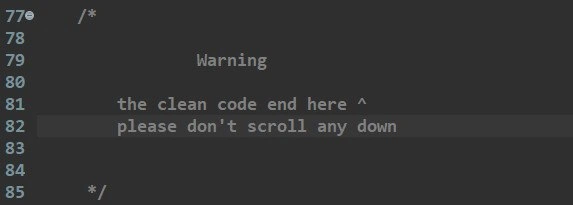
This meme shows a multi-line code comment acting as a warning label. In many programming languages (like C, C++, Java, JavaScript), anything between /* ... */ is a comment, which means the computer ignores it. Comments are meant for humans to read, often to explain what the code does. But here, the programmer uses a comment for a different purpose: to jokingly announce that “the clean code ends here.” In plainer terms, they’re saying: “Up to this point, I kept the code tidy and understandable. After this... all bets are off!”

The phrase clean code refers to code that is easy to read, well-organized, and maintainable. There’s even a famous book called “Clean Code” that teaches developers how to write nicer, clearer code. Clean code typically follows good practices: clear naming, short functions, obvious structure — basically code that wouldn’t make a fellow developer groan in confusion. When the comment says “clean code end here,” it implies that below that line, the code might violate those ideals. It's like the developer drew a literal line in the source file separating the good, structured part from a more chaotic part.

So what exactly might be below this ominous comment? Probably a section of messy, complex code that the developer is not proud of. Developers sometimes nickname such tangles of logic “spaghetti code.” Just like a bowl of spaghetti noodles, spaghetti code is all tangled up: it's hard to follow where things start and end. For example, imagine a function that goes on for hundreds of lines, jumping in and out of loops and conditions, weaving a confusing web. Reading it is tough, and changing it without breaking something is even tougher. By writing “please don't scroll any down,” the coder humorously suggests that if you keep reading, you’ll enter a world of confusion and frustration.

This is a classic example of DeveloperHumor and also a sign of CodingFrustration. The person who wrote it likely did so with a sigh or a chuckle, acknowledging their own TechnicalDebt. Technical debt is a term developers use to describe what happens when we write quick, messy solutions instead of clean ones – usually due to time pressure or other constraints. Just like financial debt, technical debt “interest” comes due later: the messy code will be harder to fix or build upon in the future, so eventually someone (maybe the same developer, maybe a future teammate) will have to invest extra time to clean it up. Here, the original coder basically says, “Yep, I took a shortcut here and now the code is kind of ugly. Good luck if you need to work with it!” It’s a very self-deprecating way to tag the code.

From a junior developer’s perspective, seeing such a comment can be surprising. Aren’t we supposed to strive for clean code everywhere? Ideally, yes. In school or coding tutorials, you learn to do things the right way: clear structure, no redundant code, lots of documentation. But in real projects, especially ones that have been around for a while, you’ll find sections that are far from ideal. Deadlines, new feature requests, or tricky bugs can lead to code that’s written in a hurry just to make things work. Over time, a codebase can develop pockets of ugliness — parts that nobody has had time to refactor (rewrite cleanly). Developers often know those parts exist. Sometimes teams even have jokes or warnings about certain files or functions (“Don’t touch OldInvoiceCalculator.cs unless you have a week to spare!”).

What makes this meme relatable is that the developer didn’t hide the mess — they put up a big warning sign for everyone. It’s both funny and oddly polite. Instead of just leaving the SpaghettiCode for the next person to untangle, they’re giving a heads-up: “Proceed with caution, gnarly code ahead.” It’s similar to putting a “Caution: Wet Floor” sign after mopping, except here it’s “Caution: messy code, watch your step.” The use of the word “Warning” centered in the comment, plus the little arrow ^ pointing up to the end of clean code, really drives the joke home visually. You can almost imagine it in a dark-theme code editor (as described) — a big gray comment on a black background acting like yellow tape at a crime scene.

Let’s break down a few terms from the tags/category for clarity:

  • Code Quality: This means how good or bad the code is, in terms of readability and maintainability. High quality code is clean and easy to work with. Low quality code is a pain. The meme is directly about code quality dropping below this comment.

  • Code Comments: These are annotations in the source code for humans. Here the entire meme revolves around a comment left by a dev as a warning label. It doesn’t affect the program’s execution, but it speaks volumes to developers reading it.

  • Clean Code Principles: Guidelines that help programmers write better code (like clear naming, small functions, not repeating yourself, etc.). The comment humorously claims that such principles were in use until this exact line. Below that, presumably, the code breaks those rules.

  • Technical Debt: As mentioned, it’s like taking a shortcut in code that you’ll pay for later. Think of it as borrowing time: you save time now by doing it the quick-and-dirty way, but you “borrow” trouble for the future. The messy code below is a debt that one day will need cleaning (repayment).

  • Developer Experience (DX): This refers to the overall experience of developers when building or maintaining software, similar to user experience (UX) but for devs. A good DX means it’s pleasant and productive to work with the code. A section of tangled, undocumented code is bad DX – it slows developers down and causes frustration. By flagging the bad area, the original coder is almost trying to mitigate the DX hit by at least preparing you mentally.

  • Spaghetti Code: Slang for code that’s logically all over the place. If you picture a pile of spaghetti, it’s hard to find one strand from start to finish without getting lost in the tangle. Likewise, spaghetti code has a tangled control flow and is hard to follow. It often arises in long-lived projects or when multiple quick fixes stack on top of each other.

  • Developer Humor & Coding Frustration: This meme sits right at that intersection. It’s funny because it’s born out of real frustration. A lot of programmer humor is self-aware and self-deprecating like this. We laugh at our own mistakes or messy creations, then share it so others can commiserate. It’s a coping mechanism. Seeing a comment like this in a code review or codebase can actually break the tension — you realize the last maintainer knew it was bad and had a sense of humor about it.

In summary, at this level, understand that the meme is about a programmer openly marking the spot where their code stopped being ideal. It’s like putting a joking “Do Not Enter” sign in code because the next lines are a mess. Every developer, even juniors, eventually encounters code that’s hard to read or just plain ugly. This meme reassures you that even experienced devs end up writing such code sometimes — and the best ones have the humility (and humor) to flag it for others.

Level 3: Abandon All Hope

In a veteran developer’s eyes, this comment is the code equivalent of a biohazard sign. We've all seen it (or written it) — a big ominous warning in the source:

/* 
   Warning
   the clean code end here ^
   please don't scroll any down
*/

This tongue-in-cheek annotation marks the exact border between well-structured code and a looming big ball of mud. It's a moment of dark humor and brutal honesty in the codebase. The author is effectively saying: “Beyond this line, all Clean Code Principles have collapsed under their own weight.” It’s a self-deprecating code note acknowledging that what lies below is technical debt incarnate.

Seasoned engineers immediately recognize the scenario. This is the point of no refactor, where a system likely hit a deadline or a nasty problem that couldn’t be solved elegantly in time. The code above line 80 might be pristine — functions doing one thing, variables named clearly, everything nicely decoupled. But after that "clean code stops here" marker? Here be dragons 🐉. We expect to encounter the kind of spaghetti code that gives architecture astronauts nightmares. The comment author might as well have written “Abandon all hope, ye who enter here.” It’s both a warning and a confession: beyond this, CodeQuality takes a nosedive.

Why is this funny to those of us battle-scarred by messy systems? Because it’s too real. It reflects a shared DeveloperExperience (DX): at some point, under pressure, even the best of us have shoved in a quick-and-dirty solution that we're not proud of. We usually hope nobody notices our gremlins, but here the programmer preemptively waves a flag: I know this is bad, please don't judge me (or my code) beyond this point. There’s a camaraderie in that transparency. It’s the gallows humor of software development—laughing so we don't cry about the late-night hacks and TechnicalDebt we accumulate.

This warning comment also implies a story. Perhaps an urgent production bug at 3 AM forced the developer to throw elegance out the window. Maybe an API changed on Friday evening and the only way to keep things running was a maze of duct tape code patched together hastily. The next morning, the dev, fully aware of the monstrosity created, left this snarky beacon for future maintainers (possibly themselves). It’s a mix of apology and caution: "I left the road of clean architecture here; beyond this point lies a swamp. Enter prepared."

The humor lands because any experienced programmer can immediately imagine the horrors lurking below that comment. The unspeakable horrors may include:

  • Functions hundreds of lines long doing way too many things.
  • Variables named data or temp scattered everywhere with no explanation.
  • Copy-pasted blocks of logic with slight differences (the hallmark of copy pasta 🍝).
  • A raft of // TODO: fix this comments from 2015 that never got fixed.
  • Maybe even a legendary goto or two, sending you on a wild goose chase through the file.

In short, this comment is a neon sign of CodingFrustration. It’s a grudging admission that the CodeQuality beyond has fallen below any acceptable standards — likely a "temporary" hack that turned permanent. The dev carved out a do_not_scroll_comment as a dark joke and a shield for their sanity. For maintainers, it's both hilarious and ominous: you laugh seeing it, then gulp because you know messy_code_warning signs mean trouble ahead. This paradox — a funny comment about a not-funny situation — is what makes the meme resonate. It's developer humor at its finest: transforming pain into a punchline.

Description

Dark-theme code editor screenshot showing line numbers 77-85. A multi-line comment begins with '/*', followed by centered text: 'Warning'. Beneath it, two indented lines read: 'the clean code end here ^' and 'please don't scroll any down', then the comment closes with '*/'. The light-gray text on charcoal background humorously cautions future maintainers that everything after this line is messy, implying looming spaghetti code or technical debt below the fold. This tongue-in-cheek self-deprecation epitomizes the ongoing struggle for code quality and maintainability that senior devs frequently encounter
Comments

6
Anonymous ★ Top Pick Git blame shows that “clean code ends here” comment has outlived three CTOs and a full cloud migration - proving technical debt is the only component with 99.999% uptime
  1. Anonymous ★ Top Pick

    Git blame shows that “clean code ends here” comment has outlived three CTOs and a full cloud migration - proving technical debt is the only component with 99.999% uptime

  2. Anonymous

    This is the software equivalent of "Abandon hope, all ye who enter here" - except Dante's circles of hell are replaced by nested callbacks, global state mutations, and that one function everyone's afraid to refactor because it somehow keeps the entire payment system running

  3. Anonymous

    Every senior engineer has left this exact comment at least once - it's the software equivalent of 'Here Be Dragons' on ancient maps. The real tragedy is that the 'clean code' section above probably isn't that clean either, but we've all learned that managing expectations through strategic commenting is a survival skill. The caret pointing up is doing more architectural work than most design documents

  4. Anonymous

    That comment is our architecture diagram: above is DDD; below is Deadline‑Driven Development - singletons, temporal coupling, and a 2k‑line switch pretending to be the anti‑corruption layer. Do not scroll

  5. Anonymous

    The event horizon of the technical debt singularity: clean code enters, never refactorable again

  6. Anonymous

    We replaced CODEOWNERS with a comment - scroll past it and congratulations, you’re the maintainer

Use J and K for navigation