From palindromes to Docker whales: a harsh college-to-industry reality check
Why is this Learning meme funny?
Level 1: Toy Blocks to Skyscrapers
Think of it like this: In school, learning to program is like playing with toy blocks. You might stack a few blocks and build a tiny house on your table. It’s fun and you feel proud – look, you made a little house! You even start thinking, “Wow, I’m great at this. I could build a real house someday.” But then you step out into the real world of construction and someone asks you to help build a giant skyscraper. Suddenly you’re surrounded by huge cranes, bulldozers, countless metal beams, and very complicated blueprints. Building that skyscraper is a totally different game than your toy-block house. You feel lost and overwhelmed because there are so many new tools and machines you’ve never seen, and you’re not even sure what half of them do.
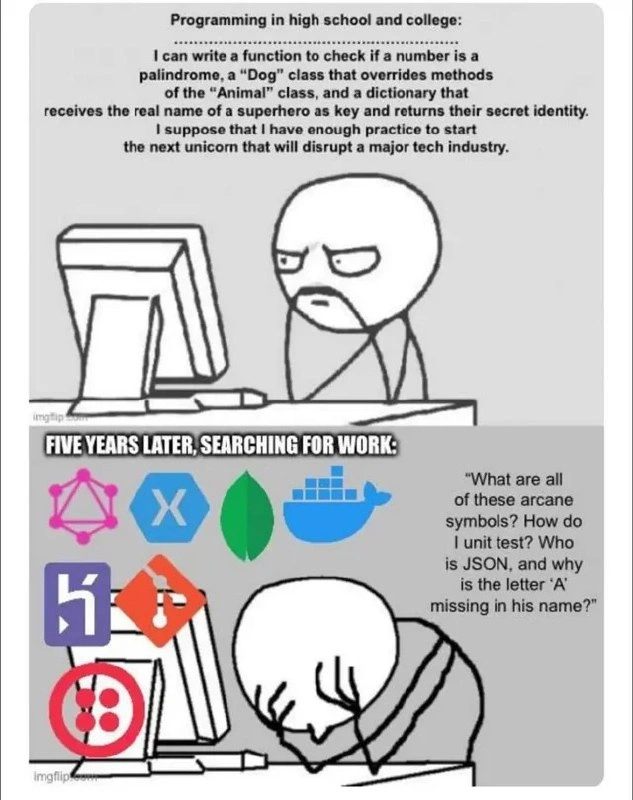
In this meme, the student’s school projects (like checking palindromes or making a simple superhero dictionary) were the toy-block houses. He felt confident, even a bit smug, like “I’ve got this coding thing down!” But five years later, when he’s looking for a programming job, he’s dropped into the middle of a construction site for software – with all these strange logos and terms flying around. It’s the equivalent of facing that skyscraper with no preparation. He sees weird symbols (the logos of real-world tools) and panics: “What are all these? How do I even start?” It’s a funny exaggeration of a real feeling many people have when they move from class projects to real projects. The joke is basically that doing a few homework problems made him overconfident, and now the reality check has hit – there’s a lot more to learn. Just like a kid who was good with toy blocks realizes that building a real house means learning about cement, cranes, and architecture, our budding programmer realizes real-world software means learning about databases, cloud services, testing, and other platforms. The meme makes us laugh because we understand that wide-eyed confusion. It’s poking fun at that moment when you go, “Oh… this is much bigger and harder than I thought!” But hey, just as every architect once played with blocks, every developer writing great software was once that confused newbie. The important thing is: with time and practice, those “arcane symbols” stop being scary, and you learn how to build that skyscraper, block by block.
Level 2: Arcane Symbols Demystified
In the second panel, the stick-figure developer faces a colorful collage of unfamiliar logos. It’s like a nightmare pop quiz on every technology he was never taught in class. Let’s break down these arcane symbols one by one and explain what each actually is in the real world (and why a newcomer might find them overwhelming):
GraphQL – That pinkish, connected nodes logo represents GraphQL, a query language for APIs. In simple terms, GraphQL is a technology that lets a client ask for exactly the data it needs from a server. Instead of the old way (REST APIs that return fixed data formats), GraphQL allows more flexible queries (almost like asking a database). If you’ve only ever done basic web requests or small database queries in class, GraphQL’s syntax and concepts can look strange. It’s a key part of modern frameworks for building web services, so seeing this symbol in job postings means employers expect you to know how to fetch and combine data in a more advanced way than you might have learned with textbook examples.
Xamarin – The stylized blue “X” logo stands for Xamarin. Xamarin is a framework for cross-platform mobile development. It allows developers to use C# (a language similar to Java) to write apps for Android, iOS, and more, all from one codebase. Imagine you learned Java or Swift separately for mobile apps in school; Xamarin says “use one language for both.” For someone coming from academic projects (who maybe only built a simple Android app once, or none at all), Xamarin represents an entire ecosystem of mobile tooling that they might not even know exists. Suddenly seeing “Xamarin” in a job requirement can be confusing – “Is that a tool? A person’s name? Some arcane spell?” In reality, it’s an important tool in industry for efficient mobile app development, especially in companies that use Microsoft’s tech stack.
MongoDB – That green leaf logo is MongoDB, a popular NoSQL database. In school, you might have encountered relational databases (like MySQL or learned SQL queries) or perhaps you just stored data in simple text files or arrays. MongoDB is different: it stores data in JSON-like documents rather than tables. It’s schema-less, meaning you don’t have to define the structure of data rigidly beforehand. This flexibility is powerful for building modern applications, but if you’ve only ever used, say, a Python dictionary or a small SQLite database for a class project, the concepts of collections, documents, and queries in MongoDB will be new. NoSQL (the category MongoDB falls under) itself might be an unfamiliar term – it just means “non-relational databases” which often scale out horizontally and store data more flexibly. A newbie seeing the MongoDB logo might think, “Green leaf? Does the job involve gardening?” when in reality it involves learning a new way to handle data at scale.
Docker – The blue whale carrying stacks of containers is the logo for Docker. Docker is a tool that packages software into containers – a lightweight, portable way to run applications consistently across different environments. Think of a container like a little box that has your app and everything it needs to run (libraries, runtime, system tools), so it can be shipped to any server or your laptop and it will work the same. In college, chances are you ran your code directly on your machine or the school’s servers. You probably didn’t worry about “it works on my machine, why not on the server?” issues. Docker solves exactly those problems in industry, by using Docker images that encapsulate apps. To someone new, Docker’s concepts can seem esoteric: images, containers, Dockerfile,
docker runcommands – it’s a whole new layer of knowledge on top of just writing code. Seeing that smiling whale icon might actually be intimidating if you’ve never deployed anything outside of your own IDE. It’s a symbol of DevOps and deployment practices that academia often doesn’t cover.Heroku – The purple logo with a stylized H represents Heroku. Heroku is a platform-as-a-service (PaaS) cloud platform. In simpler terms, Heroku is a cloud service where you can deploy your applications without managing any servers yourself. You just push your code, and Heroku handles running it, whether it’s a simple website or an API backend. If all you’ve done is run programs on your laptop or a college lab machine, deploying to “the cloud” via a platform like Heroku can feel like magic. But many companies expect new developers to know how to host an app online, create a Heroku app, configure environment variables, and keep it running. When the meme character is job hunting, he sees Heroku’s logo and is flustered: it represents yet another thing he’s never tried. It’s basically the difference between writing code that works on your computer and delivering a working service that anyone on the internet can use – a huge leap for a beginner.
Git – The orange diamond-shaped logo with branching lines is the logo for Git. Git is a distributed version control system used to track changes in code and collaborate with others. It’s absolutely everywhere in professional software development – platforms like GitHub or GitLab (which you might have heard of) are built around Git. In a classroom setting, maybe you wrote code on your own and turned in assignments, possibly never using version control beyond maybe copying files. But in the real world, Git is how teams of developers coordinate. You create branches, commit changes with messages, merge code, handle conflicts when two people edit the same file – it’s an entire workflow. Our meme’s protagonist likely has never done a
git commitor resolved a merge conflict. So when he encounters that Git logo (or sees job requirements like “familiarity with Git and collaborative workflows”), he’s bewildered. “Git? That thing with the weird graph icon?” For a junior developer who hasn’t used it, Git can seem confusing (commands likegit push origin mainlook like gibberish initially). But it’s a fundamental tool, and not knowing it would indeed make the real world feel daunting.Twilio – The red circle logo with two white dots is Twilio. Twilio is a cloud communications platform – basically, it provides APIs to send text messages, make phone calls, handle WhatsApp, and so on. If you’ve ever used an app that sends you a verification SMS, chances are something like Twilio was behind it. In school projects, you probably never had to integrate a third-party API for messaging; you focused on the core assignment logic. But modern software often isn’t built in isolation – you use services like Twilio to add common features (why build an SMS system from scratch if a service exists?). To our job-seeker here, Twilio’s logo showing up feels like seeing a random emblem with no context. It’s an external service he must learn to interact with via APIs (Application Programming Interfaces). The question “What are all these symbols?!” covers Twilio too – he doesn’t know if Twilio is a library, a framework, or a person’s nickname. It’s just another mysterious name that the real world expects him to recognize. Really, it stands for needing to learn how to read API documentation and use keys/tokens to integrate services – again, stuff that academic exercises rarely delve into.
JSON – Not shown as a logo, but mentioned explicitly in the character’s panicked question, JSON stands for JavaScript Object Notation. It’s a lightweight data-interchange format, basically a way to structure data using key-value pairs (and arrays) in plain text. It looks like curly braces
{ }with data inside, kind of like Python or JavaScript objects. For example:{"name": "Bruce Wayne", "secretIdentity": "Batman"}could be a JSON snippet. JSON is extremely common in web development: APIs send data in JSON, configuration files are often in JSON, and databases like MongoDB use a JSON-like structure. The meme joke “Who is JSON, and why is the letter 'A' missing in his name?” highlights that the poor developer doesn’t even realize JSON is an acronym, not a person. (He expects maybe it should spell “Jason” like a name – that’s the humor). Explaining it simply: JSON doesn’t have an “A” because it’s not a name at all – each letter stands for something (there’s no “A” in the phrase). If our protagonist spent his coding time only on classroom problems, he might not have encountered JSON explicitly, even if he unwittingly used it (some classes might use JSON data without emphasizing what it is). JSON is basically a format, one you have to learn by practice – so encountering it during a job hunt and treating it like some guy’s name is a silly, exaggerated way to show his ignorance. But no shame – every expert was a beginner once, and we all had to learn what JSON was at some point!Unit Testing – The character’s despairing question “How do I unit test?” reveals he’s unfamiliar with the concept of unit tests. A unit test is just a small piece of code that automatically tests another piece of code (usually a single function or module) to make sure it works as expected. In school assignments, students often run their program with some input and manually check the output against the expected result. But in industry, we write formal tests so that we can run hundreds of them quickly every time we change the code, to catch bugs early. There are frameworks like JUnit (for Java), unittest or PyTest (for Python), etc., to write these tests. For example, if you had a function
is_palindrome(x), a unit test would callis_palindrome(121)and assert that it returns True, and callis_palindrome(123)and assert that it returns False. Many fresh graduates have little exposure to testing practices, so the meme’s developer is basically saying “I have no idea how to systematically test my code beyond just trying it out.” This is something one typically learns on the job or in advanced courses – hence he’s overwhelmed. It underscores the larger theme: learning curve. The tools (like testing frameworks) and best practices (like writing tests, doing code reviews, using Git, deploying with Docker) often aren’t covered in academic settings but are expected knowledge in real-world jobs.
In summary, the bottom panel’s logos and the confused questions illustrate the huge breadth of knowledge a modern developer is expected to have. Our job seeker is confronted by the vast tooling and frameworks that power real software projects:
- He knew how to code small algorithms, but now he must learn about entire platforms (cloud hosting on Heroku),
- He understood basic data structures, but now he faces production databases (MongoDB) and data formats (JSON),
- He practiced simple programs, but now he needs to package and deploy applications (Docker, Heroku),
- He wrote code alone, but now he’ll collaborate using version control (Git),
- He solved contrived problems, but now has to use multiple frameworks and services (GraphQL, Twilio, Xamarin) to build features,
- He rarely tested beyond “run and see,” but now must adopt systematic testing (unit tests, possibly continuous integration).
No wonder he’s overwhelmed! Each symbol is like a new subject in itself. This is a classic learning curve moment: when a developer steps out of the classroom bubble and into the fast-paced tech industry, they experience a sink-or-swim flood of new things to master. The meme humorously compresses that experience into one image – an avalanche of logos and a hapless developer asking fundamentally novice questions. It’s poking fun at his earlier overconfidence, but in a way, it’s also poking at the education system and industry expectations. Bridging the college-to-job gap is tough. Don’t worry, though – everyone starts somewhere. Seeing these “arcane” tools for the first time is intimidating, but given a bit of time, our meme protagonist (and any real-life counterpart) will start picking them up one by one. Today’s “mystery symbol” can become tomorrow’s trusty tool. Framework fatigue is real, but so is the rewarding feeling when you finally understand what all those once-cryptic logos and terms actually do.
Level 3: Framework Fatigue Hits Hard
The top panel of this meme oozes naïve overconfidence: our hero brags about writing a palindrome function, a trivial Dog subclass of Animal, and a toy dictionary of superhero identities. In academia, these toy projects are celebrated as big wins. He genuinely believes these small victories mean he’s ready to "start the next unicorn" and disrupt an industry. Every experienced dev can spot the joke: writing a function to check if "racecar" reads the same backwards is a far cry from building real-world software. Academic programming exercises (palindromes, basic OOP, simple data structures) are like coding karaoke – you follow well-known tunes. Meanwhile, production code is an improvisational jazz jam with a dozen instruments, each playing in a different key. The humor comes from that shared industry truth: we’ve all met our past self in this meme, the junior who thought a few class projects made them a programming prodigy.
Fast forward five years, and reality hits like a freight train full of frameworks. In the bottom panel, our once-cocky stick figure is slumped over the keyboard, crushed by the logos of GraphQL, Xamarin, MongoDB, Docker, Heroku, Git, and Twilio. It’s a comically exaggerated but painfully relatable scene of framework fatigue and tooling shock. Each logo represents a tool or platform ubiquitous in industry but likely missing from a college syllabus. The meme lampoons the college-to-job gap: universities focus on algorithms and theory, while the job market screams for cloud deployment, containerization, NoSQL databases, and multi-platform development. The poor guy is staring at this wall of arcane symbols like they’re hieroglyphs from an alien civilization. To a new grad, the Docker whale, MongoDB leaf, and GraphQL node icon might as well be magical sigils. Seasoned developers chuckle because we remember that feeling – the first time we saw a package.json or a Dockerfile and thought, “What fresh sorcery is this?”
The speech bubble nails the punchline: “What are all of these arcane symbols? How do I unit test? Who is JSON, and why is the letter 'A' missing in his name?” This line is both absurd and telling. It’s absurd because JSON isn’t a person at all – it’s a data format (JavaScript Object Notation) – and of course there’s no “A” in it (it’s an acronym, not the name Jason). But it’s telling because it perfectly captures the bewilderment of someone realizing how little their school projects prepared them for real-world development. He’s basically asking, “Who the heck is this JSON guy and why haven’t I met him in class?” An experienced developer reading that is likely smirking (or facepalming) because JSON is everywhere in modern apps – configuration files, API responses, you name it. Not knowing JSON in today’s tech is like a chef not knowing salt. The unit test confusion is equally on-point. In school, you write a function and eyeball if it works; in industry, you’re expected to write unit tests (small programs to automatically verify your code). His plea “How do I unit test?” exposes that he’s never formally learned to test code – a rude awakening when job postings demand “TDD experience” and “write automated tests”.
What makes this meme so true for seasoned engineers is the biting reality check it depicts. We’ve seen this story: The intern brags about their neat class project, only to freeze up when asked to git merge or deploy a Docker image to staging. The meme’s contrast highlights systemic issues in how we learn programming versus what working in tech actually entails. Academic assignments, like the palindrome checker or the classic Dog extends Animal inheritance demo, focus on isolated problems and idealized code. They rarely expose students to the messy tooling and collaborative aspects of real software development. There’s no Git version control exercise in most intro courses (so newbies think “Git” is just slang for a person with bad manners), no continuous integration pipelines, no deployment to cloud platforms. So graduates entering the job market feel blindsided by the laundry list of technologies they’re expected to know. It’s a common job market trend to see entry-level positions asking for experience with things like container orchestration, cloud functions, or full-stack frameworks – a phenomenon that leads to widespread imposter syndrome and plenty of Reddit threads complaining about “entry level” jobs that paradoxically require 3+ years of experience in half a dozen tools.
The “five years later” part also carries a whiff of cynical humor about how fast tech evolves. Today’s shiny framework can become tomorrow’s outdated skill. A developer who blinked might miss the rise of something like GraphQL or Docker. Five years is long enough in tech that a comfortable stack can turn into a legacy stack and a new wave of logos appears. The meme exaggerates that the protagonist completely missed the memo on basically everything – which is hilarious and also a tad sympathetic. It’s a nod to how relentless and overwhelming the learning curve in this industry can be. Even seasoned pros sometimes wake up feeling like “junior” developers when confronted with a new paradigm or a fad they haven’t tried (looking at you, countless JavaScript frameworks 😅).
To really drive home the point, consider this tongue-in-cheek comparison between the protagonist’s school accomplishments and the real-world skills he now finds he lacks:
| Academic Practice | Industry Reality |
|---|---|
| Wrote a function to check if a number is a palindrome. | Handling real data validation and complex input processing (rarely about palindromes, but about data formats and user inputs). |
Created a trivial Dog subclass of Animal in OOP. |
Working in a large object-oriented codebase or a web framework with dozens of classes and design patterns. |
| Used a dictionary to map a hero’s real name to secret identity. | Managing a production database (like MongoDB) with collections, queries, indexes, and scaling concerns. |
| Ran code on a personal laptop and manually checked output. | Deploying services to the cloud (on platforms like Heroku), running apps in Docker containers, and monitoring them in production. |
| Coding solo or with maybe one partner in class. | Collaborating via Git with a team, dealing with branches, merge conflicts, code reviews, and version control workflows. |
| No formal testing – if the code “seems to work,” it’s done. | Writing unit tests for each component and setting up CI pipelines to run tests on every commit (ensuring nothing breaks). |
| Requirements are clearly defined by a professor. | Navigating vague or changing requirements, learning new APIs (like Twilio for sending messages) on the fly, and reading docs to integrate services. |
| Confidence sky-high after a few small projects. | Realizing that continuous learning is the norm, and feeling humbled by how much there is to know (hello, framework fatigue!). |
The table above sums it up: our meme’s hero went from a sheltered sandbox to the wild forest of real-world development. The overconfidence in school has been stabbed by cold hard reality – and it’s darkly funny because so many of us have been that person! The meme resonates with developers who’ve lived through that reality check: discovering that being a great student programmer doesn’t automatically translate to being job-ready in a rapidly evolving tech industry. It’s the kind of joke that makes you laugh, then sigh and mutter “so true.”
Description
A two-panel rage-comic style meme depicts a stick-figure developer at a desktop computer. In the top gray panel, the heading reads "Programming in high school and college:" followed by text bragging about writing a palindrome checker, a "Dog" subclass of "Animal," and a superhero-identity dictionary, concluding “…I suppose that I have enough practice to start the next unicorn that will disrupt a major tech industry.” The character looks confident. The bottom panel, captioned "FIVE YEARS LATER, SEARCHING FOR WORK:", shows floating logos for GraphQL, Xamarin, MongoDB, Docker, Heroku, Git, and Twilio while the same figure slumps over the keyboard. A speech bubble asks, “What are all of these arcane symbols? How do I unit test? Who is JSON, and why is the letter 'A' missing in his name?” The meme humorously contrasts classroom toy problems with the overwhelming real-world stack - cloud platforms, containerization, NoSQL, API layers, and version control - illustrating the steep learning curve and tooling shock many engineers face when job hunting
Comments
6Comment deleted
Turns out all that time writing palindrome checkers was foreshadowing: fifteen years later my data still leaves a Docker sidecar, bounces through three GraphQL gateways, a Mongo change stream, and six microservices… only to return exactly as it went in
Five years in and you realize your CS degree taught you how to implement quicksort seventeen different ways, but not how to explain to product why their "simple" feature request requires rewriting half the authentication service and will definitely break something in production on a Friday
The real tragedy isn't that they don't know what JSON is - it's that by the time they figure out why the 'A' is missing, half those logos will be deprecated and replaced by three new frameworks that all solve the same problem slightly differently. Welcome to the industry where your CS degree taught you Big O notation but forgot to mention you'd spend more time debugging YAML indentation than implementing algorithms
CS taught Big‑O; industry is logo‑O - proving you know the GraphQL/Mongo/Docker/Heroku/Git runes while gently explaining that JSON isn’t a person, and the only missing “A” is the one in our SLA when prod goes dark
College: 'Hashable Animal classes will unicorn this!' Reality: 'Decode these YAML runes or enjoy ramen season indefinitely.'
CS101 taught me to prove palindromes; the job req wants me to Docker a GraphQL API on Mongo, deploy to Heroku, wire Twilio, push with Git, add unit tests, and explain that JSON never had an A to begin with