Anthropic Announces Gigawatt TPU Deal and $30B Run-Rate Revenue
Why is this AI ML meme funny?
Level 1: The Bakery That Bought a Power Plant
A bakery announces two things at once: "We've ordered ovens so big they need their own power station — they'll be ready in a year" and "By the way, we're selling three times more bread than last year, so we need those ovens." The first announcement alone sounds crazy; the second one is there so you understand the crowd outside the door. The wow factor is the scale: the bakery is now measuring its future not in loaves or even ovens, but in how much electricity a small city uses.
Level 2: The Vocabulary of the Arms Race
- TPU (Tensor Processing Unit) — Google's in-house chip designed specifically for the matrix math that neural networks run on; an alternative to the GPUs most of the industry trains on.
- Run-rate revenue — current revenue pace annualized: take this month (or quarter), multiply forward. It signals momentum, not audited yearly results — which is exactly why fast-growing companies prefer quoting it.
- Gigawatt — a billion watts; the rough output of a large power station. Datacenter capacity is increasingly described this way because power, cooling, and grid hookups — not chips — are the scarce inputs.
- Frontier models — the largest, most capable model generation at any moment; training each new one costs dramatically more compute than the last, hence deals signed years before the capacity exists.
- Capex — capital expenditure; the up-front infrastructure spending that demand must eventually justify.
For someone early in their career, the practical reading: the layer of the stack where careers compound fastest keeps shifting downward — from apps to models to chips to, apparently, electrical substations.
Level 3: When the Unit of Account Becomes the Gigawatt
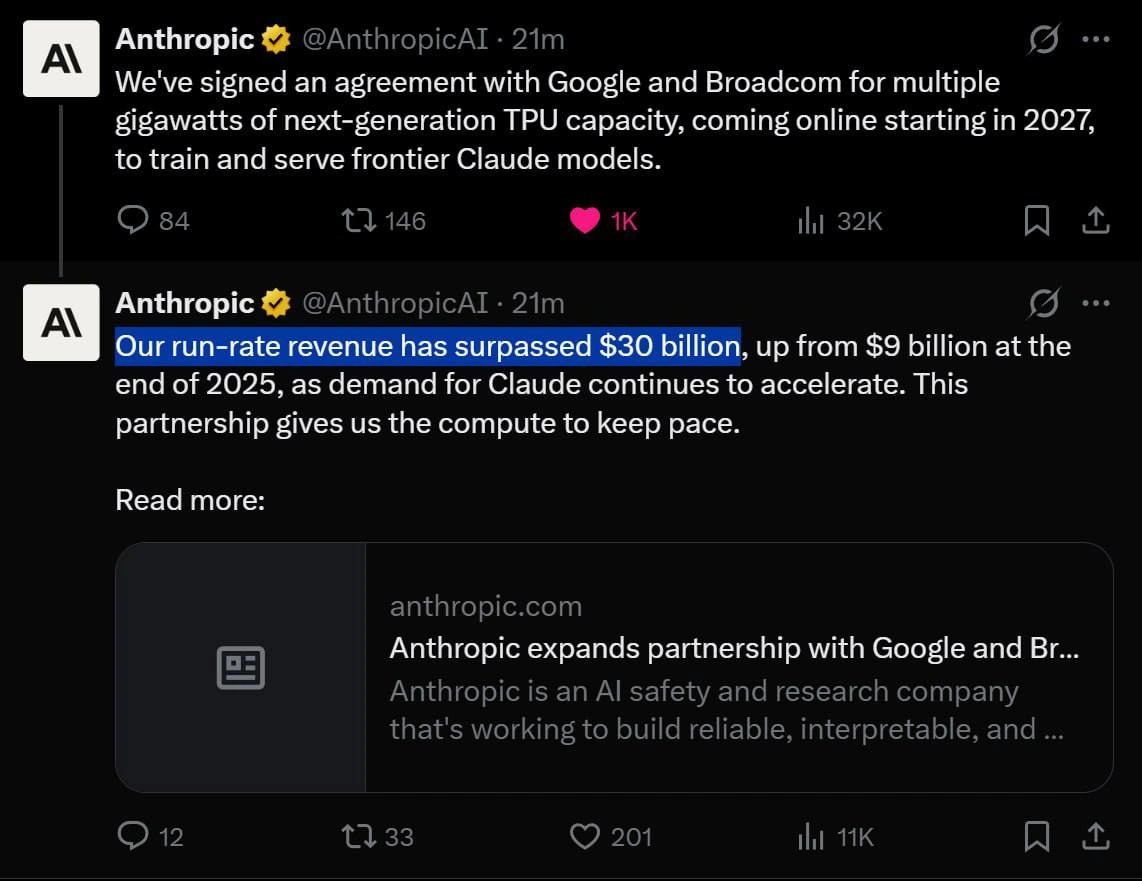
Two chained posts from the verified @AnthropicAI account, both 21 minutes old at screenshot time, and together they compress the entire economics of the frontier-AI era into a dark-mode rectangle. The first announces an agreement with Google and Broadcom for "multiple gigawatts of next-generation TPU capacity, coming online starting in 2027, to train and serve frontier Claude models." The second — key clause highlighted in blue by whoever shared it — reads:
Our run-rate revenue has surpassed $30 billion, up from $9 billion at the end of 2025, as demand for Claude continues to accelerate. This partnership gives us the compute to keep pace.
The historically interesting detail is the unit. Compute deals used to be denominated in dollars, then in chips ("100,000 H100s" as a flex), and now in gigawatts — a power-grid unit. That progression is the industry quietly admitting where the binding constraint moved: not capital, not silicon, but electricity and the physical infrastructure to deliver it. A gigawatt is power-plant scale; "multiple gigawatts" is a sentence about substations, transmission lines, and multi-year construction schedules wearing an AI-lab press release as a costume. When your procurement language converges with a utility company's, you have stopped being a software company in any traditional sense.
The pairing of the two posts is deliberate corporate rhetoric worth decoding. Post one alone reads as terrifying capex — the kind of spending that fuels "AI bubble" discourse. Post two is the preemptive rebuttal: a 3.3x revenue jump in roughly a year ($9B → $30B run-rate), framing the gigawatts as keeping up with demand rather than speculative overbuild. The channel author's commentary sharpens it: Anthropic's own optimistic scenario reportedly projected $18B for all of 2026, and the company crossed $30B before spring ended. Whatever one thinks of run-rate accounting, blowing through your own bull case by 60%+ with three quarters to spare is the kind of error bar that makes both optimists and skeptics nervous — for opposite reasons.
The Broadcom mention is the supply-chain subplot. TPUs are Google's custom accelerators, co-developed with Broadcom — and frontier labs courting custom silicon is the industry's structural hedge against single-vendor GPU dependence. Every gigawatt landed on TPUs is negotiating leverage against the market's default chip supplier. Compute procurement is now geopolitics with purchase orders.
Description
A dark-mode screenshot of two chained X/Twitter posts from the verified @AnthropicAI account, both 21 minutes old. First post: 'We've signed an agreement with Google and Broadcom for multiple gigawatts of next-generation TPU capacity, coming online starting in 2027, to train and serve frontier Claude models' (84 replies, 146 reposts, 1K likes, 32K views). Second post, with the key phrase highlighted in blue: 'Our run-rate revenue has surpassed $30 billion, up from $9 billion at the end of 2025, as demand for Claude continues to accelerate. This partnership gives us the compute to keep pace', followed by a link card to anthropic.com titled 'Anthropic expands partnership with Google and Br...'. The content is industry news on the AI compute arms race: hyperscaler-scale TPU procurement and a 3.3x year-over-year revenue jump

Comments
3Comment deleted
Measuring datacenter deals in gigawatts instead of dollars is the industry quietly admitting the binding constraint is now thermodynamics, not budget
I guess going open source nowadays raises the income Comment deleted
Based on... A twitter post by Anthropic. Yeah right. Sam jippity Altman was also claiming OpenAI is earning "much more" than the public figures. With Anthropic is even worse, with Pentagon bowing out of the income. So, I'll believe it when I see it. Comment deleted