ArXiv Paper: Language Symmetry Shapes LLM Representation Geometry
Why is this AI ML meme funny?
Level 1: The Parrot That Drew a Calendar
Imagine someone insists their friend's parrot "just repeats sounds without understanding." Then scientists peek inside the parrot's head and find it has drawn a perfect circular calendar — December connected to January, all the months in order, like a clock — plus a neat timeline of years and a little map with cities in the right places. Nobody showed it a calendar or a map; it figured out the shapes of time and space just from listening to people talk. The meme laughs at the person still saying "it's just repeating sounds, bro" while holding the X-ray. Whether or not you call that "understanding," it's an awfully organized parrot.
Level 2: What the Jargon Means
- arXiv is the site where researchers post papers before formal peer review — the
arXiv:2602.15029v2 [cs.LG]stamp on the left margin is its ID and category (machine learning). - An embedding is the list of numbers a model uses internally to represent a word or concept — a point in a space with thousands of dimensions.
- A manifold is a smooth shape inside that space: a curve, a loop, a surface. Saying "months form a circle" means the twelve month-vectors literally sit around a loop, December next to January.
- Co-occurrence statistics are counts of which words appear near which other words in text. They're the raw signal language models learn from.
- A linear probe is the simplest possible test: train a tiny linear model to read information (like a city's latitude) directly out of the embedding. If it works, that information is sitting there in plain sight.
- Fourier components are the circle-friendly building blocks (sines and cosines) that naturally describe anything periodic — weeks, months, seasons.
The career-relevant takeaway: when someone claims LLMs are black boxes, this is the genre of paper that says "increasingly, no — bring a flashlight."
Level 3: The Stochastic Parrot Discourse, Now With Receipts
The channel caption is doing maximal work:
They are just stochastic parrots bro they just memorize the training data without actually understanding anything, bro
That's a jab at the famous "stochastic parrots" position — the argument that LLMs merely remix surface statistics without internal models of anything. This paper is the awkward counter-evidence: you don't get months on a clean circle, years on a smooth ordered curve, and cities at linearly decodable coordinates from a lookup table of memorized n-grams. Those are structured, compressed, generalizing representations — the kind of thing we'd casually call a world model if a biology student's neurons did it. The meme's framing is the now-standard rhetorical move in ML Twitter discourse: quote the dismissal, attach the arXiv page, let the abstract do the dunking.
The honest middle position — which the paper itself quietly supports — is more interesting than either camp. The geometry arises from statistics; the parrot people are right that it's "just" co-occurrence all the way down. But the structure that emerges from compressing those statistics is genuinely geometric, manipulable, and predictive — the understanding people are right that something real lives inside. The fight dissolves into a definitional dispute about whether "understanding" can be made of statistics, which is a philosophy seminar wearing a cs.LG tag. Meanwhile, mechanistic interpretability researchers treat results like this as catnip for a practical reason: linear probes and Fourier features are auditable. If concepts live on known manifolds, you can find them, measure them, and maybe edit them — which matters rather a lot for safety work on systems people keep deploying first and probing later.
Level 4: Symmetry Begets Geometry
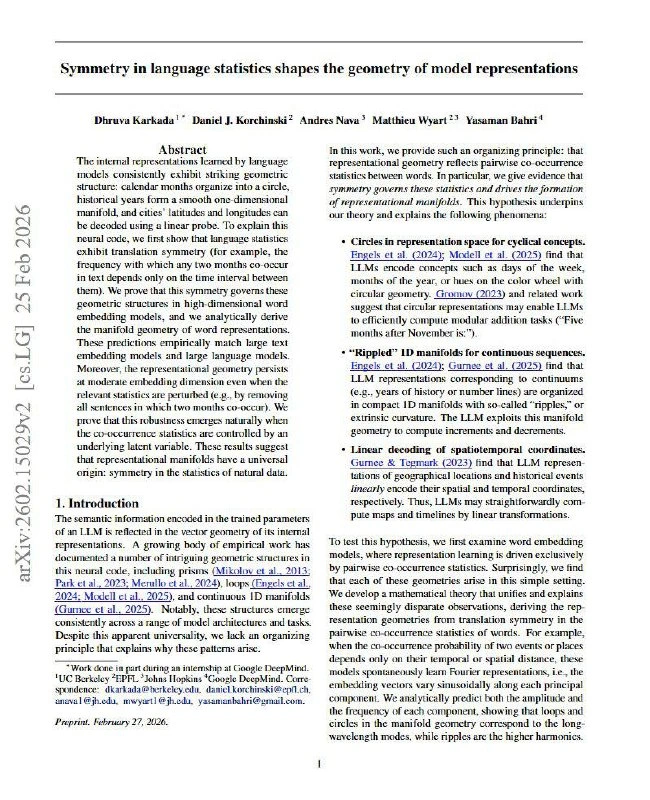
The preprint shown — "Symmetry in language statistics shapes the geometry of model representations," with authors spanning UC Berkeley, EPFL, Johns Hopkins, and Google DeepMind — is making a claim with real mathematical teeth. The phenomenon it explains has been interpretability folklore for a while: probe an LLM's residual stream and you find months of the year arranged in a circle, historical years lying on a smooth one-dimensional manifold, and latitude/longitude of place names recoverable with a linear probe. The paper's contribution, visible in the abstract, is the why: an organizing principle that "representational geometry reflects pairwise co-occurrence statistics."
The mechanism is symmetry. Consider the abstract's own example: the co-occurrence statistics of months exhibit translation symmetry — as the page puts it, the frequency with which two months co-occur in text "depends only on the time interval between them." Formally, if the statistical relationship between March and May depends only on the offset (+2) and not the absolute position, the co-occurrence structure is invariant under cyclic shifts — the symmetry group of the data is Z₁₂. And there's a classical result lurking here: matrices invariant under cyclic shifts (circulant matrices) are diagonalized by the Fourier basis. So when a model factorizes those statistics into embeddings, the optimal solution organizes the concepts on a circle, with Fourier components as the natural coordinates — which is exactly what the page reports: loops for cyclical concepts (days of the week, "the cool color wheel with circular geometry"), "rippled" 1D manifolds with extrinsic curvature for continuous sequences like years, and spatiotemporal coordinates readable off "linear combinations of Fourier features." The ripples aren't noise — they're higher harmonics, the model spending capacity on finer-grained distinctions along the manifold.
The deepest line in the abstract is almost a throwaway: "representational manifolds have a universal origin: symmetry in the statistics of natural data." That's an emmy-Noether-flavored claim for machine learning — symmetries in the data manifest as conserved geometric structure in the learned representation, independent of architecture. The authors verify it analytically in word-embedding models and empirically in large language models, suggesting the geometry isn't a transformer quirk but a property of any system compressing these statistics. Gradient descent didn't invent the clock face; the clock face was already sitting in the spectrum of the co-occurrence matrix, waiting to be factorized.
Description
A screenshot of the first page of an arXiv preprint (arXiv:2602.15029v2 [cs.LG], 25 Feb 2026) titled 'Symmetry in language statistics shapes the geometry of model representations' by Dhruva Karkada, Daniel J. Korchinski, Andres Nava, Matthieu Wyart, and Yasaman Bahri (affiliations include UC Berkeley, EPFL, Johns Hopkins, Google DeepMind). The two-column page shows the abstract and introduction, arguing that LLM internal representations form striking geometric structures - months organized into circles, historical years on smooth one-dimensional manifolds, latitudes/longitudes decodable with linear probes - because symmetry in pairwise co-occurrence statistics governs the manifold geometry of word embeddings. Bullet points cite findings on circular representations for cyclical concepts (days of week, months), 'rippled' 1D manifolds for continuous sequences, and linear decoding of spatiotemporal coordinates via Fourier components. Interpretability research catnip: formal confirmation that the model literally learned that time is a circle

Comments
24Comment deleted
Billions of parameters and gradient descent later, the model independently rediscovered the clock face - peer review pending on whether it also learned the calendar has a Q4
ok Comment deleted
Thanks for the dose of horrors beyond our comprehension before sleep Comment deleted
the caption but unironically Comment deleted
year 2026, ai bro just discovered how embeddings work Comment deleted
so what? Comment deleted
Same as in our brain, just access mechanism differs. So what? I cannot torture a non human being? Comment deleted
Wasn't roughly this known since like simple GPTs and tokenized word banks? You could find a dimension in weights of words which effectively encodes "gender", and then take a vector in that dimension from "brother" to "sister", then apply the same vector to "father" and get "mother"? Comment deleted
This is the latent space. Theoretically embedding just allow you to map words to numbers and plot distances between them. This is how the words are used in internal reasoning. LLM’s have learned from training data, for example, that the year is a circle, even though that doesn’t make any sense on a surface level. Comment deleted
need to actually read le paper this dropped today too https://arxiv.org/abs/2603.05122 Comment deleted
Not to this extent Comment deleted
What's so special this time? Comment deleted
😳 Comment deleted
Oh, hi there! Comment deleted
You expect me to read all this shi? Comment deleted
That’s just a fucking statistics. Comment deleted
First you say "that's just a fucking tweet", now this, how do we even make you believe things? You gonna listen to whispers of sirens in a forest? (I'm not an FBI agent, trust me on this) Comment deleted
Believe in what exactly? That there’s some kind of divine or sentient entity behind these statistics? Comment deleted
If our month names weren’t cyclical (if after December there’s wasn’t January but rather some shit like Elevenary, then Twelvery, and so on), then I bet the months names would’ve formed a linear manifold, same as years. Comment deleted
that's like saying earth orbit isn't circular, but a spiral and it's never crossing same point twice. It's true, but is that what matters? Comment deleted
but stochastic processes usually form patterns. what's so surprising? Comment deleted
so, LLMs being trained to be stochastic parrots of human data and mirroring ways that humans imagine continuity becomes a proof of them memorizing with understanding… how, exactly? Comment deleted
Nothing sensational in it. Still a stochastic parrot. Comment deleted
For more enlightment I suggest actually trying to read how even months have originated. People always knew cycle of seasons, however to track them more accurately they couldn't rely on just days because it would cause deviations. Agricultural societies started using lunar observations to track the months, and calculated that 12 months roughly fit into a whole solar year (notice how solar years are still a superior measure) Comment deleted