Claude Code at 3% Context Asked to Refactor the Whole Codebase
Why is this AI ML meme funny?
Level 1: One More Chore at Bedtime
Imagine someone who has been carrying heavy boxes up the stairs all day. They're sweaty, out of breath, sitting down with an oxygen tube in their nose, completely spent. And right at that moment you walk in and cheerfully ask them to rearrange every single room in the house. The look on their face — too tired to even argue — is this whole meme. The computer helper has almost no energy left, and the person asks it to do the biggest job there is. It's funny because we've all been on both sides: the exhausted one being asked, and the oblivious one doing the asking.
Level 2: Working Memory for Robots
- A context window is the maximum amount of text (measured in tokens, roughly word-fragments) an LLM can consider at once. Everything the model "knows" about your session must fit inside it — there is no hidden long-term memory.
- Claude Code is a terminal-based AI coding agent: it reads files, runs commands, and edits code in loops, with every step consuming context. The UI shows a percentage remaining, like a fuel gauge.
- Refactoring means restructuring code without changing behavior — extracting functions, renaming, untangling dependencies. Done across a whole codebase, it requires understanding everything at once, which is why it devours context.
- Compaction is the emergency measure when the window fills: older history is replaced with a summary. It's like photocopying a photocopy — usable, but detail dies each time.
The early-career lesson hiding here: tools have operating envelopes. Just as you learn not to git push --force to a shared branch or not to run a migration at peak traffic, you learn to glance at the context gauge before asking an agent for something enormous. The model doesn't refuse — it tries, wheezing, and ships something sad. Knowing your tool's limits is the skill; the meme is what learning it feels like.
Level 3: Attention Is Not Infinite, Actually
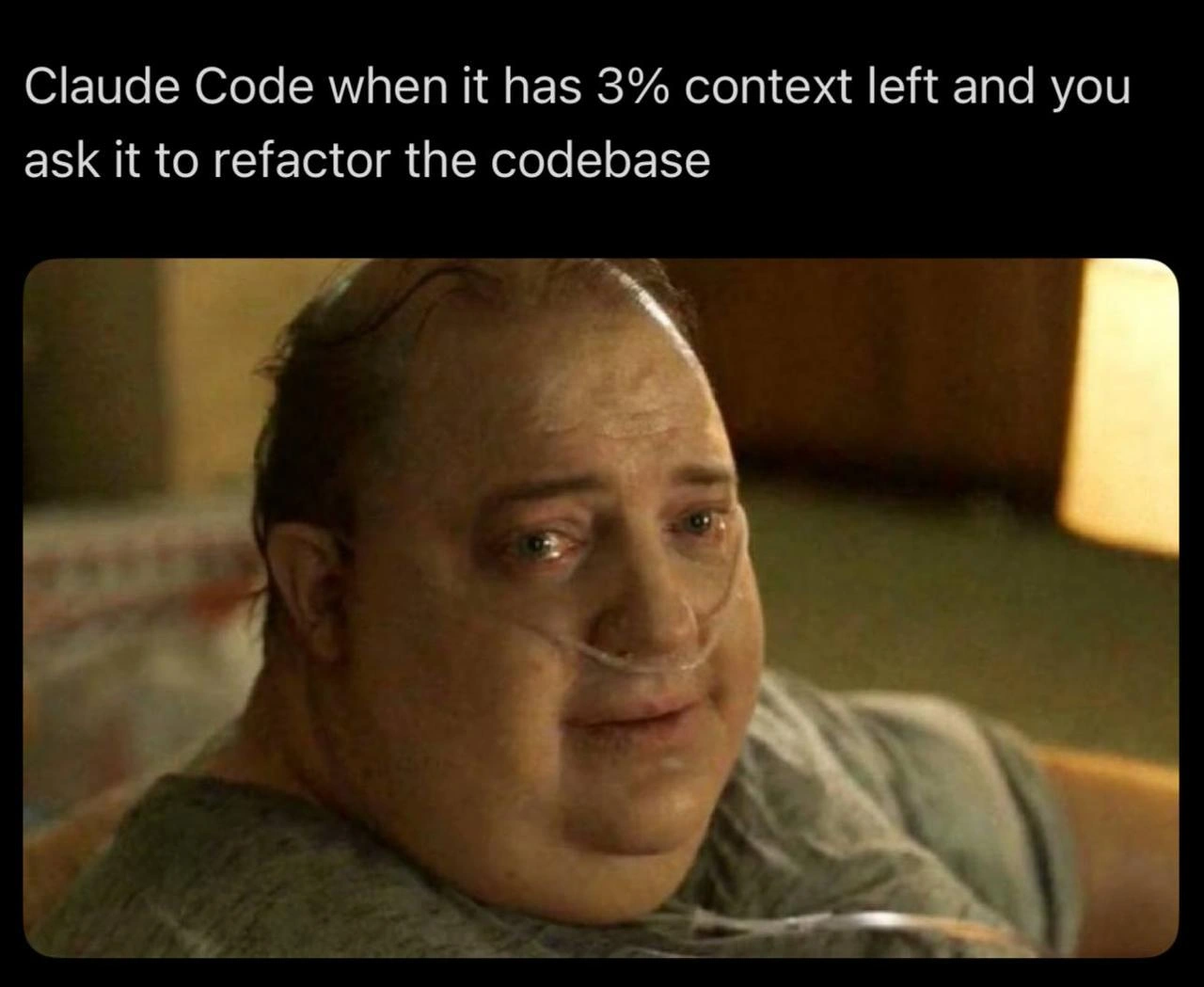
Claude Code when it has 3% context left and you ask it to refactor the codebase
The image: Brendan Fraser as Charlie in The Whale — sweat-matted hair, nasal oxygen cannula, eyes glistening with the particular exhaustion of a body operating far past its limits — gazing back at someone making one more demand. The casting is cruelly perfect, because a context window at 3% is exactly this: a system that has consumed nearly all of its working capacity now being handed the single heaviest task in software engineering.
The technical reality the meme nails is that agentic coding tools like Claude Code don't degrade gracefully or linearly. The context window is the model's entire working memory — every file it has read, every diff it has applied, every tool result and conversation turn. A codebase-wide refactor is the worst-case request for a depleted window because it's maximally context-hungry: you must hold the old architecture, the new architecture, and every call site in mind simultaneously. At 3%, the agent can't even read one more medium-sized file without overflowing. What happens next is compaction: the tool summarizes the conversation history to reclaim space, and summaries are lossy. The agent comes back knowing it was doing something with UserService, but the precise invariant it discovered forty minutes ago — the one that made it choose this approach — is now a vague sentence. Quality doesn't dip; it falls off a cliff. The agent renames a variable, declares victory, and the human stares at the diff in betrayal.
The deeper satire targets the user, not the tool. Experienced operators of these systems treat context as a budget: start broad refactors in fresh sessions, externalize state into plan files and commit messages, decompose work into context-sized chunks. Asking for a full refactor at 3% is the agentic-era equivalent of assigning a critical feature at 4:55 PM on Friday — a failure of resource management dressed up as a request. The meme resonates in 2026 precisely because an entire generation of developers has now watched the context meter drain in real time, felt the dread at 10%, and learned that the right move is /compact early or start over — never "one more big ask."
Description
A dark-mode meme with white caption text: 'Claude Code when it has 3% context left and you ask it to refactor the codebase'. Below is a still of Brendan Fraser as Charlie from the film 'The Whale' - an extremely heavy, exhausted man with a nasal oxygen cannula, sweaty hair, and a weary, tearful expression, sitting in a dim room. The image equates a context window stuffed to bursting with the character's labored state: the AI coding agent, nearly out of usable context, being asked to take on the heaviest possible task. It resonates with developers who use agentic coding tools and watch quality collapse as the context meter approaches zero and compaction kicks in
Comments
2Comment deleted
At 3% context it doesn't refactor the codebase - it summarizes its will to live and renames one variable
i believe it doesn’t have any visibility into the remaining length (other than what can be inferred by it not having seen longer contexts in its training?) Comment deleted