Skip to content
DevMeme
7275 of 7435
Job Listed as 'Remote' for Visibility, Actually Onsite in Nevada
RemoteWork Post #7975, on May 7, 2026 in TG

Job Listed as 'Remote' for Visibility, Actually Onsite in Nevada

Why is this RemoteWork meme funny?

Level 1: The Ice Cream Truck That Sells Broccoli

Imagine a truck driving through your neighborhood playing the ice cream jingle, and when kids run up, there's a handwritten sign on the window: "We play the ice cream song for visibility, but we only sell broccoli." Everyone is annoyed for the same reason job hunters are annoyed here — the truck didn't make a mistake, it planned to waste your sprint to the curb because the song gets more kids than the truth would. The laugh is the honesty about the dishonesty: they wrote down, in nice italics, that the label is fake and they're keeping it anyway.

Level 2: How the Remote Tag Actually Works

A few concepts behind the joke:

  • Workplace-type field: platforms like LinkedIn store "Remote / Hybrid / On-site" as structured data, separate from the free-text description. Search filters read the structured field, not the prose — which is why a lie there beats a correction buried in paragraph one.
  • Filter gaming: deliberately mislabeling structured data to appear in searches you don't belong in. Same family as clickbait titles and app-store keyword stuffing.
  • Bait-and-switch: advertising one offer to attract interest, then substituting a worse one. Here the switch is pre-announced, which is rare; usually you discover the "hybrid, actually" part on the phone screen.
  • Return-to-office (RTO): the broader corporate push to refill offices, which made genuinely remote roles scarce and turned the remote filter into prime real estate worth lying about.

Early-career lesson: read the whole posting before investing in an application, and treat the structured tags as marketing, not fact. The disclaimer asterisk is doing the same job as fine print on a "free trial."

Level 3: Metadata Fraud as a Service

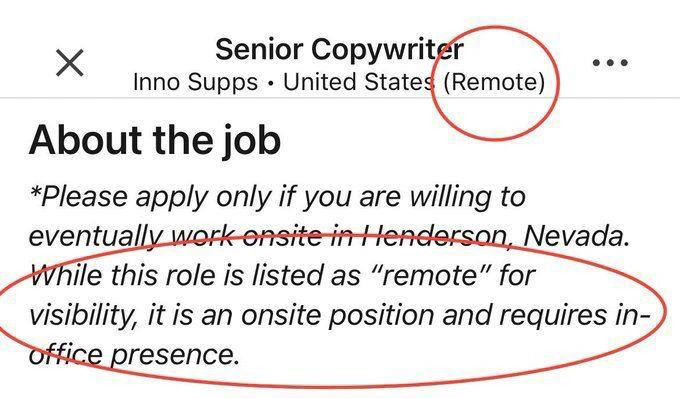
The breathtaking part of this screenshot isn't the bait-and-switch — it's the documentation. Most companies gaming job boards at least pretend. This posting for a Senior Copywriter at Inno Supps, tagged United States (Remote) in the header, opens its "About the job" section with a confession in italics:

Please apply only if you are willing to eventually work onsite in Henderson, Nevada. While this role is listed as "remote" for visibility, it is an onsite position and requires in-office presence.

"Listed as remote for visibility" is the corporate equivalent of writing // TODO: this is a lie directly above the lie. The two red circles annotating the screenshot — one around (Remote), one around the disclaimer — form a minimal reproducible test case: the metadata and the body contradict each other, and the author knows it.

Mechanically, this is search-filter gaming, the same dark pattern as keyword stuffing in SEO. Job boards expose a structured workplaceType field precisely so candidates can filter; the post-pandemic, return-to-office era turned "Remote" into the single highest-signal filter on any platform. Setting that field falsely is metadata fraud against the platform's ranking system, with applicants as collateral. Every engineer who has watched a product manager ask "can we just tag it differently so it shows up?" recognizes the move — garbage in the indexed fields, garbage in everyone's search results, and the commons degrades one "for visibility" at a time.

There's a systemic angle that makes this "too real" rather than merely scummy. Recruiting funnels are measured on top-of-funnel volume — applications per posting — not on applicant-hours wasted. So the incentive structure rewards exactly this: pollute the remote filter, harvest a bigger pool, let the disclaimer (or worse, the third interview) filter people back out. Multiply across thousands of listings and you get the modern job hunt's signature failure mode: candidates spray hundreds of applications because listings are unreliable, recruiters drown in unqualified volume because candidates spray, and both sides blame the other. It's a distributed trust failure, and like most of them, it persists because each individual defection is locally rational. Bonus irony, freely provided: the role being advertised with dishonest copy is Senior Copywriter. The job description is itself the writing sample.

Description

Screenshot of a LinkedIn-style job posting for 'Senior Copywriter' at Inno Supps, United States (Remote), with two red circles annotating the bait-and-switch. The '(Remote)' tag in the header is circled, and below in the 'About the job' section the circled italic text reads: '*Please apply only if you are willing to eventually work onsite in Henderson, Nevada. While this role is listed as "remote" for visibility, it is an onsite position and requires in-office presence.' The posting openly admits to gaming the job board's remote filter to harvest applicants for an in-office role - a dark pattern painfully familiar to anyone job hunting in the post-remote-work era

Comments

6
Anonymous ★ Top Pick They A/B tested honesty against reach and shipped the variant with better CTR - the senior copywriter role apparently starts before you're hired
  1. Anonymous ★ Top Pick

    They A/B tested honesty against reach and shipped the variant with better CTR - the senior copywriter role apparently starts before you're hired

  2. @dzek69 2mo

    they should be banned forever for the job listing website, but nobody has balls do to that, because fuck actual users, let's collect money from the companies

    1. @acidbong 2mo

      unless it's their own website

  3. @abra_mixabra 2mo

    or... emphasise on eventually :) like, in several years

  4. Егор 2mo

    who even needs copywriters in 2026. or it’s like «role is listed as copywriter for visibility, it is a janitor role»

  5. @chupasaurus 2mo

    Work hours above 1 per week are for compliance, it is a clown fiesta that should be compensated in full.

Use J and K for navigation