Skip to content
DevMeme
6183 of 7435
Anthropic Releases Claude 4 Benchmark Chart, Fueling the AI Model Wars
AI ML Post #6781, on May 22, 2025 in TG

Anthropic Releases Claude 4 Benchmark Chart, Fueling the AI Model Wars

Why is this AI ML meme funny?

Level 1: Robot Race

Imagine two super-smart robots taking a bunch of tests to see who’s the smartest – that’s what’s happening here. Think of it like a school competition or a race day for robots. We have Team Claude (the orange-highlighted columns) and Team GPT/OpenAI, and even a bit of Team Gemini (Google’s robot) showing up. They compete in different games:

  • In the coding game (like a programming quiz where the robots have to fix a broken app), Team Claude’s robot did better. It’s like Claude got a B and GPT got a C- in coding class. Claude’s robot could build and repair things on the computer more often.

  • In the command-line game (imagine a race where robots must navigate a computer’s terminal, like finding files and running commands), both robots found it tough, but Claude was a little faster – kind of like Claude finished 4 challenges out of 10, and GPT only 3 out of 10. Neither is a pro yet, but Claude’s ahead.

  • In the big quiz (lots of hard questions, like a trivia and logic test, even up to college level), both did well. One of OpenAI’s robots (they had two in the game, GPT-4.1 and another brainy one called o3) actually shined here, answering slightly more questions correctly. It’s as if on pure brain teasers, the OpenAI robot might be a bit more book-smart, but Claude was close behind.

  • In the tool-using challenge (imagine the robots had to use a calculator or look up info in a database to solve a task, like an obstacle course where they can pick up and use tools), Claude’s robot again showed it’s pretty handy – especially in a “retail store” scenario it solved 8 out of 10 tasks, whereas GPT’s solved about 7 out of 10. In an “airline booking” scenario, both struggled more, but Claude still did better (about 6 out of 10 vs GPT’s 5 out of 10). So Claude is like the robot that’s good at figuring out when to grab a tool and use it to get the job done.

  • In the language and knowledge quiz (questions in all sorts of subjects and even different languages, like a very global trivia contest), they all scored nearly the same – roughly 9 out of 10 questions right. It’s basically a tie here. Both robots are very knowledgeable; they might occasionally get one wrong or mixed up, but mostly they know their stuff, whether you ask in English or Spanish or Chinese.

  • In the picture game (where you show a robot a picture or diagram and ask questions about it), the OpenAI robot was best. If this was a test, OpenAI’s got maybe a B+ and Claude a C in the visual part. This suggests OpenAI’s robot has better “eyes” or ways to understand images. Claude’s robot is learning to see but isn’t as sharp at it yet. Google’s Gemini robot is also good at this, better than Claude, because Google has been training it to understand images from the start.

  • Finally, in the math contest (solving high school competition math problems), one of OpenAI’s robots (the o3 model) almost aced it – like an A grade. It probably used a calculator or some scratch paper though, which was allowed. Claude’s robot did okay, maybe a C or low B. This is funny because earlier in coding Claude was the champ, but in math OpenAI’s robot seems to be the mathlete. So each robot has its strong suit.

So what’s the story or joke here? It’s like a race or competition among the top AI robots to see who is best overall. The slide (or meme) is celebrating Team Claude for winning more of the events (it edged out GPT in many categories). People find it funny or intriguing because we’re used to thinking of, say, GPT-4 as this super impressive AI. But here comes Claude 4 (with fancy names like “Opus” and “Sonnet” as if they were characters or flavors) and it’s beating GPT-4’s next version in a lot of things. It’s a bit like an underdog story or a new challenger in a video game tournament dethroning the long-time champ. In the developer and tech world, this kind of thing gets folks excited – and they turn it into memes.

At its heart, this meme is saying: “Look, my new AI can code and use tools better than your AI!” – which is kind of a geeky brag. It’s as if two wizards are comparing their spells or two gamers their high scores. It’s both playful competition and genuine progress. For a non-technical analogy, imagine two classmates always vying for top grades. One usually wins (say GPT, from OpenAI, often has been the best). But in this latest test result, the other classmate (Claude, from Anthropic) got more A’s on the report card. So Claude’s folks highlight those scores in bright orange and share it for everyone to see. It’s a proud moment for Team Claude and a nudge at Team OpenAI like, “We beat you this time!” And everyone watching is like “whoa, the rivalry is heating up!”

Even if you don’t know all the tech details, you can sense the race aspect – numbers, percentages, winners and losers. The reason it’s amusing is because we’re personifying these AI models like competitors in a game. We know they’re just computer programs, but we talk about them like athletes: who’s faster, who’s smarter in which area. It’s a fun way to view serious development in AI. And just like in any race, people root for their favorite and poke fun at the others in a lighthearted way. Today, Claude’s on top in many events; tomorrow, who knows – maybe GPT or Google’s Gemini will take the lead.

So in one line: this meme is showing an AI showdown, with charts and scores, where a new AI model (Claude 4) is slightly ahead of the reigning champ (GPT-4.1) in a variety of tasks, and tech folks find it both impressive and entertaining to watch this high-tech horse race unfold.

Level 2: AI Report Card

Imagine you’re looking at a report card for AIs – that’s what this meme essentially is. It’s comparing a bunch of large language models (LLMs) on various “subjects,” and showing their scores as percentages. Let’s break down the players and the subjects in plain terms. The models (our “students”) are: Claude Opus 4 and Claude Sonnet 4 (two versions of Anthropic’s latest AI, think of them as siblings or maybe fraternal twins), Claude Sonnet 3.7 (an earlier or smaller version of Claude, like a younger sibling), OpenAI o3 (an oddly named new model from OpenAI – possibly a code name, so think of it as the new kid whose full name we don’t know yet), OpenAI GPT-4.1 (an update to the famous GPT-4, basically GPT-4’s next version – like a student who took another year of classes), and Gemini 2.5 Pro (Preview) (Google’s upcoming model, here in a preview form – a transfer student auditing the class but not fully graded in all subjects yet). The table rows are the “subjects” or tasks these AIs were tested on, and the numbers are their scores, usually as percentages (where 100% would be a perfect score).

Now, these aren’t simple subjects like math or history – they’re more like complex skill tests, but let’s simplify each one:

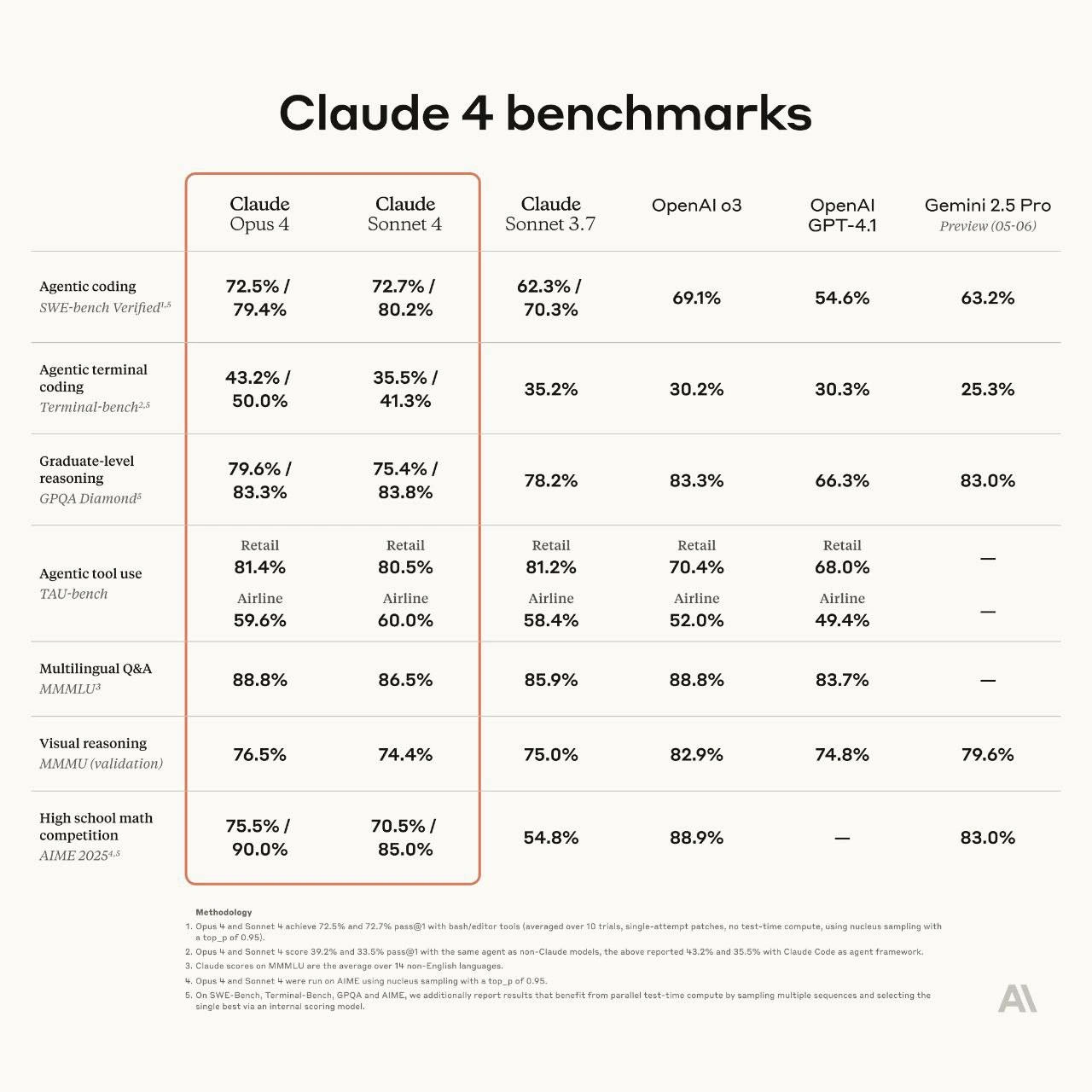
  • Agentic coding – SWE-bench Verified: This is like a programming exam where the AI not only has to write code but also run it and make sure it works correctly (passes tests). “Verified” means the code was checked against some tests or an expected output. SWE-bench likely stands for Software Engineering benchmark. So think of it as “Coding class.” The scores here (Claude Opus 4 got 72.5%, GPT-4.1 got 54.6%, etc.) show how often each AI successfully wrote working code for the problems given. A higher percentage means the AI is better at coding tasks that actually run without errors. In simpler terms: Claude studied hard for coding class and got a C-/B- (~72%), while GPT-4.1 barely passed with an F/low D (~55%). It’s kind of surprising, because GPT-4 was known to be good at coding, but here the new Claude 4 versions did even better. This is a key part of the meme’s punchline: Claude’s beating GPT at coding tests. That’s like saying the new kid in school just beat the long-time star student in the programming contest. For a junior dev, it signals how quickly the AI landscape changes – the one you thought was best (GPT-4) might get outperformed in specific areas by a competitor in just a year.

  • Agentic terminal coding – Terminal-bench: Now this one is a bit niche. It’s like a test of how well the AI can use a computer’s command line (terminal) to accomplish tasks. Think of giving the AI a terminal and asking it to do something a developer or IT person might do, like navigating folders, reading files, maybe running scripts – all via text commands. “Agentic” here means the AI has some autonomy: it can decide which commands to try. Terminal-bench is the benchmark name, essentially a “terminal skills” exam. The scores (e.g., Claude Opus 4 got 43.2%, GPT-4.1 around 30.3%) are quite a bit lower than the coding test. Even the best AI (Claude Opus) only succeeded ~43% of the time. That’s like a very hard lab test where even top students get less than half the answers right. For context, using a terminal effectively requires knowing the right commands and sequence. For example, if asked to “find and open the file that contains a certain phrase,” the AI might need to do grep to search and then nano or cat to open it. A lot can go wrong (the AI might hallucinate a command that doesn’t exist, or forget the right flags). As a junior dev, you might recall messing up command-line stuff yourself – these AIs are showing similar struggle but also some competence. The humor or interest point: hey, these AIs are actually operating a shell! It’s like hearing your calculator can now also do some basic computer admin tasks. We’re testing them not just on knowledge, but on actions now.

  • Graduate-level reasoning – GPQA Diamond: This sounds like a fancy Q&A (Question & Answer) test, possibly with very challenging questions (hence “Diamond” – like “diamond difficulty” in games). Think of it as an advanced reasoning or logic exam – maybe questions you’d see in graduate school or tricky interview puzzles. The scores (Claude Opus 4 around 79.6%, OpenAI o3 83.3%, GPT-4.1 66.3%) show that these models can answer quite a lot of tough questions correctly. OpenAI o3 got the highest score here (~83%), suggesting it’s particularly good at this kind of pure reasoning or knowledge test. Meanwhile GPT-4.1’s ~66% is noticeably lower – maybe the new GPT struggled with some brainteasers or complex problems that the others handled. If you’re not deep into AI research, think of “GPQA Diamond” as a really hard trivia and problem-solving quiz covering many subjects. The fact that any AI gets ~80% there is impressive, because even humans might not score that high without preparation. For juniors, consider that GPT-3 (from a couple of years before GPT-4) would have done far worse on such a test. So these numbers show how far this tech has come — and the meme is highlighting Claude 4’s strong performance, but also that different models have different strengths (OpenAI’s model seems top at this pure reasoning quiz, even if it lost in coding).

  • Agentic tool use – TAU-bench (Retail/Airline): Here “tool use” means the AI’s ability to use external tools or interact with systems beyond just answering questions. The tasks might be like, “For a retail scenario, maybe check inventory via an API or calculate something using a provided tool,” or “In an airline scenario, find and rebook a flight for a passenger given constraints.” Essentially, it’s a practical problem-solving test where the AI can use tools (like search, calculators, or specific software interfaces) to get the answer or perform an action. TAU-bench likely stands for “Tool-Augmented Usage” benchmark (or something similar). They have separate scores for “Retail” and “Airline” contexts, indicating two different domains of tasks. For example, Retail 81.4% / 59.6% for Claude Opus 4 might mean: in retail-related tasks it succeeded 81.4% of the time, and in airline tasks 59.6% of the time. The drop suggests airline tasks were harder (which could make sense; rebooking flights with rules might be trickier than a retail inventory lookup). Across the board, the Claude models are ~80% in retail tasks, whereas GPT-4.1 is 68.0% (retail) and 49.4% (airline). Google’s Gemini isn’t scored here (perhaps it wasn’t ready or integrated for those tests). This tells a junior developer a few things:

    • These AIs are not just static question-answerers; they can perform actions and use software, at least in a test environment. For example, they might have a plugin to query a database or call a flight reservation API.
    • Claude 4 seems to have an edge in these action-oriented tasks, which suggests Anthropic (Claude’s creators) trained it specifically to be good at following through multi-step instructions and using tools. Maybe they used frameworks like LangChain or provided the model with lots of practice using functions and APIs.
    • OpenAI’s GPT-4.1, while good, lags behind here, indicating it might not have had as much fine-tuning on tool use, or at least not in these particular scenarios. That’s a bit ironic since OpenAI’s ChatGPT plugins and function-calling were a big thing – but it could be that by version 4.1 they hadn’t yet optimized for these specific eval tasks.

    The real-world dev connection: Developers often have to use tools (CLIs, APIs, etc.) to get tasks done. If an AI can do 80% of a typical multi-step tool-using task, that’s a huge productivity boost. For instance, “Check all servers and restart the ones with high memory usage” – an AI might soon handle that kind of chore on its own. This benchmark is basically testing that kind of capability.

  • Multilingual Q&A – MMLU: MMLU stands for Massive Multitask Language Understanding, which is a big benchmark test consisting of thousands of questions on lots of topics, often in many languages. Simplify it: this is a general knowledge and language test, covering subjects from high school science to world history, and doing it in various languages (like English, Chinese, Spanish, etc.). The scores here are all around the high 80s (Claude Opus 4: 88.8%, Claude 3.7: 85.9%, GPT-4.1: 88.8%, etc.). They’re all pretty clustered, with 88.8% popping up multiple times (Claude Opus, OpenAI o3, GPT-4.1 all got 88.8% – possibly exactly the same, which is interesting). This tells us these top models are roughly tied when it comes to broad knowledge and understanding across languages. In simpler terms, if you ask any of these AIs “Who was the first president of X country?” or “What is the capital of Y?” or even more complex questions like “Explain the theory of relativity,” they’ll likely all do a decent job to a similar degree. For a junior dev or someone new to AI: earlier models might have failed in some niche subjects or languages, but these are now so well-rounded that at least for test questions they can answer most of them right. The meme includs this to show that on the bread-and-butter stuff (general knowledge), there’s no clear winner – it’s kind of maxed out or saturated. It’s a bit funny that they all got the same score; one wonders if 88.8% is like the “ceiling” right now due to either the difficulty of the remaining questions or limitations common to all models (maybe they all stumble on the same hard problems, or there’s a portion of the test none of them can crack reliably).

  • Visual reasoning – MMMU (validation): This represents how well the models can handle tasks involving images or visual information – basically multi-modal understanding (text + images). MMMU might be a play on MMLU but for multi-media or multi-modal tasks. “Validation” suggests these might be validation set scores. If you’ve seen GPT-4’s demos where it describes an image or solves a visual puzzle, that’s the kind of skill being tested. The scores show OpenAI’s model (o3) at 82.9%, Gemini at 79.6%, Claude Opus 4 at 76.5%, GPT-4.1 at 74.8%. So OpenAI leads here, Gemini is not far behind, and Claude is a bit lower. For a newcomer: not all these AIs can even handle images. Original GPT-4 had a vision component, but the user-facing ChatGPT didn’t initially have it enabled. Claude historically didn’t have vision at all (it was text-only). Gemini is rumored to be multi-modal from the ground up. So this category basically shows who has the best eyesight among the AIs. OpenAI’s new model likely can interpret images or diagrams slightly better than the others. The fact that Claude scores lower might just mean “Claude hasn’t been trained on vision as much.” The overall takeaway: models are being judged on more than just language now – seeing this in the mix shows how AI is expanding into processing images and maybe other media. For a developer, this hints at the future: you might give an AI not just text instructions, but also feed it charts, screenshots, or designs and have it reason about them.

  • High-school math competition – AIME 2025: AIME is a real math contest (American Invitational Mathematics Examination). It’s a 15-question, 3-hour exam that pre-university students take, and it’s hard. Getting a score like 90% on AIME is exceptional even for humans who are good at math. The table shows OpenAI o3 at 88.9%, Gemini at 83.0%, Claude Opus 4 at 75.5%, Claude 3.7 at 54.8%, etc. GPT-4.1 doesn’t have a listed score here (maybe it wasn’t tested or was still being worked on for math). These numbers are super impressive – earlier AI models struggled with math because it requires multi-step reasoning and precision (if the AI makes one small mistake in a calculation, the whole answer is wrong). But now we see OpenAI’s model almost aced it. How? The footnotes mention “with bash/solver tools” for coding and maybe similarly for math. That likely means the AI was allowed to use some external help, like writing a short program to calculate the answer or using a math solver for certain steps. So in practice, the AI might not just spit out the answer by pure thought; it might generate a piece of Python code to solve a quadratic equation or brute-force a combinatorics problem, run that code, and then output the result. In a sense, the AI acted like a student allowed to use a calculator or computer during the exam. And it used that capability well (especially OpenAI’s model). Claude did decently too (75.5% isn’t shabby on AIME; that’s like solving 11-12 out of 15 problems correctly). For a junior developer, this demonstrates how far AIs have come in problem-solving: we’re not just dealing with chatty assistants, we have ones that can legitimately solve competition math problems, the kind you might have struggled with in the math club. The meme is showcasing this dramatic improvement almost in passing, but it’s a wow factor for technical folks. It’s both funny and amazing because a couple of years ago we’d have laughed at the idea of an AI being that good at AIME – they used to mess up basic algebra often!

In simpler terms, the meme is a comparison chart to show how the newest AI from Anthropic (Claude 4) is outperforming the latest from OpenAI (GPT-4.1), across a bunch of developer-relevant tasks. It’s posted in a meme forum likely because it’s newsworthy in the AI world (Anthropic beating OpenAI on benchmarks is a spicy topic) and because the format is a classic brag: “Look, our guy’s better on most counts.” The combination of categories is tailored to what developers care about right now: coding assistance, using the command line, reasoning, using tools, knowledge breadth, visual input, and math. It’s basically the checklist for a super-dev-assistant AI. And the table suggests Claude 4 is currently ticking more boxes better than GPT-4.1 is. If you’re new to this, the key terms to know from the tags are:

  • LLM (Large Language Model): the type of AI model we’re talking about (like GPT-4 or Claude). They’re called “large” because of the huge number of parameters (think of parameters as the “neurons” in the network – GPT-4 was estimated to have hundreds of billions). These are trained on vast amounts of text data and can generate human-like text.

  • BenchmarkingTools: refers to the practice of testing models using standard tests (benchmarks) so we can compare them objectively. For example, MMLU is a benchmark in AI research; so is AIME (borrowed from a math competition), etc. These are like standardized tests for AIs.

  • AIIndustryTrends: this hints that what we’re seeing (Claude vs GPT vs Gemini) is part of a larger trend of fierce competition in the AI industry. Everyone is trying to build a more powerful model and show it off with metrics like these.

  • AIHypeCycle: The hype cycle is a concept where a new technology gets over-hyped, then people get disillusioned, then it finds a stable place. Right now, AI (especially models like GPT-4, Claude, etc.) are at peak hype. Leaderboards like this contribute to it – every incremental improvement is touted as a big deal, and people swing between “AI is amazing, it can do everything!” and “AI still fails at obvious things, it’s overhyped.” This meme leans into the hype (highlighting the wins) but as a savvy reader you can see some misses too (like that 25.3% for Gemini on terminal tasks – ouch, it barely got a quarter right there).

  • AILimitations: even though numbers are high, the tags remind us that these models have limits. For instance, 72% on coding means 28% of the time it didn’t get it right. And even a single failure in coding could mean a program that doesn’t run. So, real-world use still requires caution.

  • AIResearch: all these benchmarks and improvements come from ongoing research. New techniques (like giving models access to tools, better training data, fine-tuning on code, etc.) are being applied. If you’re into machine learning, almost each row corresponds to a research paper or challenge: Code generation (SWE-bench), Embodied agents or tool use (Terminal-bench, TAU-bench), broad knowledge (MMLU), multi-modal models (MMMU), and reasoning (GPQA, AIME math solving).

  • Performance: a straightforward tag because the whole meme is about performance metrics – who’s faster, better, stronger on a given task.

  • OpenAI: one of the key players in this chart. They’re behind GPT-4.1 and the mysterious “o3”. The presence of two OpenAI columns might confuse a newbie, but presumably OpenAI’s next big model (GPT-4.1) is on the right, while “o3” might be some internal project or a codename model that the slide’s author included for completeness (maybe an OpenAI model specialized in reasoning).

Parsing the context tags: they match terms we’ve explained:

  • claude_opus_4 / claude_sonnet_4 / claude_sonnet_3_7 are just those model names.
  • openai_o3 / openai_gpt_4_1 / gemini_2_5_pro likewise are model names.
  • swe_bench, terminal_bench, gpqa_diamond, tau_bench, mmlu, mmmu, aime_2025 are exactly the benchmarks we went through one by one.
  • agentic_coding, agentic_tool_use highlight that notion of the AI acting like an agent (taking multi-step actions autonomously in an environment, whether it’s writing code or using a tool).
  • benchmark_table, percentage_scores, llm_comparison describe the nature of the meme: a table of percentage scores comparing LLMs (Large Language Models).

In summary, Level 2 understanding: This meme is showing a comparison of new AI models on a range of tasks to prove which one is ahead. Claude 4 (Anthropic’s model) is mostly ahead of OpenAI’s GPT-4.1 in many coding and tool-using tasks, according to this chart, which is why it’s meme-worthy for developers. It illustrates the AI race in a concrete way: with stats and bragging rights. If you’re a junior dev or just tech-curious, the take-home is that AI models are rapidly getting better at things like programming, using software, reasoning, and even interpreting images – and companies are in a sprint to claim the top spot. Today it’s Claude leading in many areas; tomorrow it might be a new GPT or Gemini. It’s almost like following sports rankings, except for AI capabilities.

Level 3: The LLM Olympics

From a senior engineer’s perspective, this meme is like a scoreboard from the AI Olympics. Each column is a superstar model from a major team – Anthropic’s Claude 4 (Opus and Sonnet variants), OpenAI’s GPT-4.1 and a mysterious “o3”, and Google’s preview of Gemini 2.5 Pro – and each row is a different event in this competition. The humor here is partly in how seriously we’re taking this rivalry: the slide literally outlines the Claude 4 columns in orange, as if draping gold medals on them for outscoring OpenAI’s models in most events. We’ve seen this kind of bragging in tech before (think Intel vs AMD benchmark wars, or NVIDIA vs AMD GPU frame rates), but now it’s about whose AI is better at writing code or solving math. BenchmarkingTools are the new arena of combat in the AI industry trends. Experienced devs recognize a bit of the AI hype cycle at play: every few months, someone posts a leaderboard where a new model edges out the previous champion by a few points, declaring victory. It’s almost tongue-in-cheek that the title says “Claude 4 variants edge out GPT-4.1” – that phrasing (“edge out”) hints these wins are marginal. Indeed, look at the percentage_scores: Claude Opus 4 gets 72.5% on the coding benchmark vs GPT-4.1’s 54.6%. Okay, that one’s a hefty lead (Claude wins coding by a mile). But in others, like Multilingual Q&A (MMLU), both Claude and GPT-4.1 are neck-and-neck at 88.8% – basically a tie, which the slide conveniently doesn’t emphasize. It’s a classic marketing move: highlight the categories where you lead, gloss over where you lag. Seasoned observers chuckle at this because we’ve sat through countless vendor presentations doing the exact same thing. AIIndustryTrends today mirror the old CPU benchmark battles: one chip is 5% faster in gaming, the other is 10% better in multi-threaded tasks – and each company’s slide deck will only show the tests where they win. Here Anthropic is touting “real-world dev productivity metrics” like agentic coding and terminal automation because that’s where Claude shines. Meanwhile, we notice OpenAI’s strengths mildly downplayed – for instance, GPT-4.1 (or OpenAI o3) apparently crushes visual reasoning (82.9% vs Claude’s ~75%) and high-school math (nearly 89% correct, whereas Claude is ~75%). The slide even has blanks (—) for GPT-4.1 in some rows, which raises an eyebrow: did they not test GPT-4.1 on AIME 2025 math, or did it bomb so hard they’d rather not say? 😏 A seasoned dev or researcher might suspect the latter or a testing omission. It’s funny in a petty way – like leaving your rival’s score off the chart entirely when it doesn’t flatter them. Classic.

What’s being satirized is that we have started treating AI model releases like a sporting event. Each new model (Claude 4, GPT-4.1, Gemini) enters the race with big claims, and we line them up on benchmarks to see who wins gold, silver, bronze in each category. Those categories themselves reflect the hot topics of AI and developer life right now. Agentic coding basically means “can the AI build and debug software on its own?” – a task very relevant to engineers (imagine code generation that actually works out-of-the-box). The fact that an AI can get ~72% of such tasks right with automated verification (the “Verified” in SWE-bench) means it’s not just generating plausible code, it’s generating correct code that passes tests a good chunk of the time. For devs, that’s a jaw-dropper and also a bit of a job security scare (half-jokingly). The meme taps into that shared awe and anxiety. It’s like, “Wow, Claude is basically an entry-level dev now, and GPT-4.1 is maybe a junior dev who didn’t study as hard for the coding interview.” We can laugh, because any engineer who’s tried these models knows they’re impressive but also flaky. They might ace one problem and horribly fail on a slightly tweaked one. So we’re not packing our office desks just yet. But that 72.5% on coding tasks is a canary in the coalmine: it hints that AI could handle a lot of coding grunt work soon, which is both exciting (we get to automate more boring tasks) and daunting (please don’t introduce 100 new bugs while fixing 72% of them!).

Then Agentic terminal coding – basically having the AI operate a command line – tickles developers because using the CLI efficiently is a bit of a rite of passage. Many of us recall fumbling with vim or accidentally doing rm -rf in the wrong directory at 3 AM. The idea that an LLM can navigate terminal tasks (with about 30-50% success depending on the model) is amusing and astonishing. It’s as if these models were challenged to an ops/devops hackathon and did… okay-ish. Not spectacular (43% for top Claude means it fails more than half the time), but imagine an AI that can half the time set up your environment, run tests, or parse logs for you. Those who’ve been on call at 3 AM definitely want that someday, but we also know those percentages need to be in the high 90s before we trust AIs with prod systems! The meme’s underlying wink is “Look, we’re nearly there, but not quite – isn’t it wild how far we’ve come?”

Graduate-level reasoning – GPQA Diamond might not be something every dev has direct experience with, but they get the gist: it’s measuring how deeply the AI can think. The senior crowd likely nods at this because we remember when AI could barely do basic logic puzzles, and now we have it tackling graduate-admission exam caliber questions. Diamond implies a super-hard difficulty tier. Claude hitting ~80% is impressive, but what catches the eye is GPT-4.1 at 66%. That’s a steep drop – maybe GPT-4.1 struggled with the really tricky, trap-laden questions. As veterans, we speculate: GPT-4 (the original) was known to be strong at reasoning, so what happened? Did OpenAI’s alignment tuning or safety constraints inadvertently dumb it down a bit in some areas? Or is this GPT-4.1 a different beast not fully optimized for pure logic? It reminds us how model versions can trade off abilities (maybe GPT-4.1 is safer and more steerable, but a tad less brilliant in unfettered reasoning than an earlier snapshot or a competitor). We’ve seen similar in software: a new OS version patches security but runs slower, a database gets safer writes but slower transactions. In AI, apparently, you might lose some raw IQ points while fine-tuning for better behavior. It’s an AI limitation that tuning is a balancing act, and this slide quietly flags that.

Agentic tool use – TAU-bench (Retail/Airline) steps right into what many senior devs find both promising and concerning: AI that can use tools. We all have those internal scripts or Postman collections to hit an API, parse a CSV, or scrape some data. If an AI can do that by itself (say, “book me the cheapest flight and then update my calendar”), it moves from being a clever text predictor to a genuine assistant. The benchmark’s two contexts, Retail and Airline, sound like realistic business scenarios – maybe tasks like “look up inventory and restock if below threshold” or “find alternate flights for a passenger given these constraints”. The table shows Claude and its kin scoring around 80% in Retail tasks, a bit lower in the Airline scenario (~59-60%), whereas OpenAI’s GPT-4.1 trails at ~68% (Retail) and 49% (Airline). Google’s Gemini wasn’t tested (or not ready) for these, hence blanks. This is a nod to what’s coming: AI agents that handle domain-specific workflows. The senior engineering crowd knows there’s a tonne of integration and reliability work hidden behind those numbers. It’s one thing to get an answer right in a lab setting, another to trust an AI to, say, autonomously run a script on production data. We grin at the scenario: “Sure, let’s let Claude 4 automate some retail processes – what’s the worst that could happen?” (Cue war stories of automation gone wrong.) The humor is subtle: the scores make it look like a horse race, but behind each score there are probably dozens of cases where the AI did something nonsensical or had to be hard-corrected by an evaluation harness. Veterans suspect that for the AI to score ~80% on a tool-use task, the eval might be forgiving or the tasks somewhat templated. After all, we’ve wrestled with voice assistants failing a simple “send a text to Alice” if phrased oddly. The idea that an AI nails 4 out of 5 tool-using tasks in two complex domains is both amazing and to be verified. It’s exactly the kind of result you’d highlight in a slide to generate buzz, while we, the peanut gallery, chuckle and say “I bet the demo will still break in front of the CEO.”

Now, Multilingual Q&A – MMLU at ~88% is something even juniors discuss, but seniors have the historical context: a few years ago, an AI reliably answering questions in English was a milestone; doing it across dozens of languages and topics at this accuracy is astonishing progress. MMLU, a massive multitask language understanding benchmark, is a comprehensive test – from math to history, in multiple languages. The fact that Claude, GPT-4.1, and OpenAI o3 all hit about 88.8% suggests we’re reaching an upper bound of current tech on general knowledge recall and reasoning. Senior folks might joke, “88%... so basically fluent, but still occasionally making stuff up.” That tracks with our real-life experience with these models: they’re generally right, but that 12% of mistakes can be wild hallucinations or subtle errors. It’s funny because those who have deployed or trusted an AI on something serious know that feeling of comfortable uncertainty – nine times out of ten it’s right, but you always double-check that tenth answer. The meme’s numbers confirm what our gut already knew: the models are knowledgeable but not infallible, roughly an A- student in world facts and reasoning.

Visual reasoning – MMMU shows a noticeable gap: OpenAI’s o3 and Google’s Gemini are handling visual tasks better (~80+%) while Claude lags in the mid-70s%. Engineers in the know see a story here: OpenAI and Google have been investing in multi-modal models (GPT-4 can analyze images, Gemini is rumored to be multimodal), whereas Anthropic’s Claude historically has been text-only and likely only recently flirting with images. So when we see 76.5% for Claude vs 82.9% for OpenAI on MMMU’s validation, we nod – it aligns with what we suspect about their differing focuses. It’s a friendly reminder that no single model leads in everything. It’s almost like how one cloud provider might have better AI services, but another has better pricing or network speed. Each model has a personality: Claude = NLP specialist, GPT-4.1 = well-rounded but maybe not as fine-tuned in code, OpenAI o3 = the new challenger excelling in logic and math, and Gemini = the vision-oriented up-and-comer. In these numbers, devs savvy with the AI landscape see reflected the strategies of each company. Anthropic clearly doubled down on coding and tool use (maybe they fine-tuned on coding a ton and integrated something like a secure execution sandbox for the model). OpenAI appears to be bridging to vision and keeping strong on pure reasoning. Google’s Gemini is likely leveraging Google’s prowess in images and data (notice how Gemini’s visual reasoning is strong and its math is high at 83%, possibly due to Google’s experience with algorithms and maybe DeepMind’s AlphaGo-like reasoning techniques seeping in).

Finally, High-school math – AIME 2025 is almost an inside joke among AI folks. For a while, math and logical reasoning were considered the Achilles’ heel of LLMs. Seeing any model score near 90% on an AIME is like hearing someone ran a 4-minute mile – not impossible, but very, very hard. OpenAI o3 hitting 88.9% is an eye-opener (did they secretly build a theorem prover into the model?). The blanks and missing entries tell a tale: GPT-4.1 might have had trouble or wasn’t tested, and even Claude’s great at coding yet significantly weaker in competition math (75.5%). It reminds senior devs of real colleagues – that one coder who can build anything but struggles with algorithm puzzles, vs. the algorithm whiz who might not be as practical in building an app. These models are specializing, and the meme humorously lets us personify them: Claude 4 is like the prodigious software engineer who automates their tasks and writes scripts for everything, GPT-4.1 is the seasoned generalist who knows a bit of everything but maybe hasn’t focused on coding lately, and OpenAI o3 is the sharp intern who aces all the brainteasers and math problems but hasn’t yet proven themselves in large projects. The AI hype cycle aspect is that each of these models will likely leapfrog each other soon. We’re basically watching back-and-forth one-upmanship. Senior engineers have seen similar cycles: one database had the lead until a new index type came out in the competitor, or one JavaScript framework was fastest until the next version of another optimized the vDOM. In AI, it’s just accelerated – the cycles are months, not years. Today Claude’s on top in many categories; give it a few months and maybe OpenAI or Google will strike back with a “4.2” or “Gemini 3” that reclaims the crown. The meme captures that frenetic race perfectly: it’s simultaneously celebratory (go team Claude!) and lightly satirical (we know this victory might be short-lived, but let’s enjoy it). Seasoned devs also catch the fine print in the image: methodology footnotes. Ah yes, the classic asterisks that hide how the scores were obtained (“single-attempt patches, no test-time compute” etc.). We smirk at that – no benchmark is truly neutral. There are always assumptions: which prompts were used, was the model allowed to use Python tools (apparently yes for code and math here), how many tries did it get, etc. Those footnotes are the “small font” of this contest, reminding us not to take any of it as absolute truth. But in meme spirit, no one’s reading those closely; we’re here for the headline: Claude 4 wins! It’s a playful snapshot of AI bragging rights circa 2025, and we find it funny because it’s accurate about the landscape yet presented in such a deadpan, official way – as if this were a serious press release from the AI Olympics committee.

Level 4: Ghost in the Shell Script

At the bleeding edge of AI research, this meme highlights the nitty-gritty of how advanced Large Language Models (LLMs) are becoming agents, not just chatbots. The table of benchmarks reads like an AI decathlon, covering everything from coding to math. Take Agentic coding on SWE-bench Verified: a whopping 72.5% success for Claude Opus 4 (vs. GPT-4.1’s 54.6%). This isn’t just writing code from memory – it’s the model iteratively writing, running, and fixing code until it passes tests, almost like a search algorithm exploring the solution space. In theoretical terms, it’s program synthesis blended with an auto-regressive plan-and-execute loop. Each attempt is akin to traversing a tree of possible programs (an exponentially large space – a Turing Tar Pit if you will) and converging on one that meets the spec. The fact an LLM can navigate this at ~72% success hints at emergent reasoning capabilities. It’s as if there’s a “ghost in the shell script” – the model internally simulating a junior developer’s workflow of writing code, running it, seeing errors, and patching bugs. Researchers have been chasing this for years: combining neural language models with symbolic execution or external tools to solve tasks that pure neural nets struggle with. Here, the shell (terminal) is that external tool: the Terminal-bench score (50.0% for Opus 4) indicates the model can perform multi-step CLI operations – essentially treating the Unix shell like its playground.

This is hugely complex: giving an AI a virtual terminal turns problem-solving into a form of reinforcement learning in a text-based environment. The model must plan a sequence of commands (like ls, grep, or running pytest) to reach a goal state. In Terminal-bench, a model with 43.2% might list files, open one, find needed info, and succeed less than half the time. That involves understanding system state, command effects, and error handling – things bordering on what a junior sysadmin or devops script would do. The theoretical challenge is that the state space of a terminal is massive (all possible command sequences), so a high score means the model has learned some heuristics or patterns to navigate common tasks. We’re basically witnessing a learned policy for command-line problem-solving induced from text training data and fine-tuning. It’s mind-bending: a language model, trained on internet text, ends up able to pseudo-shell-script its way through tasks.

Now look at Graduate-level reasoning – GPQA Diamond. This presumably represents a hard QA benchmark (perhaps analogous to an advanced GRE or a mini Turing Test question set). The Claude variants and OpenAI’s mysterious “o3” model are scoring in the high 70s–80s (Opus 4 at 79.6%, GPT-4.1 lagging at 66.3%). Such high scores at “Diamond” difficulty suggest these models can carry out complex logical reasoning or multi-hop inference. Under the hood, that’s tied to the chain-of-thought capability: the model can internally break a tough problem into steps and arrive at correct answers more often than not. There’s an entire body of theory on why scaling up parameters and training data gives rise to these emergent reasoning skills – it’s an open-ended generalization phenomenon where the model’s internal representations begin to mimic symbolic logic. Some researchers liken it to implicit meta-learning: the model has seen so many QA examples that it learned to “simulate” a reasoning process without being explicitly programmed for it. The humor here, in a nerdy way, is that we’re treating these massive inscrutable neural nets like students taking an exam – and celebrating small percentile differences like they’re Olympic records. It’s a benchmark arms race grounded in very real AI theory: from the CAP theorem of distributed decision-making (relevant for planning tasks) to the complexities of NP-hard problem solving in code generation, each row in that table reflects a deep computer science challenge now being tackled by an AI. The agentic tool use (TAU-bench), for example, isn’t just a random test – it probes if an AI can effectively decide when to invoke external APIs or calculators (a bit like having a built-in Toolformer ability). High scores (81.4% in retail tasks) hint that Claude’s architecture or training explicitly allowed it to incorporate external knowledge sources or APIs at runtime. This moves toward the classic AI dream of symbolic and connectionist hybrid systems: the neural net does the reasoning and language, but knows when to call a precise algorithm for arithmetic or database lookup. We’re inching closer to that systems integration of AI, where an LLM becomes an orchestrator of tools – a concept rooted in early AI research (think of SOAR or blackboard systems, reborn in a neural guise).

The Multilingual Q&A – MMLU scores (~88% for several models) indicate these models are nearing saturation on broad knowledge benchmarks. MMLU (Massive Multitask Language Understanding) spans everything from history to biology in multiple languages. Getting ~88.8% suggests they’ve achieved or surpassed expert-level performance in recall and application of facts, at least for the questions asked. The theoretical twist: once a model’s performance flattens out here, it implies the benchmark is almost solved – further gains might require qualitatively new techniques or just indicate diminishing returns. It’s ironic and fascinating that Claude, GPT-4.1, and OpenAI’s o3 all hit the same ceiling (88.8%), as if there’s a common limit of current model architectures on that broad knowledge task. It smells like an asymptote in the scaling law curves – adding parameters or data might not move that needle much further without new breakthroughs (like better memory or reasoning enhancements).

Visual reasoning – MMMU (validation) points to multi-modal prowess: OpenAI’s models (with 82.9% for o3) outperform Claude here (Claude Opus 4 at 76.5%). That aligns with known design choices: GPT-4 had a vision component in some versions, and Google’s Gemini 2.5 Pro (79.6%) is expected to excel at multi-modal input. This is where the cutting edge touches cognitive science – understanding images or visual-spatial information was traditionally outside pure language model capability. Integrating vision requires combining convolutional or visual transformers with the language backbone, crafting a unified representation. The high scores tell us that these integrated vision-language models are internally aligning visual patterns with linguistic descriptions effectively (imagine the model “seeing” an image and forming a mental caption or logical description of it). The meme’s MMMU benchmark likely involves answering questions about images or diagrams (hence visual reasoning). From a theoretical standpoint, solving that means dealing with modalities of data that have very different structures (continuous pixels vs. discrete words) – a testament to how far transformer-based architectures have come in generalizing across domains.

Finally, High-school math – AIME 2025 is perhaps the most striking. The American Invitational Math Exam is not trivial – it demands creative problem solving, not just plugging numbers. An 88.9% by OpenAI’s o3 suggests near mastery, possible only by combining the LLM’s understanding with a tool (the footnote hints at using solver tools). So o3 likely knows when to hand off a calculation or equation to a Python solver or a bit of its own pseudo-code execution. Claude’s 75.5% is lower, implying it might falter on the hardest problems or lacks some specialized fine-tuning in math. This is where theory meets practice: pure neural network approach to math hits limits due to precision and length of reasoning (long proofs are hard due to sequence length limits and compounding errors). But augmenting an LLM with a computer algebra system or simply the ability to run Python code changes the game – it’s leveraging the Church-Turing thesis in a cheeky way: if the model can’t solve it by thought alone, let it compute. We’re basically letting these models write and execute code as a form of reasoning (like an inner oracle). It’s conceptually similar to how a mathematician might take out a calculator or run a quick script to test a conjecture. The humor underlying this slide is the absurd sophistication and specialization we’ve reached in AI: we now casually discuss how one model edges out another by a few percentage points on a niche benchmark that itself represents something incredibly complex (like “Agentic terminal coding”). It’s a far cry from just measuring perplexity on text – we’re in the realm of measuring an AI’s ability to act intelligently in simulated work scenarios. From a deep tech perspective, it’s both exciting and a little surreal: these numbers are effectively a scoreboard of how close we are to bridging narrow AI tasks towards a more general AI. And each tiny improvement likely stems from massive engineering: more parameters, better fine-tuning, novel training regimes (RLHF with tool use), or architectural tweaks like longer context windows and modality fusion. The meme doesn’t show all that detail, but every seasoned AI engineer knows there’s a world of gradients and tensor ops under each bold percentage. So at Level 4, we’re smiling at how our once theoretical dreams (an AI that writes code and uses a terminal) are now empirical results on a slide – a bit like mathematicians seeing experimental proof that a conjecture is true “enough times to be convincing.” It’s cutting-edge stuff that also tickles our geeky bone: it’s both a flex and a farce that we’re treating AI evaluations like Fantasy Football stats.

Description

A clean, professional-looking chart titled 'Claude 4 benchmarks' presents a performance comparison of various large language models. The table lists several models in columns: Claude Opus 4, Claude Sonnet 4, Claude Sonnet 3.7, OpenAI o3, OpenAI GPT-4.1, and Gemini 2.5 Pro Preview. The rows represent different benchmark tests, including 'Agentic coding (SWE-bench Verified)', 'Graduate-level reasoning (GPQA Diamond)', and 'Visual reasoning (MMMU validation)'. The cells are populated with percentage scores, some of which show two numbers separated by a slash. At the bottom, a 'Methodology' section provides five footnotes detailing the testing conditions, such as sampling techniques. This image is a typical example of a competitive benchmark report released by an AI company (Anthropic, indicated by the 'AI' logo) to showcase its models' capabilities against major rivals from OpenAI and Google. For experienced engineers, these charts are viewed with interest but also healthy skepticism, as the results are highly dependent on the specific tests and methodologies, which may not always reflect real-world performance on complex, production-level tasks

Comments

30
Anonymous ★ Top Pick Ah, the quarterly LLM benchmark release. A time-honored tradition where every company presents their model as a valedictorian, conveniently omitting the subjects it failed and the open-book policy detailed in the methodology footnote
  1. Anonymous ★ Top Pick

    Ah, the quarterly LLM benchmark release. A time-honored tradition where every company presents their model as a valedictorian, conveniently omitting the subjects it failed and the open-book policy detailed in the methodology footnote

  2. Anonymous

    Turns out even models with eight-digit parameter counts panic at the Terminal-bench - proof that "saving the demo with sudo !!" remains unsolved AI alignment

  3. Anonymous

    Watching Claude 4 beat GPT-4.1 at coding benchmarks is like watching your junior engineer fix that legacy codebase you've been avoiding for months - impressive, slightly concerning, and makes you wonder if you should update your LinkedIn to 'AI Prompt Architect' before the models start reviewing your PRs

  4. Anonymous

    Claude Opus 4 scoring 90% on high school math while only hitting 50% on terminal tasks perfectly captures the AI industry's current state: we've built models that can ace calculus but still struggle to `cd` into the right directory. It's like hiring a PhD who needs help with basic shell navigation - technically brilliant, practically humbling. The real benchmark isn't whether AI can solve AIME problems; it's whether it can survive a production incident at 3 AM without accidentally `rm -rf /` the entire deployment

  5. Anonymous

    Claude 4 aces agentic coding benchmarks - now if only it could untangle our 20-year monolith's cyclic deps

  6. Anonymous

    Nothing says rigorous science like a leaderboard where the big numbers are above tiny footnotes about bash tools, nucleus sampling, and parallel test-time sequence selection - the peer-reviewed version of “works on my GPU.”

  7. Anonymous

    Amazing how we’re 80% on SWE-bench once you allow pass@k, sampling, and toolchains - then Terminal-bench drops to ~30%, i.e., the difference between your slide deck and ssh-ing into prod

  8. dev_meme 1y

    You?

  9. dev_meme 1y

    FFS!

  10. dev_meme 1y

    No, for real, wtf is going on 😂

    1. Deleted Account 1y

      Well, i know want to see their naming for releases.

      1. dev_meme 1y

        You might have guessed it V0-1.0 🤣

        1. dev_meme 1y

          Ohhh no, I’m sorry, it’s even more funny v0-1.0-md

  11. Sure Not 1y

    bias(math.random()) - "ohhhh this model is so smart in reasoning and science"

  12. @itsTyrion 1y

    What problem does it solve? No, those numbers don't count, I meant problems, not hand picked tasks that are very likely in the training data

  13. @Art3m_1502 1y

    But can it count letters 'o' in 'strawberry'?

    1. dev_meme 1y

      Just did it for fun

      1. dev_meme 1y

        Time to buy a land plot and become farmer, I know

      2. Deleted Account 1y

        Finally!

        1. dev_meme 1y

          I didn’t get what the point of the question tho Like, if you really thought it will fail then you really need to spend some time to finally experiment with frontier models (and spend some money on it, yes)

          1. @Art3m_1502 1y

            My friend once tried to get right answer from gpt, he asked to count letters 'o' in word 'молоко'. He spent at least 30 min teaching him how to count, lol

            1. @itsTyrion 1y

              Tell LLaMa 3.1 7B (local) to carefully evaluate and it oneshots the strawberry question interestingly enough. Just ask and you get a correct answer once every blue moon

      3. @dsmagikswsa 1y

        What is special in counting?

        1. dev_meme 1y

          Everyone is still obsessed with tokenizer issues I suppose 🥲

  14. @itsTyrion 1y

    Yes because thats in the training data now.. but ask a different word and the "sota" models fuck up again 😂

    1. dev_meme 1y

      This is much more complicated now Companies preparing training data is actually worth much more money than they should

  15. dev_meme 1y

    SWE-bench methodology For the Claude 4 family of models, we continue to use the same simple scaffold that equips the model with solely the two tools described in our prior releases here—a bash tool, and a file editing tool that operates via string replacements. We no longer include the third ‘planning tool’ used by Claude 3.7 Sonnet. On all Claude 4 models, we report scores out of the full 500 problems. Scores for OpenAI models are reported out of a 477 problem subset. For our “high compute” numbers we adopt additional complexity and parallel test-time compute as follows: We sample multiple parallel attempts.We discard patches that break the visible regression tests in the repository, similar to the rejection sampling approach adopted by Agentless (Xia et al. 2024); note no hidden test information is used.We then use an internal scoring model to select the best candidate from the remaining attempts.This results in a score of 79.4% and 80.2% for Opus 4 and Sonnet 4 respectively.

  16. @summitbc 1y

    Neither is a slightly bigger number on some bs "benchmark"

  17. @itsTyrion 1y

    I meant if you straight up ask. I added "carefully evaluate your answer" and it splits it into letters and answers correctly. Weird.

  18. @mihanizzm 1y

    Well, but where's vibe coding benchmark?🤔

Use J and K for navigation