The Three Hard Problems of Programming, with an Off-by-One Error
Why is this CS Fundamentals meme funny?
Level 1: Counting Gone Wrong
Imagine you ask someone to list two important things, and then they do something like this: “There are two big chores we need to do today: 1. Wash the dishes, 3. Take out the trash, 2. Do the laundry.” You’d probably blink and say, “Huh? You skipped number 2 and put things out of order!” It’s immediately silly, right? They said there were two chores, but they actually mentioned three, and the numbering went 1, 3, 2. Clearly, they messed up the counting and the order of the list.
This meme is funny for the same kind of reason. It’s like the person writing the list forgot how to count properly and how to list things in sequence. In a normal list you’d go “1, 2, 3.” If you go “1, 3, 2,” it’s obvious something’s mixed up. The joke here is that programmers – people who are usually very logical – often joke about making exactly these kinds of simple mistakes when they code. One of the “hard problems” mentioned is naming things, which just means coming up with a good name for something (imagine trying to name a pet or a game – sometimes you just can’t find the perfect name and it’s weirdly tough!). The other two problems are basically counting and timing mistakes: off-by-one errors are when you’re off by one in counting (like counting to 10 but accidentally stopping at 9 or going to 11), and race conditions are when things happen in the wrong order because two events were rushing (imagine two kids racing to grab a toy, and they end up doing tasks out of order because they’re not taking turns).
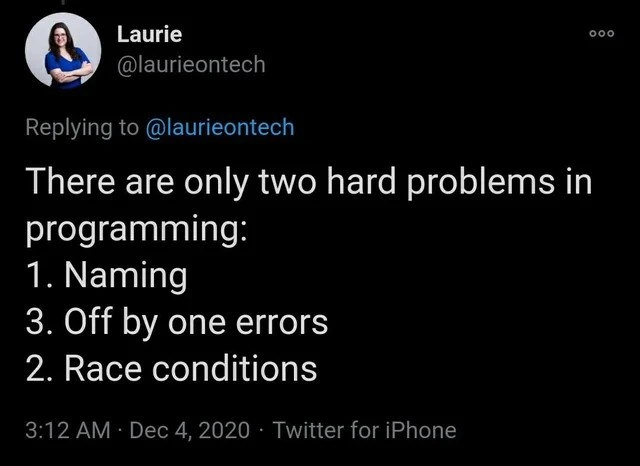
In the tweet, the person says “only two hard problems in programming” but then lists three problems — that’s a cheeky way to show they miscounted by one. And listing “3” before “2” shows things got out of order. It’s as if the list itself suffered a couple of little glitches! If you’ve ever assembled something with steps and accidentally skipped a step, you know how confusing that can get. Here, skipping the number 2 and putting things out of order is a playful demonstration of how even very basic tasks (like counting or ordering steps) can go wrong.
The reason programmers find this hilarious is that it’s an inside joke about the kind of errors they deal with. It’s poking fun at the fact that, in coding, simple things can become surprisingly tricky. We laugh because the tweet’s author intentionally made a “mistake” to prove a point: even the list of problems isn’t safe from those problems! On the surface, it’s just someone counting wrong in a funny way. But if you know about coding, you recognize that it’s referencing real issues that can cause real bugs. It’s a bit like a clown act for computer folks – the humor comes from seeing someone trip over an obstacle they themselves set up, all in good fun. So, basically, the meme makes us laugh because the list of “two hard problems” ironically creates two more problems (a counting mistake and an ordering mix-up) right before our eyes. It’s a little mathematical comedy sketch that anyone who’s ever mis-numbered a list or done things in the wrong order can chuckle at.
Level 2: 1, 3, 2... Oops!
Let’s break down the joke in simple terms, because it’s packed with references to programming basics. This meme (a screenshot of a tweet) is a piece of coding humor that lists “only two hard problems in programming” but then actually lists three things. The list of items is:
- Naming
- Off by one errors
- Race conditions
Notice anything weird? The numbering goes 1, 3, 2 instead of 1, 2, 3. That’s not a typo – it’s the joke! The tweet’s author intentionally misnumbered the list to illustrate two of the problems being mentioned (off-by-one errors and race conditions) in a tongue-in-cheek way.
Now, if you’re newer to programming, here’s what each of those terms means and why they’re considered “hard problems”:
Naming (things): In programming, naming means coming up with clear, descriptive names for variables, functions, classes, etc. It sounds easy – after all, it’s just words, right? – but picking a good name can be surprisingly tricky. For example, imagine you have to name a function that calculates an interest rate. Do you call it
calcInt()orcomputeAnnualInterestRateor something else? A good name is important because other developers (and future you) rely on it to understand what the code does. If you name things poorly or inconsistently, it leads to confusion and bugs. That’s why there’s a common saying among developers that “naming things is one of the hardest parts of software development.” It’s a bit of an exaggeration, but it resonates because we’ve all spent far too long trying to find the right name for something in code. Good naming is part art, part science, and it’s definitely a skill that you develop over time.Off-by-one errors: An off-by-one error is a classic programming mistake where a calculation is off by one unit. This often happens with counting, indexing, or loops. It’s the kind of bug where you accidentally do one iteration too many or too few, or you start counting at 0 when you should have started at 1 (or vice versa). For instance, if you have a loop that’s supposed to run 5 times, an off-by-one error might make it run 4 times or 6 times by mistake. A common scenario is with arrays: if an array has 5 elements, valid indices go from 0 to 4. But a beginner might try to access index 5 (thinking 5 elements means you go up to 5), which is an off-by-one error that causes an out-of-bounds bug. Here’s a quick C example of an off-by-one mistake:
// We have an array of 3 ints, but the loop runs 4 times (0 through 3).
int arr[3] = {0, 0, 0};
for (int i = 0; i <= 3; i++) {
arr[i] = i; // Oops! When i = 3, this writes past the end of the array.
}
In the code above, the loop uses <= 3 which makes it iterate with i values 0,1,2,3 – that’s 4 iterations for an array of length 3. The last iteration tries to set arr[3], but since valid indices are only 0,1,2, this is an out-of-bounds write. That’s a textbook off-by-one bug (we went one index too far). These errors are so common they’re joked about a lot. In the meme, saying “There are only two hard problems” and then listing three is itself an off-by-one error on a conceptual level – the count of problems was off by one. Even the numbering “1, 3, 2” shows an off-by-one in action: it skips the number 2 when it should have come second. Misnumbering like that is exactly what an off-by-one bug looks like, just shown in a human-readable list instead of code. It’s a clever visual gag that programmers instantly recognize.
- Race conditions: A race condition is a type of bug that occurs in concurrent programming (when multiple things are happening at the same time). If two parts of a program (say, two threads) are supposed to run one after the other, but actually run at the same time, the end result can be wrong or unpredictable. They’re called “race” conditions because two operations are basically in a race to finish, and the program’s outcome depends on who wins the race. For example, imagine two threads trying to increment the same counter: if they intermix their reads and writes in just the wrong way, one increment might overwrite the other’s result, and you end up with the counter increased only once instead of twice. The tricky part is that the bug might not happen every time – maybe thread A usually wins and then thread B, which is fine, but once in a while thread B wins first and causes a mix-up. This unpredictability makes race conditions hard to find and reproduce. In the context of the meme’s list: the item “3. Off by one errors” appears before “2. Race conditions”, which is out of order. It’s like those two list items raced each other and the third one printed before the second one. In other words, the list items themselves experienced a race condition! In a normal numbered list, you expect “2” to come before “3” (just like you expect certain steps in a program to happen in sequence). If they don’t, something went wrong. So the meme is joking that race conditions are so prevalent that even the act of listing “race conditions” fell victim to one. It’s a playful illustration: think of two people trying to speak – if they race to talk, they might end up talking out of turn. In programming, if two processes race without coordination, you get jumbled, out-of-order results.
All together, the tweet references these three concepts and humorously demonstrates two of them. It’s replying to itself (“Replying to @laurieontech” is visible), which suggests the author Laurie was likely building on a previous tweet or making a self-contained joke thread. The dark background and the formatting show it’s a Twitter screenshot, a common way coding jokes get shared online. This one became popular because it wraps up a lot of programmer in-jokes into a single clean package. To a newcomer, the tweet might look confusing (“Did they just count wrong by accident?”), but once you know the context, you see it was very much on purpose. Each of these issues – naming things, off-by-one errors, and race conditions – is a fundamental concept you’ll encounter when learning to code. They’re often mentioned in textbooks and courses on CS fundamentals or debugging. The tweet simply presents them in a funny, self-referential way. So if you ever come across a programmer laughing about “only two hard problems,” now you know they’re referencing this classic trio of challenges.
Level 3: Race for #2
For experienced developers, this tweet hits home because it references those persistent gremlins we’ve all battled throughout our careers. The humor comes from how the tweet itself falls victim to the very problems it lists, creating a self-referential joke that’s so on point it hurts. The phrase “There are only two hard problems in programming” is a tongue-in-cheek reference to a bit of industry lore, and we immediately expect to hear more than two things listed. Laurie delivers: she lists three items instead of two, and even messes up their numbering. It’s a classic bit of coding humor where the punchline is in the format as much as the content. Seasoned devs have seen variants of this gag before (often including “cache invalidation” in the mix), but this version brilliantly uses misnumbered list items to illustrate both an off-by-one error and a race condition in action. It’s like the tweet is debugging itself: the mistakes in the list aren’t really mistakes at all – they’re deliberate references to common programming bugs.
Why do we find this so funny (and painfully relatable)? Because naming things, off-by-one errors, and race conditions have each caused us countless headaches:
Naming: It sounds so simple, yet coming up with good names for variables, functions, or even product features is notoriously difficult. Every senior dev has agonized over what to call a function or class so that its purpose is crystal clear. Misname something (say, call a variable
tempordatawhen it’s actually critical) and you guarantee confusion for anyone reading the code later. We joke about it, but inconsistent or bad naming is a form of technical debt. Teams can literally spend entire meetings bikeshedding over naming conventions because choosing the right name can save hours of debugging later. As the meme implies, naming is always Problem #1 – and yes, we sometimes joke that it’s one of the hardest parts of development.Off-by-one errors: This is the classic bug where you’re off by one in a count or index. Seasoned developers cringe remembering the times a simple
+1or-1mistake led to a production bug. For example, you might write a loop that iterates one time too many and ends up accessing an array out of bounds, or one time too few and skips processing the last item. These are also called fencepost errors, and they can be devilish: the code compiles, it runs, but maybe your result is subtly wrong or you get that dreaded “Array Index Out of Range” crash. What’s funny in a dark way is how such a tiny error – literally the difference of 1 – can cause hours of debugging. In the tweet, the numbering jumps from 1 to 3, clearly a one-off mistake. Any programmer immediately recognizes that pattern as an off-by-one, and probably chuckles thinking, “Ha, been there, done that.” We’ve all had that moment where our loop runs N+1 times by accident or our pagination shows page 1, page 3, page 2... Oops. It’s a fundamental programming slip-up that spares no one, from beginners to experts, hence its place on the hardness list.Race conditions: Ask any seasoned dev about the most hair-pulling bugs, and race conditions will be near the top. These are concurrency bugs where the system’s behavior changes based on unpredictable timing of events (threads “racing” each other to some goal). The meme’s list is out-of-order – item 3 comes before item 2 – which perfectly represents the chaos a race condition can introduce. In practice, a race condition might be something like two threads attempting to update a shared record at the same time: sometimes thread A wins, sometimes thread B wins, and the end result differs. We laugh at the meme because it shows a trivial example – just the numbering of lines – but in real life, race bugs are no joke. They’re infamously hard to reproduce and debug, often appearing only under specific conditions (like high load or that 3:12 AM on-call incident from hell). Many of us have experienced the nightmare of a bug that only happens once in a blue moon, when processes interleave just so. When the tweet jumbles the order of “3” and “2,” senior devs immediately think of those times an event that was supposed to happen second actually happened third because something went wrong in the thread scheduling. It’s a war story we all share: debugging troubleshooting a non-deterministic failure, adding print statements or logs (which mysteriously make the bug disappear or change – a true heisenbug!), and eventually realizing “Oh, it was a race condition…”. The relief and dread in that realization is practically a rite of passage in software engineering.
This meme encapsulates a whole lot of that collective experience in just a few lines of text. It’s developer humor that resonates because it’s built on truth: these really are three of the hardest kinds of problems we deal with. Laurie even posted it on Twitter at 3:12 AM, which is hilariously appropriate – plenty of us have been awake at that hour wrestling with exactly these issues. The ordering “mistakes” in the tweet are the icing on the cake. By listing the items as 1, 3, 2, she simulates the very bugs she names:
- The count “two hard problems” vs. three listed items is an immediate off-by-one joke (she miscounted the number of problems by one).
- The fact that 3 is listed before 2 is like a race condition – the third item jumped ahead of the second.
And all the while, “Naming” sits at number 1 as the granddaddy of hard problems, possibly even reflected by the slight misnomer of saying “two” problems when it’s actually three. It’s a beautiful little puzzle of a tweet that senior devs can appreciate from all angles: the surface humor and the deeper references. In short, we’re laughing with a wince because we’ve been bitten by all of these before. It’s funny because it’s true: even in a list of our hardest problems, we managed to mess up the list!
Level 4: Out-of-Order Execution
At the deepest technical level, this meme sneakily alludes to core computer science fundamentals and even hardware-level behaviors. The mis-numbered list 1, 3, 2 is a playful nod to out-of-order execution and memory ordering problems that can occur in concurrent systems. In a multithreaded program (or distributed system), operations might complete in a different order than intended if there's no synchronization – a classic race condition. Here, the item labeled "3" appears before the item labeled "2," just like two threads racing: thread for item 3 “wins” the race and updates the output first. In concurrency theory, we'd say the order of events is non-deterministic without a defined happens-before relationship. This is exactly why handling concurrency is hard: ensuring the correct sequence of events (or list items!) often requires mutex locks, memory fences, or atomic operations to avoid unintended interleavings.
On the algorithmic side, the numbering “mistake” (skipping from 1 to 3, then 2) highlights the perennial off-by-one error in a self-referential way. An off-by-one error is a boundary-case bug: it usually happens when a loop runs one time too many or too few because of a < vs <= mistake or a miscalculated index. These errors are so common that they’re considered one of the classic bugs in software development. Formally, off-by-one errors relate to inclusive and exclusive range bounds – a tiny logic slip in index arithmetic that can cause array overflows or missing data. For instance, if an array has N elements, accessing index N (instead of N-1) is a one-off error that can crash a program or read garbage memory. Robust systems often include formal proofs or static analysis to verify loop bounds and prevent these mishaps. There’s even a nickname for this in textbooks: the Fencepost error, referring to the puzzle of counting fence sections where people often miscount the posts by one. It’s a simple math error with serious consequences in code (like buffer overruns). Amazingly, some high-profile software bugs and security vulnerabilities boil down to such tiny arithmetic mistakes.
Even naming things, the first item in the list, has deep roots in the complexity of programming. It’s not a joke: choosing consistent, clear naming in a large codebase is akin to solving a tricky ontology problem. Good naming requires understanding the domain and the program’s design – essentially creating an accurate abstraction with words. In academic terms, naming relates to the concept of assignment of semantic meaning to identifiers, and it’s crucial for readability and maintainability. Poor naming can lead to miscommunication between developers or even logical errors if someone misinterprets what a variable or function should do. There’s a famous saying by Phil Karlton: “There are only two hard things in Computer Science: cache invalidation and naming things.” The meme riffs on this wisdom. Interestingly, “cache invalidation” (managing stale data in distributed caches) is indeed a notoriously hard problem involving consistency models and the CAP theorem – but here the meme swaps it out for “race conditions,” another beast of similar caliber. Both caching issues and race conditions stem from the challenge of keeping data consistent across time and threads, whether it’s ensuring all nodes see updated data or all threads see updated state in the right order. In fact, ensuring correctness in the presence of concurrency or distributed updates is one of the most theoretically difficult areas of CS, tied to results like the FLP impossibility (for consensus) or the intricacies of memory models in modern CPUs.
So under the hood of this humorous tweet, we find a convergence of three fundamental difficulties in programming:
- Cognitive complexity: coming up with clear and correct names (a human-hard problem of communication and abstraction).
- Logical correctness: handling off-by-one boundaries in algorithms (a mathematical precision problem).
- Concurrency correctness: preventing race conditions so events occur in the intended order (a problem of time, ordering, and coordination in systems).
Each of these has a rich body of theory and decades of real-world pain behind it. The tweet manages to demonstrate two of them (the numbering issue and ordering issue) within its own text – a self-referential nod that any seasoned engineer or CS academic can appreciate. It’s a compact example of developer humor hiding layers of computer science: from the quirks of zero-based indexing to the chaos of thread scheduling. And perhaps the cleverest part? The meme doesn’t just tell us about the hard problems – it experiences them in real time, like a program live-demonstrating its own bugs. The result is an inside joke that operates on multiple levels, delighting those of us who know just how deep these rabbit holes go.
Description
A screenshot of a tweet from user Laurie (@laurieontech). The tweet presents a classic computer science joke with a clever twist. It reads, 'There are only two hard problems in programming: 1. Naming 3. Off by one errors 2. Race conditions'. The humor operates on multiple levels for developers. First, it plays on the well-known aphorism about the two hardest things being 'cache invalidation and naming things.' Second, it explicitly lists 'Off by one errors' as a hard problem while simultaneously demonstrating one by stating there are 'two' problems but listing three. The intentionally jumbled numbering (1, 3, 2) adds to the chaotic humor, making it a perfectly crafted meta-joke that resonates with anyone who has ever debugged these exact types of issues
Comments
21Comment deleted
The original list only had two problems, but the PR to add 'cache invalidation' had a merge conflict, and now we have this race condition
The list is accurate: 1 grabbed the naming mutex, 3 skipped the boundary check, and 2 lost the scheduler race - just another day in prod
The fourth hard problem is explaining to the PM why fixing the race condition that only happens in prod requires more than "just adding a mutex somewhere"
This joke perfectly encapsulates the irony of software engineering: we can build distributed systems that handle millions of requests per second, yet we still manage to number a list incorrectly while explaining why numbering things is hard. It's the programming equivalent of a linguist making a typo while discussing grammar - except in our case, the typo ships to production and takes down the payment processing system at 3 AM
Two hard problems: naming and race conditions - the third item is just the off‑by‑one you get when the list is enumerated with a non‑atomic counter under contention
When your loop index escapes the lock, even the bullet numbers become eventually consistent - so “two” hard problems deterministically evolves into three
Self-demonstrating proof: the list's off-by-one swap sneaks in a third hard problem while claiming only two
по русскому можно?? Comment deleted
В программировании есть только 2 сложные проблемы: 1. Именование 3. Ошибки в граничных условиях 2. Состояние гонки Comment deleted
фига 2ое сложное ! спасибо))) Comment deleted
можно обратно на английском)) Comment deleted
правильность перевода п.3 под сомнением Comment deleted
https://ru.m.wikipedia.org/wiki/%D0%A1%D0%BE%D1%81%D1%82%D0%BE%D1%8F%D0%BD%D0%B8%D0%B5_%D0%B3%D0%BE%D0%BD%D0%BA%D0%B8 Comment deleted
Fk translation bots Comment deleted
Cache invalidation beats 2 and 3 imo Comment deleted
3 значит не работает без ошибки, а не то что вы там мелите Comment deleted
english please. Since the situation isn't getting better regarding this, I'm gonna introduce a warning system, and you're its first target. yaay warning 1/3 for @dengleo warning removed, see down below Comment deleted
Wtf??? I've translated this meme Comment deleted
if you're translating something into Russian, please mark it as a translation. I unfortunately can't translate every foreign text I see. Suffice to say, your warning is removed. Comment deleted
And what will it be with 3 warnings? Comment deleted
we'll see when that happens to someone. I hope it won't. Comment deleted