Build Everything In Chromium
Why is this Microsoft meme funny?
Level 1: The Browser Flag
This is like someone discovering that one kind of toolbox can fix a lot of things, then running through town yelling that every single problem should be solved with that toolbox. It is funny because the idea works often enough to be tempting, but using it for everything can make simple things feel heavy and a little ridiculous.
Level 2: Electron Everywhere
Chromium is the open-source browser project behind Google Chrome and many other browsers. A browser engine is the part that understands HTML, CSS, JavaScript, layout, rendering, and a lot of security rules. Electron lets developers build desktop applications using web technologies by bundling Chromium with Node.js access to local system features.
That is why VS Code is central to the caption "Microsoft Execs after the success of VS Code." VS Code showed that a serious developer tool could be built this way and still feel productive. It helped make web-based desktop tooling feel normal instead of like a compromise made in a meeting no engineer wanted to attend.
The joke is that once this approach works, organizations start seeing nails everywhere because they own a very shiny browser-shaped hammer. Need an editor? Chromium. Need a chat app? Chromium. Need an admin console? Chromium. Need a native settings window? Well, the flag is already printed.
Level 3: Browser With Benefits
BUILD EVERYTHING IN CHROMIUM
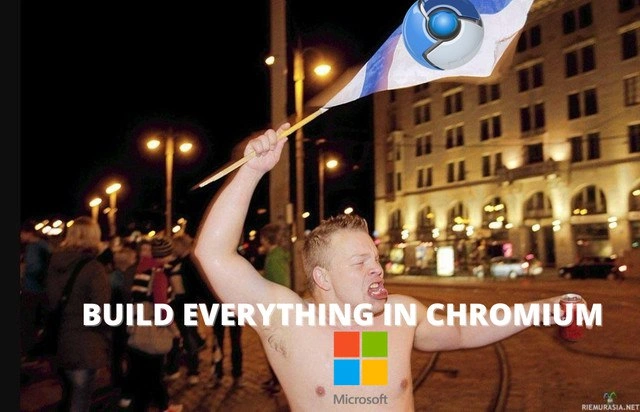
The image turns Microsoft into a street-corner Chromium zealot: shirtless, flag raised, logo on the chest, shouting the architectural strategy in all caps. The visible Microsoft logo matters because the joke is not just "web apps are everywhere"; it is aimed at a company that once pushed its own browser stack hard, then became one of the most visible champions of Chromium, VS Code, and browser-powered desktop tooling.
For developers, the humor sits in the uneasy success of Electron apps. VS Code is beloved because it is fast enough, extensible, cross-platform, and backed by a huge ecosystem. It also comes from the broader idea that a desktop application can be built with web technologies, packaged with a browser engine, and shipped like a native tool. That trade-off is both brilliant and cursed. You get one codebase across Windows, macOS, and Linux; you also get the feeling that every text editor, chat client, dashboard, and settings pane is secretly a tab wearing a blazer.
The anti-pattern being teased is platform abstraction by shipping an entire platform inside every app. Chromium gives teams rendering, JavaScript execution, devtools, sandboxing primitives, extensions of web knowledge, and predictable behavior across operating systems. It also invites software bloat, duplicated runtimes, memory hunger, and the slow normalization of "desktop application" meaning "website with local file permissions." The flag-waving pose makes that escalation look ideological instead of pragmatic, which is why the meme lands. A sensible engineering compromise has been promoted to a lifestyle brand, as these things tragically tend to do.
Description
A night street-photo meme shows a shirtless person waving a flag with the Chromium logo, while a Microsoft four-color logo is pasted onto their torso. Large white text across the image reads, "BUILD EVERYTHING IN CHROMIUM," and the sibling post caption frames it as "Microsoft Execs after the success of VS Code." The joke points at Microsoft's embrace of Chromium-based technology after VS Code's Electron success and the later normalization of browser-engine-powered desktop apps. It lands for developers as both tooling praise and a jab at the industry habit of packaging every application as a browser with ambitions.
Comments
1Comment deleted
Microsoft discovered Electron and immediately asked the classic architecture question: what if every native app was secretly a tab with HR benefits?