Skip to content
DevMeme
2010 of 7435
The classic programmer's holiday mix-up
CS Fundamentals Post #2240, on Nov 6, 2020 in TG

The classic programmer's holiday mix-up

Why is this CS Fundamentals meme funny?

Level 1: Numbers in Costume

Imagine you have a special way of counting that’s like a secret code. In this make-believe way of counting, the number “31” doesn’t really mean thirty-one – it actually stands for the ordinary number twenty-five. Sounds wild, right? It’s as if the number 25 is wearing a Halloween costume labeled “31”! Now, think of October 31 (Halloween) and December 25 (Christmas). To most people, those dates are completely different. But to a programmer using that secret counting trick, “Oct 31” looks the same as “Dec 25” because 31 in their code equals 25 in normal counting. It’s like a little magic trick with numbers: two totally different holidays end up looking identical on paper. That’s why the programmer jokes they can’t tell the difference between Halloween and Christmas – not because they’re actually confused about holidays, but because they’re seeing a sneaky numbers trick that makes those dates match in a code-like way. It’s a bit like a secret club joke: if you know the special counting code, it’s funny, and if you don’t, it just looks like nonsense. The fun part is that reveal – realizing Halloween’s date in one “number language” equals Christmas’s date in another. It’s a geeky way of playing dress-up with numbers, turning a simple calendar question into a clever little riddle.

Level 2: Base-ic Humor

So, what does “oct 31 = dec 25” really mean? To unpack this inside joke, we need to understand numeric bases. In everyday life we use the decimal (base-10) system—there are 10 possible digits (0 through 9) in each place value. Octal (base-8) is a less common system that uses 8 possible digits (0 through 7). The base of a number determines how you interpret its digits. When you see “31” as a decimal number, it means 3×10 + 1 = 31. But “31” as an octal number means 3×8 + 1 = 25 in decimal. The two digits "3" and "1" are the same symbols, but their value changes depending on the base.

Think of it like different counting languages: in one “language” (base-10), "31" means thirty-one. In another “language” (base-8), "31" actually means twenty-five. The meme is using these two languages at once. It claims that October 31 and December 25 are equal, but not in the usual sense—instead by interpreting “Oct 31” as one number and “Dec 25” as another number. Specifically, Oct 31 (Halloween) is being read as “31 in octal”, and Dec 25 (Christmas) is being read as “25 in decimal”. And indeed, 31₈ = 25₁₀ as we calculated above. It’s a little math trick hidden in plain sight.

To make this clearer, let’s break down the conversion of octal 31 to decimal step by step:

  • The octal number 31 means (3 \times 8^1 + 1 \times 8^0).
  • (3 \times 8^1 = 3 \times 8 = 24).
  • (1 \times 8^0 = 1 \times 1 = 1).
  • Add those together: 24 + 1 = 25.

So, "31" in base-8 represents the value 25 in our usual base-10. That’s why oct 31 = dec 25 is a true statement in numeric terms. The meme is essentially saying “31 (octal) equals 25 (decimal).”

Now, why would a programmer even think about octal? It turns out that in the world of programming different bases are common. Computers work in binary (base-2), and programmers often use hexadecimal (base-16) or sometimes octal (base-8) as a shorthand to represent binary groupings. Many programming languages let you write numbers in various bases. For example:

  • In C or JavaScript, a number starting with 0x is interpreted as hex, and one starting with 0 (zero) was historically interpreted as octal.
  • In Python, you can write 0o31 to explicitly represent octal 31.

A quick Python demonstration:

print(0o31 == 25)  # Outputs: True, because 0o31 (octal) is 25 in decimal.

Here 0o31 is how you write “31 in base-8” in Python. The comparison returns True, confirming that indeed octal 31 and decimal 25 are the same number. A programmer familiar with these notations will immediately recognize "oct 31" as a hint that 31 is in base-8 form, and "dec 25" as meaning 25 in base-10 form.

The meme capitalizes on this knowledge. “Oct” is an abbreviation for October, but in a programming context it instantly evokes octal. Similarly, “Dec” is short for December, but also makes us think of decimal. It’s a playful double meaning. If you haven’t encountered this number-base concept before, the joke seems nonsensical—how could Halloween and Christmas ever be equal? But once you know about octal vs decimal, it clicks: it’s not talking about the holidays directly at all, but the numerical representation of their dates. It’s an inside joke that says, “We as programmers sometimes read things very differently!”

For a junior developer or a student, this is a fun introduction to the idea that numbers aren’t inherently decimal — decimal is just the system we’re used to. In other bases, the same physical quantity is written differently. As a learning moment: octal vs decimal is a great example of positional numeral systems in action. And as a humor moment: it shows how programmers love to mix everyday life with technical quirks. After all, once you know about alternate bases, you start noticing them everywhere, even in the dates on a calendar! Now you’ll understand why a fellow coder might smirk at the phrase “Oct 31 equals Dec 25” — it’s not that they actually mix up Halloween and Christmas, it’s that they can’t resist a good numeric base humor pun.

Level 3: Disguised Digits

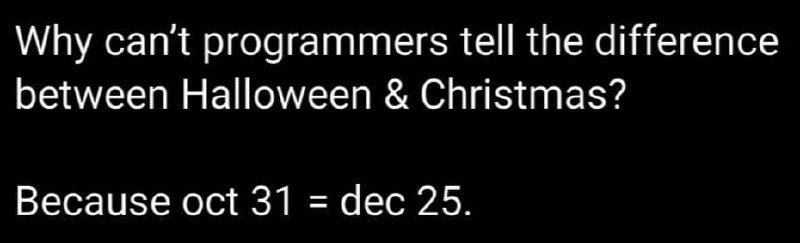
This meme is a classic piece of computer science humor playing on numeric bases. It asks: “Why can’t programmers tell the difference between Halloween & Christmas?” The punchline answers: “Because oct 31 = dec 25.” At first glance, that looks like gibberish—October 31 is Halloween and December 25 is Christmas, obviously not the same date. But to a programmer (especially one versed in CS fundamentals like number systems), that line isn’t about dates at all. It’s an equation in two different numeral bases: “31” interpreted as an octal (base-8) number equals “25” interpreted as a decimal (base-10) number. In other words, 31 in base-8 is the same quantity as 25 in base-10. This little equality is true because of how positional numeral systems work:

$$ 31_{8} = 3 \times 8^1 + 1 \times 8^0 = 24 + 1 = 25_{10}. $$

So from a coder’s point of view, Oct 31 literally equals Dec 25 in value, making it a sly inside joke that merges calendar dates with programming notation. It’s the kind of nerdy pun that causes groans and grins in equal measure. Seasoned developers have seen this joke for years—eight out of ten of them will chuckle knowingly, while the other two might momentarily scratch their heads before the aha moment hits.

Why is this particularly funny to programmers? It highlights how we can’t help but see the world through “code-colored” glasses. The meme exploits the fact that "Oct" is common shorthand for October and for octal, and "Dec" abbreviates December and decimal. In code, we often use prefixes or notations for number bases (like 0x for hex, 0b for binary, 0o or a leading 0 for octal). That means a developer’s brain is trained to interpret something like oct 31 as “an octal 31” rather than just a date. The punchline reads like a snippet of code or a math statement, not an English sentence. Essentially, it’s treating Halloween’s date (Oct 31) as an octal literal and Christmas’s date (Dec 25) as a decimal literal, and noting they represent the same number. It’s a perfect storm of dual meaning: one side of our brain reads everyday “Oct 31” (the date 10/31), the other side reads geeky “oct 31” (the number 31 in base 8). When those collide, you get a delightful “haha, got it!” moment.

This joke also nods to the quirks of programming languages. Historically, in languages like C and older Python, writing a number with a leading zero (031) meant you were using octal. For example:

int x = 031;  // In C, this is octal 31, which equals decimal 25
if(x == 25) {
    printf("Oct 31 equals Dec 25!\n");  // This will execute, because 031 == 25 in value
}

A newbie might mistakenly think 031 is thirty-one, when it’s actually twenty-five. Many of us have heard tales of bugs caused by someone using a leading 0 in a config or code and accidentally changing the number’s base. (Fun fact: trying to write 08 or 09 as a literal in C will even throw an error, because 8 and 9 aren’t valid digits in base-8!) These are the kind of lessons that turn numeric bases into ingrained knowledge for experienced devs. So when we see oct 31 = dec 25, we immediately recognize it as a clever reference to base conversion, not a calendar mistake. It’s humor born from the inside knowledge that, in the land of code, things like this can happen.

In the big picture, the meme is poking fun at how programmers mentally parse everything. We’re so habitually exposed to binary, hex, octal, etc., that even a holiday question gets answered in code-speak. It’s an absurd equivalence – conflating two major holidays – made completely logical by a simple math truth. The beauty is that it’s both technically correct and completely nonsensical in the real world, which is exactly the kind of absurdity developers love. This numeric_base_humor has been passed around since the early days of programming, right alongside the infamous binary joke "There are 10 types of people in the world: those who understand binary and those who don't." Both jokes require the reader to interpret a number in a non-default base. They’re a geeky litmus test: if you laugh, you’re in the club. And if you didn’t laugh – well, stick around for the explanation, because there’s a cool CS fundamental concept to learn here!

Description

An image displaying a classic computer science joke in white text on a black background. The joke is presented in a question-and-answer format. The question is: 'Why can't programmers tell the difference between Halloween & Christmas?'. The punchline below reads: 'Because oct 31 = dec 25.' The humor is a pun based on different number base systems used in computing. 'Oct 31' refers to the number 31 in the octal (base-8) system, which translates to (3 * 8) + 1 = 25 in the decimal (base-10) system. 'Dec 25' is the number 25 in decimal. Therefore, the statement is mathematically correct, creating a clever joke that only those familiar with programming or computer science fundamentals would understand

Comments

18
Anonymous ★ Top Pick The junior dev laughs at this joke. The senior dev explains it. The principal engineer complains that the joke isn't future-proof for when we colonize Mars and have to add a new Martian calendar case to every date library
  1. Anonymous ★ Top Pick

    The junior dev laughs at this joke. The senior dev explains it. The principal engineer complains that the joke isn't future-proof for when we colonize Mars and have to add a new Martian calendar case to every date library

  2. Anonymous

    Our 3 a.m. deploy died when someone set replicaCount: 031 in the Helm chart - turns out Kubernetes still lives in that vintage POSIX world where a leading zero means Halloween and Christmas fall on the same day

  3. Anonymous

    This joke is the 'Hello World' of programmer dad jokes - everyone's heard it, everyone groans at it, yet we still share it every October like we're deploying the same legacy code for the 47th time because 'if it ain't broke, don't refactor the humor.'

  4. Anonymous

    This joke perfectly encapsulates why code reviews sometimes feel like explaining a punchline - you either get the base conversion immediately, or you're stuck wondering why your senior architect just chuckled at a calendar. It's the programming equivalent of 'there are 10 types of people in the world,' except this one actually requires you to remember that octal exists outside of Unix file permissions. Bonus points if you've ever debugged a production issue caused by someone accidentally treating a leading zero as decoration rather than an octal prefix

  5. Anonymous

    Senior devs nod knowingly: parseInt('31',8) === parseInt('25',10), but juniors just see candy math

  6. Anonymous

    Funny until someone writes chmod(755) instead of 0755 and you realize radix is a security control, not just trivia

  7. Anonymous

    Oct 31 == Dec 25 is how you learn the parser defaulted to radix 8 - and why our “holiday freeze” accidentally became the release window

  8. @UQuark 5y

    gold

  9. @kiskiskis 5y

    best

  10. @ViktorPelepiak 5y

    тонко

  11. @ViktorPelepiak 5y

    но я б поставил ==

  12. @annalzrv 5y

    лучшее

  13. @anyo822 5y

    didn't get it..

    1. @AnakinSkywalker09 5y

      It's talking about octal and decimal notation

  14. @RiedleroD 5y

    boo

  15. @RiedleroD 5y

    bad joke

  16. @Quantum0 5y

    ==

  17. @dengleo 5y

    ===

Use J and K for navigation