The Ultimate Enterprise Cost-Saving Strategy: Buying the Company
Why is this Enterprise meme funny?
Level 1: Buying the Candy Store
Imagine you have a favorite candy that you really like, but it’s super expensive to buy each time. Every candy bar costs so much that it makes you shake your head. One day, instead of spending money on candy every week, you joke, “What if I just bought the entire candy store so I can have all the candy I want?” That sounds silly and over-the-top, right? But that’s exactly the kind of joke in this meme. In the tech world, Splunk is like an expensive candy that companies pay for to keep their computers and apps watched and safe. Cisco is a big company with a lot of money. People are joking that Cisco thought, “Hmm, Splunk’s product is so pricey to keep buying – maybe we should just buy the whole company!” It’s funny because it’s such an extreme way to avoid paying for something. It’s like solving the problem of expensive candy by buying the candy shop itself. The humor comes from that wild leap – instead of paying each time, just own the source – which is a crazy but amusing solution to something being too costly.
Level 2: Splunk Sticker Shock
Let’s break down what’s going on here. Splunk is a popular software platform for monitoring and logging in IT systems. “Logging” means collecting all the messages and events that computers and servers generate (like errors, user actions, or system statuses) so engineers can search through them. Observability is a broader term that means being able to understand what’s happening inside your systems by collecting logs, metrics, and traces (kind of like medical vitals for software). Splunk helps with that by letting you gather and search through huge piles of log data to spot problems or security issues. Sounds great, right? Well, the catch is Splunk is enterprise software – it’s made for big companies – and it comes with a very high price tag. Splunk’s licensing is often based on how much data you send into it (for example, how many gigabytes of logs per day). The more you use it, the more you pay. This can get exorbitant (extremely expensive) if your apps are churning out tons of data. New engineers or small startups often get “sticker shock” when they see how much Splunk will charge for, say, a terabyte of logs a day. It’s not unusual for a large company’s Splunk bill to be in the hundreds of thousands or even millions of dollars per year. 😬
Now, Cisco is another big name in tech, but from a different angle – historically, they’re known for building the internet’s networking hardware (routers, switches, etc.). If you’ve ever heard of those internet boxes with blinking lights in data centers, Cisco likely makes a lot of them. Cisco is huge in the enterprise world: banks, governments, and large corporations buy Cisco’s equipment and services. And just like Splunk, Cisco isn’t cheap. Buying Cisco stuff often costs a premium, but companies pay because Cisco is seen as reliable and standard. Cisco also sells software and subscriptions (for security, management, and recently things like monitoring too). So both Splunk and Cisco have reputations for expensive deals in their respective areas.
What about lock-in? Vendor lock-in means once you commit to a product, it’s really hard to switch away. Splunk has this because if you’ve built your whole monitoring system around Splunk – all your logs go there, your team knows how to use it, your alerts are set up in it – moving to a different tool would be a huge project. It’s like if all your schoolwork is saved in one special app; switching to another app means converting everything and learning a new system. So you’re “stuck” with Splunk unless you’re willing to endure a lot of pain. Cisco has a similar effect: if your office has all Cisco gear and your IT staff is trained on Cisco, bringing in a different brand’s equipment could be complicated. In enterprise tech, companies often stick with what they started with, even if it gets pricey, because it’s safer and easier than a big change.
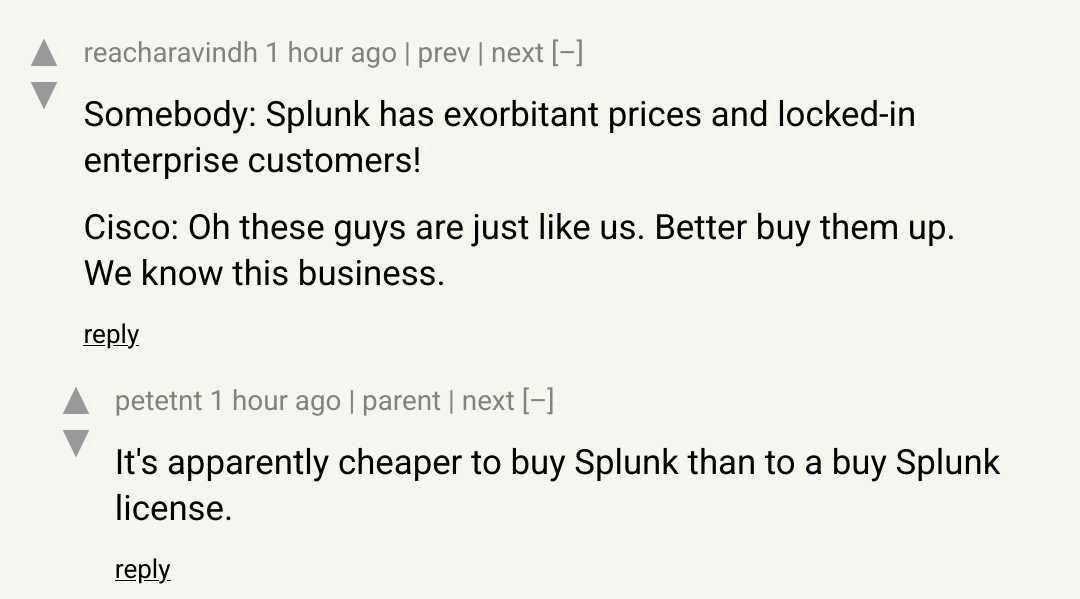
Now onto the meme itself: it’s formatted like a discussion thread from a site called Hacker News (a popular forum where tech folks discuss industry news). The first person in the thread jokes that someone says “Splunk is super expensive and traps its customers,” and Cisco responds “These guys are like us. Let’s buy them – we understand this kind of business.” This tongue-in-cheek comment is joking that Cisco sees Splunk’s expensive pricing and customer lock-in and finds it familiar (because Cisco also uses those tactics). Basically, Cisco might think, “Hey, Splunk’s business model is a lot like ours (high prices, loyal big customers). Instead of competing with them or paying them, why not just acquire them and make them part of Cisco.”
The reply to that comment doubles down on the joke: “It’s apparently cheaper to buy Splunk than to buy a Splunk license.” This is an exaggeration to be funny. Of course, a license (permission to use the software) for Splunk isn’t actually more expensive than buying the whole company! Buying Splunk outright cost Cisco tens of billions of dollars, which is way more than any single customer would spend on a normal license. But it feels like Splunk licenses cost an arm and a leg, so the commenter is basically saying, “Wow, Splunk charges so much that even buying the entire company seems less crazy than paying their yearly fees.” It’s a bit like joking, “At these rates, might as well buy the factory.”
This humor also nods to the real news: around the time of this meme, Cisco truly did agree to buy Splunk in a massive acquisition deal. In the tech world, when a big company (like Cisco) acquires another (like Splunk), it’s often because they want to instantly get the technology and the customer base without building it all from scratch. Cisco must have seen value in owning Splunk (maybe to sell more services, integrate it with their products, or prevent a competitor from owning it). Tech folks on forums often cynically joke about these things, suggesting that sometimes huge companies solve problems by just throwing money at them – in this case, by outright buying the source of the problem (or profit!). Here, the “problem” was Splunk’s steep costs, and the outlandish “solution” framed in jest is buying Splunk itself.
In summary, the thread is poking fun at enterprise software pricing and the extremes of corporate behavior. It’s saying: Splunk charges a ton for logging and monitoring, Cisco knows all about charging a ton (they do it too), so Cisco decided to handle Splunk’s high cost by making Splunk part of Cisco. It’s funny to developers because it’s an absurd twist on what we experience – high prices and vendor lock-in – taken to a comically literal solution.
Level 3: If You Can’t Beat ’Em, Acquire ’Em
This meme is a screenshot of a Hacker News comment thread dripping with sarcasm about observability tool costs and big corporate moves. The top comment imagines an exchange:
- Somebody complains “Splunk has exorbitant prices and locked-in enterprise customers!”
- Cisco replies “Oh, these guys are just like us. Better buy them up. We know this business.”
The punchline? A reply deadpans: “It’s apparently cheaper to buy Splunk than to buy a Splunk license.” 😅
For seasoned engineers, this hits close to home. Splunk is a heavyweight observability platform (mainly for logging and search) famous for its exorbitant pricing model. They charge based on how much data you ingest for monitoring – often licensing costs in the millions for large companies. It’s the kind of pricing that gives CFOs heartburn and leads teams to ration their log data. Once a company has all its logs, dashboards, and alerts in Splunk, switching out is a massive pain. Splunk’s entrenched in so many workflows (from error monitoring to security audits) that customers are effectively locked-in. This VendorLockIn means Splunk can jack up renewal prices and enterprises grudgingly pay, because migrating to a cheaper tool could risk downtime or months of reengineering. Every experienced DevOps or SRE has heard the annual gripe: “Our observability bill is insane – but we’re stuck unless we spend a year moving off Splunk.” It’s an open secret in EnterpriseSoftware that once a vendor has you hooked, they’ve got leverage to charge high margins.
Cisco enters the story as the granddaddy of high-margin enterprise tech. This is the company known for $20,000 network switches and pricey support contracts. Cisco’s whole business playbook is “sell expensive gear and services to big companies, and keep them on the hook with proprietary features and certifications.” In other words, Cisco lives and breathes the enterprise lock-in game too. Need to expand your network? Gotta buy more Cisco licenses. Want the new firewall features? That’s an upgrade SKU. It’s classic CorporateCulture in enterprise IT: nobody gets fired for buying the established vendor, but you’ll pay through the nose for the privilege. Cisco’s even been known to use smart licensing chips in hardware to enforce that you pay annual fees for full functionality. They love customers who are stuck in their ecosystem.
So the joke paints Cisco recognizing a kindred spirit in Splunk: “These guys are just like us.” It’s like two high-priced supervillains finding each other and deciding to team up. Why would Cisco gripe about Splunk’s observability_platform_pricing when they could simply acquire Splunk and own that lucrative revenue stream? 💰 After all, if you can’t beat the pricing (and if you’re probably paying for Splunk internally too), might as well buy the company and pocket those license fees yourself. The comment “cheaper to buy Splunk than to buy a Splunk license” absurdly exaggerates this logic. Of course, a Splunk license isn’t literally billions of dollars, but it feels that way to customers. That quip nails the frustration: Splunk’s bill is so high that dropping $20+ billion to purchase the whole vendor starts to sound like a rational solution in corporate-land. (In reality, Cisco did announce plans to buy Splunk around that time for an eye-watering $28 billion – the largest acquisition in its history – precisely because Splunk’s business was that valuable.)
This dark humor reflects real patterns in the industry. Large enterprises often reach a point where continuing to pay extreme vendor fees has diminishing returns. Senior engineers joke with management, “For what we pay these guys, we could buy them outright!” It’s usually hyperbole said over coffee in frustration – except Cisco actually went and did it. 😈 The meme highlights the absurd economics of big tech mergers: instead of negotiating down a costly Splunk license or developing a competitor, a giant like Cisco just swallows the whole company. It’s a power move that says we have so much cash, we’ll solve budget problems by making them part of us. And cynically, Cisco “knows this business” of selling expensive monitoring solutions to enterprise clients, so they likely figure they can integrate Splunk and continue the same strategy. (No one expects Cisco to suddenly make Splunk cheaper – if anything, they’ll bundle it into Cisco’s suite and keep those margins healthy.)
In essence, this meme resonates because it’s too real. It skewers Enterprise tech’s habit of solving problems with mergers and mocks the pain of LicensingCosts in Observability_Monitoring. Veteran devs laugh (and groan) because they’ve lived versions of this: the tools we rely on in production often start affordable, become indispensable, then turn into exorbitant line items that only grow. And the “solution,” in true corporate fashion, might be an even bigger spend – like an acquisition – rather than making the product affordable. It’s a perfect storm of VendorLockIn, expensive EnterpriseSoftware, and big-company hubris, all captured in two snarky forum comments.
| Splunk’s Playbook (Observability Vendor) | Cisco’s Playbook (Enterprise Vendor) |
|---|---|
| Ingest logging data, charge per GB aggressively. | Sell high-end routers, charge per feature/user. |
| Profits from locked-in data & workflows. | Profits from locked-in hardware & training. |
| Customers stuck due to integration & volume. | Customers stuck due to ecosystem & support. |
| Yearly license renewal = 😱 sticker shock. | Yearly maintenance renewal = 😱 sticker shock. |
| Solution to cost complaint? 🤷 Pay up or cut usage. | Solution to cost complaint? 🤷 Pay up or upgrade gear. |
| If all else fails, get acquired for $28B. | If all else fails, spend $28B to acquire vendor. |
When two masters of high pricing find each other, the result is this kind of joke. The thread’s sarcastic tone is a coping mechanism: engineers laughing so we don’t cry about budgets. It’s a humorous take on a real scenario where corporate culture rewards lock-in and massive deals. Observability, meant to bring clarity, ironically ends up obscured behind massive paywalls – and this meme calls out that irony with a wink.
Description
A screenshot of a comment thread from a minimalist, text-based forum, likely Hacker News. The first comment, by user 'reacharavindh', satirizes the acquisition of Splunk by Cisco. It reads: 'Somebody: Splunk has exorbitant prices and locked-in enterprise customers! Cisco: Oh these guys are just like us. Better buy them up. We know this business.' This comment humorously suggests that Cisco's motivation for the acquisition was a shared business model of high prices and vendor lock-in. A nested reply from user 'petetnt' delivers the punchline: 'It's apparently cheaper to buy Splunk than to a buy Splunk license.' This witty remark exaggerates the notoriously high cost of Splunk's enterprise licenses, joking that the multi-billion dollar price of acquiring the entire company is a more economical choice. The meme resonates with senior engineers and tech leaders who have experienced the pain of enterprise software procurement

Comments
7Comment deleted
Cisco's CFO approved the Splunk acquisition after seeing the renewal quote for their internal cluster and realizing a hostile takeover was the cheaper option
FinOps discovered that at 100 TB/day of logs the spend curve flips from “upgrade Splunk ingest” to “file an HSR and acquire the vendor,” so please keep log.level firmly at WARN
The only thing more expensive than migrating off Splunk is staying on Splunk, unless you're Cisco, in which case the cheapest option is becoming Splunk
When your enterprise logging solution costs so much per GB that acquiring the entire company for $28 billion starts looking like the budget-friendly option. Cisco's accountants probably ran the numbers on their own Splunk bill and realized they could just buy the invoice generator instead
Splunk: The only SaaS where buying the company unlocks the free tier
Splunk: the only vendor whose volume discount is negotiated by Corporate Development, not Procurement
At a few hundred terabytes a day, procurement learned the only Splunk discount that scales is called M&A as a Service