When a logo tweak trips every senior engineer’s threat-model radar
Why is this Security meme funny?
Level 1: Something Feels Off
Imagine you’re playing on a soccer team, and everyone on your team wears a blue jersey while the other team wears red. Now suppose one day, one of the players shows up without a jersey at all—no blue, no red, just a plain shirt. You’d probably stop and ask, “Hey, which side are you on?” It would feel weird, right? You might even get a little worried that something’s not right, like maybe this person isn’t supposed to be in the game.
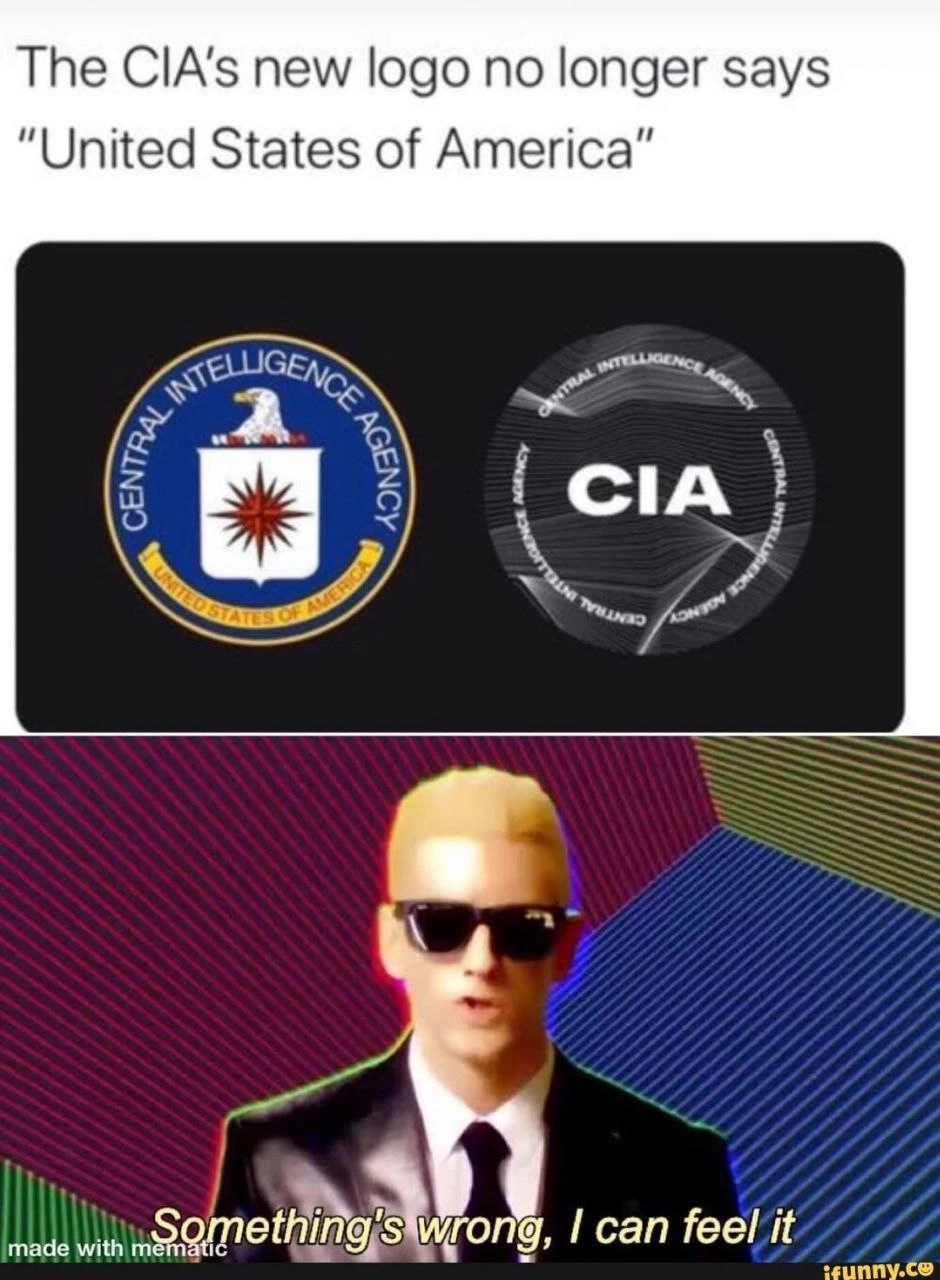
That’s what’s happening in this meme, in really simple terms. The CIA is like a team that always used to wear a badge saying “United States of America,” kind of like their team jersey or name tag. Suddenly, they made a new badge that just says “CIA” with no country name. It’s as if that player took off the team name. People who work with secure things (like senior engineers) immediately get a funny feeling about it, just like you felt unsure about the jersey-less player. They’re thinking, “Hmm, something’s off here.”
It’s like getting a letter in the mail with a different return address, or seeing a delivery person without their usual uniform — it makes you instinctively suspicious. Not because something is definitely wrong, but because it’s different from what you expect. In the picture, the guy in the suit and sunglasses saying, “Something’s wrong, I can feel it,” is showing that exact feeling. It’s the meme’s silly way of saying: even a tiny change in a name or label can make someone who’s very careful about security go, “Uh oh, what’s going on?”
So, this meme is funny by comparing a fancy spy agency’s logo change to a simple game where a missing name tag would confuse people. Both situations give you that little gut feeling that maybe there’s a secret or a trick happening. And at the end of the day, it’s poking fun at how extra cautious experienced tech folks can be — they’ll even get suspicious about a logo, the same way you might get suspicious about a teammate without a jersey. It’s a playful reminder that when something familiar suddenly looks different and a bit secretive, we all kind of think, “Hold on a second… this feels a bit fishy!”
Level 2: Missing Label, Big Alarm
So, what’s going on here? The image shows the CIA (Central Intelligence Agency) updating its logo. The old emblem spelled out “United States of America” around the border, proudly stating the agency’s country. The new design drops those words entirely— it just says CIA with some fancy graphic lines. This small change immediately makes experienced tech folks feel uneasy. Why? Because in the world of security and software, missing labels or identifiers are a big deal.
Let’s break down some terms from the meme’s description: A threat model is basically a plan or mindset for what could go wrong in a system. Senior engineers develop an almost instinctive “threat-model radar,” meaning they quickly sense when something isn’t right in a design or system that could signal a security problem. Here, the missing “United States of America” text is like a red flag to them. It’s as if an official ID suddenly has no country or organization listed — strange, right?
They compare it to vital data being removed in tech contexts:
JWT claims: A JWT is a JSON Web Token, kind of like a digital ID card used for logging into services. It contains claims (fields) such as who issued it (
iss), who should use it (audfor audience), etc. If a JWT came through without an expected claim (say, no audience listed), a cautious developer gets suspicious. It’s like getting an ID card with the name but no affiliation — you’d wonder if it’s fake or if someone could misuse it. In fact, historically, there have been security bugs where a token with a missing ornonealgorithm was accepted by systems, leading to serious breaches. So engineers are trained by experience to never ignore a missing field.API headers: When one service talks to another (API calls), it often sends extra information in headers. For example, a request might include a header like
X-Org: AcmeCorporX-Env: Productionto indicate who’s calling or the context. If those identifiers suddenly vanish, the receiving system might not know who is asking, or might accidentally let an unintended party in. Imagine an internal API that no longer tells you it’s internal — you’d worry outsiders could be knocking on the door. So if an engineer sees a crucial tag or label drop off, their reaction is, “Uh oh, are we now accepting requests from anywhere?”SSL certificate CN field: An SSL certificate is like a website’s passport — it proves the site is really who it claims to be, enabling that lock icon in your browser. The CN (Common Name) or related fields (these days, SAN – Subject Alternative Name) usually include the domain name of the site and often the organization and country. For example, a bank’s certificate might say “CN=bankofexample.com, O=Bank of Example, C=US.” If you got a certificate that just said “CN=bankofexample.com” without the country or org, you’d be a bit wary: Is this actually the official cert, or is something omitted? It might be fine (sometimes those fields are optional), but security pros have learned to be on alert for anything out of the ordinary in credentials. A missing country code or org name in a cert could hint it’s a generic or mistakenly issued cert — or worse, a malicious one. Just as a web browser might throw a warning if part of the identity doesn’t match, a senior engineer’s brain throws a warning when a familiar identity marker goes missing.
Now, back to the CIA. Why does a design change cause this gut reaction? The CIA is America’s intelligence agency, so explicitly stating “United States of America” was a clear identifier of ownership (and accountability). Removing it is probably just a branding choice to look modern and sleek. But engineers joke that this is like a piece of important metadata being dropped. In tech terms, it feels like the scope of something changed unexpectedly. Scope creep means a project or system starts doing more (or other) than it was originally intended to. If the CIA’s logo no longer mentions the USA, a tongue-in-cheek interpretation is: “Are they expanding their scope? Are they not just about the USA anymore? What are they up to now?” It’s a humorous way to frame a likely innocent design tweak as if it were a sneaky change in mission. It taps into that paranoid humor common in CyberSecurityMemes — always suspect a hidden agenda or vulnerability.
We also see a slice of CorporateCulture in this meme. Big organizations often go through logo redesign phases, trying to appear more modern or inclusive. Engineers, however, are detail-oriented and often resistant to change that isn’t clearly beneficial. When a new logo drops important text, the marketing team might see “sleek minimalism,” but the engineering team sees “ambiguity” or even “potential security gap.” This contrast is funny to us: the idea that a harmless branding change sets off someone’s internal intrusion detection system. The bottom panel with the guy in a suit and tie, saying “Something’s wrong, I can feel it,” perfectly captures that hunch — the squinting, suspicious look a senior dev gets when an app’s behavior changes slightly or a server’s response looks 0.1% different. In other words, once you’ve been burned by subtle bugs or hacks, you develop a almost comedic level of caution.
So, put simply: the meme jokes that a tiny missing country identifier in a logo is enough to make a seasoned security engineer mentally dive into a threat analysis. It’s a playful take on how people in tech, especially infosec, can be hyper-vigilant. They’ll joke, “What’s next, did the CIA outsource themselves? Is this some 4D chess move in SurveillanceTechnology?” – not because they truly believe it, but because that’s how our brains have been trained to react to missing information. It’s a form of nerd humor, blending real-world government branding with the everyday experiences of engineers who have felt that cold sweat when an “insignificant” detail turned out to matter a lot.
Level 3: When “USA” Goes MIA
At the highest technical level, this meme highlights a security engineer’s instinct to spot a missing identifier and immediately suspect a threat-model violation. The CIA’s new logo omits the text “United States of America,” and to a seasoned infosec professional that’s like suddenly finding a critical field blank in a security credential. Why does dropping three words trigger DEFCON 1 in a senior engineer’s mind? Because in security, if something that should name a trusted entity goes missing, it’s an alarm bell.
Think of a JWT (JSON Web Token) that loses its issuer or audience claim, or an API call that suddenly stops including a tenant ID in its header. These seemingly minor omissions can mean the difference between scoped trust and global free-for-all. A veteran developer has seen how a missing claim turns a token into a skeleton key across systems, or how an API without a proper context header could be invoked by the wrong party.
In technical terms, a logo is just branding—but here it’s analogous to a certificate’s Common Name (CN) or an email’s domain identifier. Removing “United States of America” from the CIA’s seal is like issuing an SSL certificate without specifying the domain’s country or organization. It dilutes the anchor of trust. The senior engineer threat radar immediately pings: “Is this a bug or a feature? What new attack surface might this hint at?” The humor comes from treating a graphic design choice as if it were a production security regression. We’re laughing because we’ve all had that paranoid moment—like noticing the tiniest change in a server’s SSH fingerprint and thinking, “Whoa, did someone man-in-the-middle my connection?”
This meme resonates in Security and CorporateCulture circles because it mashes up a branding decision with the surveillance-honed instincts of experienced engineers. In corporate branding, dropping text might be just aesthetic “modernization,” but to an engineer it smacks of scope creep. Perhaps the CIA is going “international” or going stealth mode; that missing country label hints at an expanded mission beyond its original scope. This is reminiscent of classic SecurityTheater moves where cosmetic changes are made for PR, while the technical folks scream internally: What else changed under the hood? It’s also a wink to the security community’s mantra: “Trust, but verify.” If the trusted badge suddenly lacks a key identifier, the truly paranoid (and let’s face it, every senior security engineer is a bit paranoid) will immediately verify why.
Even the visual details underscore this vibe: the new logo’s edgy black design with contour lines looks like an abstract surveillance map. Combine that with a blurred-sunglasses agent (the meme’s bottom panel) saying “Something’s wrong, I can feel it,” and you have the perfect depiction of an engineer’s spidey-sense. It’s the sixth sense you develop after years of debugging breaches and chasing down weird logs at 3 AM. You can practically hear that internal siren: Missing identifier detected – potential unauthorized use case! In short, the meme is funny because it’s too real: over-alert engineers can’t even see a logo tweak without instinctively doing a mini threat assessment.
Description
Meme split in two panels. Top text reads, "The CIA’s new logo no longer says 'United States of America'." Beneath, two circular emblems appear side-by-side: on the left, the classic blue CIA seal with text "CENTRAL INTELLIGENCE AGENCY" around the top and "UNITED STATES OF AMERICA" on a bottom ribbon; on the right, a modern black graphic with contour-line waves, a thin ring repeating "CENTRAL INTELLIGENCE AGENCY", and bold white letters "CIA" in the center - noticeably omitting any mention of the country. The lower panel shows a person in a black suit and tie, face pixel-blurred, standing before a neon, diagonal-striped backdrop. Yellow subtitle at the bottom says, "Something's wrong, I can feel it." Small watermarks read "made with mematic" (bottom left) and "ifunny.co" (bottom right). Technically, the gag mirrors how security-minded engineers instantly suspect scope creep when vital identifiers vanish - whether in JWT claims, API headers, or SSL cert CN fields
Comments
6Comment deleted
The same gut-check as when a prod JWT suddenly drops the `aud=enterprise` claim - nice new skin, but somebody’s definitely rewriting the mission parameters
When the CIA rebrands to look like a stealth startup, you know they've finally admitted they're just another data company with questionable privacy practices and a Series Z funding round from taxpayers
When your product manager insists on 'simplifying the brand identity' and removes all the context that made it meaningful - it's like refactoring your entire codebase to microservices, removing all the documentation, and wondering why nobody knows what service does what anymore. Sometimes 'less is more' actually means 'less is just... less.'
Spotting that one-line omission in a million-line monolith - the refactor that nukes sovereignty without a changelog
Dropping “United States of America” from the seal is the branding equivalent of changing your OAuth issuer from https://auth.company.com to https://auth.unqualified/ - same JWKS endpoint, but every senior engineer files a sev‑2 and refuses to type a password until someone bumps the major version and posts the RFC
An IdP dropping “United States of America” from the seal is the branding equivalent of rotating JWKS without updating iss/aud - suddenly every SSO prompt smells like a phishing kit