Skip to content
DevMeme
5367 of 7435
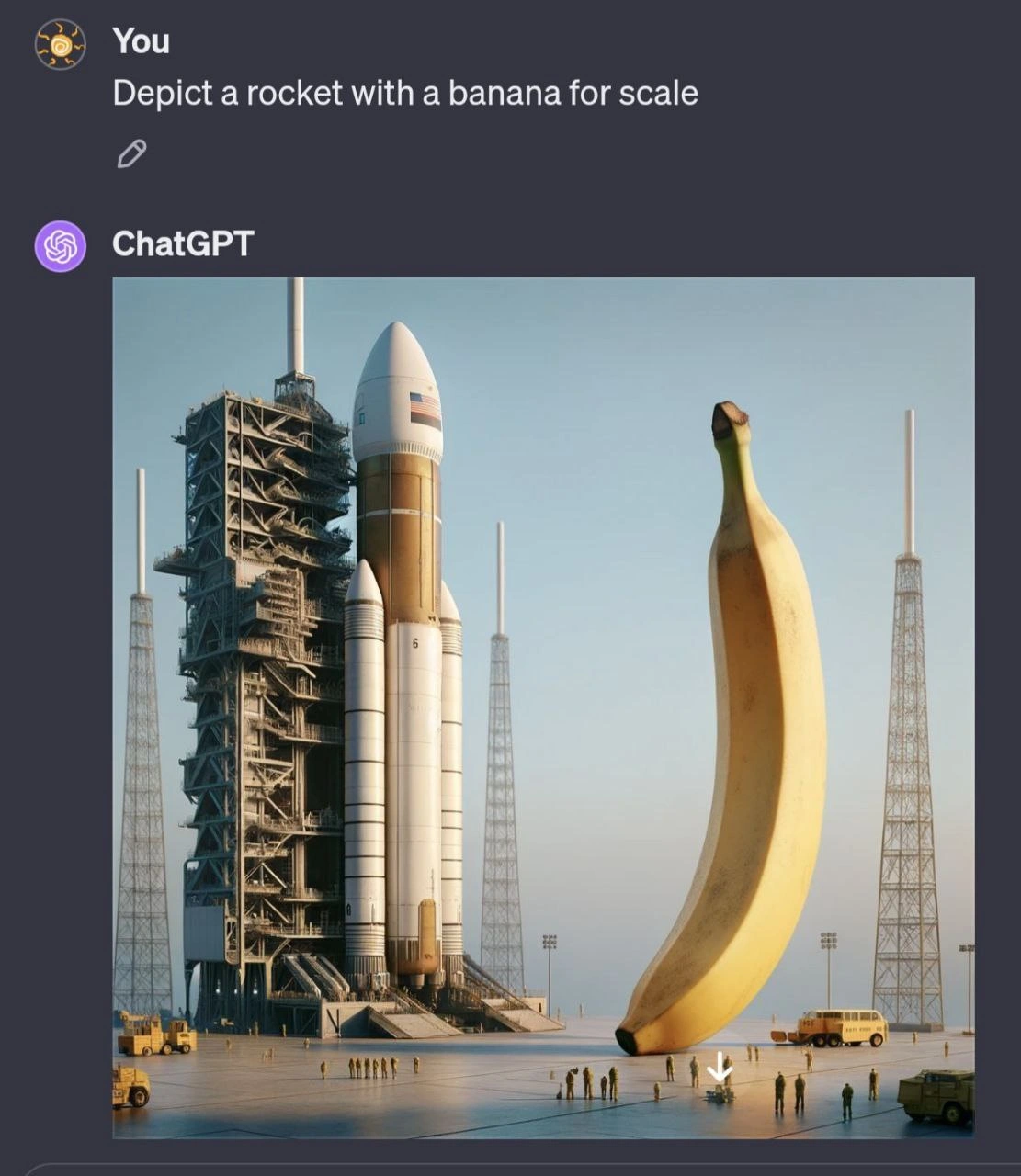
When the AI takes “banana for scale” far too literally
AI ML Post #5886, on Feb 13, 2024 in TG

When the AI takes “banana for scale” far too literally

Why is this AI ML meme funny?

Level 1: Big Banana, Little Rocket

Think of it like this: you ask someone to show you how big a rocket is by putting a banana next to it (since everyone knows the size of a banana). Instead, they put a banana that’s bigger than the rocket! It’s as if you said, “Use this banana as a ruler,” and they brought a banana the size of a building. Of course that makes no sense – you can’t compare sizes when the reference object is enormous. The result looks completely ridiculous, and that’s why it’s funny. It’s a simple mix-up: the helper (in this case, the AI) followed the exact words of the request, but didn’t have the common sense to do it in a sensible way. We laugh because it’s a huge, silly mistake that no human would ever make in the same situation.

Level 2: Banana for Scale 101

Let’s break down the joke in simple technical terms. The image is from a chat conversation with ChatGPT, which is a conversational AI. ChatGPT is powered by a Large Language Model (LLM) – essentially a very advanced program trained on massive amounts of text (and in this case, able to produce images too). When the user says “Depict a rocket with a banana for scale,” they’re giving the AI a prompt (an instruction or request). The user wants the AI to create an image of a rocket, and include a banana next to it to show how big the rocket is. “Banana for scale” is a popular meme and phrase: people often put a banana next to objects in photos as a funny way to indicate size, since almost everyone knows roughly how big a banana is.

Now, what did the AI do? It fulfilled the request, but in a goofy way. The AI generated a photorealistic image of a rocket on a launchpad (it looks like a NASA rocket ready to launch, complete with service towers and little vehicles around). It also put a banana in the image – but the banana is enormous, much taller than the rocket itself! The banana is standing upright in the foreground, and you can even see tiny human figures and trucks near the banana’s base, which really highlights how comically huge it is. The whole point of saying “with a banana for scale” was to use a normal banana as a point of reference, not to create a giant banana. So the AI technically heard “include a banana to show scale” and did include one, but it completely misunderstood the intention. This is a classic example of a generative AI prompt misinterpretation: the AI followed the literal words of the prompt without understanding the common-sense meaning behind them.

Why is this funny to developers and the tech crowd? First, it’s the absurdity of the image itself – a tiny rocket next to a banana titan. It’s like seeing an ant next to a skyscraper and calling the skyscraper “the reference size.” Second, it highlights how AIs, even very advanced ones, can lack basic context understanding. ChatGPT (the AI) doesn’t actually “know” that a banana is supposed to be a measuring stick here. It just knows the prompt talked about a banana and a rocket. Developers recognize this kind of mistake from their own experience: computers are very literal. If you don’t specify exactly what you mean, you might get a wild result. In coding, if you give ambiguous instructions to a program, it might do something logically correct but practically wrong – the same thing happened here, but with an image.

This meme also touches on what’s happening in the industry right now. There’s a ton of hype around AI – people are excited and sometimes think AI is almost magical. But as this AIHumor demonstrates, the reality is that AI can mess up simple things because it doesn’t have human-level understanding. It’s creating AIGeneratedContent (an AI-made image) based on patterns, not genuine comprehension. So, “banana for scale” turned into a ridiculously literal scene. For someone new to this, the takeaway is: AI is powerful (it drew a pretty convincing rocket and banana!), but it can also be pretty clueless about obvious stuff. And that mix of impressive and silly is exactly why everyone is sharing and laughing at this image.

Level 3: Large Language, Larger Banana

Every experienced developer can spot the comedy in this scenario: it’s the age-old truth that computers (and now AIs) do exactly what you say, not what you meant. The user said “Depict a rocket with a banana for scale,” and the AI delivered precisely that – a rocket plus a banana – but completely missed the point of the request. This combination is hilarious because it turns an internet in-joke (“banana for scale”) into a case of extreme literalism. In developer circles, putting a banana in a photo is a tongue-in-cheek way to indicate size: everyone knows roughly how big a banana is, so it’s a goofy yet useful reference. Here, the AI eagerly included the banana, but by rendering it several times larger than the rocket, it made the “scale” reference worse than useless. It’s a perfect example of AIHypeVsReality: the hype says these models understand us, but in reality a famously smart AI just flubbed a basic context clue.

For those of us who have played with AIGeneratedContent tools, this scenario is too real. You craft what you think is a clear prompt, and the AI produces something that technically fulfills it while completely mangling the intent. (Cue memories of early GitHub Copilot code suggestions that were syntactically correct but logically bonkers.) The shared laugh here is partly relief: phew, the AI isn’t coming for our jobs just yet if it can’t even handle a banana prop correctly! It’s also a nod to the tedious process of prompt engineering. We’ve learned that to get useful output, you often have to spell things out in unnatural detail. “Banana for scale” in human-speak means a normal banana beside the rocket, but the model doesn’t pick up that nuance. This feels like dealing with an overly literal junior developer or an intern: if you don’t specify every detail, you might end up with a giant banana in your rocket presentation (literally or figuratively).

The meme also riffs on the absurd imagery itself. The rocket on the launchpad is a symbol of high-tech engineering and grand ambition, while the banana is a humble, everyday object. By blowing the banana way out of proportion, the AI inadvertently created a scene that satirizes its own lack of common sense. It’s as if the AI promoted the banana to the star of the show, upstaging the rocket entirely. For seasoned devs, it’s a reminder of countless meetings where a minor detail became a major distraction – the classic case of a small thing overshadowing the main project because someone took a request too literally. We laugh because we’ve been there: maybe not with produce and spacecraft, but certainly with requirements and code. This mix of high-tech failure and slapstick misunderstanding hits the sweet spot of DeveloperHumor: it validates our skepticism about shiny new tech and gives us a funny story to share at the stand-up.

Level 4: Multi-Modal Misinterpretation

At the cutting edge of AI/ML, we have generative models that can produce strikingly realistic images from text. However, they’re still pattern-recognition systems without true common-sense understanding. This meme highlights a subtle failure in multi-modal comprehension: the AI took the phrase “banana for scale” far too literally. Under the hood, a text-to-image model encodes the prompt into a high-dimensional embedding vector. The phrase “with a banana for scale” gets parsed by the model’s language encoder, but there’s no explicit module that understands the intent behind that idiom. Instead of treating the banana as a known unit of measurement, the model likely just registers “rocket” and “banana” as two important objects to include, and treats “for scale” as a cue that they should appear together in the scene.

Without an actual world model or sense of physics, the AI has no concept that a banana is typically much smaller than a rocket. The latent diffusion model generating the image works by iteratively refining visuals to satisfy the prompt’s keywords in a visually clear way. Making the banana gigantic actually helps the algorithm ensure the banana is clearly present — ironically defeating the human purpose of using it as a modest reference object. In technical terms, there’s a misalignment between language semantics and visual output. The model’s training data might contain many images of rockets and bananas, but it hasn’t truly learned the relative scale of these objects in reality. It only knows how to draw a rocket launchpad render and insert a banana somewhere in that scene. The result is an oversized reference object because the AI optimizes for including the banana vividly rather than positioning it realistically.

This is a classic case of the AI’s literal interpretation overriding context. In natural language processing, understanding the phrase “for scale” requires pragmatic knowledge: realizing it’s about providing a size reference, not commanding a large-scale banana invasion. The humor here actually exposes a known challenge in AI: grounding language to real-world concepts. The AI doesn’t “know” what “scale” means in physical terms – there’s no built-in understanding that rockets are hundreds of times taller than bananas. Absent that, the request gets executed superficially: rocket? Check. Banana? Check. Relative size? Oops. The nuance of scale is lost in translation. And that dissonance is exactly what makes developers chuckle: it’s a prime example of AIHumor, where a sophisticated system confidently produces an obviously silly result. This flavor of LLMHumor reminds us that even cutting-edge models can trip over a simple phrase.

From a research perspective, moments like this are insightful. They show how even advanced Large Language Models (LLMs) and image generators lack robust common-sense reasoning. We often hype these systems as near-omniscient creators, but here the AIHypeVsReality gap is on full display. The model follows the prompt’s words but not the intended spirit, much like a hyper-literal genie. Solving this would require better grounding of AI models – teaching them, for example, that “banana for scale” implies the banana’s role is just to calibrate size, not to dominate the scene. Until then, we’ll continue to see such multi-modal misinterpretations, where the AI does something bananas (pun intended) and gives us a good laugh while highlighting its underlying limitations.

Description

Screenshot of a dark-themed chat interface. The user message reads, “Depict a rocket with a banana for scale.” Beneath, the ChatGPT avatar responds with an image: a photorealistic launchpad scene showing a NASA-style white-and-copper rocket beside service towers, service vehicles, and tiny human figures. Towering absurdly in the foreground is an enormous, upright banana that is several times taller than the rocket, making the supposed scale reference useless. The humorous mismatch highlights the occasional over-zealousness of generative AI image tools and the classic developer meme about using a banana for scale
Comments

6
Anonymous ★ Top Pick Proof that letting an unchecked LLM handle ‘relative sizing’ is how you end up provisioning a t3.nano to run the monolith - looks right in the prompt, catastrophically wrong in production
  1. Anonymous ★ Top Pick

    Proof that letting an unchecked LLM handle ‘relative sizing’ is how you end up provisioning a t3.nano to run the monolith - looks right in the prompt, catastrophically wrong in production

  2. Anonymous

    This is exactly why we need a domain expert in the prompt engineering team meeting - the AI correctly implemented the requirement but completely missed the implicit context, just like when product asks for "user-friendly authentication" and you deliver biometric scanning that requires a blood sample

  3. Anonymous

    When your AI model has perfect pixel-level accuracy but zero understanding of internet culture - it's like having a junior dev who implements every requirement exactly as written in the spec, including that one joke the PM made in a comment. Sure, the banana provides scale, but perhaps we should have been more explicit about relative proportions in our acceptance criteria. This is what happens when your training data includes aerospace engineering documentation but not enough Reddit threads

  4. Anonymous

    Prompt engineering classic: 'banana for scale' births the dependency that outscales the entire payload

  5. Anonymous

    Classic Goodhart: the spec said 'banana for scale,' so the model maximized banana, passed QA, and left Ops filing a sev‑1 for produce load on the launchpad

  6. Anonymous

    Natural‑language specs in production: ask for “banana for scale,” get a 70‑meter Cavendish - now capacity planning uses fruit_per_rocket and Grafana reports NaN

Use J and K for navigation