Skip to content
DevMeme
5869 of 7435
The programmer's dual existence
MentalHealth Post #6428, on Nov 25, 2024 in TG

The programmer's dual existence

Why is this MentalHealth meme funny?

Level 1: Hero or Zero

Imagine you’re playing a game or doing a little task and you have two ways you might start feeling about yourself – really, really good or really, really bad – even though nothing huge happened. This meme is like a picture of a person (a programmer) coming to a big split in the road. Down one road, they feel “I’m not good at this at all, I shouldn’t even be here.” Down the other road, they feel “I’m the best, everyone else is doing it wrong!” It’s a funny cartoon because it shows how a lot of people who write code (and honestly, anyone learning or doing hard things) can flip between these two moods even over very small problems. It’s like if you got one math question wrong and thought, “I’m the dumbest person ever,” but then later you figure out a simple puzzle and go, “Wow, I’m a genius!” In reality, neither the mistake nor the easy win means you’re awful or amazing – they’re just little things (that’s what the meme calls “meaningless shit,” meaning not a big deal). But our feelings can trick us. The picture shows storm clouds and lightning on both paths to say that both of those extreme feelings can lead to trouble or make you upset. It’s as if no matter which mood the programmer picks – feeling like a fraud or acting over-proud – they’re heading into a storm. Why is this funny? Because it’s so exaggerated and so true at the same time. We laugh seeing it drawn out: a tiny person faced with a huge dramatic choice that, in their own head, seems like the only options. The heart of the joke is that many of us have felt like that – one day you’re on top of the world, the next day you’re down in the dumps, even though not much really changed. It’s a reminder (in a joking way) that feelings can swing wildly and make a simple day in coding feel like a heroic triumph or an epic fail. The meme makes us smile because we’ve all been that character at the crossroads, shaking our head at ourselves and thinking, “Here we go again – which ridiculous mood am I going to choose today?”

Level 2: Confidence Rollercoaster

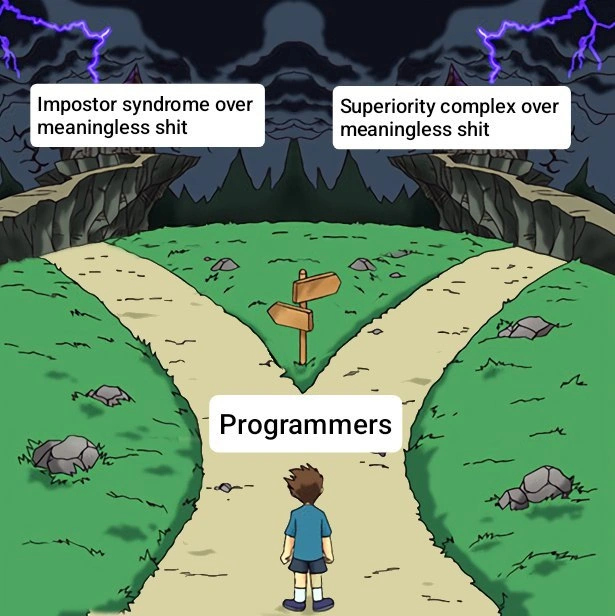
For a newer developer or someone outside the field, let’s break down what’s happening in this cartoon. We see a single programmer character standing at a fork in the road – literally two paths to choose from. This image is styled like a video game or fantasy RPG decision point, which many people recognize: you’re about to choose a direction for your journey. Here, though, the choice isn’t between saving a village or exploring a cave, but between two extreme mindsets a developer might have. The sign on the left says “Impostor syndrome over meaningless shit”. Impostor syndrome is a real term used in psychology and in tech circles – it means feeling like a fraud or “not good enough,” even when you actually are competent. A programmer with impostor syndrome might think, “I don’t really know what I’m doing, and it’s just a matter of time before everyone realizes I’m not a ‘real’ developer.” On the right, the sign reads “Superiority complex over meaningless shit.” A superiority complex in this context means having an overly high opinion of your own knowledge or skills – basically thinking “I’m better than all these other coders; I know best.” Importantly, both signs end with “over meaningless shit,” which is informal slang meaning about things that aren’t actually that important. This is the comic’s way of saying the poor programmer is getting mentally worked up about really trivial matters.

What kind of trivial matters? In tech, classic silly debates include tabs vs spaces – literally how you indent your code (using the Tab key or using spaces; it makes no difference to the final program, but developers famously argue about it endlessly). Another example given is the number of microservices – that’s a software architecture choice about splitting an application into many small independent services versus having one big application. There’s no single “correct” number of services – it depends on the project – but developers can still treat their particular choice as if it’s a badge of honor or a fatal flaw. These are the kind of “meaningless” (or very minor) issues that the meme suggests are causing huge swings in the programmer’s feelings.

Now, notice the environment in the image. Both paths – left (impostor self-doubt) and right (overconfidence) – lead off into a dark, stormy landscape. The sky is purple and filled with thunder and lightning above both routes. This tells us that neither choice is actually pleasant. Whether the programmer decides “I’m awful at my job” or “I’m the smartest around here,” the outcome (at least in their head) is going to be emotionally turbulent. The wooden signpost at the split doesn’t have any helpful arrows or guidance on it; it’s blank or directionless. That detail suggests that when a developer faces these feelings, there’s no clear external guide on what the “right” mindset is – you’re kind of on your own in deciding how to feel that day. The character labeled “Programmers” is just standing there, presumably conflicted. This reflects a very common developer experience (DX): on a daily basis, programmers often teeter between self-doubt and overconfidence. If something small goes wrong – say, your code doesn’t run because of a missing semicolon – you might suddenly feel incompetent (impostor syndrome kicking in: “How could I mess up something so simple? Maybe I’m not cut out for this.”). But if later that day you solve a bug that others struggled with, you might swing to feeling on top of the world (“Wow, I’m really good at this coding thing, maybe even better than my teammates.”). Neither of those feelings truly reflects reality (hence “meaningless shit” – we’re talking about minor incidents, not an objective measure of skill), but it’s remarkably easy to feel them.

This emotional rollercoaster is very relatable humor in tech communities. Developers joke about it because so many of us experience it. It’s essentially a shared form of developer anxiety: a loop of worrying about your skill on the one hand and then reassuring yourself too much on the other. Importantly, this meme is also hinting at the impact on mental health. Constantly feeling like a fraud is unhealthy and stressful, and constantly feeling like you’re superior can alienate you from your team and also set you up for a hard fall (because eventually, something will prove you wrong). From a productivity standpoint, both states can be harmful too – impostor syndrome might make someone afraid to contribute or slow to write code (second-guessing everything), while a superiority complex might lead someone to ignore feedback or skip tests (“my code is perfect, I don’t need to double-check”), which can cause real issues in a project. The meme’s comedic framing – an RPG crossroads with a tiny programmer facing two thunderous paths – exaggerates and brings to light this everyday inner drama. It’s saying, “Look, developers often feel like it’s either one extreme or the other: either ‘I know nothing’ or ‘I know everything,’ and it’s always over tiny things.” Seeing it depicted so starkly is funny because we recognize the truth in it, and it’s a bit of a laugh at our own expense as developers. The shared experience of these confidence swings makes the joke land: you nod and chuckle because yes, you’ve stood at that very crossroads in your mind, even if the rational part of you knows it’s silly to be so extreme.

Level 3: Holy Wars & Self-Worth

From a senior engineer’s perspective, this meme hits home as a commentary on the daily psychological whiplash many of us feel in our work. It's that too-real feeling of standing at a decision point thinking, “Either I know nothing at all, or I’m the only one who knows anything”. The humor here comes from the absurdity of how trivial tech debates can balloon into full-blown crises of confidence or egotistical crusades. In team chats and code reviews, developers famously wage holy wars over seemingly meaningless stuff like whether to use tabs or spaces for indentation, the “proper” number of microservices, or which JavaScript framework du jour is superior. These topics are the quintessential bikeshedding material: minor issues that everyone feels qualified to argue about. And argue we do – with shocking conviction. One minute a dev is evangelizing their preferred code formatter as if it’s the one true religion (riding a wave of superiority complex), and the next minute they’re quietly panicking that they don’t understand a new library as well as a junior colleague does (sinking into impostor syndrome).

The meme art nails this with the RPG-style crossroads: our lone “Programmers” protagonist has to choose either the left path labeled impostor syndrome or the right path labeled superiority complex. It’s a sarcastic visual metaphor for how developers often perceive their self-worth as a binary state – zero or one, nothing in between. And crucially, both options are explicitly “over meaningless shit.” This phrase adds a layer of cynical humor: we’re not talking about life-and-death decisions or million-dollar mistakes here – these wild swings of self-esteem can be triggered by something as petty as a code style comment or a 30-minute architecture discussion that, in the grand scheme, isn’t that critical. Yet emotionally, it feels huge. Any senior dev can relate to getting unreasonably worked up about a trivial issue: maybe you spent hours refactoring code for cleanliness and pridefully think “I’m a genius of good code hygiene,” only to have a colleague ask “why bother, it was fine,” and suddenly you spiral into “Oh no, maybe I’m just a pedantic fool, did I waste everyone’s time? I have no real skill.” These internal monologues are the shared experience the meme satirizes. We’ve all felt that twinge of developer anxiety when seeing someone else’s elegant solution (triggering “I’m not worthy to call myself a programmer”) or conversely the developer cynicism when reviewing sloppy code (“Ugh, who wrote this? Do they even know what they’re doing? I could do better in my sleep.”). The superiority surge and self-doubt crash often come as an emotional package deal.

What makes this especially relatable is the context of modern software development: technology changes so fast and teams are so diverse in skills that even very experienced engineers constantly confront areas where they're novices. One day you’re the expert who built the whole deployment pipeline (and you kind of secretly relish being the only one who knows how it works), and the next day someone mentions a new AI coding tool you haven’t tried and you feel hopelessly behind. It’s an existential dilemma for productivity and mental well-being: a continuous confidence swing that can sap your developer productivity. Instead of focusing purely on writing good code, you’re mentally teetering between overcompensating (dismissing others’ ideas, not listening – because hey, you’re the expert, right?) and paralyzing self-critique (hesitating to contribute because you’re afraid of being “wrong” or “not good enough”). The signpost in the graphic offers no guidance, which is exactly how it feels – there’s no clear metric for when you should trust yourself versus when you should stay humble. So you end up vacillating, often in the same day. This is reflective of real developer life: morning stand-up might inflate your ego (perhaps your feature demo got applause), but an afternoon architecture review might deflate you (perhaps your design got ripped apart by peers). The purple lightning and dark mountains on both paths suggest that both choices are stormy – indeed, whether you indulge in arrogance or wallow in self-doubt, you pay a psychological price. Over time, constantly switching between these modes is exhausting – it’s the “psychological tax” of always second-guessing design decisions and judging others’ choices. The meme gets a knowing laugh from devs because it captures that relatable humor of our emotional extremes: it’s funny because it’s true. Every experienced programmer has stood at this crossroads, thinking “Well, whichever path I take today, it’s gonna be a rough journey.” And yet, we can’t resist the pull of those thunderous trails, day after day, editorializing our self-worth based on the most insignificant tech squabbles.

Level 4: Dunning–Kruger Pendulum

At the highest level, this meme is poking fun at a cognitive paradox in developer psychology: how we oscillate between grossly underestimating and wildly overestimating our own abilities. It's essentially the Dunning–Kruger effect doing a chaotic dance in a programmer’s head. The left path, “Impostor syndrome over meaningless shit,” reflects the classic Impostor Phenomenon – a seasoned dev with deep knowledge of a system’s complexity becomes painfully aware of everything they don’t know. The more you learn, the more you realize how much there is you still don’t understand. This often plunges experienced engineers into the “Valley of Despair” on the confidence curve, where they worry they’re frauds despite their competence. The right path, “Superiority complex over meaningless shit,” is the flip side: a surge of illusory superiority when someone knows just enough about a topic to think they're an authority. This is the notorious “Mount Stupid” peak – where limited knowledge fuels unwarranted confidence.

In tech, these two extremes can bizarrely coexist. A developer might be a guru in one niche (making them just aware enough of unknown unknowns to doubt themselves) while being a novice in another area (blissfully ignorant and overconfident). For instance, a backend veteran who intimately understands database partition tolerance and the CAP theorem (and thus lies awake at night worrying they chose the “wrong” consistency model) might simultaneously boast that their 100-line Python script is “obviously” better engineered than everyone else’s code. The impostor syndrome often kicks in when dealing with legitimately complex, meaningful technical decisions (like critical architecture or a hairy concurrency bug). Meanwhile, the superiority complex tends to flare up over trivial tech debates – the meaningless shit – precisely because those are safe battlegrounds to feel right about. This is a classic case of Parkinson’s Law of Triviality in action: it's psychologically easier to be confident about simple, low-stakes decisions (like code style or naming bikesheds) than about the truly complex issues.

By framing it as a literal fork in the road under a stormy sky, the meme highlights an almost inevitable, law-of-nature vibe to this pendulum swing of ego. The two paths (impostor doubt vs. arrogant pride) are like opposite poles of a developer’s self-assessment spectrum. And both paths lead into ominous thunderclouds, suggesting that whether you go down self-doubt or overconfidence, you’re heading for trouble either way. In theoretical terms, there’s a kind of unstable equilibrium here: finding the balanced midpoint of realistic self-confidence is as tricky as solving a non-linear optimization problem with no clear optimum. There’s no easy algorithm for accurate self-assessment – just like there’s no closed-form solution for all NP-hard problems. Thus, programmers end up stuck oscillating between the extremes, a pendulum of confidence swinging in response to each new tiny victory or setback. The humor lands because it’s rooted in a very real self-referential paradox: the more expertise you gain, the more you doubt your expertise; the less you know, the more certain you are. In other words, every developer’s brain is running a bug-ridden confidence calibration algorithm that often overshoots in one direction or the other. The meme wryly exposes this broken loop, speaking to the mental health in tech context by showing how developer emotions can defy logic as much as badly written code does.

Description

A meme in the 'Two Paths' or 'Fork in the Road' format. A character labeled 'Programmers' stands at a fork where a dirt path splits in two. Both paths lead to an identical dark, stormy, and treacherous-looking landscape with lightning flashing in the clouds. The path on the left has a label that reads 'Impostor syndrome over meaningless shit'. The path on the right is labeled 'Superiority complex over meaningless shit'. The humor comes from the relatable and cyclical psychological states many developers experience. It satirizes the tendency to swing between extreme self-doubt and feelings of arrogance, often over trivial technical details, and points out that both emotional states are equally unproductive and stressful

Comments

11
Anonymous ★ Top Pick The junior dev sees two paths. The senior dev knows it's a single state machine, oscillating between the two based on whether their obscure webpack config worked on the first try
  1. Anonymous ★ Top Pick

    The junior dev sees two paths. The senior dev knows it's a single state machine, oscillating between the two based on whether their obscure webpack config worked on the first try

  2. Anonymous

    The senior trick is to A/B test both paths daily - deploy just enough hubris to approve your own PR, then roll back to impostor mode before the post-mortem

  3. Anonymous

    After 20 years in tech, you realize the real skill isn't choosing between impostor syndrome and superiority complex - it's context-switching between them based on whether you're debugging your own code or reviewing someone else's pull request

  4. Anonymous

    After 15 years, you realize both paths lead to the same destination: spending 3 hours in a PR review arguing about whether to use `?.` or `&& obj.property`, while the actual architectural decision that will haunt the codebase for years gets rubber-stamped in 5 minutes because everyone's too exhausted from the syntax debate

  5. Anonymous

    Senior devs master the ultimate merge conflict: balancing imposter doubts with superiority snark over the same linter warning

  6. Anonymous

    My inner SRE runs an unstable control loop: one green deploy and I’m pitching a ground‑up rewrite; one flaky e2e and I’m unqualified to edit the README

  7. Anonymous

    Senior truth: if a decision won’t change latency, cost, or blast radius, ship it - the brain will oscillate between impostor and demigod anyway, and production will recalibrate via PagerDuty

  8. @imfreetodowhatever 1y

    Not good enough for impostor syndrome...

  9. @ArtemVoikov 1y

    in every pull request

  10. @misesOnWheels 1y

    paycheck is meaningless go be a farmer

  11. @a5211314right 1y

    funny

Use J and K for navigation