Onboarding a New Hire to the Legacy Codebase
Why is this LegacySystems meme funny?
Level 1: One Big Mess
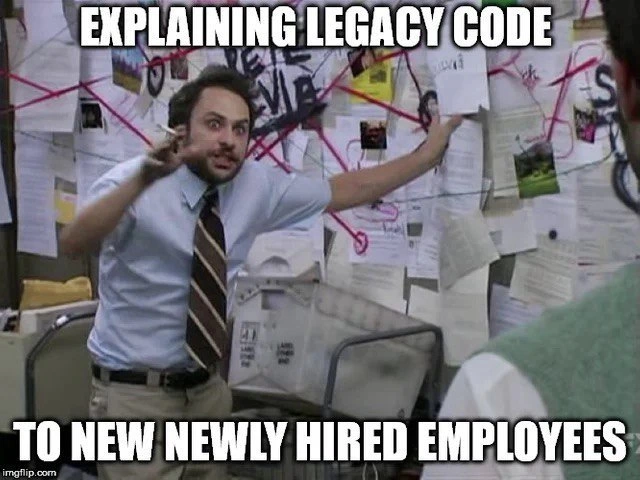
Imagine you walk into a room where someone tried to solve a giant puzzle, but now it’s a huge mess. The puzzle pieces and clue cards are spread out everywhere, and strings connect one piece to another like a big spiderweb. There's an older kid excitedly pointing at one thing, then another, trying to explain to their friend how it all fits together. It looks really confusing and a bit crazy, right? The older kid isn’t actually crazy – the room is just super messy, so he has to act like a detective to make sense of it all. This meme is funny because it compares that scene to explaining a really messy old computer program. It’s as if the code is such a tangled mess that the only way to explain it is by frantically pointing out piece by piece, just like the kid with the wild puzzle wall.
Level 2: Spaghetti Code Unraveled
On a simpler level, this meme is funny to developers because it shows a senior programmer desperately trying to explain a messy old codebase to newly hired teammates. The wall full of papers and red yarn is a comic exaggeration: in real life, a team might use a whiteboard or a flowchart to map out how different parts of a program connect. Here, the red strings on the wall stand in for the many hidden connections inside the software. The phrase legacy code means code that has been around for a long time (often written by people who have since left) and is still mission-critical. Such code carries a lot of history: quick fixes, outdated design decisions, and odd quirks that have accumulated over years. Because many changes were made without restructuring, the program’s internals became tangled up. Developers often nickname a very tangled program “spaghetti code” because its logic winds and loops around in a messy way (imagine a bowl of spaghetti noodles all crossed over – that’s how the program’s structure feels). In the picture, the man’s frantic pointing at a chaotic web of notes humorously represents how convoluted and intertwined everything in a legacy system can be.
Why does this situation happen? Often it’s due to technical debt. Technical debt is a term for the consequences of taking coding shortcuts. For example, if a team rushed out features to meet a deadline and skipped cleaning up the code or writing documentation, they’ve “borrowed” time. The "debt" comes due later, when that messy code is harder to fix or explain. Over years, these quick-and-dirty changes pile up, and the whole codebase (the entire collection of source code) grows into a confusing maze. When a new developer joins the team (that onboarding process of learning the ropes), they face this inherited codebase complexity, which makes getting up to speed quite painful and overwhelming. Instead of a neat introduction, it turns into a detective mission where the existing team has to explain a bunch of unwritten rules and strange behaviors. The meme is exaggerating for humor – most onboarding sessions don’t literally involve a conspiracy board with yarn – but it rings true. It captures that feeling when the senior dev says, “Okay, this part is a little weird, but here’s how it works,” and the new hire’s eyes widen at how unexpectedly complicated the “simple” system really is. It’s funny in a relatable way: the senior engineer looks like a mad scientist, and the new person is thinking, "What have I gotten into?"
Level 3: Red Yarn Architecture
Imagine a senior developer turning into a detective, complete with a wall of evidence taped up and connected by red yarn. That’s essentially what's happening when explaining a sprawling legacy codebase to fresh hires. The meme uses the infamous conspiracy board scene (Charlie Day’s character in It's Always Sunny in Philadelphia, often referred to as the Pepe Silvia meme) as a visual metaphor, and it's disturbingly accurate. You get printouts of ancient code, sticky notes with cryptic comments, and bug reports from 2010 – all pinned up and linked by red strings to illustrate how one piece of code triggers another. It's as if the entire codebase were a crime scene and the tech lead is desperately mapping out suspects and motives. This chaotic map represents the tangled dependencies in the software: global variables that magically alter behavior in distant modules, functions with hidden side effects that cascade through the system, and quick-fix patches piled on for years. In short, it's a physical manifestation of spaghetti code, drawn out so a newcomer might grasp the sheer codebase complexity. All this dramatization highlights the very real onboarding chaos: a new engineer’s first exposure to such a system can be overwhelming, and sometimes a bit comic in how absurdly complicated things have become.
This scenario arises from years of technical debt accumulation. Perhaps the product started as a simple script, but over time business needs kept changing and new features were bolted on without proper refactoring. Deadlines loomed, so developers kept saying “We’ll clean it up later”, but "later" never came. The result? A codebase so convoluted that explaining how it works feels like unraveling an urban legend. The senior engineer presenting this "conspiracy" has likely spent countless late nights (and 3 AM on-calls) piecing together why a seemingly unrelated module breaks when you change a line in a different part of the system. Over the years, these hidden connections turned into landmines. The poor veteran dev tries to warn the newcomers about every trap. For example:
"Don't remove this check or the login page will crash!"
"This global variable must stay true or the payment system will freak out!"
It’s a frantic legacy walkthrough where decades of tribal knowledge get dumped in one epic, slightly panicked briefing.
Underneath the humor, there's an uncomfortable truth: many enterprise codebases end up as a Big Ball of Mud – a term for systems with no clear architecture, just a hodgepodge of code held together by duct tape and prayers. Such a system resists understanding. Why? Because over the years, dozens of developers worked on it, each leaving their mark (or scar) with differing styles and quick fixes. Organizational churn and rushed schedules meant no single person ever had the time (or courage) to re-engineer it properly. Rewriting from scratch is often deemed too risky or costly by management ("if it ain't broke, don't fix it"), so the beast continues to evolve, warts and all. The result is that bringing a new hire up to speed becomes an exercise in storytelling and detective work. The veteran isn't actually crazy – they have a mental map of the code’s quirks that took years of hard experience to build. Now they're desperately trying to transfer that hard-won knowledge in a few hours, hence the manic energy. It’s developer humor with a dose of PTSD: we chuckle at the exaggerated depiction, but deep down every programmer who’s been there is thinking, "Yep, that’s exactly what it feels like."
Description
This image uses the famous 'Pepe Silvia' or 'Charlie Day Conspiracy Board' meme format from the TV show 'It's Always Sunny in Philadelphia'. It shows the character Charlie Kelly looking manic, with wild eyes and a cigarette, frantically gesturing at a wall covered in papers, notes, and photos connected by a complex web of red string. The top caption reads, 'EXPLAINING LEGACY CODE', and the bottom caption says, 'TO NEW NEWLY HIRED EMPLOYEES'. The meme perfectly captures the feeling of trying to explain a complex, poorly documented, and convoluted legacy system to a newcomer. For experienced engineers, the conspiracy board is a painfully accurate metaphor for the tangled dependencies, arcane business logic, and historical 'quick fixes' that make up old codebases. The humor lies in the shared experience of this chaotic knowledge transfer, where the explanation sounds less like a technical walkthrough and more like a rambling conspiracy theory
Comments
11Comment deleted
This part of the code is the way it is because of a server outage in 2008 and a temporary fix by a contractor named Dave who we can no longer contact. Any questions?
Those red strings aren’t decoration - they mark the precise ticks when the 2006 monolith, the “temporary” microservices, and that one mission-critical Excel macro accidentally achieve eventual consistency
The AbstractSingletonProxyFactoryBean was deprecated in 2009 but if we remove it, the entire payment system stops working and nobody knows why - including Dave, who wrote it and is now our CTO
Explaining legacy code to new hires is like trying to rationalize a 15-year-old monolith where the original architects have long since departed, the design docs exist only as folklore, and every module is held together by a Jenga tower of monkey patches that nobody dares refactor because 'it works in production.' You find yourself saying things like 'this singleton was necessary because of a threading issue in Java 1.4' to someone who's never seen a world without async/await, while internally screaming because you know the real reason is that Bob from 2009 just really liked singletons
Onboarding here is just Kahn’s topological sort on the red-string wall - fails immediately because the only DAG in this company is the org chart
Explaining legacy code to new hires: here’s the architecture diagram - red yarn is synchronous calls, blue yarn is cron, and anything with a pushpin runs as root on a server we’re afraid to reboot
Legacy code's true dependency graph: less UML, more red yarn proving that 'self-documenting' was always a cruel joke
it's ezier to rewrite the whole thing from scratch Comment deleted
Breaks backwards compatibility Comment deleted
every day, starting from scratch Comment deleted
some memes here are kinda cringe because they’re so conventional Comment deleted