The Unreleased Harry Potter for CS Majors
Why is this Compilers meme funny?
Level 1: Not a Wizard Story
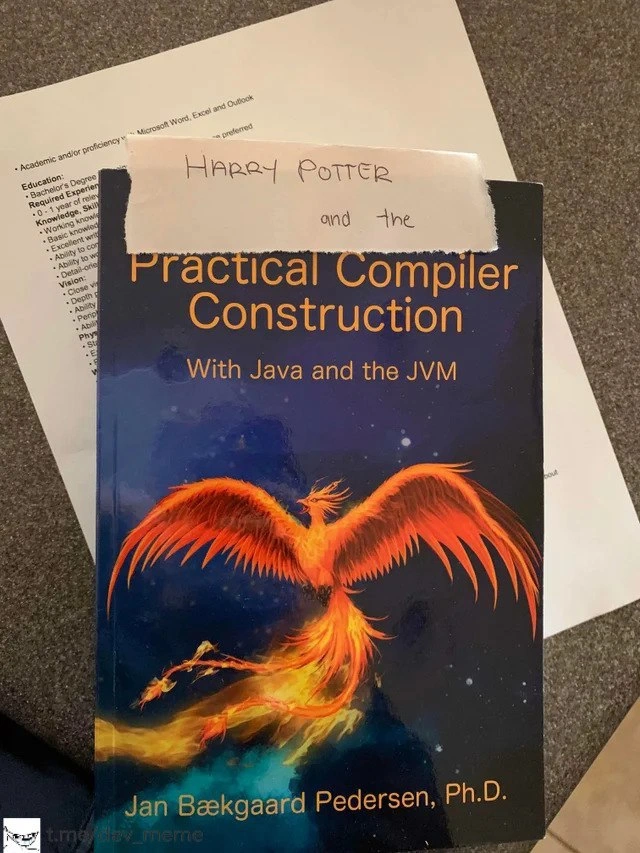
Imagine you see a big, complicated textbook about computer programming that has a picture of a fiery magical bird on the cover. Now imagine someone put a “Harry Potter and the …” label on that book to make it look like it’s a Harry Potter story. Funny, right? That’s exactly what happened here. The joke is that the book is not actually a Harry Potter novel at all – it’s a super technical book about how computers understand programming languages (something called a compiler, which is like a translator for computer code). By adding the Harry Potter title to it, the person is pretending this boring (to most people) book is an exciting wizard adventure. It’s like taking a math textbook and wrapping it with a Harry Potter book jacket so it feels more fun. The fiery bird (a phoenix) on the cover makes it even easier to fool the eye, because a phoenix is a magical creature from the Harry Potter world.
So why is this funny? It’s because of the mismatch. Reading Harry Potter is usually light and fun, full of magic spells and adventure. Reading a textbook on compilers is heavy and difficult, full of math and computer code – no magic spells to be found. By combining them, the picture creates a silly contrast. It’s as if a really tech-savvy person (a true computer geek) is saying, “This complicated programming book is as thrilling to me as a fantasy novel!” It’s a bit of nerdy humor. Even the paper under the book adds to the joke: it lists things like Microsoft Word and Excel skills (pretty normal stuff for a job), while the person is casually going through an advanced computer science book. That’s like studying rocket science when you only need to know how to ride a bicycle – kind of overkill, and therefore humorous.
In simple terms, the meme is funny because someone took a plain, difficult book and dressed it up to look like Harry Potter, mixing something very technical with something very magical. It makes you smile because you realize no kid (or even most adults) would mistake that compiler book for a real Harry Potter tale – but somewhere, a proud nerd is joking that, for them, this is their kind of magical story.
Level 2: No Magic Here
Let’s break down the joke in simpler terms. The image shows a real textbook titled “Practical Compiler Construction – With Java and the JVM.” A compiler is a program that translates code written in one language (like Java, C++, or others) into another form, typically into a lower-level form that the computer can execute (like machine code or, in Java’s case, JVM bytecode). In plain terms, if programming is giving instructions to a computer, a compiler is like a master translator that converts our human-friendly instructions into something the machine can actually run. “With Java and the JVM” means this particular book teaches how to build a compiler using the Java programming language and targeting the Java Virtual Machine (JVM) platform. The JVM is basically an imaginary computer inside your real computer – Java programs get converted (compiled) into JVM instructions (bytecode), and then the JVM runs those. It’s what allows Java programs to run on different operating systems without changes. So, this book is heavy computer science material, often taught in upper-level university courses. It covers how programming languages work under the hood. Studying compilers is known to be challenging (there’s a reason not every developer delves into compiler design unless they have to). It’s definitely part of core CS fundamentals, but it’s not something most beginners tackle early on because the learning curve is steep. Think thick textbooks, mathy formalisms for grammar, and lots of focus on how to manage details like variables and data types at a very low level – definitely not what you’d call a casual read.
Now, the funny part: someone taped a small piece of paper with the handwritten words “HARRY POTTER and the” over the top of this textbook’s cover. This makes the book’s title appear to start with “Harry Potter and the…” followed by the existing title “Practical Compiler Construction with Java and the JVM.” So it reads as one long title: “Harry Potter and the Practical Compiler Construction With Java and the JVM.” Clearly, that’s not an actual Harry Potter book! In the Harry Potter series, every book title starts with “Harry Potter and the [Something Mystical]” – for example, Harry Potter and the Sorcerer’s Stone, ...Chamber of Secrets, ...Goblet of Fire, ...Order of the Phoenix, etc. Here the “something mystical” has been replaced with an extremely technical subject. This contrast is the heart of the joke: magic vs. programming. Harry Potter is a beloved fantasy story about wizards, whereas “Practical Compiler Construction” is an academic subject about as muggle (non-magical) as it gets — it’s all logic, code, and engineering. By combining them into one title, the meme creates a silly image of a Harry Potter crossover that nobody would expect: imagine Harry attending a class at Hogwarts called “Compiler Construction with Java.” Instead of Defense Against the Dark Arts, he’s learning about parsing algorithms and memory management! The idea is so absurd that it’s funny.
The cover of the compiler book even shows a fiery phoenix in orange-red rising from blue flames. Coincidentally (or perhaps intentionally by the book publisher), this mythical bird is also a big symbol in Harry Potter (there’s a phoenix named Fawkes in the series, and one of the HP books is Harry Potter and the Order of the Phoenix). That phoenix artwork makes the mashup look oddly legit – as the original poster said, “Looks legit 🤔.” It’s like the person who made the meme found the perfect textbook cover to turn into a pretend Harry Potter book, since it already had magical-looking art on it. The little taped label “Harry Potter and the” is torn and taped rather casually, but from a short distance it could fool someone into thinking that’s part of the book. This visual gag is something a nerd or geek might do to amuse their friends: take a super nerdy book and frame it as if it’s a best-selling fantasy novel. It’s both a celebration of the nerdy subject (hey, compilers are cool!) and a way to poke fun at how dense and unapproachable it can seem (you almost wish it were as fun as a wizard story).
Also visible in the photo is a sheet of paper underneath the book, which appears to be a job posting or resume snippet. We can see lines about “Academic and/or proficiency… Microsoft Word, Excel and Outlook” and some bullet points like “Required: ... preferred”. That bit is telling us a story: it suggests the person who set up this scene might be preparing for an interview or updating their resume. But instead of reading something directly relevant to a typical job (like brushing up on Excel or general interview Q&A), they’re diving into a hardcore compiler textbook. This contrast is comedic. It’s as if someone preparing for a fairly ordinary job (that only demands MS Office skills) decided to over-prepare in the most over-the-top way, by reading about the JVM internals and compiler theory. It’s like bringing a rocket science manual to study for a driver’s license test. Of course, it’s possible the person is just reading this book out of personal interest or for a more specialized interview, but including the Microsoft Office skills list under the book implies a joke: the requirements are basic, but our hero’s study material is anything but basic.
From a newbie developer or student perspective, there are a few takeaways in the humor:
- Compilers are complex: If you’re new to programming, you might not have touched this topic yet, but you can appreciate that it’s “advanced stuff.” The meme exaggerates this by pairing it with something as epic as Harry Potter.
- Programmers have quirky humor: This is a form of nerd humor where we mix a popular theme (Harry Potter) with an internal joke about the challenges of computer science. No actual knowledge of compilers is needed to find it amusing – just knowing that one of these things is not like the other.
- Loving the grind: It also reflects that some programmers genuinely find joy in these deep technical topics. What looks like a boring textbook to many is exciting to a certain kind of geek. Calling it Harry Potter (even as a joke) implies the reader sees it as an adventure. There’s pride in that – “My idea of fun reading is this hardcore CS text!” It’s self-deprecating and boastful at the same time.
- Visual pun with the phoenix: The phoenix on the cover art ties it nicely back to Harry Potter’s world. For those who know the series, it immediately triggers the memory of “Order of the Phoenix.” Here it serves as a visual pun: a phoenix belongs in a fantasy tale, but it’s on a very non-fantasy book. The meme creator leveraged that coincidence perfectly.
In essence, to a junior developer or someone early in tech, this meme is saying: People in tech sometimes joke about our work by comparing it to magic or pop culture. Here, the serious topic of compiler construction (part of learning how programming languages work) is being cheekily presented as if it were the latest Harry Potter adventure. It’s funny because obviously reading about how to compile Java code is not at all like reading about Hogwarts, but the crossover makes you do a double-take and maybe appreciate that, in a way, making software is kind of magical — just not the kind of magic you read about in novels.
Level 3: The Compiler’s Stone
For seasoned engineers, the humor in this meme is instantly recognizable: it’s the juxtaposition of young-adult magical adventure with the un-magical grind of low-level programming theory. If you’ve ever taken a Compilers class or sweated through implementing a parser by hand, you know there’s nothing whimsical about it – it’s meticulous, brain-bending work. That’s exactly why slapping a Harry Potter title on a compiler textbook is funny. The original post caption “Looks legit 🤔” underscores how the taped paper with “Harry Potter and the” almost blends in, as if Harry Potter and the Practical Compiler Construction with Java and the JVM could be some secret seventh-year curriculum at Hogwarts (for the especially nerdy wizards). It’s a classic bit of geek humor: mixing pop culture with niche technical inside jokes.
Imagine sitting on a train or at a cafe with this hefty compiler design book, covered by a title that suggests a fantasy novel – you’d get some double-takes! Experienced devs chuckle at this because many of us have been in similar situations (if not literally, then in spirit). We’ve traded our childhood bedtime stories for technical tomes long ago. What used to be “Harry Potter and the Goblet of Fire” becomes “Java and the Garbage Collector” in our adult life. We read dense documentation, language specs, or academic books “for fun” or for career growth, while outsiders think we’re dealing in dark arts. This meme specifically shows a Harry Potter crossover: the world of Hogwarts meets the world of compilers and the JVM. The phoenix on the cover conveniently echoes Fawkes, Dumbledore’s phoenix in the series, making the mash-up even more perfect. It’s as if the book is a tale of the Order of the JVM Phoenix, where instead of wizards and witches, you have compiler engineers battling syntax errors and segmentation faults to conjure working programs from text. The order here might be the community of gray-bearded senior developers who have mastered these arcane skills over the years.
There’s a layer of senior engineer relatability here. Many veteran developers remember the first time they had to really understand how a compiler or a virtual machine works – it’s a humbling experience. The meme pokes fun at that by implying someone is treating this hard-knocks CS topic as light leisure reading. It’s the kind of absurd over-preparation or enthusiasm that senior folks find endearing. You see hints in the photo: beneath the book lies a printed page (possibly a job posting or resume requirement list) asking for “Academic and/or proficiency… Microsoft Word, Excel and Outlook.” That detail is golden: it suggests the reader is preparing for a job interview where the toughest required skills are basic office software, yet here they are reviewing compiler theory as if that’s going to be on the quiz. It’s a tongue-in-cheek contrast between real-world job expectations (often mundane or business-y) and the esoteric depths a passionate developer might dive into. In a senior dev’s career, you eventually realize that most jobs won’t ask you to write a compiler from scratch or delve into Java bytecode on a daily basis. But early in our careers (or during university), many of us did pour over books like this, either because it fascinated us or because a professor made us. We recall the long nights debugging a recursive descent parser or getting a segmentation fault in our compiler project and wishing for some magic wand to fix it. So seeing someone treat that experience as if it’s the next Harry Potter page-turner is rich with irony.
This meme also highlights the pride and identity in being a “nerd”. To an experienced engineer, calling oneself a wizard or magician of code is an inside joke. We know writing a compiler isn’t magic at all – it’s sweat, logic, and many Google searches – but it feels powerful. There’s a shared acknowledgement: “Haha, only a true nerd would find Practical Compiler Construction exciting enough to make a parody Harry Potter cover for it.” It’s both self-deprecating and boastful. We’re laughing at ourselves for how deep we go into our obsessions. A senior dev might comment, “I remember when I read the Dragon Book (another legendary compiler text) for fun – I must have really been under a spell.” There’s even an implicit nod to the idea that programming languages and their tools are our version of a fantasy universe: full of strange rules, powerful artifacts (think IDEs, debuggers), and the occasional monstrous bug lurking in the Forbidden Forest of legacy code. We don’t have real phoenixes, but we do have builds that rise from ashes (and Jenkins jobs that go up in flames!). It’s a humorous way to say that creating software can be just as much an epic saga as any novel – just with more semicolons and fewer prophecy scrolls.
From an industry perspective, compilers and the JVM internals are serious stuff. They form the backbone of how high-level languages run on real machines. Most developers use compilers every day (by writing code and hitting “build” or saving a file in an IDE) without thinking about them – it’s mundane, not magical. But those who have dug into compilers know that it involves everything from theory (like state machines and grammars) to practical systems programming (managing memory layouts, generating efficient machine instructions). It’s intricate and unforgiving. Thus, the phrase “decidedly un-magical grind of compiler theory” from the description is spot-on. Seasoned engineers grin at that contrast: Harry Potter is all about effortless wand flicks and Latin incantations to do astonishing things. Real compiler work is writing hundreds of lines of code to implement something like a symbol table or a garbage collector, then painstakingly testing it on edge cases. No instant Expelliarmus to disarm a bug – you have to reason it out. The humor lands because we’ve all fantasized about a world where coding could be as easy as magic words. Alas, reality is more “10 hours debugging why the segmentation fault happens only on Linux” than “10 points to Gryffindor.”
Finally, this meme plays on the idea of how we present our interests. By physically pasting “Harry Potter and the” onto the book, the creator is rebranding a dry subject as a fun narrative. It’s like a senior dev’s version of a prank. We often see jokes like “reading CPU instruction set manuals as bedtime stories” or “curling up with the latest RFC for a light read.” This image nails that trope visually. If you showed this to a room of software engineers, you’d likely get knowing chuckles. Some might even say, “Hey, I wish Hogwarts had taught compiler construction – maybe then fewer people would skip that class!” In summary, at the senior level, the meme underscores the contrast between fantasy and reality in our field, celebrates the nerdiness required to enjoy something as dry as a JVM bytecode manual, and winks at the common experience of turning hardcore learning into a kind of personal adventure. It’s a reminder that what we do isn’t magic – but it can feel magical when it all finally works.
Level 4: Arcane Bytecode Incantations
At the deepest level, this meme hides some serious compiler theory under a playful disguise. Compiler design is an arcane art of computer science, dealing with formal grammars, automata, and translation of high-level code into lower-level instructions. Here, the Practical Compiler Construction – With Java and the JVM textbook (authored by Jan Bækgaard Pedersen, Ph.D.) is front and center – a real academic tome on how to build compilers that target the Java platform. In compiler terms, “construction” means implementing the phases that turn source code into executable form: lexing, parsing, semantic analysis, optimization, and code generation. For a Java compiler (like javac), the end product is Java bytecode – a set of binary instructions for the Java Virtual Machine (JVM). This bytecode is essentially a machine language for a virtual CPU, specifying operations like loading constants, calling methods, and returning from functions. The phrase “With Java and the JVM” hints that this book uses Java (the language) to implement the compiler and that the target runtime is the JVM, meaning the output of the compilation will be .class files containing JVM bytecode. In other words, the book likely teaches how to write a compiler that turns a custom language (or perhaps a subset of Java itself) into Java bytecode, leveraging the ubiquitous Java ecosystem. This is heavy CS fundamentals material – compilers involve context-free grammars (often written in Backus–Naur Form), constructing an Abstract Syntax Tree (AST) from source, and then systematically translating that AST into an equivalent sequence of low-level operations. It’s the kind of content that gives students a steep learning curve and a healthy respect for the complexity behind the simple act of running a program.
The cover art on this compiler book features a stunning phoenix rising from blue flames. In mythology (and in Harry Potter lore), a phoenix cyclically burns and is reborn from its ashes. This imagery resonates cheekily with the world of compilers: every time you compile and run a program, the source code “dies” into machine-readable form and is reborn as a running process. A compiler’s output might undergo many transformations – for instance, just-in-time (JIT) compilation in the JVM repeatedly refines bytecode into optimized native machine code at runtime, like a phoenix reborn faster each time. The phoenix cover art could also be a subtle nod to the famous "Dragon Book" in compiler literature – another classic text (Compilers: Principles, Techniques & Tools) that used a mythical creature on its cover to symbolize conquering the “dragon” of complexity in compiler construction. Here we have a phoenix instead of a dragon, continuing the tradition of equating compiler engineering to taming mythical beasts. It’s as if mastering compilers makes you a kind of programming wizard capable of conjuring software from raw text.
Under the hood, a Java compiler performs what feels like incantations but are actually deterministic algorithms. For example, a lexer uses finite automata to break the source code into tokens (identifiers, numbers, symbols). Then a parser (often employing an LL or LR algorithm under the hood) takes those tokens and checks if they fit the language’s grammar rules, building a structured representation (the AST). Next comes semantic analysis (ensuring types match, variables are declared, etc.), followed by optimization passes (like simplifying expressions or inlining functions). Finally, code generation emits the JVM bytecode instructions. Each bytecode instruction is like a tiny command the JVM understands – push a constant, invoke a method, jump to another instruction, and so on. The end result is a .class file containing a stream of bytecode that the JVM’s class loader and interpreter (or JIT compiler) will handle. There’s a lot of serious science and engineering making sure this process is correct (no dangling pointers or type errors) and efficient (so your program runs fast). None of it is actually magic, but to the untrained eye it can seem as mysterious as a sorcerer’s spellbook. In fact, there’s an old saying in tech: “Any sufficiently advanced technology is indistinguishable from magic.” Compiler tech definitely qualifies – it takes something humans understand (source code) and automatically produces an executable that a machine can run, which is pretty magical when you think about it. But unlike casting “Wingardium Leviosa”, building a compiler requires hardcore math and logic rather than wand-waving. The only “Order of the Phoenix” here is the systematic order of compiler phases resurrecting a program into life.
For the truly curious, let’s peek at what Java bytecode looks like, to demystify the magic. Suppose we have a tiny Java program: printing “Hello, Phoenix!” to the console. The Java source might be:
// Java source (PhoenixDemo.java)
public class PhoenixDemo {
public static void main(String[] args) {
System.out.println("Hello, Phoenix!");
}
}
When compiled with javac PhoenixDemo.java, it produces a class file. If we disassemble that .class file (using a tool like javap), we see the JVM bytecode instructions:
// Equivalent JVM bytecode (simplified)
0: getstatic #2 // Get System.out (PrintStream)
3: ldc #3 // Push the string "Hello, Phoenix!"
5: invokevirtual #4 // Call PrintStream.println(String)
8: return // Return from main
Each number on the left is the bytecode offset (instruction position). Here, getstatic #2 retrieves the System.out output stream (like summoning a phoenix’s flame, perhaps), ldc #3 loads the constant string "Hello, Phoenix!" from the constant pool, and invokevirtual #4 calls the println method to actually print the line. Finally, return ends the main method. This is the mundane reality behind what a compiler does – it turns high-level intentions into low-level step-by-step operations. The bytecode may look cryptic, but it’s not written in rune or Elvish; it’s just an assembly-like encoding of what needs to happen, understood by the JVM. In summary, beneath the Harry Potter joke lies a geeky truth: compiler construction is a profound, complex process. The meme gives a wink to those in the know, acknowledging that the practical_compiler_construction_book in question contains knowledge as powerful (and dense) as any grimoire from a fantasy saga. It’s a celebration of nerd humor: turning driest academia into a scene from a wizarding world.
Description
A photograph showing a dark blue textbook titled 'Practical Compiler Construction With Java and the JVM' written by Jan Bækgaard Pedersen, Ph.D. The cover features a prominent illustration of a fiery phoenix with its wings spread against a starry sky. A torn piece of paper has been taped over the top of the title, with 'HARRY POTTER and the' handwritten on it, humorously reframing the book as a new installment in the fantasy series. In the background, a document resembling a resume or job application is partially visible. The joke lies in the absurd fusion of the magical world of Harry Potter with the highly complex, real-world 'magic' of compiler design. The phoenix on the cover, a creature central to the Harry Potter lore, makes the mashup particularly clever and believable at a comical first glance

Comments
7Comment deleted
I'm pretty sure 'Practical Compiler Construction' is the textbook they use for the Defense Against the Dark Arts class at MIT
If your compiler course feels like dark arts, just remember: every time it segfaults, that’s merely the JVM Phoenix performing an unscheduled re-birth ritual
Finally, a book that explains why parsing Voldemort's name throws a NullPointerException and why the Garbage Collector can't clean up Horcruxes - they're strongly referenced across multiple memory regions
Finally, a compiler book that explains how to parse the forbidden syntax, optimize your code with the Elder Wand of SSA form, and defeat Voldemort's O(n²) algorithms with the Patronus of tail-call optimization. Chapter 7: 'Defense Against the Dark Arts of Register Allocation' is particularly enlightening, though the section on garbage collection still involves a lot of magical thinking about reference counting
I call it “Harry Potter and the JIT of the Phoenix” - where the instruction scheduler supplies the order and the optimizer keeps resurrecting the same hot path
Phoenix on a JVM compiler book? Fitting - JIT ignites cold bytecode into hot-path flames, rising eternally from parse-error ashes
Finally, a crossover where ‘Order of the Phoenix’ is just SSA form, and the real dark arts are chasing a HotSpot deopt chain through JITted bytecode