When category theory’s elegance becomes an existential threat to engineers
Why is this CS Fundamentals meme funny?
Level 1: Pretty but Deadly
Imagine you ask a very smart friend to help you tie your shoes, and instead of showing you the simple loop-and-swoop method, they launch into a lecture about every knot in the world. They pull out a piece of paper and draw a super intricate knot diagram that looks gorgeous – way fancier than your shoelaces need – and it technically shows how to tie any knot. But while they’re busy being a genius, you’re still standing there with your shoes untied. You just needed to learn one basic bow, and now your laces are loose and you’re starting to wobble. In fact, you might trip and fall because this overly fancy lesson took so long 🙃. That’s the heart of this joke: category theory is like that overly smart friend with the beautiful, super-general ideas that end up not helping you in the moment. It’s funny (and a bit scary) because something so elegant and powerful can actually make life harder when all you want is a practical, quick solution.
Level 2: Burritos and Monads
If you’re a newer developer or not deep into functional programming, this meme might seem mystifying at first. Why is category theory being told to "stop"? What’s with ideas being too abstract or diagrams too pretty? Let’s break it down in simpler terms, because the tweet is basically nerd-speak for "this math stuff is awesome but terrifying."
First off, category theory is a branch of math that deals with very abstract concepts. Instead of numbers or specific data structures, it talks about objects and arrows (also called morphisms) between those objects. You can think of a category as like a context or a domain – for example, one category could be “all sets,” where the objects are individual sets and the arrows are functions that go from one set to another. Category theory looks for patterns that hold true no matter what the actual objects are, which is why we call it abstract. It’s the ultimate general framework, so general that it can apply to almost anything. That’s where the tweet’s idea of "too abstract" comes from: category theory will cheerfully describe a process in the broadest possible terms, which can leave your head spinning if you’re used to concrete examples.
Some terms from category theory have made their way into programming, especially in languages that emphasize functional programming (like Haskell, Scala, or even certain JavaScript libraries). Here are a few key concepts mentioned or alluded to in the meme, explained in a more concrete way:
Functor – In plain programming terms, a functor is something you can map a function over. Think of a list: you can apply a function to every element in a list (for example, doubling each number in
[1,2,3]to get[2,4,6]). In Haskell or Scala, they would call the list type aFunctorbecause it implements a genericmapoperation. The math definition is a bit more elaborate (a functor maps objects and arrows from one category to another, preserving the structure), but you can remember it as “a mappable container.” Other examples of functors in coding: an optional value (you can map a function to transform the value inside if it’s present), or a tree structure (you can map a function to every node in the tree). If you’ve usedarray.map(...)in JavaScript or list comprehensions in Python, you’ve used the functor idea without even knowing it.Monad – This is a famously confusing term that sparks a lot of jokes. Simply put, a monad is a design pattern that lets you chain operations while keeping track of some context. For example, consider how you handle something that might fail: you have a value that could be an error or a valid result (think of an
Option/Maybetype or aResulttype in various languages). With a monad, you can say “if it’s okay, do the next thing; if it’s an error, skip the next thing” – all in a uniform way without a bunch of nestedifstatements. Promises in JavaScript are a real-world example of a monad: a.then()call will take the successful result of a promise and feed it into the next step, or skip ahead to the.catch()if an error happened, passing the error along. Another everyday example is dealing with a list of tasks: you might want to perform a sequence of operations on each task, and a monad can handle the plumbing of looping and error checking for you. There’s a running joke that “a monad is like a burrito” – an analogy from a programmer’s blog trying to simplify the concept by saying a monad wraps a value (filling) in a computational context (a tortilla) along with rules for how to combine those wraps without spilling anything. The tweet’s line about results being "too general" is nodding to how monads (and category theory structures) are incredibly general – they can apply to any type of data or effect, which is awesome but also a bit hard to wrap your head around. The actual math definition of monad (often cited as “monad is a monoid in the category of endofunctors”) sounds intimidating, but the truth is you can use monads in code (like promises, or stream pipelines, etc.) without ever knowing that definition. Many programmers do it every day!Commutative Diagram – This is basically a picture that mathematicians draw to show relationships between different things and ensure consistency. Imagine you have points labeled A, B, C (which could be anything: sets, types, whatever) and arrows connecting them that represent functions or transformations. If you can go from A to C directly, or go from A to B and then B to C, a commutative diagram means both paths give you the same end result. It’s like having two routes on a map that both lead to the same place in the end – no matter which route you take, you arrive at the identical destination. These diagrams are a way to visualize equations or rules in category theory. They often end up looking like neat squares or triangles. Mathematicians find them very satisfying because they clearly show that “doing things in this order or that order doesn’t matter, you end up in the same state.” When the tweet jokes that the diagrams are "too pretty," it’s comparing these clean, elegant visuals to the kind of messy diagrams we see in real software projects (imagine a big jumble of boxes and arrows in a UML diagram or an architecture flowchart). In contrast, a commutative diagram might look almost like a simple piece of art. The humor is in suggesting that those polished math diagrams could be lethal – as if their beauty is deceitful, hiding the complexity behind them.
In the tweet, when Matteo says "they'll kill you," he doesn’t literally mean code or math will come after you with a knife 😅. It’s an exaggeration common in tech humor. Here it means “this stuff is so advanced and mind-bending, it might ‘do you in’ if you get too deep into it without preparation.” Think of it like a warning said in jest. It’s as if category theory is a daredevil stunt driver and the engineer is saying, “Slow down, you’re going to crash!” The whole meme personifies category theory as a genius friend who is just too good at what they do — so much that it’s frightening. The friend’s ideas are brilliant but impractical for everyday use, and if we try to copy them recklessly, we could end up in trouble. In a software context, trouble could mean code that nobody else understands, or spending so much time on a perfect abstraction that the project misses its deadline.
The key takeaway for a junior developer is: don’t be scared off by the fancy math talk. You actually don’t need to master category theory to write good software. It’s a sort of intellectual hobby or advanced tool – very cool, but not mandatory for most programming jobs. In fact, you’re probably using watered-down versions of these concepts already. Ever used a map function to transform a list? That’s leveraging the functor concept. Used a try/catch or error handling mechanism to short-circuit when something goes wrong? That’s akin to the monadic way of chaining operations. The meme is funny because even veteran engineers sometimes look at pure category theory and say, “Whoa, that’s overkill for what we need.” It’s a gentle reminder that while it’s great to learn new abstract ideas, you should also know when to say, “thanks, but no thanks,” and solve a problem in a simpler way. In short: category theory’s superpowers are real, but with great power comes great responsibility (and maybe a headache). The joke is basically the coding world teasing the math world: “Your stuff is awesome – just please don’t let it melt our brains or our code!”
Level 3: Monads vs Mortals
For seasoned developers, especially those who’ve dipped a toe into Haskell or Scala, this category theory meme elicits a knowing groan (and a laugh). It’s pointing to that classic clash between academic elegance and down-to-earth engineering. The tweet’s author addresses category theory like a person, essentially saying, “Chill out with the high-level magic, you’re going to hurt someone!” In all lowercase deadpan, it reads like an exhausted senior engineer talking to an overly enthusiastic teammate who just discovered a fancy new paradigm and is about to refactor the whole codebase by Monday. The humor works because it’s painfully relatable: it mixes an academic in-joke (an idea so abstract it’s borderline dangerous) with classic nerd humor (casting an abstract concept as a comic-book villain we must stop).
What industry pattern is being roasted here? It’s the tendency to over-engineer by applying ultra-general, theoretical solutions to very concrete problems. We’ve seen this movie before: someone falls in love with a new abstraction and starts wielding it everywhere. In the case of category theory, a developer might take a straightforward design and elevate (or rather, contort) it into a highly generic, math-heavy framework. Picture a simple data processing pipeline suddenly reimagined as a series of functor transformations and monadic binds. The original code was clear and good enough — but now it’s a temple of generalized patterns, understandable only to the high priests of math. As the description puts it, a “perfectly practical design disappear[s] into a vortex of functors and natural transformations.” That line could be pulled from a war story at any senior dev gathering. It’s the tale of code that used to make sense until somebody insisted on solving not just the task at hand, but an entire class of theoretical tasks no one asked for.
One unspoken truth here is the bus factor problem. If only one or two people truly grok the category-theoretic approach used in a codebase, the project becomes fragile. I’ve seen eyes glaze over in code review when a diff introduces >>=, μ (mu), or some obscure categorical combinator. Sure, those constructs might eliminate certain classes of bugs or prove some correctness property, but now no one else can confidently modify the code. If the original author leaves, the remaining team feels like they’ve inherited an alien artifact. This is where the existential dread kicks in: the project’s future could be at risk because it’s dependent on concepts few can grasp. In a sense, the meme’s hyperbole about “they’ll kill you” isn’t too far off – a project can die when drowned in unnecessary abstraction. At the very least, it can kill your timelines and team morale.
Why do smart people keep falling into this trap? Partly because our industry subtly rewards cleverness and abstraction. “Don’t Repeat Yourself,” we’re taught. Write code that can handle more than one case. Use elegant patterns. In moderation, these are great practices, but category theory takes “general solution” to stratospheric levels. It’s like trying to solve every coding problem by first solving all of mathematics and then tailoring it back to your app. The intentions are noble: eliminate redundancy, ensure correctness across the board. But in practice, it’s often overkill (the essence of abstract math overkill). Once a hyper-general framework is in place, ripping it out feels sacrilegious. There may even be organizational pride tied up in it – “Look, our system is based on category theory, isn’t that cutting-edge?” – which makes it hard to admit that maybe it’s hurting productivity. It’s a classic case of a solution being so elegant in theory that folks become blind to its costs in practice.
The tweet also nods to the aesthetic seduction of these ideas. Those pretty commutative diagrams and neat algebraic laws can lull engineers into a false sense of “we’ve got it all figured out.” Seasoned folks have learned to be a bit wary of something that looks too perfect on paper – there’s usually a hidden cost when you bring it into the real world. It reminds me of the saying: “In theory, theory and practice are the same. In practice, they’re not.” On a whiteboard, drawing a diagram where various arrows elegantly commute might make you feel like you’ve achieved architect nirvana. But when you translate that to actual code and real user requirements, you discover edge cases, performance quirks, or simply that your teammates do not share your enthusiasm for turning the codebase into a research paper on lambda calculus.
There’s a cultural divide at play as well. The functional programming community (with Haskell as a prime example) thrives on these abstractions – they’re proud of how principled and general their code can be. A Haskell guru will casually mention terms like Monoid, Functor, Applicative, Monad, Natural Transformation as if they were discussing variables and loops. In that world, this stuff isn’t scary; it’s empowering. But when those ideas leak into a typical product team that isn’t steeped in FP, it can cause chaos. I recall a meeting where a developer enthused about using a monad transformer stack to handle configuration and logging in an application. Another teammate, perplexed, asked, “Do I need a math degree to add a new config option now?” It was only half in jest. In the end, half the team was excited about the new level of abstraction, and the other half felt like they’d been handed an alien toolkit. That kind of split is exactly what this meme is joking about: the “elegance” that threatens to leave some team members behind.
Ultimately, Matteo Capucci’s tweet is a light-hearted cautionary tale from the trenches of software development. It says, in effect, “We respect the heck out of you, category theory, but please don’t go overboard.” It’s a wink and a nudge reminding us that in engineering, pragmatism often trumps purity. The senior perspective here is clear: use the right tool for the job. Category theory is an extremely powerful tool – maybe even a bit of a dangerous one – and like any power tool, you should put on a hard hat before you unleash it on a codebase. In other words, enjoy the pretty diagrams and general results, but don’t let them kill your project.
Level 4: Commutative Diagrams of Doom
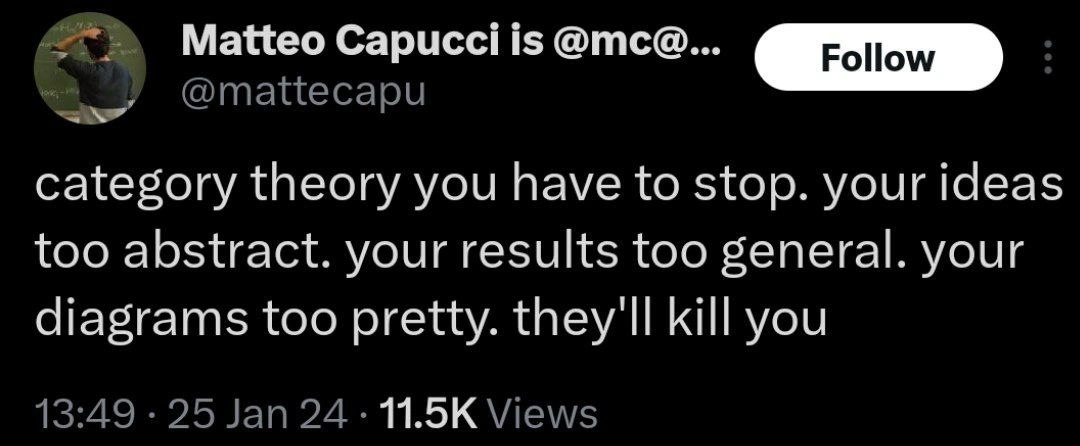
At the highest echelons of theoretical CS fundamentals and pure mathematics, we find category theory – a towering framework of abstraction sometimes nicknamed "abstract nonsense" for its unapologetic generality. This meme humorously casts category theory as an almost villainous force: its ideas too abstract, its results too general, and its iconic commutative diagrams too pretty for the practical world of engineering. The exaggerated warning "they'll kill you" evokes the dramatic flair of an academic horror story: the notion that such elegant math could be perilous if taken to extremes in software design.
To understand the joke, let’s unpack why category theory has this intimidating aura. In category theory, all of mathematics is distilled into categories (collections of objects) and morphisms (arrows representing relationships or functions between objects). It’s a kind of meta-language for math that can describe everything from simple sets and functions to complex structures in algebra, topology, and logic in one uniform way. Its power lies in being infinitely abstract: a theorem proven in category theory often applies to countless specific domains at once. In other words, category theory thrives on generality. For example, instead of proving a property separately for numbers, strings, and lists, a category-theoretic result might prove it for any structure that meets certain axioms – covering all those cases (and more) in one fell swoop. One famed result, the Yoneda Lemma, essentially says a category can be fully understood just by examining all the arrows into any given object. It’s a mind-blowingly general theorem – a cornerstone of category theory – but if you mention "Yoneda" in a typical software design meeting, you’ll probably get perplexed stares. "Your results too general" is the meme pointing out this head-spinning breadth: category theory’s theorems are often so broad that they solve problems you didn’t even know you had, in fields you might not have even heard of.
This extreme abstraction gives rise to proofs and diagrams of almost ethereal beauty. Category theorists love using commutative diagrams – grids of points and arrows – to illustrate how different compositions of morphisms lead to the same end result. When those diagrams commute, it means whichever path you follow through the arrows, you end up in the same place, fulfilling a perfectly balanced equation in arrow form. These diagrams can look like elegant geometric patterns, far nicer to behold than the tangled web of a typical software UML class diagram. The tweet quips "your diagrams too pretty" as if even the visual aesthetics of category theory are dangerously disarming. It’s as if the meme warns: don’t be seduced by these immaculate arrow-charts; they might lure you into a deadly trap of over-engineering.
And indeed, the humor hides a real tension: category theory’s elegance can be a double-edged sword. The final punch line "they'll kill you" is a tongue-in-cheek way of saying that if an engineer dives head-first into category theory without caution, the sheer abstraction could spell disaster. How so? Consider an infamous example from functional programming folklore: “a monad is just a monoid in the category of endofunctors.” This one-liner is mathematically precise – it defines a monad in succinct category-theoretic terms (basically describing a monoid structure within the realm of endofunctor mappings). To a category theorist, it's like poetry: it packs enormous insight into a few symbols. But to a working programmer encountering monads for the first time, that sentence is practically an incantation from an arcane grimoire. It’s too abstract and too general all at once – exactly what the meme lampoons. Many engineers have jokingly said that reading such definitions nearly killed them (at least, killed their enthusiasm or confidence) when all they wanted was a straightforward way to handle, say, I/O or asynchronous calls.
Historically, category theory was developed by mathematicians (Samuel Eilenberg and Saunders Mac Lane in the 1940s) with no concern for writing web apps or shipping product on a deadline. Yet over time, its concepts seeped into computer science. By the late 20th century, language designers and type-system architects were mining category theory for ideas to make code more like math – predictable and safe. This led to languages like Haskell embracing category-inspired constructs (Functor, Monad, etc.) to ensure correctness and composability in code. Suddenly, ideas from an abstract math realm were running around in real programs. The meme’s horror-movie tone ("category theory, you have to stop!") winks at this development: the academic monster has escaped the lab and is now threatening unsuspecting engineers with its too-general solutions and beguiling diagrams.
Description
Screenshot of a tweet displayed in Twitter’s dark mode UI. The profile header shows a small circular avatar of someone facing a blackboard, the name line reads “Matteo Capucci is @mc@…”, the handle is “@mattecapu”, and a white “Follow” button sits to the right. The tweet text, all in lowercase, says: “category theory you have to stop. your ideas too abstract. your results too general. your diagrams too pretty. they'll kill you”. Below it, the metadata bar shows “13:49 · 25 Jan 24 · 11.5K Views”. The meme pokes fun at how category theory - beloved by language theorists, Haskell aficionados, and type-system architects - can feel dangerously over-powered: infinitely abstract proofs, impossibly generic results, and commutative diagrams prettier than any UML. It resonates with senior engineers who have watched perfectly practical designs disappear into a vortex of functors and natural transformations

Comments
8Comment deleted
Architectural rule #42: the moment your system diagram requires an adjoint functor to explain data flow, you’ve officially exceeded the blast radius of stakeholder comprehension - and probably the budget, too
After 20 years in the industry, I've seen category theory transform from 'abstract nonsense' to the foundation of modern FP libraries, and yet somehow the only thing more incomprehensible than a monad tutorial is explaining to stakeholders why we spent three sprints implementing a functor that could've been a for-loop
Ah yes, category theory - where you spend three months proving that your monad is just a monoid in the category of endofunctors, only to realize your stakeholders wanted a REST API by Friday. The diagrams may commute beautifully, but your pull request comments definitely won't when you try explaining why the codebase now requires a PhD in abstract algebra to understand the error handling
Category theory: so general it unifies all paradigms, except the legacy COBOL monolith you're refactoring
Our architecture review started with “add a queue” and ended with proving a right adjoint - PM marked the RFC as shipped because the commutative diagram looked production‑ready
Category theory is great until the incident doc explains the rollback with a commutative diagram - beautiful at 3 a.m., useless to the pager
A monad is just a monoid in the category of endofunctors, what's the problem? Comment deleted
I just imagined how this catchphrase would look like as an error message: You: Trying hard learning a new language. The language: Error: A monad is just a monoid in the category of endofunctors in src/foo.bar on line 2123. Foo.bar: only has 32 lines. Comment deleted