When "Kubernetes" gets auto-translated to "coopernetties" by your living-room audience
Why is this Containerization meme funny?
Level 1: When Words Sound Weird
Imagine you hear your friend say a big fancy word you’ve never heard before – it might sound like pure gobbledygook. In this meme’s story, a guy in a work meeting said “Kubernetes,” a very technical word, and his girlfriend, listening from the couch, heard “coopernetties” instead. It’s like if someone talked about an exotic fruit called “pitaya” and you heard “pajama” – you’d be confused! The girlfriend found the word so strange that she texted him asking what it meant. The funny part is that he was talking about something totally real (a tool that computer folks use every day), but to her it sounded like a made-up silly word. This shows how people who work with computers often use special words that can sound really weird to anyone else. It’s a bit like hearing another language. The humor comes from that mix-up: one person says a complicated tech term, and the other person goes, “Huh? What’s that supposed to mean?” We laugh because we’ve all experienced a moment where a word didn’t make sense to us and we turned it into something playful in our heads. Here, “Kubernetes” turned into “coopernetties,” and that little misunderstanding brings out the giggles. In simple terms: tech folks sometimes sound like they’re casting magic spells, and this girlfriend just let him know one of his “spells” sounded pretty funny to her.
Level 2: It’s All Greek to Her
Let’s break down what’s actually going on in this meme for those newer to these terms. Kubernetes (often stylized as K8s) is a hugely popular technology in the software world, but it’s not a common English word by any means. In fact, its name comes from Greek, meaning “helmsman” or ship pilot, which hints at its purpose: it helps steer and control application containers in the vast sea of the cloud. Kubernetes is a system for containerization orchestration – which in plain language means it manages and deploys software packaged in containers (like lightweight, self-contained mini-applications) across many computers. If you’ve heard of Docker: Docker packs an application into a container, and Kubernetes is what you use when you have lots of those containers and you need them to work together smoothly, spread across multiple servers. It’s like an air traffic controller for software containers, making sure each container (plane) takes off, lands, and goes to the right gate without crashing into each other. 🚦
Now, in a company that uses Kubernetes, engineers will talk about it regularly, especially in team meetings. A stand-up meeting is a daily check-in where each team member quickly says what they’re working on or if they have blockers. It’s called stand-up because originally everyone stood up to keep it short and sweet. In a remote stand-up (everyone on a video call from home), it’s common to update others on infrastructure tasks: e.g. “I deployed our service to Kubernetes” or “We had an issue with our Kubernetes cluster, but it’s resolved now.” This is routine for a DevOps or SRE (Site Reliability Engineering) team. DevOps is a field that bridges development and operations – basically the folks who set up servers, deployment pipelines, and ensure the app runs reliably. SRE is similar, focusing on keeping systems up (think of them as the tech firefighters and plumbers, keeping everything flowing). In these roles, mentioning tools like Kubernetes, Docker, CI/CD is everyday chatter.
Now picture the developer’s girlfriend sitting in the living room while he’s in this remote meeting. She’s not in tech, so she’s half-listening and hearing all these weird terms fly by. When someone says “Kubernetes” in the meeting, her brain doesn’t have any ready definition to match it, so it grabs the closest-sounding familiar words: she comes up with “coopernetties.” It’s a bit like hearing a song lyric you don’t understand – your mind fills in a closest guess (often hilariously wrong). The girlfriend probably thinks, Did they just say coop... something? She’s curious enough to ask him via text message, “What’s coopernetties?” because it truly sounds like nonsense to her. This single word highlights technical jargon versus normal vocabulary. For her, Kubernetes might as well be a random invented term – she has no frame of reference.
Let’s clarify the term for any junior developers or non-devs scratching their heads: Kubernetes is essentially the platform that keeps modern apps running reliably across lots of machines. Think of a big website or service (like Netflix, for example) – it runs as many small pieces (microservices) in containers. Kubernetes automates the job of starting those pieces, restarting them if they fail, moving them if one machine is overloaded, and so on. It’s a powerful tool in DevOps/SRE work, but explaining it to your family can be tricky. You might say, “It’s like a manager for a bunch of little apps running everywhere.” If the term sounds complicated, that’s because it is! Even pronounced correctly (“koo-ber-NET-eez”), it doesn’t sound anything like common English words. No wonder a non-techie’s ears turned it into a whimsical-sounding “coopernetties.”
The meme is relatable humor for developers because many of us have had to translate our work talk into plain English for loved ones. For example, if you mention “I spent all day debugging a Kubernetes deployment,” you might then clarify, “—which means I was fixing issues in the system that runs our software.” The girlfriend’s text is basically asking for that translation. It’s a lighthearted reminder: when we speak in acronyms and product names (K8s, pods, cloud, cluster, deployment, etc.), someone outside our field might think we’ve invented a secret language. And honestly, we kind of have! The term “Kubernetes” itself was chosen by its creators at Google because it evokes steering a ship — very meaningful to us tech folks orchestrating containers, but to everyone else it’s just Greek.
Level 3: Tech Babel at Home
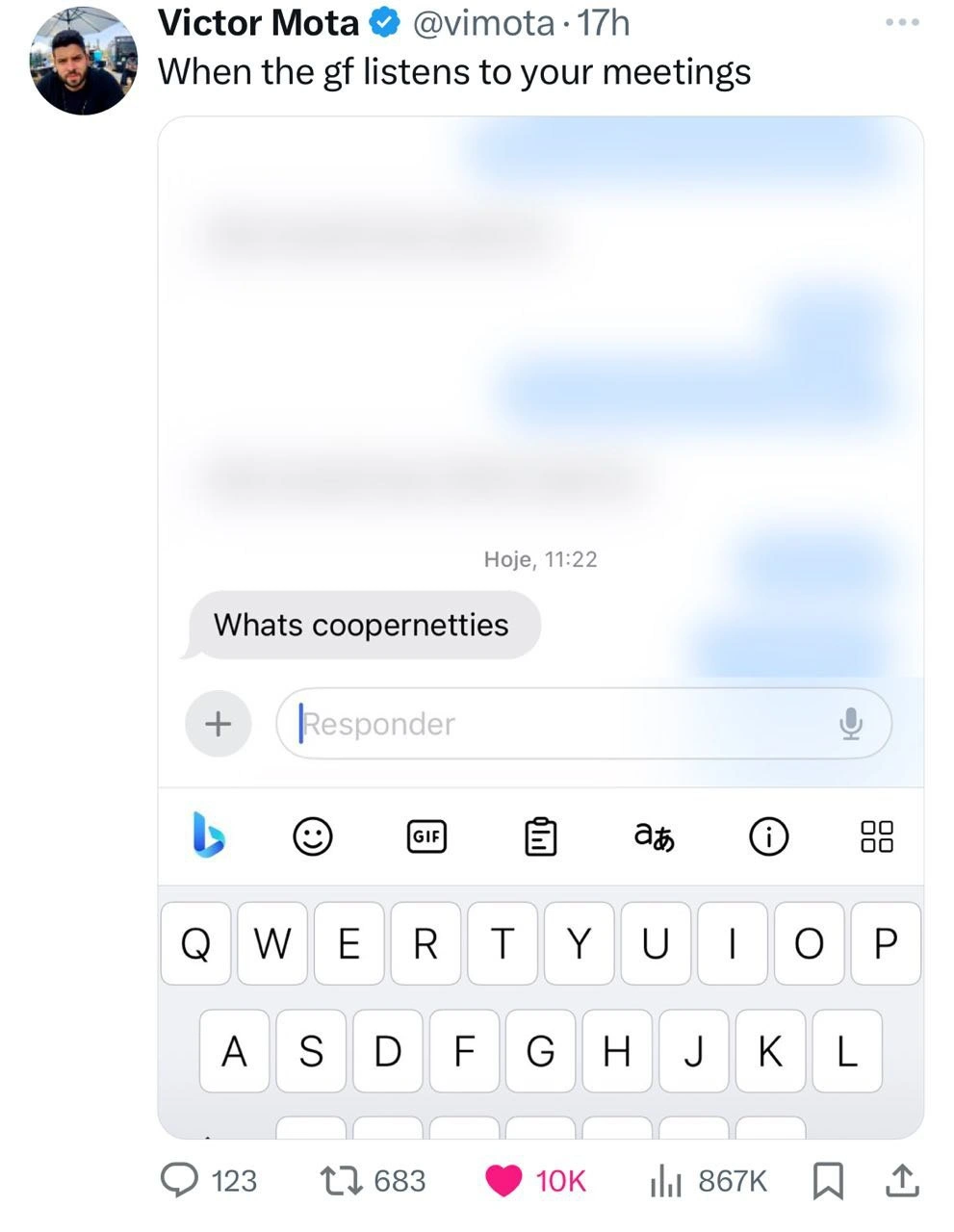
This meme hits home for anyone in DevOps/SRE or really any tech field: it humorously captures that moment when our everyday work jargon sounds like absolute nonsense to our family or friends. In the tweet screenshot, developer Victor Mota shares, “When the gf listens to your meetings,” and we see his girlfriend’s confused text:
Whats coopernetties
She was overhearing a remote stand-up meeting and latched onto this bizarre term that kept coming up: “Kubernetes.” To those of us on the engineering side, Kubernetes is as common a term as “internet” or “server.” But to a non-tech partner casually eavesdropping from the couch, it might as well be a foreign language. This is a classic case of technical jargon creating a mini “Tower of Babel” right in the living room. The developer is speaking fluent Cloud-ese about deployments and clusters, while the listener hears “coop-er-netties” and wonders what on earth that means.
The humor here is multifaceted. First, there’s the pure phonetic silliness of coopernetties—it sounds like maybe a brand of chicken nuggets or a whimsical children’s toy, definitely not the cornerstone of modern cloud infrastructure! DevOps folks chuckle because “Kubernetes” is an odd word (even many engineers stumble over it the first time). In fact, we often abbreviate it to K8s to save time. Imagine how that abbreviation sounds out loud: “K-eight-ess.” That might confuse an eavesdropper even more, or worse, they’ll think we’re talking about some cate or Katie. The girlfriend’s interpretation highlights how opaque our everyday work talk is to outsiders. It’s relatable humor for anyone who’s tried to explain their job at a family gathering and been met with blank stares.
Secondly, the scenario is MeetingHumor gold. In a typical morning stand-up (a short team meeting where developers share updates), DevOps engineers might casually say things like, “We deployed the new build to Kubernetes,” or “The Kubernetes pods failed to schedule on the node.” To an uninitiated listener in the next room, that sounds like, “We blah-blah’d the new blah to Kubernetes,” with that one weird word sticking out. The girlfriend, genuinely puzzled, texts to ask what this strange “coopernetties” word is—probably as he’s still in the meeting! You can almost feel the developer trying not to laugh on the Zoom call when he sees that message pop up. It’s the ultimate case of work-from-home worlds colliding: professional Containerization lingo meets domestic life. Remote work means our partners or roommates catch snippets of our daily scrums and incident calls. Here, the “living-room audience” auto-translates unfathomable DevOps talk into something that almost makes sense phonetically.
There’s also an affectionate subtext: the fact that she even asks “What’s coopernetties?” shows she’s listening and interested (or at least concerned you might be summoning elder gods in your office 😄). Many techies have experienced their non-tech significant other poking fun at the absurd words they hear us use: “Honey, did you just say ‘Node balancer’ or ‘gnome dancer’?” It’s endearing and funny. As insiders, we laugh because we know exactly what Kubernetes is (the de-facto platform for running containers at scale), and we also know how ridiculous that word can sound out of context. We remember that aha moment when we first learned about it—“Kuber-what?!”—so we totally sympathize with her confusion. This meme nails the DevOpsHumor vibe: it’s poking fun at our own tendency to live in an echo chamber of acronyms and strange project names. Our everyday vocabulary includes gems like Pod, Ingress, Kubectl (pronounced “cube-cuttle” or jokingly “kube-cuddle”). To us, these have very specific meanings. But accidentally overhear them, and you might think we’re discussing chemistry sets or speaking in tongues.
In essence, the tweet is funny because it’s true: Kubernetes has become so mainstream in engineering discussions that we forget it’s practically gibberish to normal people. It highlights the gap between a container orchestration mastermind and someone hearing about it with zero context. The girlfriend’s phonetic guess — coopernetties — is a perfect comedic translation of how technical jargon sounds to those not fluent in it. It’s a reminder that even though Kubernetes is a powerful, real thing in tech, from the outside it might as well be a made-up word from a cartoon. Every developer who’s had to answer, “So, in simple terms, what do you do at work?” can chuckle at this. We’ve all struggled to make concepts like cloud infrastructure or CI/CD pipelines sound normal. This meme crystallizes that struggle in one misspelled, hilarious word. It’s both a facepalm and a warm chuckle moment: “Oh boy, we really do speak a different language at work.”
Level 4: Symphony of Schedulers
At the highest technical level, Kubernetes is an ingenious piece of distributed systems engineering—a master orchestrator for containerized workloads. It coordinates hundreds (or thousands) of application containers across a cluster of machines as if conducting a symphony. Under the hood, Kubernetes’ control plane runs a scheduler that decides which machine (node) should run each new container (pod), balancing loads and resource constraints in real-time. This scheduling problem is NP-hard; Kubernetes uses clever heuristics and continuous adjustments (the reconciliation loop) to approach an optimal distribution of work. It’s essentially doing logistics for software: ensuring every microservice finds a home, restarts if it crashes, and scales out when demand spikes. All this is done declaratively—you describe the desired state (for example, “3 instances of my web server running”) in YAML, and Kubernetes works tirelessly to converge the actual state to match, self-healing like an automated ops team.
Behind that funny name lies serious computer science. Kubernetes relies on a strongly consistent data store (etcd) using the Raft consensus algorithm to keep the cluster brain in sync—every node agreeing on what should be running where. This guarantees that even if individual parts fail (nodes going down, network glitches), the cluster as a whole stays reliable and eventually consistent. These theoretical foundations (think CAP theorem trade-offs and distributed consensus) mean Kubernetes can promise high availability and state correctness. It’s a beautiful irony: a system built on rigorous algorithms and Greek nomenclature (Kubernetes means helmsman or pilot in Greek, guiding the ship) gets misinterpreted as gibberish by an uninitiated ear. In a sense, the girlfriend’s comical “coopernetties” is the human equivalent of a distributed system fault: a decoding error in the audio transmission layer, if you will. Meanwhile, the technology itself is all about preventing miscommunication between servers! This contrast between the platform’s elegant complexity and how outsiders hear it is subtly hilarious to seasoned DevOps engineers. We’ve constructed an entire containerization empire on terms like K8s (geek-speak for Kubernetes, with "8" letters in the middle) that are everyday vocabulary in a Site Reliability Engineering war room, yet they sound like magical incantations in a living room. It’s a reminder that technical jargon can be as impenetrable as any code—without the context, even a state-of-the-art cloud orchestrator’s name might as well be abracadabra. The result? A platform that moves mountains of containers at scale, while someone in the next room wonders if you’re talking about a pet or a snack called coopernetties. 🚀🎶
Description
The image is a screenshot of an X/Twitter post. At the top, the tweet shows a blurred profile picture, the name "Victor Mota" with a blue-check badge, the handle "@vimota", and the timestamp "17h". The tweet text reads: "When the gf listens to your meetings". Below, a cropped chat window (iOS iMessage style) is displayed; earlier conversation bubbles are heavily blurred except for one gray bubble that says exactly: "Whats coopernetties". Beneath the bubble, the placeholder text field shows "Responder", and the iOS keyboard with the full Q-W-E-R-T-Y layout plus emoji, GIF, clipboard, and other icons is visible. Interaction counters at the bottom read "123" comments, "683" retweets, "10K" likes, and "867K" views. The gag is that the girlfriend, overhearing a remote engineering stand-up, mishears the term "Kubernetes" - the ubiquitous container orchestration platform - as the nonsensical "coopernetties", highlighting the linguistic gulf between DevOps jargon and everyday language that senior platform engineers sling around in meetings
Comments
10Comment deleted
Explaining Kubernetes to family is the ultimate chaos-monkey test - if the term survives pronunciation drift to "coopernetties", your cluster isn’t the only thing that needs an ingress controller
After years of explaining container orchestration, auto-scaling, and service meshes, the real challenge is explaining why 'coopernetties' isn't a typo in your YAML manifests but actually your partner's new pet name for your favorite distributed systems nightmare
Nothing says 'production-ready relationship' quite like your partner casually asking about your 'coopernetties' deployment strategy. At least she's showing more interest in your infrastructure than your PM does - though her understanding of container orchestration might be about as solid as your company's disaster recovery plan. On the bright side, 'coopernetties' sounds way more approachable than explaining why you need to horizontally scale pods at 3 AM again
Coopernetties is the household fork of Kubernetes - CRDs are chores, RBAC decides who touches prod, and every upgrade breaks dinner
Autocorrect: partitioning 'Kubernetes' into 'cooper netties' with perfect availability, zero consistency
Coopernetties: the platform that schedules 5,000 YAML files into a microservice co‑op, then calls a 3am HOA meeting when etcd hiccups
Cooper what? Comment deleted
Cooper's titties Comment deleted
Copper NETIS Comment deleted
Κυβερνήτης Comment deleted