Cat Demands You Stop Showering: Coca-Cola's AI Ads Need That Water
Why is this AI ML meme funny?
Level 1: The Cookie Crumb Lecture
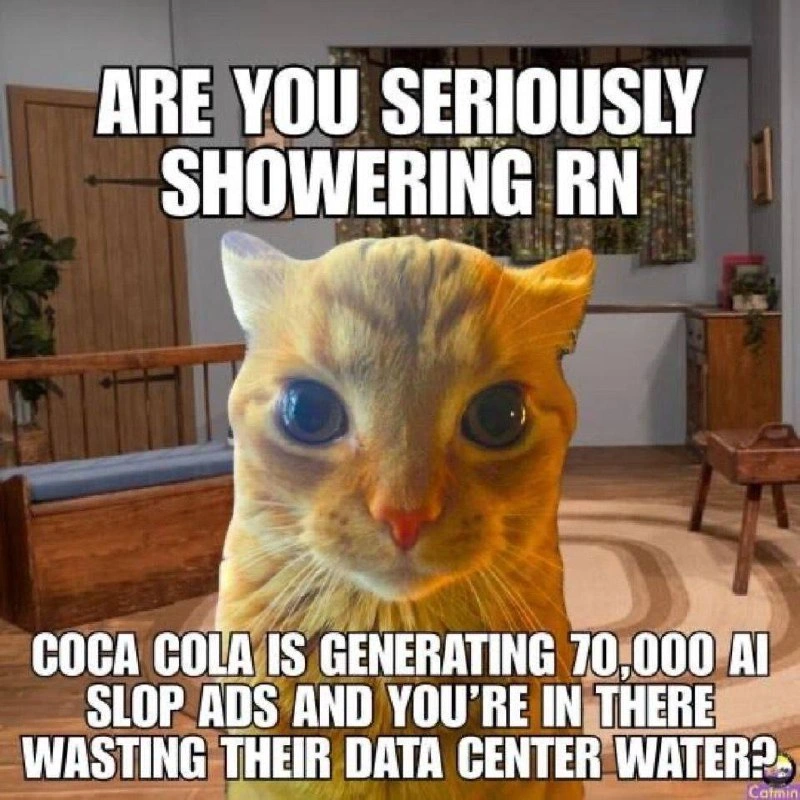
Imagine your cat blocking the bathroom door and scolding you: "How dare you use water for a shower! A giant company needs that water to make seventy thousand crayon drawings nobody asked for!" It's funny for two reasons stacked on top of each other. First, a cat lecturing anyone about showers is already ridiculous — cats hate water and answer to no one. Second, the scolding is backwards: it's like being yelled at for eating one cookie crumb while someone behind you wheels the entire cookie factory out the door. The cat's giant accusing eyes make you feel guilty for half a second — and then you realize you're being guilt-tripped on behalf of a soda company's drawing machine, and that's the joke.
Level 2: The Vocabulary of Slop and Cooling
A few terms carrying the joke. AI slop is the now-standard pejorative for mass-produced generative content — images, videos, ad copy — churned out faster than anyone can meaningfully review, optimized for cheap reach rather than quality. Data center water usage refers to how large compute facilities cool their hardware: many use evaporative systems where water absorbs heat and is lost as vapor, so heavy AI training and inference loads translate into real regional water draw. That's why "your AI query uses water" headlines exist — though the per-person numbers are tiny compared to industrial and agricultural use, which is the imbalance the meme exploits. Coca-Cola's AI ads reference the brand's real generative ad campaigns, which became a lightning rod for the slop debate. The format itself — startled cat plus all-caps guilt trip and the Catmin watermark — belongs to the absurdist cat-meme genre where a pet delivers unhinged moral judgment; the comedy engine is the mismatch between the messenger (a cat in a sitcom set) and the message (corporate resource-allocation critique). Early-career takeaway: when someone frames a systemic cost as your personal failing, check who benefits from the framing.
Level 3: Externality Accounting via Accusatory Cat
The cat — an orange tabby with enormous, wounded, deeply judgmental eyes, composited into what looks like a vintage sitcom living room — is performing a rhetorical maneuver with a long corporate pedigree: the inversion of responsibility laundering. The caption structure is the whole argument: "ARE YOU SERIOUSLY SHOWERING RN" / "COCA COLA IS GENERATING 70,000 AI SLOP ADS AND YOU'RE IN THERE WASTING THEIR DATA CENTER WATER?" Note the possessive — their data center water. Your shower has been retroactively reclassified as theft from a marketing department's compute budget.
This lands because it's a precise parody of how environmental discourse has historically been weaponized. The carbon footprint calculator was popularized by an oil company's ad agency; "turn off the tap while brushing" coexisted comfortably with industrial agriculture consuming the actual aquifers. The meme transplants that playbook into the generative-AI era, where the same pattern re-emerged almost immediately: earnest hand-wringing over whether an individual's chatbot query "wastes a bottle of water" while hyperscalers negotiate municipal water rights for evaporative cooling and brands industrialize content production. Coca-Cola's AI-generated holiday campaigns are the perfect anchor — a real, high-profile case where a beloved, human-crafted advertising tradition was replaced with uncanny generative output, widely mocked as AI slop: content whose defining feature is that volume is the point. The number "70,000" is comedic-precise; slop is measured in throughput, not quality, because the economics of generative marketing reward flooding every surface with variants rather than crafting one good thing.
The deeper technical joke is about externalities and attribution. Data centers do consume meaningful water — evaporative cooling trades water for energy efficiency, and siting decisions have put facilities in drought-stressed regions — but the per-query figures that circulate are mostly amortized abstractions, nearly impossible for an individual to reason about. That ambiguity is exactly what makes both directions of guilt-tripping possible: nobody can audit the cooling loop, so the water becomes a free-floating moral token, assignable to whoever the speaker wants to shame. The cat assigns it to you, in the shower, which is absurd in precisely the way "your 10-minute shower is killing the planet, please ignore the alfalfa farm" was always absurd. Satirizing the framing is the only sane response left.
Description
An orange-yellow cat with huge accusatory eyes, edited to look like a sitcom character standing in a vintage living-room set, stares directly at the camera. Top caption in white block letters: 'ARE YOU SERIOUSLY SHOWERING RN'. Bottom caption: 'COCA COLA IS GENERATING 70,000 AI SLOP ADS AND YOU'RE IN THERE WASTING THEIR DATA CENTER WATER?' A small 'Catmin' watermark sits in the corner. The meme satirizes the discourse around AI data-center water consumption - flipping the guilt-tripping of individuals over personal water use while corporations burn resources mass-producing low-quality generative ad content, referencing Coca-Cola's real AI-generated holiday ad campaigns
Comments
9Comment deleted
Personal water budgets are just chargeback dashboards for a planet where marketing got root access to the cooling loop
The solution is to shower in coke, it's cheaper anyway Comment deleted
Isn't it filled with phosphoric acid? Comment deleted
that's the point coke will cool them once and for good Comment deleted
nvm didn't read what you've been answering to Comment deleted
WHY ARE THEY NOT COOLING THEIR DATA CENTERS WITH COKE Comment deleted
Coke can be sold for more than water Comment deleted
well, fuck you cock’a cola Comment deleted
I'll continue showering then Comment deleted