Kasparov 1989: 'Never Shall I Be Beaten by a Machine!'
Why is this TechHistory meme funny?
Level 1: The Fastest Kid in School
Imagine the fastest runner in school laughing at the idea that a car could ever beat him in a race. "Ridiculous! A car is just a thing to carry my bags! And while we're at it, could a car ever sing a song? Could a car ask me questions in an interview?" Eight years later, a car beats him in front of the whole world — and today, cars sing, talk, and conduct interviews while everyone shrugs because it's normal now. The joke isn't that he was bad at running. He was the best there ever was. The joke is that being the very best at something is exactly what makes it hardest to believe a machine could ever do it too.
Level 2: The Names in the Quote
Garry Kasparov was world chess champion from 1985 to 2000 and widely considered among the greatest players ever — which is why his prediction carries the weight it does; this isn't a random pundit being wrong, it's the domain's apex expert. Deep Thought was a chess computer built at Carnegie Mellon and later absorbed by IBM, where its successor Deep Blue used massively parallel hardware to evaluate hundreds of millions of positions per second — no intuition, just search depth and tuned evaluation functions. Chess engines don't "understand" chess the way humans describe understanding; they explore game trees so deeply that understanding becomes unnecessary, which is exactly the possibility Kasparov dismissed when he insisted a machine "will always remain a machine... a tool to help the player work and prepare." Ironically, that line did come true — every modern grandmaster trains with engines — he was right about the tool and wrong about the ceiling. The meme works as dramatic irony: the audience knows the ending the speaker can't see, like watching a horror-movie character announce they'll be right back.
Level 3: A Falsifiable Prophecy, Itemized
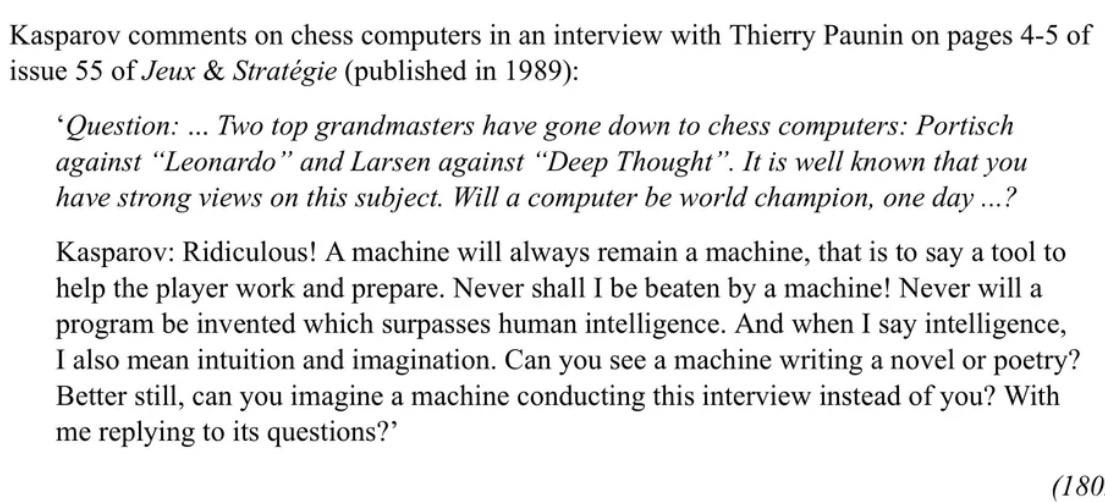
What elevates this beyond the usual "aged like milk" screenshot is how methodically Kasparov constructs his own refutation. The image quotes his 1989 interview with Thierry Paunin in Jeux & Stratégie (issue 55, pages 4–5), where the interviewer has already laid out the warning signs — grandmasters Portisch and Larsen had each lost games to the chess machines "Leonardo" and "Deep Thought" — and asks the obvious question: will a computer be world champion one day? Kasparov doesn't merely say no. He answers "Ridiculous!" and then enumerates, in escalating order of confidence, every claim that the next three decades would dismantle:
"Never shall I be beaten by a machine! Never will a program be invented which surpasses human intelligence... Can you see a machine writing a novel or poetry? Better still, can you imagine a machine conducting this interview instead of you? With me replying to its questions?"
The first "never" lasted eight years: Deep Blue — IBM's direct descendant of the very Deep Thought named in the question — defeated Kasparov in the 1997 rematch, the most symbolically loaded loss in the history of human-computer competition. The deeper irony is structural: Kasparov was standing on the exact trend line and refused to extrapolate it. Grandmasters were already losing individual games to machines in 1989; the question wasn't whether brute-force search plus evaluation heuristics would scale, but when Moore's law would push it past one specific human's ELO. He treated an engineering trajectory as a philosophical impossibility.
Then there's his rhetorical escalation — the moves he chose as reductio ad absurdum anchors. Machines writing novels and poetry, machines conducting interviews: he picked these precisely because they seemed categorically beyond computation, requiring the "intuition and imagination" he claimed defined real intelligence. Every one of them is now a free-tier LLM feature. The pattern recurs constantly in tech forecasting: experts defend their domain by relocating the goalposts to whatever currently seems hardest, and the goalposts keep getting paved over. Chess fell to search, Go fell to self-play, prose fell to next-token prediction — each time accompanied by a confident chorus explaining why this one was different. To his genuine credit, Kasparov later became one of the more thoughtful voices on human-machine collaboration, championing centaur chess — but this screenshot circulates precisely because the discourse never lets anyone's strongest "never" expire quietly.
Description
A text screenshot quoting Garry Kasparov's interview with Thierry Paunin on pages 4-5 of issue 55 of Jeux & Stratégie (1989). The interviewer notes grandmasters Portisch and Larsen had lost to chess computers 'Leonardo' and 'Deep Thought' and asks if a computer will ever be world champion. Kasparov replies: 'Ridiculous! A machine will always remain a machine... Never shall I be beaten by a machine! Never will a program be invented which surpasses human intelligence. And when I say intelligence, I also mean intuition and imagination. Can you see a machine writing a novel or poetry? Better still, can you imagine a machine conducting this interview instead of you? With me replying to its questions?' The quote is devastating dramatic irony: Deep Blue beat Kasparov in 1997, and every rhetorical 'impossible' he lists - machine-written prose, machine-conducted interviews - is now mundane LLM output
Comments
8Comment deleted
Every confident 'never' in tech ships with an eight-year TTL; Kasparov's just happened to have excellent logging
Are machine becoming more human like, or are humans becoming more like machines? Comment deleted
Both Comment deleted
the channel is experiencing brain death Comment deleted
them clankers launched a psyop against it so that everyone leaves Comment deleted
I am becoming more gay Comment deleted
Kaspars is literally him Comment deleted
Wasn't Kasparov beaten by Deep Blue shortly after that interview? Comment deleted