When You Optimize the Algorithm of Life
Why is this Career HR meme funny?
Level 1: Cheat Codes for Rides
Imagine you’re playing a game where the computer is in charge of handing out rewards or turns, and you figure out exactly how it decides who wins. If you learn the secret rules, you can start doing things that make sure you get picked more often. For example, if a game gives a prize to the player who reaches a certain spot first, you’d try to always be at that spot at the right time. In kids’ terms, think of a teacher who always chooses the student sitting up straight to answer questions. Once you realize that, you always sit up super straight so you get picked every time. You found a trick to get chosen more.
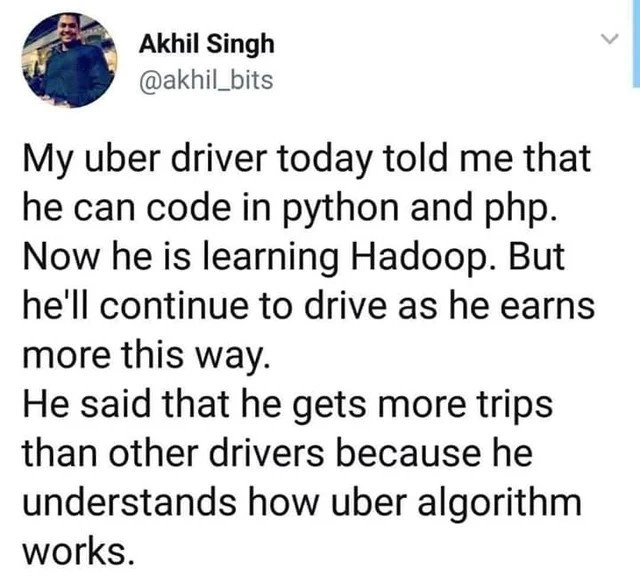
In this meme, an Uber driver found the grown-up version of a cheat code for a real-life system. Uber is an app that decides which driver to send when someone needs a ride. The driver doesn’t get to pick the passenger — the app’s computer program (algorithm) does the matching. This driver learned a lot about computers and how programs work (he knows how to write computer code in languages like Python, and study big amounts of information). Because of that, he figured out some secret rules or patterns in how Uber chooses drivers for rides. It’s like he peeked into the game guide. Maybe he noticed “If I wait in this area, I get more ride requests,” or “If I accept rides really fast, the system likes me more.” By following those patterns, he makes sure he’s the one getting the ping (ride request) more often than other drivers.
It’s funny and cool because normally you’d expect someone with those computer skills to go work at a tech job, maybe in an office coding all day. But this guy is using his skills in a totally different way. He’s basically turned driving into a game where he knows the cheat codes. Just like a gamer who finds a special trick to get extra coins or lives, he found a way to get extra ride requests (which means extra money). So he’s saying, “I’ll keep driving because I actually earn more doing this, since I kind of hacked the system in my favor.” It’s an unexpected story: a driver who can code and do big data stuff beats the app at its own game and ends up better off. That surprise — someone using super tech knowledge in a regular job to get ahead — is what makes it both funny and a little inspiring. It’s like finding out your ice-cream seller has a secret formula to always get the most customers because he analyzed all the foot traffic patterns in the neighborhood. You’d think, “Wow, that’s clever…and kind of funny that they went that far!” Here, the Uber driver did exactly that with his knowledge, essentially using a real-life cheat code to win in the ride-sharing game.
Level 2: Under the Algorithm’s Hood
Let’s break down what’s happening in simpler terms. The tweet says an Uber driver knows how to code in Python and PHP, and is learning Hadoop. These are tech skills usually associated with software developers and data engineers, not drivers. First, Python is a popular programming language known for its easy-to-read syntax and versatility. Developers use Python for everything from web development to data analysis and machine learning. If someone says “I can code in Python,” it means they can write software or scripts to automate tasks or analyze information.
PHP is another programming language, traditionally used to build websites and web applications (it powers a lot of older websites and content management systems). It’s a bit old-school but still quite common. Knowing PHP suggests the driver has some background in web development or scripting, perhaps making tools for himself.
Now, Hadoop is a big one (literally big, as it deals with Big Data). Hadoop is an open-source framework that allows handling extremely large data sets by distributing the work across many computers. It’s something companies use when they have so much data (think millions of Uber rides data points) that one computer can’t process it all in a reasonable time. Hadoop introduced the idea of MapReduce, meaning it “maps” a big job into smaller chunks, processes them in parallel, then “reduces” (combines) the results. When the driver says he’s learning Hadoop, he’s basically diving into Big Data processing skills — the kind you’d need if you wanted to analyze huge logs of information (like all the trips in a city over a year) to find patterns. BigDataAnalytics refers to examining these giant datasets (often with tools like Hadoop) to discover useful trends or insights. It’s somewhat surprising (and humorous) to hear a gig driver casually mention Hadoop, because it’s not trivial stuff; it’s something data scientists or engineers at large tech companies specialize in.
So why is he learning all this? The clue is in the next part: He said he gets more trips than other drivers because he understands how Uber’s algorithm works. An algorithm in this context is basically Uber’s automated decision-making code – the instructions or formula the Uber app uses to decide which driver to send each ride request to. Whenever a rider requests a trip, Uber’s system has to pick a driver from the ones available nearby. The algorithm might consider factors like: Which drivers are closest? Who has been waiting the longest without a fare? Who has a high rating? Who usually accepts rides quickly? All those rules and calculations behind the scenes make up the “ride-allocation algorithm.” It’s essentially the secret sauce that tries to make sure riders get picked up quickly and fairly, and drivers get a steady flow of work. Uber (and other gig platforms) typically keep these algorithms secret and tweak them over time. Regular drivers might only have a vague idea, formed by experience like “it seems to give more rides if I go near downtown.”
This driver, however, is actively trying to understand and exploit that algorithm. When he says he understands how it works, he probably has figured out patterns. For example, maybe he noticed at certain times of day, being in a less crowded neighborhood gets him more requests (because in busy areas there’s too much driver competition). Or he discovered that staying logged in consistently and accepting every request quickly makes the system treat him as a preferred driver (since he’s reliable and always available). With Python, he could write small programs to log his rides, track times, locations, surge pricing occurrences, etc., building his own dataset to analyze. Learning Hadoop suggests he’s serious about scaling up that analysis—perhaps he’s gathering data from fellow drivers or public sources to see the bigger picture of Uber’s demand and supply trends. It’s almost like he’s doing his own little data science project on ridesharing.
Now, he mentions he’ll continue to drive because he earns more this way. This is a key point. Typically, if someone knows Python/PHP and even Hadoop, they might qualify for entry-level software developer jobs or data analyst roles. Why would he stick with driving? Possibly because he found a loophole or advantage. By gaming the Uber algorithm in the gig_economy, he gets more ride requests (and thus more income) than the average driver. If he can significantly boost his hourly earnings by being the go-to nearby driver all the time, he might be making, say, more money per hour than a starting tech job would pay him in his area (consider that he also has flexibility over his hours). It’s also possible he simply enjoys the independence of driving and being his own boss, and the tech knowledge just supercharges his efficiency. This is a bit of CareerHumor/TechIndustryHumor element: it challenges the assumption that someone with coding skills will automatically ditch other work. Instead, he merged the two worlds – using coding/data skills in his driving job.
To put it plainly: he’s treating Uber like a system that can be studied and optimized. Drivers in gig platforms usually just follow the prompts, but this guy is thinking like a programmer: “How can I tweak the inputs (my location, my online status, my acceptance behavior) to get a better output (more rides) from the algorithm?” It’s a very logical, almost hacker-like approach, except it’s perfectly within legal bounds – he’s just being smart about it. Uber’s app isn’t designed for drivers to need computer knowledge, but having that knowledge gives him a leg up. It’s similar to how someone good at math might figure out a winning strategy for a board game faster than others.
In summary, the tweet’s humor comes from this unexpected crossover of skills: a seemingly ordinary Uber driver turning out to be a self-taught big data enthusiast who applies his Python programming and analytical know-how to outsmart a ride-sharing algorithm. It highlights the idea that understanding how tech works, even if you’re not working in tech, can pay off in surprising ways. It also subtly points out that tech skills are everywhere, even in jobs where we might not expect them, and that sometimes an unconventional path (like coding to be a better driver) can be more rewarding at least in the short term than the conventional path (coding to be a developer at a company).
Level 3: Hadoop on the Highway
For seasoned developers, this meme hits a sweet spot where tech industry absurdity meets real-life hustle. Imagine picking up an Uber and discovering your driver casually chats about coding in Python, PHP, and even studying Hadoop clusters—all while expertly weaving through traffic. It’s both impressive and darkly funny. The humor comes from the role-reversal: usually, a person learns Python and Hadoop to leave their day job and join a big tech company or a data analytics team. Here, the techie stayed behind the wheel, because he figured out that understanding Uber’s algorithm nets him more cash than a typical junior developer gig might. This is CareerHumor with a twist: the driver literally weighed a tech career (writing code) versus driving, and found driving more lucrative once he applied his coding brain to it. It subverts the expectation that tech skills automatically lead to a cushy office job.
Experienced devs recognize this as a commentary on the power of understanding the system you’re in. Uber’s dispatch algorithm is a black box to most drivers, but this driver-coder treated it like a puzzle to be solved. In software terms, he performed a kind of reverse engineering on the Uber app’s behavior. By observing patterns (when and where he’d get ride pings, how certain actions affected his ride allocations), he’s likely deduced some rules. Perhaps he noticed that drivers who accept rides quickly and have high ratings get priority, or that being in a slightly less crowded area yields more requests per hour than waiting in a driver swarm. With coding skills, he might go a step further: writing scripts to simulate scenarios or analyze data from driver forums. It’s BigDataAnalytics meets street smarts. We’re essentially looking at someone doing A/B testing on their own driving strategy!
From a senior developer’s perspective, a few likely tactics emerge from his understanding:
- Strategic Positioning: If the Uber algorithm favors proximity, he’ll position himself in high-demand zones or near likely request sources (e.g. airports at 5 PM, or downtown on weekend nights). He’s basically doing geo-optimization like a routing algorithm.
- Acceptance Rate and Timing: Knowing that declining rides or slow responses might downgrade his priority, he could use a custom setup to accept rides within milliseconds. Perhaps a special ringtone or even a little Python script on a second phone to auto-accept certain trips. It’s like tuning a server for low latency—here he’s tuning his reflexes and tools to beat other drivers to the punch.
- Surge Surfing Intelligently: With data chops, he can predict or identify genuine surge pricing (higher fares when demand outstrips supply) and be just around the corner when it happens. There have been stories of drivers coordinating in the gig economy to trigger surges; a lone wolf with data skills could do a milder version solo, like an Uber-specific algorithmic trading strategy: log off when the area is saturated, log back in right as surge kicks in.
What makes developers smirk is that this “Uber driver” is basically acting like a data engineer or a growth hacker, but for his personal earnings. It’s classic TechIndustryHumor: the kind of disruptive thinking startups love, appearing in an unlikely place. The mention of PHP alongside Python is another chuckle-worthy detail. PHP is an old-school web language – maybe he made a personal website or scripts to scrape info. It paints the picture of a self-taught programmer who’s picked up whatever tools he can. It’s not the sleek new Rust or Go; it’s PHP, which many senior devs cut their teeth on years ago. That adds to the authenticity and humor: he’s using down-to-earth, accessible tech skills, not some futuristic AI chip in the car.
This story also reflects on the tech job market and personal choices. Many experienced devs know colleagues or acquaintances who drive for Uber or do gig work due to job market fluctuations, side hustles, or preference for flexibility. Usually, though, those folks aren’t leveraging their coding skills in the act of driving. Here the guy is basically saying: “I could join a big data team, but I’ve weaponized big data knowledge to make my rideshare gig pay better.” It’s a sly commentary on switching_careers (or choosing not to). Why grind 80-hour weeks in a junior dev job when you can be your own boss and, thanks to your tech savvy, potentially earn more with less stress? Of course, seniors also know the longer-term prospects – eventually coding jobs typically pay more – but there’s an immediate cleverness in his approach. It’s a form of AlgorithmHumor because it jokes about “knowing the secret formula.” In dev culture, there’s an ongoing gag that once you truly grok the algorithm, whether it’s cracking code interviews or optimizing some system, you win. This driver literally applied that: he grokked Uber’s algorithm and he’s winning more rides.
It also hints at the oft-unspoken truth that behind every “smart” system are patterns that can be exploited. We laugh because we’ve seen similar things: power users messing with Facebook’s news feed algorithm, YouTubers optimizing content for recommendation engines, or SEO experts tweaking websites for Google. In this case, it’s an Uber driver doing algorithms_in_gig_platforms hacking. That’s both hilarious and intriguing to any senior techie. This is TechHumor with a dash of social commentary: the supposedly infallible algorithm that governs gig workers can be outsmarted by one determined, knowledgeable individual. The next time an engineer brags about their optimized load-balancing code, someone might joke, “Yeah, but can it beat an Uber driver with Hadoop skills?”
Ultimately, “Uber driver uses Python skills to game ride-allocation” is a story where worlds collide. It tickles developers because it’s an inversion of the usual power dynamic—the platform usually has all the intelligence, but here the underdog, a solo driver, flips the script by using the same tools and knowledge we associate with Silicon Valley. It’s inspirational in a geeky way: knowledge really is power, even if it’s Python vs driving. This self-taught big data aficionado has turned the uber_algorithm into his ally. It resonates as CareerHumor (non-traditional use of skills) and as a wink at big tech: sometimes the disruptors get disrupted by their own users! And let’s be honest, part of us is cheering for him—he’s living proof that understanding technology can directly improve your lot, even if you’re not in a fancy office writing code for a FAANG. Instead, he’s in a car, using code to conquer the road. That’s one heck of a plot twist in the tech industry narrative, and we’re here for it.
Level 4: The Algorithmic Arms Race
At a theoretical level, this situation is about gaming a complex algorithm in a real-world system. Uber’s ride allocation can be modeled as a dynamic graph matching problem: riders and drivers form two sets of nodes, and the dispatch algorithm must optimally match them in real-time. This is akin to solving an assignment algorithm (like the Hungarian algorithm for bipartite matching) under constantly changing conditions. The platform likely crunches massive amounts of data (GPS locations, driver status, customer ratings, predicted demand) using big-data pipelines. Uber’s backend might employ technologies like Hadoop or Spark to analyze historical ride patterns and feed into machine learning models that predict supply and demand. In essence, the driver is turning the tables by using the same data-oriented mindset. This becomes an algorithmic arms race: one individual versus a giant system. In algorithmic game theory, once participants understand the system’s rules, they adapt their strategy to maximize personal gain—potentially undermining the system’s original fairness or efficiency goals. Here, the driver has (through observation or coding) deduced the parameters Uber’s system optimizes for. It’s a slice of mechanism design in the wild: if Uber’s dispatch logic isn’t incentive-compatible (meaning drivers can benefit by acting strategically rather than honestly), savvy drivers will find exploits. The mention of Hadoop is intriguing—Hadoop is a framework built for distributed computing and the MapReduce paradigm, often used by companies like Uber to sift through Big Data logs (billions of rides, GPS pings, etc.). The fact that a single driver is learning Hadoop suggests he’s thinking like a data engineer, perhaps analyzing trends from his own ride data or community-shared data. He’s effectively performing a one-man Big Data analytics operation to reverse-engineer a piece of Uber’s platform. This is reminiscent of adversarial tactics in other systems (like SEO experts decoding Google’s ranking algorithm or Wall Street quants dissecting market behaviors). The humor hides a deep technical truth: even highly optimized algorithms can be poked at and prodded by individuals with enough knowledge and data. The absurd elegance here is that the gig worker is applying concepts from distributed computing and algorithm analysis—fields rooted in computer science theory—to something as everyday as getting more ride requests. It’s a beautiful collision of academic knowledge and street smarts, blurring the line between a data scientist and a resourceful hustler. And if many drivers started doing this, Uber’s system would face an evolving challenge, much like an arms race between spam filters and spammers: as one side (the platform) adjusts, the other side (drivers with algorithmic insight) would adjust back. In short, this driver has turned a ride-hailing platform into his own case study in algorithmic efficiency, applying high-level tech concepts to gain an edge in the gig economy’s digital battleground.
Description
A screenshot of a tweet from a user named Akhil Singh (@akhil_bits). The tweet text reads: 'My uber driver today told me that he can code in python and php. Now he is learning Hadoop. But he'll continue to drive as he earns more this way. He said that he gets more trips than other drivers because he understands how uber algorithm works.' The image has a clean, standard Twitter interface look with a circular profile picture of Akhil Singh. This meme highlights the practical and sometimes more lucrative application of deep technical knowledge in unconventional fields. For experienced engineers, it's a humorous take on how understanding complex systems, like Uber's dispatch algorithm, can be a more valuable skill than simply writing code for a traditional tech company. It touches on themes of the gig economy, algorithmic literacy, and the surprising ways software engineering skills can be monetized
Comments
7Comment deleted
He probably treats ride requests as a distributed stream processing problem and uses his Hadoop knowledge to predict surge pricing. His car isn't just a vehicle; it's an edge node
My Uber driver bragged his 30-line Python notebook reverse-engineers the platform’s ε-greedy dispatch, doubles his surge hits, and ships straight to prod - meanwhile I’m on hour three of a Kubernetes incident for stock options that vest in dog years
Finally found someone who actually makes money from understanding recommendation algorithms instead of just complaining about them in standup meetings
When your Hadoop knowledge is impressive but your ROI analysis is even better - turns out the real Big Data insight was calculating that surge pricing beats senior engineer salary after you factor in SF rent, equity cliff vesting, and the probability your startup's Series B falls through. Man's literally A/B testing his career path in production
The only Hadoop job with positive unit economics is the one where the data scientist is also the driver gaming the dispatch scoring function
Reverse-engineering Uber's black-box dispatch algo for surge profits: higher ROI than any Hadoop cluster we've tuned, no PhD required
He gets more trips because he understands Uber’s algorithm - proof we shipped a reward function drivers can optimize faster than our ML; Goodhart’s Law with surge pricing