CalcGPT: A Calculator Unnecessarily Powered by GPT That Gets 1+1+1+1 Wrong
Why is this AI ML meme funny?
Level 1: Hard Way to Add
Imagine you have four apples and you want to know how many you have in total. You could just count them: 1-2-3-4, and you’d get 4. That’s the easy and obvious way, right? Now picture this: instead of counting the apples yourself, you ask a talkative parrot that has heard a lot of people talking but doesn’t really know math. You say, “Hey, what’s 1+1+1+1?” The parrot squawks and confidently answers, “13!” 🙃. Clearly, that answer is wrong – the parrot isn’t actually calculating, it’s just blabbering something it heard before, and it might even believe it’s right. You’d probably scratch your head and think, “No, that’s not correct. Maybe if I ask again I’ll get a different answer.” That’s already a pretty silly way to do a simple addition, right?
But it doesn’t stop there. Now imagine another friend jumps in and says, “Hold on! To be super fancy, let’s also write down each step of counting these apples in a special magical book that everyone in the world can see, and we’ll lock each page of that book with a golden seal so no one can ever change it.” This magical book is like a blockchain – it’s very secure and everyone can check it, but do we really need everyone in the world to verify how we counted four apples? Probably not! It would be like doing a huge official ceremony for a tiny little task. By the time you finish making a big deal out of it, you could have just counted the apples ten times over.
So, in the end, what’s funny here is that something super simple (adding 1+1+1+1) is being done in the most roundabout, absurd way. Using a confused parrot (the AI) to do basic math is already over-complicating things and might give a crazy answer. And then deciding to involve the magical unchangeable book that everyone watches (the blockchain) is just piling on even more unnecessary stuff. It’s like using a rocket ship to drive your little toy car across the sandbox – not only is it overkill, it might not even work right! We laugh because it’s obvious that the people in this scenario have lost sight of the simple solution (just count or add normally) and are messing it up by insisting on using all the latest trendy gadgets for no good reason. The meme makes us imagine this ridiculous situation, and that’s why it’s so amusing.
Level 2: Over-Engineered Calculator
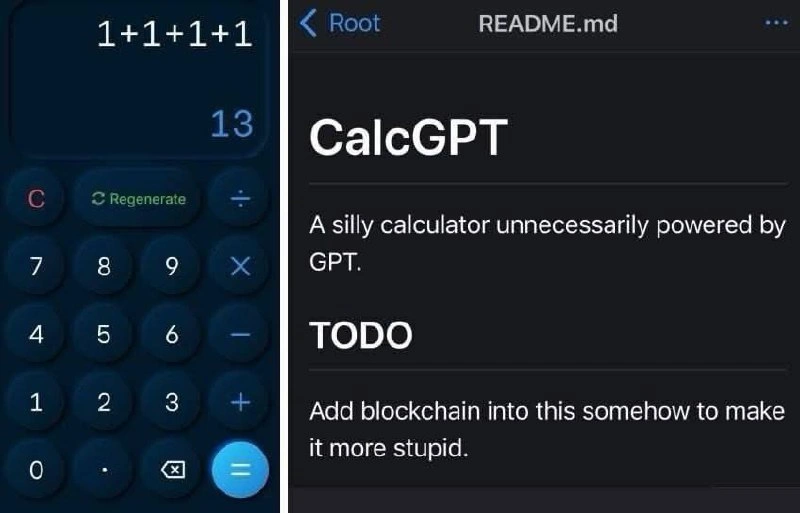
Let’s break down what’s happening in this meme in simpler terms. On the left side, we have a calculator app interface. Normally, when you type an arithmetic expression like 1+1+1+1 into a calculator and hit “equals”, you expect to get the correct result, which is 4. Calculators are designed to do these operations exactly. However, this particular calculator (jokingly named CalcGPT) isn’t using the normal arithmetic logic at all – it’s using GPT (Generative Pre-trained Transformer), which is a kind of AI language model. GPT is the engine behind ChatGPT, an AI that can answer questions and have conversations. GPT was trained on a lot of text from the internet and tries to continue any prompt with a plausible answer. The key thing: GPT is great at sounding convincing but it doesn’t actually understand math the way a proper calculator or even a simple program does. It treats the input 1+1+1+1 as a sequence of characters and tries to guess a reasonable continuation, kind of like an advanced autocomplete. If it hasn’t learned to do addition reliably (and often these models can get simple arithmetic wrong unless specifically guided), it might output something bizarre like “13” – which is what we see. This incorrect answer is what we call an AI hallucination or simply a mistake. The AI is basically making stuff up here. In real life, users of ChatGPT and similar AIs have encountered these kinds of errors: the AI might confidently give wrong answers to factual or mathematical questions. That’s one of the known AI limitations – they’re not infallible calculators or databases; they’re pattern predictors.
The presence of the “Regenerate” button (in green on the left panel) mimics the ChatGPT interface. In ChatGPT, if the answer it gives is wrong or you want a variation, you hit “Regenerate response” to have it try again. In a normal calculator, such a button is absurd because math isn’t a matter of trying again – it should be right every time. So, seeing that button in a calculator UI is a clear sign that this is a joke: the calculator’s “brain” is an AI that might get it wrong, thus you might need to ask it again. That visual clue is a wink to the viewer about what’s going on under the hood.
Now, look at the right side. It shows a text file (like on a programmer’s code editor) titled README.md with the project name “CalcGPT” and a description: “A silly calculator unnecessarily powered by GPT.” Already, the author is admitting it’s unnecessary. There’s a TODO list note saying: “Add blockchain into this somehow to make it more stupid.” This is dripping with sarcasm. Let’s unpack why adding “blockchain” would make it (even more) stupid.
Blockchain is a technology you might have heard in relation to Bitcoin or other cryptocurrencies. It’s basically a way to keep a secure, decentralized ledger of transactions. In simple terms, blockchain lets a network of many computers agree on a list of records (blocks) in a way that you can trust the list hasn’t been altered. This is awesome for digital money or any case where strangers need to trust shared data without a central authority. But here’s the catch: blockchains are complex and slow compared to normal databases or computations, because they’re doing a lot of extra work to ensure security and consensus. If you apply blockchain to a scenario that doesn’t need decentralized trust – like, say, a personal calculator app – it’s total overkill. It’s like hiring an entire security firm to watch over your single piggy bank in your room; the poor piggy bank doesn’t need that level of protection and coordination.
So the meme is highlighting a trend we’ve seen in the tech industry: sometimes companies or developers shoehorn buzzwords like AI or blockchain into their products simply because they sound cool or marketable, not because they actually improve the product. We call this over-engineering when something is made far more complicated than necessary. In this case, doing simple addition by invoking GPT is over-engineering because you could just code return 1+1+1+1 and get 4 every time with zero fuss. Adding a blockchain would be even more over-engineering, like adding a Rube Goldberg machine to a process that could be one step.
For context: A normal calculator app might use a programming language’s built-in arithmetic or a small library to evaluate expressions. That’s straightforward and guaranteed accurate. But CalcGPT uses an AI model (GPT) for the calculation, which introduces the possibility of errors (like giving “13” as the sum). It’s also inefficient: GPT models usually run on servers or require a lot of memory, all for something your phone’s processor can do in a split-second with no internet. It’s like asking a wise but eccentric wizard for the answer to a basic math problem – he might give you the correct answer, or he might go on about some prophecy and give a random number. You wouldn’t build a reliable calculator out of that! Yet that’s exactly the joke: someone did, just to say it’s “AI-powered.”
Now, about that TODO note to “add blockchain”: This is a jab at the blockchain hype that was prevalent a while back (and still pops up). People were adding blockchain to all kinds of projects, sometimes just to attract investors or press, even when a normal solution worked fine. For a single-user calculator, a blockchain could mean maybe they want each calculation result stored as a transaction on a public ledger, or use a blockchain network to verify the calculation. Either idea is pointless for a calculator: you don’t have multiple untrusted parties – it’s just you and your device. So it would only make the app slower, more complicated, and likely require internet connectivity and even cryptocurrency to function. The meme calls this out by saying it would “make it more stupid,” meaning it would take an already silly concept and amplify the silliness. The author is fully aware that combining AI and blockchain for a calculator is ridiculous – that’s the humor.
To put it simply, the left image mocks AI tools (specifically GPT) for sometimes giving incorrect results (AI humor: the calculator is getting basic math wrong). The right image mocks the tech world’s obsession with buzzwords like AI and blockchain (industry trends hype). Together, they highlight an example of a bug or flaw (the hallucinated math result) caused by this unnecessary tech combo. This aligns with tags like AIHypeVsReality (the reality is the AI doesn’t even do math right) and OverEngineering (using far more complex tech than needed). If you’re a junior developer or new to these concepts, the takeaway is: just because something is hyped (AI, blockchain), doesn’t mean you should use it for every problem – especially not trivial ones like a sum of four numbers! Sometimes the simple, tried-and-true solution (a basic algorithm) is superior. The meme gets laughs by showing an extreme parody of what happens when you ignore that common-sense advice.
Level 3: Buzzword-Driven Arithmetic
This meme lands squarely in the realm of buzzword-driven development, where every hot technology gets shoehorned into projects whether it makes sense or not. Seasoned developers will immediately recognize the satire: a calculator is perhaps the simplest piece of software imaginable – it’s basically the poster child for correct, unambiguous functionality. Yet here someone decided, “Hey, let’s power it with GPT!” 😅. The left panel’s interface looks like a normal calculator app, but the telltale “Regenerate” button (styled just like ChatGPT’s) gives away the joke. In a ChatGPT session, regenerate is what you press when the AI’s answer is wrong or unsatisfactory, hoping it will produce a better attempt on the next try. The fact that a calculator would ever need a “regenerate answer” button is hilariously wrong. It implies the calculator’s first answer might be incorrect, which is a complete betrayal of trust for a tool that should be consistently right on the first try. The displayed calculation 1+1+1+1 = 13 drives the point home: our fancy AI-powered calc just hallucinated a basic sum. This is a nod to real instances of AI tools messing up elementary tasks – for example, early versions of GPT would confidently assert false arithmetic results, or voice assistants would misunderstand simple queries. It’s a bug (or “feature”?) born from using AI where straightforward code should suffice. Any senior engineer can tell you that replacing a simple, deterministic operation with a black-box machine learning model is an invitation to bizarre bugs. We’ve all seen managers or product folks get infatuated with phrases like “Let’s make it AI-driven” without understanding the technical trade-offs, resulting in over-engineered solutions that are less reliable than the boring old approach. Here, the meme exaggerates that trend to comedic effect: it imagines a world where even adding four numbers is delegated to an LLM – with predictably loopy results.
Now, as if one hype technology wasn’t enough, the right panel shows the project’s README with a big TODO: “Add blockchain into this somehow to make it more stupid.” This line satirizes the relentless push to incorporate the latest trendy tech (blockchain, in this case) into projects, even when it’s utterly unnecessary. A veteran dev reading that will likely chuckle (or groan) remembering the height of Blockchain Hype a few years back, when suddenly every product needed a blockchain. We saw absurd attempts: from putting land titles, supply chains, voting systems, soda sales, you name it, on a blockchain – often with little justification beyond buzzword appeal. The meme combines AI hype with blockchain hype into a perfect storm of over-engineering. It’s basically saying, “We already took a simple thing and complicated it with AI for no reason, so why not sprinkle in some blockchain too, just to hit every buzzword?” This echoes real-world scenarios where projects accumulate fashionable tech like Pokémon badges: AI, Blockchain, IoT, VR/AR – whether or not they play well together. The humor here comes from how recognizably true this pattern is. Many of us have been in meetings where someone asks, “Can we use blockchain for this?” and you facepalm because the use case is a single database with trusted users – adding a blockchain would be like using a space rocket to deliver a pizza. Sure, it’s high-tech, but it’s overkill and likely to ruin the pizza.
In practice, building something like “CalcGPT” would be a nightmare for reliability. Think about it: a normal calculator app might use a simple expression parser or even direct CPU operations – it’s fast, works offline, and always correct barring any very rare bug. Swap that out for an AI model: now every time the user hits “=” the app has to query a giant model (likely running on a server), wait for a response, and hope the model’s training included enough arithmetic or chain-of-thought reasoning to get the right answer. Latency goes up (since you might be calling an API or at least a local model inference which is heavier than addition), accuracy goes down (as we see with the result 13), and predictability disappears (maybe the next time it says 4, or “11”, or writes a little poem about the number 4 – who knows, it’s GPT!). You’d have to implement a whole layer of error-checking or constraints to make sure the AI doesn’t do something crazy – effectively reimplementing a standard calculator as a safety net for your AI-driven calculator 🙃. It’s a great illustration of how AI tools can introduce bugs (here, a mathematical bug) into places that were previously considered solved and simple. And if that wasn’t enough, imagine adding blockchain: every time you calculate, you perhaps create an immutable record of the operation, or maybe you attempt to distribute the calculation across a network. Either scenario is pure over-engineering. Now your calculator needs network connectivity, consensus protocols, maybe even cryptocurrency to pay for transactions (imagine having to pay $0.10 in gas fees to know what 2+2 is!). It’s the kind of architecture that senior engineers joke about after a few beers: “What if we put the database on the blockchain and replaced the logic with an AI… hahaha… oh no, some startup actually did it.”
This meme resonates because it’s poking fun at industry trends and our collective habit of chasing shiny new technologies (AI/ML, Blockchain) without pausing to ask “Do we actually need this here?”. The best humor has a kernel of truth: we’ve lived through phases of resume-driven development where somebody in the team wants to use a hot new library or technique just to say we did, even if a simpler solution exists. It’s a comedic reminder that just because something is possible and fashionable doesn’t mean it’s a good idea for your use case. The veteran perspective here would note that maintaining such a franken-system (GPT + blockchain + calculator) would be a nightmare: you’d have obscure bugs (like these hallucinated sums) that are hard to reproduce or fix, you’d be dependent on external services or networks for basic functionality, and you’d likely spend more time troubleshooting the fancy components than the actual feature (which, lest we forget, is adding four numbers!).
To summarize the absurdity in a comparative way:
| Approach | Tools Involved | Outcome (for 1+1+1+1) |
|---|---|---|
| Classic Calculator | Basic code or hardware ALU (no nonsense) | 4 (instant, correct 👍) |
| AI-Powered "CalcGPT" | Large Language Model inference (cloud AI) | “13” (or other hallucination 🤖💭) |
| + Blockchain Ledger | Distributed ledger & consensus (global network) | 4, eventually (after some mining ⏳🔗) |
The table above highlights how each added buzzword increases complexity while giving nothing but headaches in return for this scenario. Over-engineering at its finest: we replaced a sure thing (basic addition) with a probabilistic guess and then thought about adding a global trust protocol to it. No wonder the README itself labels the project silly and stupid – it’s a self-aware joke about our industry’s propensity to complicate everything in the name of innovation. Every senior dev reading this is likely chuckling and thinking of that one project or decision that was just like this: when management said “we need blockchain” or “let’s integrate AI” and the dev team had to suppress an eye-roll because the use case just didn’t warrant it. This meme is basically the Tech Humor embodiment of those war stories. In the world of software engineering, there’s a tongue-in-cheek rule: “If it ain’t broke, it doesn’t have enough features yet.” CalcGPT is showing what happens when you take that to the extreme – you break the most basic feature (correct math) by adding too many “cool” features. And that irony is what makes it so funny (and a bit painful) for those of us who’ve been through real-life versions of this hype-driven insanity.
Level 4: Stochastic Arithmetic
At the deepest technical level, CalcGPT is a cautionary tale of misapplied AI and gratuitous architecture. A normal calculator would use straightforward deterministic logic (like binary addition circuits or a few CPU instructions) to compute 1+1+1+1 exactly as 4. But here, the calculator relies on a Generative Pre-trained Transformer (GPT) model – essentially a large language model (LLM) – to produce the sum. Internally, GPT models perform next-token prediction: they look at the input sequence ("1+1+1+1") and try to continue it based on patterns learned from vast internet text. They don’t actually calculate numbers; they juggle statistical correlations in a high-dimensional vector space. The absurd result "13" is a classic example of an AI hallucination: the model has confidently synthesized an answer that’s incorrect because it’s guessing rather than following arithmetic rules. In formal terms, the model lacks an inductive bias for precise numerical reasoning – there's no built-in module for doing math step-by-step like an ALU (Arithmetic Logic Unit) would. Unless explicitly trained or prompted for multi-step calculation, a transformer might interpret 1+1+1+1 as just another sequence of tokens to autocomplete, potentially recalling some unrelated pattern (like a faulty programming tutorial or random list from training data) that leads to "13". This highlights a fundamental limitation in current AI neural architectures: they excel at linguistics and fuzzy pattern matching but can flounder at symbolic logic and exact arithmetic, yielding random off-by-nine errors with a straight face.
On the right side of the meme, the README’s TODO jokingly suggests adding blockchain to this already overwrought design. From a theoretical perspective, this is piling one over-engineered paradigm atop another. Blockchain technology provides a decentralized ledger secured by cryptographic hashes and consensus algorithms (like Proof-of-Work or Byzantine Fault Tolerance). It’s brilliant for untrusted, distributed environments where multiple parties need to agree on data (such as cryptocurrency transactions) without a central authority. But applying it to a personal calculator is an absurd mismatch of problem and tool. In a single-user calculator, there are no malicious nodes to guard against or distributed state that needs global consensus – your computer adding 1+1 doesn’t require solving the Byzantine Generals Problem! Forcing a blockchain into this context would mean every simple sum is treated like a transaction: packaged into a block, hashed, and broadcast to a network of nodes who all redundantly verify that yes, 1+1+1+1 indeed equals 4 (whenever the AI isn’t hallucinating 13, that is). This would introduce latency and probabilistic finality (maybe wait several seconds or even minutes for block confirmations) to get an answer that, in a normal scenario, a pocket calculator chip gives in microseconds. It’s a textbook example of how fundamental engineering principles can be violated for the sake of buzzwords: determinism is replaced with stochastic output, and constant time local computation is replaced with O(n) (or worse) distributed consensus steps. The entropy of an AI’s imagination plus the heavy weight of blockchain consensus make a comically poor fit for basic arithmetic. Essentially, the meme is spotlighting how adding complex, inappropriate technologies (like a transformer model or a blockchain ledger) to a trivial problem doesn’t magically enhance it – in fact, theoretical analysis shows it often guarantees a worse, unpredictable outcome due to the mismatch in design assumptions. In short, just because something is advanced (AI, crypto) doesn’t mean it’s the right tool for elementary tasks. The result? A calculator that might as well be rolling dice for sums and a pending plan to record those rolls in an immutable worldwide ledger. The contrast with how elegantly simple addition could be (and has been, since early computing) underlines the humor: we replaced straightforward boolean logic and algebra with a probabilistic parrot and an overzealous distributed ledger, ensuring maximum complexity for minimal benefit. It’s a marvel of over-engineering from a theoretical standpoint – equal parts fascinating and ridiculous.
Description
A side-by-side screenshot showing two screens. On the left is a calculator app called 'CalcGPT' displaying the calculation '1+1+1+1' with the result '13' - hilariously wrong. The calculator has a 'Regenerate' button instead of a typical operator button, mimicking LLM interfaces. On the right is the project's README.md on GitHub describing it as 'A silly calculator unnecessarily powered by GPT' with a TODO section that reads 'Add blockchain into this somehow to make it more stupid.' The meme perfectly captures the absurdity of using AI for tasks that simple deterministic code handles perfectly
Comments
38Comment deleted
CalcGPT: where 1+1+1+1=13, the TODO is 'add blockchain to make it more stupid,' and somehow it still has more GitHub stars than your actual production app
This is what happens when the prompt engineer is your architect. The scary part isn't that it's wrong, but that there's a 'Regenerate' button, implying you might get the right answer through sheer luck and API credits
Sure, the sums are wrong, but once we shard the model behind a blockchain-backed microservice mesh, eventual consistency will give us the right answer - eventually
After 20 years in tech, I've seen us go from optimizing assembly for calculator apps to needing a GPU cluster and venture funding to add four ones together - and still getting it wrong. At least when we add blockchain, we'll have an immutable record of our inability to do basic math
When your startup pitch is 'We're disrupting basic arithmetic with AI-powered, blockchain-enabled calculations,' you know we've reached peak tech absurdity. The fact that 1+1+1+1 equals 13 here is actually the most honest thing about using LLMs for deterministic operations - at least it's consistently unreliable. The TODO about adding blockchain is chef's kiss: because nothing says 'enterprise-ready' like a distributed ledger for addition. This is what happens when you let VCs write your technical requirements
CalcGPT is peak innovation: replace O(1) addition with a nondeterministic, rate‑limited API call, then put the wrong answer on‑chain so it’s immutably 13
1+1+1=13: Proof LLMs excel at creative accounting, perfect for that next 'disruptive' VC pitch
Only in tech do we replace an O(1) ALU with a 700‑ms LLM call that returns 13 for 1+1+1+1, then add “make it eventually consistent on‑chain” to the TODO
Checks out. Comment deleted
Make it 49000x slower Comment deleted
after this it's extra funny, when people say "but chatGPT has calculated a different result" Comment deleted
don't forget about microservices Comment deleted
How did you guys managed to gets such bad results ? Did you use an old version ? Of course there is randomness, so it may be wrong if I rerun the prompt a lot of time. Of course it makes no sens to have such app, but pretending that today's LLMs are not capable of computing simple arithmetic is disinformation. Edit: https://github.com/Calvin-LL/CalcGPT.io Comment deleted
I tried to ask "how many h in heil hitler" and I got banned 💀 Comment deleted
doing minimal testing, chatGPT (and mistrel, which is a lot faster) seem to have dedicated math modules. I wonder if they access that on purpose or if it tries to externally detect when the AI is trying to do math. either way, I'm sure there's ways to make it not use it, be it accidentally or on purpose Comment deleted
can't test this on chatGPT (still banned), but it's completely wrong here lol. first mildly complex question and suddenly my mass is relative to gravity (yes I know it corrects this later on, but this kind of critical error would earn me an F on a school test) Comment deleted
correct calculation (to the best of my non-physicist knowledge): 45kg on the earth and moon stay same earth has around 9.8m/s² accel moon has around 1.6m/s² accel earth: ~441N moon: ~72N fwiw, you *would* feel around 6 times lighter on the moon. I'm sure it got that from some external source instead of calculating it itself. Comment deleted
I don’t get this AI hate Like, use cheap shit - get shit result Any answer of model are not final - you are human and expert here. Once humans will not be needed, governments and corpos will get rid of most of us Comment deleted
1. No model being mentioned 2. No clarification on init/system prompt Wow, this screenshot is useless! Comment deleted
my brother in christ, I just opened https://chat.mistral.ai/ and used whatever was there Comment deleted
This screenshot couldn’t be chatgpt though… Comment deleted
sry, wrong AI. same sentiment tho Comment deleted
edited the msg to correct Comment deleted
Also, if you don’t like Musk, there x5 reasons to actually hate Sam, no idea why you would still chatgpt 🌚 Comment deleted
oh absolutely, I only occasionally use GPT out of curiosity Comment deleted
Mistral is European failure, not an AI :( Comment deleted
mistrel is better than chatGPT the few times I've tested it. not that that's saying much Comment deleted
No-no-no It’s an absolute failure Comment deleted
"And used whatever was there" Do you also start work on any project with just random language? Like, you wanna landing page? Lemme quickly move some registers with asm since I have IDA opened? 🌚 Comment deleted
I was just dicking around, jeez Comment deleted
I know, but everyone dicking around for 6 months and doesn’t try to improve themselves It’s makes me angry now 😭 Comment deleted
I just don't see any reason to invest what little time I have into learning a tool that I've at best seen giving ok results Comment deleted
not to mention the financial bubble and insane electricity usage ofc Comment deleted
even openai ceo i think said it was a bubble Comment deleted
Try running it locally if you can ;) gpt-oss:20b with Ollama Comment deleted
not gonna infect my system with bloatware, but thanks Comment deleted
LGTM til it is Rust Comment deleted
"1" + (1 + 1 + 1) = "13" CalcGPT with JavaScript Logic! 💀 Comment deleted