No Strings Attached, Just Pointers
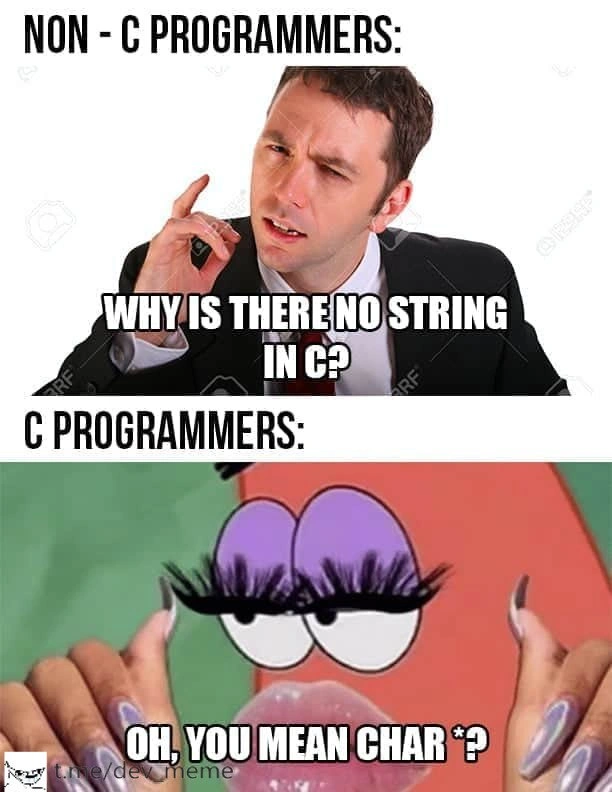
Why is this Languages meme funny?
Level 1: Some Assembly Required
Imagine two kids working on a craft. The first kid asks, “Where’s the finished bracelet with my name on it?” The second kid (who’s been doing this for a while) just hands over a piece of string and a bunch of letter beads and says, “Here you go – just put the beads on the string and tie a knot at the end.” The first kid looks confused because they expected a ready-made bracelet. The second kid is unfazed; to them, building the bracelet from scratch is completely normal. In this story, the bracelet represents a string of text. The letters are like the characters, and the final knot is like a special end marker so the letters don’t spill off. It’s funny because the beginner expected a complete, done-for-you item, while the experienced friend thought, “Isn’t it obvious you just use the pieces?” One expected convenience, the other assumed a DIY approach. That little misunderstanding – expecting something to be pre-packaged versus doing it yourself – is exactly why this scenario makes programmers grin.
Level 2: Build-a-String Workshop
If you’re newer to programming or only used high-level languages, it helps to know that C is a very low-level language compared to something like Python or Java. That means C doesn’t provide a lot of built-in conveniences, and one clear example is how it handles text. In many languages, a "string" is a special data type with lots of features – you can just create one and use it without worrying about the details. In C, a string is not a predefined type at all. It’s basically just a bunch of characters in a row in memory (what we call an array of chars), and we often refer to it by a pointer to its first character.
Let’s break that down in simpler terms: A char in C is the data type for a single character (like 'A' or $'$), typically one byte in size. If you want to store a whole word or sentence, you need multiple chars. That’s where an array comes in – an array is just a contiguous block of items in memory. So an array of char is a series of characters one after the other. For example, to store the word "Hello" in C, you could do:
char hello[6] = "Hello";
Here we told the program to set aside 6 slots (bytes) for characters and then put "Hello" there. Why 6? Because "Hello" has 5 letters, and we need one extra slot for the special '\0' character that marks the end of the string. C strings are called null-terminated strings for this reason – they end with a '\0' (null) character. That null character isn’t something you’d print; it’s just there as an end marker. So in memory, "Hello" looks like: H, e, l, l, o, and then 0. If you use the C function printf("%s", hello), it will print H-e-l-l-o and stop when it encounters that 0, knowing that’s the terminator.
Now, what about that char* the meme mentions? char* is the syntax for a pointer to a char. A pointer is basically a variable that holds a memory address. Think of it like a house address pointing to where some data lives. If we say char *p = hello;, we’re setting p to point to the start of our hello array. In this case, p would "point" to the character 'H'. If you asked p to show you what it points to (by using *p in C, which means "value at the address in p"), you’d get 'H'. If you add 1 to the pointer (like p + 1), it would then point to 'e', and so on. Pointer arithmetic like this (p + 1 to go to the next character) is one way C lets you move through an array of characters. It’s a bit like having a bookmark in a book – p is the bookmark, and moving the bookmark forward by one page is like p+1 moving to the next character.
Because C doesn’t have a built-in string type, you, the programmer, are responsible for managing the memory for strings. This means you have to be careful to allocate enough space for all your characters plus the '\0. If you need to store a bigger string later, you might have to use functions like malloc to get a new block of memory, copy the old string into it, then free the old block. (C won't resize your arrays automatically – there’s no magical expansion like in Python where strings can grow dynamically. You either allocate enough to start with or allocate new space and move things.) C does provide a standard library (<string.h>) with helper functions for common string operations. For example, strcpy will copy one string to another, strlen will count the length of a string (by looking for that '\0'), and strcmp will compare two strings. But importantly, these functions all operate on char* pointers (or arrays of char) that you provide. They assume you’ve set up the memory correctly. If you misuse them – say, try to copy a 10-letter word into an array that can only hold 5 letters – you’ll end up with a problem (the extra letters will overflow into memory they shouldn’t, causing unpredictable behavior). This is one reason people say C is less forgiving: it will happily do what you ask, even if what you ask is a bit dangerous.
Interestingly, as programming evolved, some languages that stem from C added safer string tools. For instance, C++ (which is like a big brother to C) introduced a std::string type that behaves more like a typical string object – it keeps track of its length and can grow as needed, managing memory behind the scenes. But in plain C, there’s no such construct. You’re working with just the fundamental pieces: characters and pointers. So when a non-C programmer asks "Why is there no string in C?" the answer is basically: C gives you the building blocks (letters and memory addresses) and expects you to combine them. It’s a very DIY approach to handling text. The upside is you get a lot of control and can write very efficient code since you’re close to the hardware. The downside is it’s easy to trip up if you forget something like that terminating '\0' or if you miscalculate sizes. But once you understand that a C "string" is literally an array of chars with a 0 at the end, the mysterious answer "char *" starts to make sense. It’s just the language’s way of saying, “we handle strings with pointers to characters.” Over time, as you become more comfortable with C, you start to see the elegance in this simplicity – it’s like you’ve learned how the magic trick works, and now you can actually perform it yourself, rather than relying on the language to do it for you.
Level 3: No Strings Attached
The meme paints a familiar picture for experienced developers. A confused non-C programmer asks, “Why is there no string in C?” (as if C must have forgotten to include such a basic thing). In response, the C programmer shrugs with a grin and says, “Oh, you mean char*?” This exchange is funny because it highlights a classic quirk of the language. C indeed has no dedicated string type, and to an outsider that sounds like a glaring oversight. But to a C veteran, it’s a point of pride (and a source of pain) that strings are handled as raw character pointers. In fact, what the newcomer sees as two separate concepts – a high-level "String" versus a low-level char* – are effectively the same thing in C. The non-C dev is essentially asking for a convenient abstraction, while the C dev is pointing out the low-level reality. It’s like a newbie expecting a pre-assembled gadget, and the expert responding by handing over a box of parts with a smirk.
For someone coming from a modern high-level language, the absence of a built-in string type in C is bewildering. In Python, Java, or JavaScript, you declare a string and you’re off to the races – the language manages the length, memory, and all the fiddly bits behind the scenes. In C, by contrast, if you want to store the word "Hello", you might write:
char greeting[6] = "Hello"; // In C, this makes an array: {'H','e','l','l','o','\0'}
printf("%s\n", greeting); // prints "Hello"
Notice that [6]: you had to allocate 5 letters plus one extra slot for the '\0' terminator. This manual accounting is the norm in C. Newcomers often stumble by forgetting that extra byte, or by assuming C will automatically resize a string for them (it won’t!). There’s a whole genre of bugs that stem from off-by-one errors in string buffers. Imagine a newbie tries:
char name[4] = "John"; // Oops! "John" is 5 characters (4 letters + '\0')
printf("%s\n", name); // Undefined behavior - no '\0' at the end of this array
What happens here? Since name wasn’t big enough, there's no '\0' to mark the end of the string in memory. printf will merrily march beyond name’s bounds, printing whatever bytes it finds until a 0 byte happens to appear somewhere by chance. The output might be "John♥♦?┘" (gibberish from nearby memory) or it might just crash with a segmentation fault. This kind of bug is a rite of passage for C developers. The first time you see your program spew strange symbols or blow up because of a missing null terminator, you gain a new respect (and fear) for how C handles strings. Working with pointers in C has a notorious learning curve, and a lot of that stems from exactly this scenario: handling strings as arrays of characters and juggling those pointers and buffer sizes by hand.
Seasoned C programmers have the scars to prove it. We've seen production outages caused by one forgotten '\0' or a single miscalculated buffer length. (There’s nothing quite like being paged at 3 AM because a string function wrote past the end of an array and corrupted memory somewhere else in the system.) Over the years, you develop a dark humor about it: “Of course it crashed, the string wasn’t terminated—classic C!” The meme taps into that shared experience. The Patrick Star character with exaggerated eyelashes in the image perfectly captures the slightly condescending, slightly amused vibe of a C guru explaining this to a newbie. It’s as if the C dev is batting their lashes and saying, “Aww, you wanted a fancy string type? Bless your heart... here, have a plain old char*.”
The humor lands so well because it contrasts two mindsets. The non-C folks expect the language to do more for them – they’re used to safety nets and abstractions. The C folks have learned to operate without those nets, doing a tightrope walk with pointers over the chasm of memory. There’s a hint of “kids these days with their fancy managed languages…” in the C programmer’s reaction, and a corresponding bewilderment from the newcomer thinking, “how can a language not have something as basic as a string!?” In reality, neither side is wrong: higher-level languages abstract strings to improve productivity and safety, whereas C exposes strings in their raw form for maximal control and efficiency. But when these worlds collide, it often comes out as gentle mockery. The C programmer’s “Oh, you mean char?”* is funny because it’s both a straightforward answer and a sly jab – implying the question itself is naive once you understand C’s philosophy.
In the end, this meme resonates with developers because it distills a common learning curve into a simple joke. It’s a nod to that moment of confusion every C beginner has, and the slightly smug clarification from a seasoned C dev. Whether you’ve been the baffled newbie or the all-knowing C guru, the exchange has a ring of truth that makes you grin. It’s a little piece of developer humor about the difference between expecting things to be done for you and discovering that in C, you do it all yourself (sometimes the hard way).
Level 4: String Theory vs Practice
In C, the concept of a "string" isn’t a distinct built-in type at all – it’s implemented as a null-terminated array of characters accessed via a pointer. Under the hood, everything reduces to bytes in memory. Higher-level languages might treat a string as an object with properties (like length and encoding) and methods, but C stays close to the metal. A string in C is simply a sequence of char values laid out contiguously in memory, with a special '\0' byte (value 0) marking where the text ends. In other words, a C string is defined by a convention: all characters until the first 0 byte are part of the text.
This approach uses a classic sentinel value strategy. The terminator '\0' acts as a marker that signals "stop here" to any function processing the string. It’s an elegant and minimalistic solution – one extra byte serves as an end-of-string marker without needing to store a separate length field. Early computing environments had very limited memory, so avoiding additional overhead was crucial. Many of C’s standard library functions (like strlen for length or strcpy for copying) rely on this convention internally. For example, strlen essentially does something like:
size_t strlen(const char *s) {
size_t len = 0;
while (*s != '\0') { // loop until the null terminator
s++; // move pointer to the next char
len++; // count characters
}
return len;
}
This loop marches through memory one byte at a time until it finds that '\0' terminator. If the string is long, it must check every character (making the time complexity $O(n)$ to find the length). In contrast, languages that store the string’s length (say in a separate integer) can retrieve length in constant time $O(1)$. C trades that potential speed-up for simplicity: the language doesn't automatically maintain any metadata – it trusts the programmer (and the functions they call) to handle it.
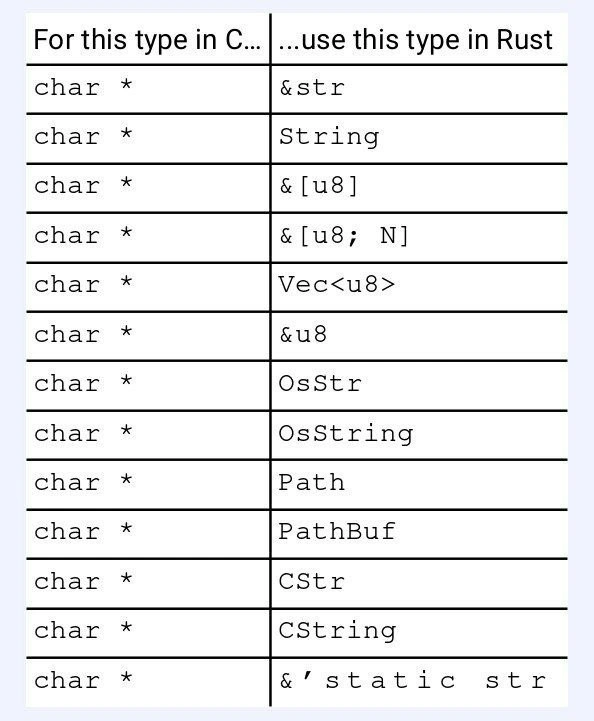
A char* (pronounced “char pointer”) is literally an address pointing to a location in memory where a char is stored. If that location is the start of an array of characters, then by convention we consider it the start of a string. The C type system doesn’t know how long the string is or even that it’s a string at all – it only knows it’s a pointer to a char. It’s entirely up to the programmer to ensure there’s a '\0' somewhere down the line. This is low-level programming at its finest (and scariest): you have direct control over memory addresses. You can do pointer arithmetic (e.g. increment a char* to move to the next character in memory), which is powerful for performance and flexibility. But with great power comes great responsibility – if that '\0' is missing or misplaced, the pointer will merrily continue past the intended bounds, reading whatever bytes follow until by chance a zero byte in memory is encountered. Such out-of-bounds access leads to undefined behavior (your program might crash with a segmentation fault, print bizarre gibberish from unrelated memory, or even create security vulnerabilities).
Historically, C’s design reflects a minimalist philosophy. The language was created by Dennis Ritchie in the early 1970s for implementing the Unix operating system. Back then, keeping the language small and efficient was paramount. A dedicated string type with automatic memory management was seen as unnecessary overhead – after all, you could already represent text with arrays of char. Some contemporaneous languages (like Pascal) chose to store a length along with the characters, but C opted for the simpler null-terminated scheme (inherited from its predecessor, the B language, and conventions in assembly). This decision has influenced computing ever since. Null-terminated strings became the norm in system APIs and file formats, and later languages in C’s family (such as C++ and Objective-C) continued this tradition. The downside is that C provides no runtime checks for string operations: it’s a double-edged sword that relies on the programmer to get it right.
In summary, there’s no keyword string in C because it’s not needed at the language level – a char* plus the agreed-upon convention of a terminating zero byte is a string in C. This design lays bare the raw mechanics of text handling. Seasoned C developers appreciate the control and transparency (you can literally see and manipulate the bytes of your strings), while newcomers often find it puzzling or even frightening. The meme highlights this disparity: the expectation of a convenient, high-level String type versus the reality of C’s DIY approach. It’s a prime example of fundamental computer science concepts leaking into everyday coding: what higher-level languages neatly package as a string object, C exposes as just an address and raw bytes in memory, with nothing extra to hold your hand.
Description
A two-panel meme contrasting programmers unfamiliar with C to seasoned C programmers. The top panel is labeled 'NON - C PROGRAMMERS:' and features a stock photo of a perplexed businessman asking, 'WHY IS THERE NO STRING IN C?'. The bottom panel, labeled 'C PROGRAMMERS:', uses the 'Sassy Patrick Star' meme format, showing a close-up of the cartoon character with glamorous eyelashes and makeup, framed by hands with long, manicured nails. This panel has the condescending reply, 'OH, YOU MEAN CHAR *?'. The meme humorously highlights a core concept of the C language: the absence of a built-in string type. Instead, C handles strings as null-terminated arrays of characters, which are typically manipulated via a pointer to the first character (char *). The joke plays on the C programmer's comfort with and pride in low-level concepts like pointers, portraying them as gatekeepers looking down on those accustomed to the high-level abstractions of modern languages
Comments
7Comment deleted
Modern languages give you strings. C gives you a memory address, a loaded gun, and says 'don't miss the null terminator'
C does have strings - every char* is a self-managed, null-terminated microservice with zero observability and a 3 AM on-call guarantee
After 20 years, you stop seeing strings and just see null-terminated char arrays, buffer overflows waiting to happen, and the faint echo of strcpy vulnerabilities from production systems past
Ah yes, the classic C programmer's smug satisfaction when explaining that strings are just syntactic sugar for pointer arithmetic and a gentleman's agreement about null terminators. Meanwhile, they're one strcpy() away from a security vulnerability that'll make the evening news, but at least they saved 8 bytes by not having a length field
C strings: char* adventures where the null terminator hides just beyond your buffer overflow
In C, “string” is a char* and a promise that strlen() finds a zero before your pager does
Strings in C: char*, NUL termination, ownership by folklore, length via linear scan - tell me again why your hot path is O(n)