The Physical Location of the Serverless Cloud
Why is this Cloud meme funny?
Level 1: Pizza Delivery Magic
Imagine you’re ordering a pizza from your favorite delivery place. You tap a few buttons on your phone, and 30 minutes later, a hot pizza shows up at your door. It feels almost like magic – you didn’t have to cook anything! But of course, we all know what really happened: somewhere, in the restaurant’s kitchen, a chef rolled out dough, added sauce and toppings, baked the pizza in an oven, put it in a box, and a delivery person brought it to you. You just didn’t see any of that happening. From your point of view, it’s like the pizza appeared “kitchen-less.”
Now, think of a serverless app like that. You write some code and send it to the cloud (let’s say to a company like Amazon or Google). Later, when people use your app, it’s like the pizza arriving – the app works, but you never saw a computer or server cooking up the results. It seems instant and you didn’t personally start any server, just like you didn’t personally bake the pizza. But behind the scenes, yes, there’s a “kitchen” full of computers doing the work. The term “serverless” just means you don’t have to worry about that kitchen. It doesn’t mean the kitchen isn’t there; it’s just out of sight.
The meme joke shows an empty rack (imagine an empty kitchen with no ovens or chefs) and says developers are using this to run serverless apps. That’s like joking, “Look, this restaurant has no kitchen at all, yet they make pizzas!” It’s funny because we know that’s impossible – if there were truly no kitchen, no chef, and no oven, nobody would be eating hot pizza. In the same way, if a data center truly had no servers, no app could run.
So the humor is a bit like a magic trick: someone claims something works with nothing behind it – ta-da! – but we all wink and know there’s actually something (or someone) working hard behind the curtain. It makes us laugh because it’s a playful reminder that even when things seem to come out of thin air (whether it’s pizza or a serverless app response), there’s always reality in the background making it happen.
Level 2: Servers Behind “Serverless”
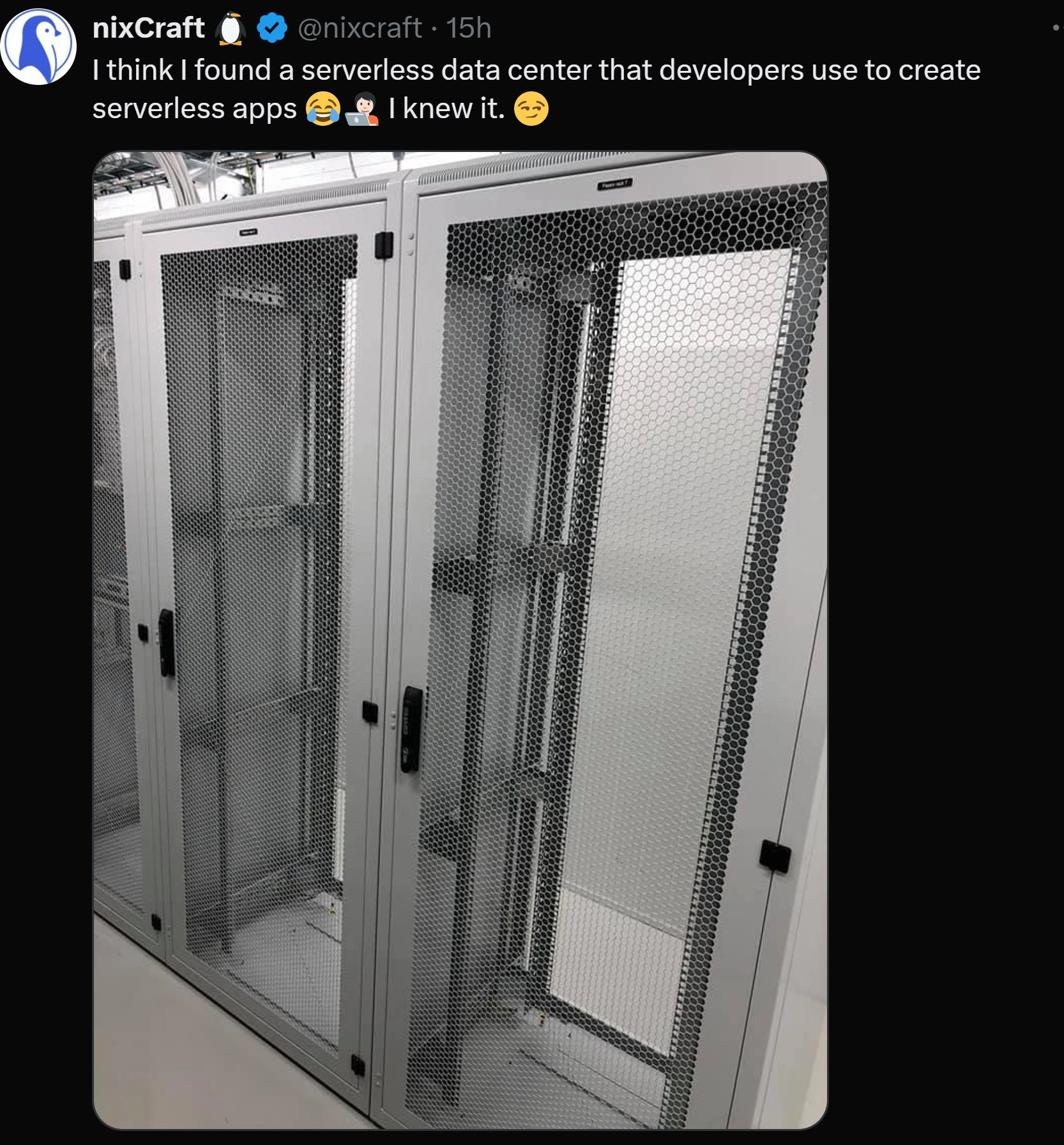
Let’s break down the joke in simple terms. The meme shows a tweet and a photo of two big data center racks that are completely empty. Usually, those metal cabinets (racks) are filled with servers – which are basically powerful computers stacked in rows. A data center is a specialized building where companies keep all these servers that run websites, apps, and online services. It’s the physical heart of “the cloud”. In the photo, however, the rack doors are open and you can see there’s nothing inside: just empty space and some rails. It’s bizarre because an empty rack isn’t doing any work. It’s like an empty fridge – it’s not cooling anything without the machinery.
The tweet text above the image says: “I think I found a serverless data center that developers use to create serverless apps 😂🤦🏻♂️ I knew it. 😏” The person tweeting (nixCraft, a popular tech humor account) is joking that this empty rack must be the secret place where “serverless” apps run. They even put a laughing emoji and a facepalm emoji, showing it’s a joke and kind of a silly one. The smirking emoji 😏 and the phrase “I knew it” add a sarcastic “Ha! I suspected there were no servers all along!” vibe. Of course, in reality, nobody literally believes that. It’s making fun of the word “serverless.”
Now, what does serverless actually mean? In modern cloud computing, serverless architecture doesn’t mean there are no servers at all; it means you don’t have to manage the servers. The servers are still there, but a cloud provider (like Amazon Web Services, Microsoft Azure, or Google Cloud) handles all the server work for you. For example, if you use an AWS Lambda function, you just write your code and send it to AWS. They will run that code whenever it’s needed, and you don’t see or touch the actual machine that runs it. You don’t worry about installing an operating system, setting up a machine, or updating it. It’s like the cloud is saying, “don’t worry, I got this, you just give me the code.” This is what we call an abstraction – hiding the complicated stuff so you can focus on your part (the code).
The term serverless is a bit misleading if taken at face value. It sounds like “no servers”. But a more accurate description would be “server-free for the developer.” The servers are there, but someone else is taking care of them. A common tongue-in-cheek line in tech is, “There is no cloud, it’s just someone else’s computer.” This captures exactly what’s happening: your code is actually running on someone else’s servers in some data center you don’t see. You pay them (through your cloud usage fees) to worry about those machines for you.
So why is the image of an empty rack funny? Because it imagines that “serverless” was literal – that developers somehow run apps on nothing at all. It’s showing an absurd scenario to get a laugh. DevOps and SRE professionals (the folks who normally maintain and troubleshoot servers and infrastructure) find this especially humorous. They know from experience that whenever something is described as “magic” or “fully managed,” it just means the hard work is happening behind the scenes. If an app is “serverless”, then the cloud’s DevOps engineers are doing the server management. Those engineers know the servers are very real – they have to replace hard drives, power units, keep the network up, etc., in huge infrastructure facilities full of equipment. The meme jokingly pretends those people’s workplaces look like this empty rack – which is obviously false, and that contrast is what makes it a joke.
Let’s explain a few terms from the tags and context as well:
Cloud: This is just a fancy word for servers accessible over the internet. Instead of running on your own PC or a server in your office, your code runs on a server in a data center owned by Amazon, Google, etc. We call it “the cloud” because from your perspective it’s somewhere out there (you don’t know the exact physical location).
DevOps / SRE: DevOps stands for Development & Operations. It’s a culture and role where the same team that writes software also helps operate it in production (live environment), using automation and practices to make it smooth. SRE stands for Site Reliability Engineering – these are engineers focused on keeping services up and running reliably. In a traditional setting, these folks worry about servers, networking, deployment pipelines, monitoring, and so on. In a “serverless” context, they might focus more on the application performance and cloud configurations, since the hardware side (rack and server maintenance) is handled by the cloud provider’s SRE teams.
Infrastructure: This means all the underlying hardware and systems that make IT services possible – servers, storage disks, network equipment, data centers, power supplies, cooling, etc. When someone says “infrastructure as code” or jokes about infrastructure, they’re talking about these foundational pieces. In this meme, the empty rack is a piece of infrastructure (a rack for holding servers) that has no servers in it.
ServerlessArchitecture (tag): This refers to designing software systems using serverless services. That might involve breaking an application into small functions that run on demand, and using managed databases or queues, etc., so that you don’t manage actual servers. It’s popular because it can scale automatically and you pay only for what you use, but it’s also a bit of a buzzword that not everyone fully understands at first.
Abstraction_humor: The meme is a form of abstraction humor – it jokes about the concept of abstraction (hiding complexity). Here, the abstraction is “we removed the servers from your concern,” and the humor is showing it as if they literally removed the servers from the rack! The empty_rack_meme and invisible_servers tags directly point to this visual gag: the servers have been made “invisible” by marketing, just like the racks in the photo are empty.
In summary, at this level: the meme is funny to people in tech because “serverless” is an abstraction that doesn’t literally remove servers. The picture of an empty data center is the literal interpretation – and it’s ridiculous, hence it evokes laughter. Even if you’re new to these terms, you can appreciate that if someone says they found a data center with no servers, that’s like saying you found a car with no engine – it sounds wrong. The tweet uses emojis (😂 and 🤦🏻♂️) to signal “this is a joke, laugh with me, and oh boy, what a silly idea serverless can sound like if you take it literally.” So the meme is basically a playful reminder: even in the age of cloud computing, there’s always a computer somewhere doing the work.
Level 3: Someone Else’s Computer
This meme riffs on a truth every experienced engineer knows: “There is no cloud… it’s just someone else’s computer.” The tweet by nixCraft shows two pristine, empty server racks and quips that he’s discovered the secret “serverless data center” powering our apps. Cue laughter and a knowing facepalm. It’s poking fun at cloud marketing that might lead the uninitiated to believe compute just happens in the ether with no hardware at all. Seasoned DevOps and SRE folks smirk at this because we’ve been through the hype cycles. We know that whenever a vendor promises “no servers to manage,” what they really mean is “we manage the servers, you just pay for it.” The servers are still very real – you’re just not the one racking and stacking them (someone at AWS or Google is, likely cursing under their breath at 3 AM while replacing a faulty disk).
Why is this funny? It’s the absurd literal interpretation of serverless. In day-to-day tech talk, serverless refers to services like AWS Lambda, Azure Functions, Google Cloud Functions – you write code and deploy it without ever touching an actual server or VM yourself. It’s all handled by the cloud provider. But the term can mislead people into imagining that the code executes in some kind of abstract nirvana with no machines involved. Of course, industry veterans know that under the hood, it’s Linux processes running on physical hardware in a data center. So seeing an empty cabinet labeled implicitly as “the serverless cloud” is a tongue-in-cheek way to say, “Look, no servers! Just like the marketing promised!” It’s basically the tech equivalent of showing an empty engine bay and claiming the car has a “motorless drive.”
There’s a shared giggle here about cloud hype vs. reality. Cloud providers love to emphasize how you don’t have to worry about infrastructure. Terms like “NoOps” (no operations) were even floated – implying you could fire your ops team because the cloud has it handled. The cynical reality: you still need operations, it’s just abstracted. Your app can still go down, your serverless function can hit resource limits, or you might get paged because your “serverless” system is timing out (and guess what, you’ll end up reading cloudwatch logs of actual servers to figure out why). As a grizzled SRE might say with a smirk, “Serverless? Sure. I love when my servers are so well hidden that I have to scroll through 5 layers of dashboards to find why my function crashed.” The meme nails this feeling with one image – if serverless were taken at face value, data centers would look like ghost towns with empty racks. Spoiler: they don’t. In reality, those same racks are filled to the brim with humming machines – it’s just you never see them because access is restricted and virtualized away.
Another layer to the humor is the absurdity of an “empty data center”. Data centers are usually portrayed as futuristic warehouses with rows of blinking server lights and tangled cables. That’s the temple of cloud computing. Now here comes a joke that the most advanced cloud data center has nothing in it. It’s a perfect parody of marketing fluff. It reminds experienced folks of all the times non-technical higher-ups have asked questions like, “Why do we need to budget for servers or ops? Isn’t it serverless now?” Meanwhile, the engineers exchange glances, knowing that “serverless” just means the server budget line moved to your AWS bill and someone else’s payroll. This image is basically the physical form of that facepalm.
For those in DevOps/SRE, there’s also an element of “hehe, if only it were that simple.” We maintain complex infrastructure – networks, machines, monitoring – even in cloud setups. Sure, using serverless services means we don’t maintain the OS or the hardware directly, but we’re still responsible for configurations, performance tuning, and dealing with the fallout when the cloud has issues. When AWS us-east-1 (a major data center region) has an outage, serverless apps go down too, and suddenly thousands of developers realize “no server to manage” doesn’t mean “no infrastructure problems.” The empty rack meme could be retitled as “What some think using AWS Lambda is like” vs. reality being very different.
In essence, this meme lands because it’s winking at the insiders. It uses a visual hyperbole that both mocks the term serverless and reassures those who know the truth that, yes, we’re all in on the joke. The phrase “I knew it. 😏” in the tweet is pure snark – as if we’ve caught the cloud red-handed running on air. It’s the kind of dry humor an old sysadmin might utter while decommissioning an on-prem server: “Soon as we go serverless, I guess I’ll be managing empty racks, huh?” Everyone who’s dealt with real servers or cloud deployments gets the subtext: servers don’t magically disappear just because marketing gave them a new name. And laughing about it is a way to cope with the sometimes overhyped promises we hear in tech.
Level 4: Conservation of Servers
At the most fundamental level, “serverless” computing doesn’t repeal the laws of physics. No code runs in a literal vacuum. If an application is running, some processor, somewhere, is crunching the instructions. In computing theory, this is akin to a conservation law: you can abstract away servers, but you can’t eliminate the need for actual hardware and energy. Every bit transformation costs real energy (as per Landauer’s principle in thermodynamics), and that energy is dissipated by real chips in real machines. So an empty rack in a data center isn’t running your code – it’s just sitting there, consuming no power and doing no work. The meme’s image of spotless, empty data-center cabinets plays on this impossibility: if those racks are truly empty, they’re not powering anything except perhaps a janitor’s floor waxer.
From a systems architecture viewpoint, serverless is really a sleight of hand by cloud providers. Consider AWS Lambda’s under-the-hood engineering: when you trigger a Lambda function, AWS behind the scenes rapidly provisions an isolated micro-VM (using their open-source Firecracker micro-hypervisor) or a container in a pool, on a host machine that’s very real (and definitely not empty!). There’s a flurry of activity: scheduling your function on an available server core, managing memory, possibly retrieving your code from storage, all in fractions of a second. This complex orchestration is built on decades of research in operating systems and distributed systems. We’re talking about things like cgroups and namespaces in Linux to isolate workloads, just-in-time provisioning, and multi-tenant scheduling algorithms. It’s a far cry from “no servers” – instead, it’s lots of servers coordinated so seamlessly that you, the developer, don’t have to know.
Think about the abstraction stack here. At the lowest level, there are physical servers (with CPUs, RAM, disks) sitting in racks (hopefully not empty ones). On top of that, a virtualization layer (VMs or containers) parcels out those physical resources into smaller units. Then a control plane dynamically assigns those units to run your functions on demand. Cloud providers have entire orchestrator services (like AWS’s internal Lambda control plane or Kubernetes-based platforms) that monitor load and spin up or tear down instances of your function. There’s also networking hardware and software routing requests to wherever your code is live. All of this is hidden from you, but it’s undeniably there. The meme is funny because it imagines a world where cloud marketing took “serverless” so literally that even the data centers have poof! vanished servers – a physical impossibility reminiscent of a perpetual motion machine hype.
In academic terms, this highlights the classic principle of abstraction in computer science. Abstraction lets us treat a complex system in simpler terms by hiding the details. But crucially, those details still exist underneath. There’s a known adage: “All problems in computer science can be solved by another level of indirection… except for the problem of too many layers of indirection.” Serverless architecture is essentially an extreme level of indirection – you’re running code via an API without any visibility into the machine executing it. The trade-off, as always, is that the complexity is pushed down the stack. The cloud provider’s engineers have to solve insanely hard problems to maintain the illusion of “invisible infrastructure.” They deal with cold starts, sandboxing, scaling limits, and hardware failures, so you don’t have to. It’s a bit like advanced stagecraft: complicated rigging and machinery behind the curtain to make the magic on stage look effortless. The meme cuts through that illusion with a wink: here’s the magical “serverless data center” – just an empty stage.
In short, even at a theoretical level, there’s no free lunch in computing. You can’t do computation without computational resources (matter and energy). The phrase “serverless” is a misnomer in literal terms – it really means “the servers are somebody else’s problem.” The empty rack photograph is a tongue-in-cheek reminder that, no matter how far our abstractions go, the bytes don’t process themselves. Until someone figures out how to run code on air and hype alone, serverless still runs on servers. The cloud hasn’t repealed matter – it’s just rented it out of sight.
Description
A screenshot of a tweet from the user 'nixCraft'. The tweet shows a photograph of three empty, metallic-gray server racks with perforated mesh doors, standing inside a clean, modern data center. The racks are completely devoid of any servers, wiring, or equipment. The caption of the tweet reads, 'I think I found a serverless data center that developers use to create serverless apps 😂🤦 I knew it. 😏'. The humor is derived from a literal interpretation of the term 'serverless'. In cloud computing, 'serverless' architecture means that developers don't manage the underlying servers, as the cloud provider handles all the infrastructure provisioning and management. This meme hilariously visualizes the concept as a data center with literally no servers, poking fun at the abstraction and buzzwords prevalent in the tech industry
Comments
8Comment deleted
This is where our serverless functions run. The cold aisle is for cooling the heated debates about the AWS bill
An entire rack of provisioned “/dev/null” instances - zero hardware, zero cold starts, yet Finance still got a five-figure AWS bill
After 20 years of abstracting away the metal, we've finally achieved peak serverless: racks so optimized they've transcended physical existence. Next up: quantum superposition deployments where your Lambda both exists and doesn't until AWS bills you
Ah yes, the mythical serverless architecture in its purest form - where 'there is no server' is taken literally rather than as 'there is no server *you* need to manage.' This is what happens when product marketing meets infrastructure reality: developers think they're running code in the ethereal cloud while somewhere, a sysadmin is still racking hardware and cursing at IPMI interfaces. The real joke? These empty racks probably have better uptime than your Lambda cold starts, and definitely more predictable billing than trying to optimize your CloudWatch costs after that recursive function incident we don't talk about anymore
“Serverless” is just CAPEX turned into OPEX and the servers moved to someone else’s pager
Serverless: where you trade SSH access for a bill that reminds you servers still exist
Finally, a NoOps platform with perfect autoscaling - scales from zero to zero across three empty AZs
Welcome to AirServ Comment deleted