Skip to content
DevMeme
4168 of 7435
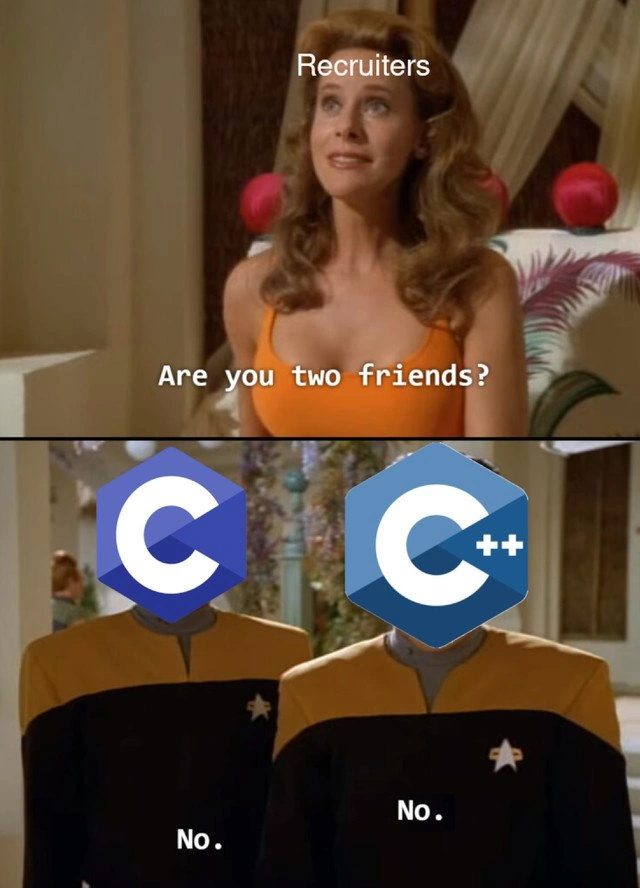
When asked if C and C++ actually get along, both answer in perfect sync
Languages Post #4550, on Jun 23, 2022 in TG

When asked if C and C++ actually get along, both answer in perfect sync

Why is this Languages meme funny?

Level 1: Brothers at Odds

Imagine two brothers who grew up in the same family – one is named C and the other is C++. The younger brother, C++, learned a bunch of new tricks and skills from school, while the older brother, C, likes to do things the old, simple way he’s done forever. Now, someone who doesn’t know them well (let’s say a friendly neighbor or a teacher, like the "recruiter" in the joke) comes along and innocently asks, “So, are you two friends?” Picture both brothers immediately shouting “NO!” at the exact same time. It’s a funny scene because you’d expect siblings to at least say something different or look at each other, but here they’re so in agreement about not being friends that they answer in perfect sync. 😃

Why is this funny? Because it shows how much these two argue and differ — they won’t even pretend to be pals, and they’re oddly united only in their disagreement. It’s like if you asked a cat and a dog in the same house if they get along, and both meowed and barked “No!” together. In real life, C and C++ are just two programming languages in the same family (C++ started out from C, like a younger sibling). People often think they must be very friendly or similar since they share a lot, but programmers joke that the only thing C and C++ truly share nowadays is a tendency to quarrel. So the meme is saying: even though C and C++ come from the same place, don’t assume they hold hands and sing songs – ask them if they’re friends, and you’ll get a big synchronized “No way!” It’s a playful way to show a sibling-like rivalry in the coding world, using a scene from a famous sci-fi show to make it extra fun.

Level 2: C Family Feud

For newer developers or those just learning about programming languages, let’s break down the joke. C and C++ are two popular programming languages that are closely related in origin, but programmers often debate their differences. C was created first (back in the 1970s) and is a procedural language — meaning it’s mostly about writing functions to operate on data. It's famous for being simple, low-level (close to the hardware), and extremely efficient. C is the language in which things like operating systems (for example, many parts of Unix/Linux) and embedded systems are written. You manually manage memory in C (using functions like malloc and free), and there’s not much built-in safety — if you mess up a pointer or array index, you might crash your program or introduce a security bug. But C’s minimalism is a point of pride for its fans: it does exactly what you tell it to, nothing more, nothing less.

C++ (pronounced "see plus plus"), on the other hand, was invented in the 1980s as basically “C with extra features.” In fact, the name C++ is a playful programming joke: in C-style languages x++ means “increment x by one,” so C++ implies it’s “one step above C.” 😀 C++ maintained a lot of C’s syntax and low-level capabilities but added object-oriented programming concepts (like classes and objects to organize code into reusable pieces). Over time, C++ kept gaining features: templates (for generic programming), exceptions (for error handling), the STL (Standard Template Library, a rich collection of data structures and algorithms), and more. It became a multi-paradigm language – you can write C++ in a C-like style, or use it in a totally different way with classes and templates. It also introduced its own memory management operators (new and delete for allocating and freeing memory, alongside higher-level abstractions like smart pointers that auto-clean). Because C++ grew so much, it ended up being a lot more complex than C. There’s a running joke that C++ is a language where you "learn it in 21 days" only to realize it takes a lifetime to master all the details.

Now, why would C and C++ be portrayed as not friends? You might think, “Hey, C++ is basically an upgrade to C, so people who like C must like C++ too, right?” Not necessarily! LanguageWars is a term developers use to describe friendly (and sometimes not-so-friendly) debates over which language is better. C and C++ have been the subject of those debates for a long time. Here are some contrasts:

  • Different philosophies: C adherents love its simplicity – there’s a mantra “keep it simple” in the C world. C++ enthusiasts love the power and convenience of its advanced features – “why write low-level code for everything when the language can help you out?” These philosophies can clash.
  • Use cases: C is often used when you need a small runtime and straightforward behavior (like coding for microcontrollers, or the kernel of an operating system). C++ is used when you want to build larger applications with many moving parts (like big game engines, GUI applications, or sophisticated tools) where its abstractions can help manage complexity.
  • Learning curve: C is considered hard in one way (because you must be careful with memory and pointers), but C++ can be hard in another way (because it has so many features and ways to do things). A newcomer might find C++ overwhelming with all its syntax, while C feels more approachable initially (until you hit a pointer bug!).
  • Community and culture: Some programmers identify strongly as “C programmers” or “C++ programmers.” They might poke fun at each other. For example, a C programmer might joke that C++ code is so complicated it’s like a spaceship control panel for doing something simple. A C++ programmer might joke that C is so bare-bones that you end up rewriting half of C++’s features from scratch in any large C program. These jabs are usually in good fun, but they highlight that the two camps see the world differently.

Because of these differences, even though C++ was derived from C, people don’t always treat them as one happy family. In fact, mixing C and C++ in one project can be tricky. Technically you can use them together (since C++ can call C code and vice versa with some effort), but you often have to jump through hoops (like using extern "C" linkage specifications so C++ knows not to “mangle” function names compiled from C). This is a bit advanced, but it shows that under the hood they aren’t seamlessly interchangeable. Many companies when hiring will say “C/C++” because they need programmers who can work with low-level code in either language. However, developers often cringe at that phrasing if they have a strong preference or expertise in one, hence the humor of the recruiter character assuming they’re pals.

Let’s look at a quick comparison to summarize C and C++ differences:

Aspect C (Procedural) C++ (Multi-paradigm)
Designed Early 1970s by Dennis Ritchie Early 1980s by Bjarne Stroustrup
Paradigm Procedural (focus on functions) Multi-paradigm: OOP, generic, etc.
Level Low-level (close to hardware) Low-level to High-level mix
Memory Manual (malloc/free for heap) Manual (new/delete plus tools like smart pointers)
Standard Lib C standard library (stdio, etc.) C++ standard library & STL (much larger)
Strengths Simple, small, fast, predictable Powerful, flexible, lots of features
Criticisms Unsafe, minimal abstractions Complex, can be overkill at times

Both languages are pillars of systems programming, and many modern languages (like C#, Java, Rust) have roots or inspirations tracing back to the C/C++ family. But as you can see, they evolved with different priorities. That’s why the meme jokes that asking “Are you two friends?” would get a synchronized “No.” It’s like asking two colleagues who fundamentally disagree on how to do the job if they get along – the only thing they agree on is that they certainly do not! This meme is hugely relatable to developers because many have encountered this exact dynamic or at least the stereotype of it. It’s common in CodingHumor to personify programming tools or languages and exaggerate their conflicts for a laugh. Everyone knows they’re just languages (they don’t have feelings), but we talk about them as if they’re people with personalities: C might be the crotchety but dependable old engineer, and C++ the sophisticated but overly complicated architect. Seeing them say “No” in unison is a fun way to capture all those culture clashes in one quick scene. And of course, using a Star Trek meme format (a star_trek_meme with a nod to a sci_fi_show_reference) just adds an extra layer of geekiness that tech folks love.

Level 3: Unified in Rejection

At the highest technical level, this meme pokes fun at the C vs C++ rivalry that seasoned programmers know all too well. In the two-panel Star Trek scene (a classic are_you_two_friends_template format), a character labeled "Recruiters" innocently asks if the programming languages C and C++ are friends. The punchline is both languages replying with a deadpan “No.” in unison. It’s a witty nod to the fact that despite C++ being an evolution of C (they share syntax and a lineage in the CFamilyLanguages), fans of these languages often insist they’re absolutely not buddies. The humor comes from the perfect synchronization of their denial — the one thing C and C++ engineers might agree on is that their languages are not on friendly terms! This resonates as DeveloperHumor because it captures a truth about LanguageComparison debates: shared ancestry doesn’t guarantee camaraderie in the programming world.

From a senior developer’s perspective, the meme highlights decades of LanguageWars between C and C++. Think of C as the venerable old guard of systems programming — born in the early 1970s at Bell Labs, all about simplicity, pointers, and getting you as close to the metal as possible. Then comes C++ in the 1980s, originally “C with Classes” (yes, that was an early name), adding layers of abstraction like object-oriented programming, templates, exceptions, and more. C++ was designed to extend C while remaining backward compatible, but over time it grew into a behemoth of features. This growth sparked endless debates: C purists chuckle at C++ for being overly complex and bloated (“why do I need all these features when printf and pointers work just fine?”), while C++ aficionados retort that C is too primitive and unsafe (“enjoy your buffer overflows and manual memory management, I’ll use std::vector and RAII”). It’s the classic c_vs_cpp_rivalry. The meme distills this tension perfectly: ask a C dev and a C++ dev if their languages are friends, and you’ll get a simultaneous, emphatic “No.”

There’s also a layer of industry inside-joke here: Recruiters (often non-technical or HR folks) tend to treat “C/C++” as a single skill in job listings, as if knowing one implies you’re buddies with the other. Veteran developers know that being fluent in modern C++ (with all its arcane template meta-programming, std:: containers, and multi-paradigm design) is a very different skill set from being a hardcore C hacker (master of pointer arithmetic, malloc/free, and squeezing performance out of a 40-year-old language). So when the recruiter in the meme asks “Are you two friends?”, it’s hilariously naïve. The unified “No.” from both languages says, “Please, don’t lump us together!” It’s a snarky reality check that what looks like a minor LanguageComparison to outsiders is, to insiders, a bit of a family feud. In fact, the only time C and C++ ever act in concert is apparently to reject the idea that they’re equivalent! This kind of joke is extremely relatable to developers who have seen “C/C++” thrown around interchangeably and have felt the need to explain, actually, they’re quite different in practice.

On a technical note, C and C++ do share a lot of DNA – C++ was built to be (mostly) source-compatible with C, so many simple C programs will compile as C++ programs. But “mostly” is doing a lot of work here. There are subtle differences that cause friction if you try to treat them as the same. For example, C allows implicit conversion of a void* to any other pointer type (no cast needed), whereas C++ forbids this without an explicit cast, enforcing stricter type safety:

// C code (permissive with void pointers):
#include <stdlib.h>
void example() {
    void *p = malloc(100);
    int *arr = p;  // OK in C: void* automatically converts to int*
}
// C++ code (stricter):
#include <cstdlib>
void example() {
    void *p = std::malloc(100);
    // int *arr = p;       // Error in C++: cannot convert void* to int* without a cast
    int *arr = static_cast<int*>(p);  // Explicit cast required
}

This small difference reflects a bigger philosophy gap: C++ tries to be safer and more type-checked (at least sometimes), whereas C sticks to its minimalist, trust-the-programmer roots. Multiply differences like that by hundreds (think object-oriented features, constructors/destructors, overloading, templates, standard libraries, etc.) and you get two ecosystems that barely recognize each other at times. A seasoned coder might joke that these languages only agree on one thing: how much they disagree. “C and C++ in perfect sync? Must be about not liking each other,” is the kind of dry humor that gets a knowing smirk in senior engineering circles. It’s tech humor that acknowledges how two closely related tools can inspire almost tribal loyalties and disputes — a phenomenon all too familiar in the history of programming languages.

To add a bit of historical sci_fi_show_reference fun: using a Star Trek meme is apt. Star Trek famously had characters (or alien species) with shared origins who nonetheless were at odds (think Vulcans vs. Romulans — common ancestry, no friendship!). Here, the Starfleet officers with the C and C++ logos could be seen as two Starfleet crew from different series or departments that just do not get along. The scene’s comedic timing — both saying “No” simultaneously — mirrors how the C and C++ communities often react in sync when asked if they’re essentially the same or friendly. Seasoned devs appreciate this because it’s a clever cross of pop culture and programming culture. It signals “we’ve been around long enough to get the in-joke.” This mixture of TechHumor and nerdy sci-fi reference makes the meme pure catnip for veteran programmers. They laugh not just at the literal joke but at the years of discussions, flame wars on forums, and Stack Overflow questions indirectly referenced by that single synchronized “No.”

Description

Two - panel Star Trek meme. Panel 1: a woman in an orange dress (face blurred, partial text on the blur reads "F…s") asks the subtitle question, “Are you two friends?”. Panel 2: two Starfleet officers stand side-by-side; their heads are replaced by the C language hex-logo and the C++ hex-logo respectively. Each subtitle under them simply reads “No.” followed by “No.”. The joke plays on the well-known love-hate relationship between C and its object-oriented descendant C++, highlighting long-standing language-war banter in systems programming circles. Ideal for developers who know that shared ancestry doesn’t always mean camaraderie

Comments

7
Anonymous ★ Top Pick Ask the linker: C and C++ stay cordial only until someone forgets the extern "C" braces - then the ABI starts flinging name-mangled divorce papers
  1. Anonymous ★ Top Pick

    Ask the linker: C and C++ stay cordial only until someone forgets the extern "C" braces - then the ABI starts flinging name-mangled divorce papers

  2. Anonymous

    The real plot twist is when the recruiter insists they need '10 years of C/C++ experience' for a junior position, not realizing they just asked for expertise in two languages that would collectively span 50+ years of computing paradigm evolution and would require explaining why extern 'C' exists in the first place

  3. Anonymous

    This perfectly captures the eternal struggle of explaining to recruiters that 'C/C++' isn't a single language - it's like asking if Java and JavaScript are siblings because they share four letters. Sure, C++ inherited from C, but after adding templates, RAII, the STL, and decades of ISO committee meetings, they're about as compatible as a malloc and a smart pointer at a memory management convention. When a recruiter treats them as interchangeable, you know you're in for a job description that also lists '10 years of Rust experience' for a language that's only been stable since 2015

  4. Anonymous

    Recruiters demanding 'C++/C#' is code for 'We couldn't tell a vtable from a ValueTask if it segfaulted on us.'

  5. Anonymous

    C and C++ only cooperate when you draw an extern "C" DMZ; otherwise name mangling, RAII, and exception semantics turn the ABI into a crash-only interface

  6. Anonymous

    C and C++ aren’t friends; they maintain an extern "C" DMZ - no exceptions, no templates, and absolutely no name mangling near the ABI

  7. @choke_hazard 4y

    Also Java and JS

Use J and K for navigation