Built-In, But Make It Hardcoded
Why is this CodeQuality meme funny?
Level 1: Fancy Shortcut
This meme is like saying a microwave's "popcorn" button is just someone hardcoding how long popcorn should cook, but with a nicer label. It is funny because the button really is a shortcut, but it also saves everyone from guessing and burning the kitchen down.
Level 2: Built-In Means Included
A built-in is something a programming language or environment gives you automatically. For example, many languages include tools for strings, numbers, arrays, errors, printing, sorting, or reading files. You do not have to write those pieces from scratch.
Hardcoded usually means a value or behavior is fixed directly into the code instead of being flexible. If a program says if user == "admin" in one hidden place, that may be hardcoded and fragile. The meme jokes that built-ins are the same idea, just made official. The funny exaggeration is that built-ins are not usually random shortcuts; they are maintained features that lots of programmers rely on.
For an early-career developer, the useful lesson is to ask what kind of "included" thing you are using. Some built-ins are ordinary library functions. Some are deeply connected to the language. Some are optimized by the runtime. The more central they are, the more you should understand their rules, because small details can affect performance, errors, and compatibility.
Level 3: Abstraction Laundering
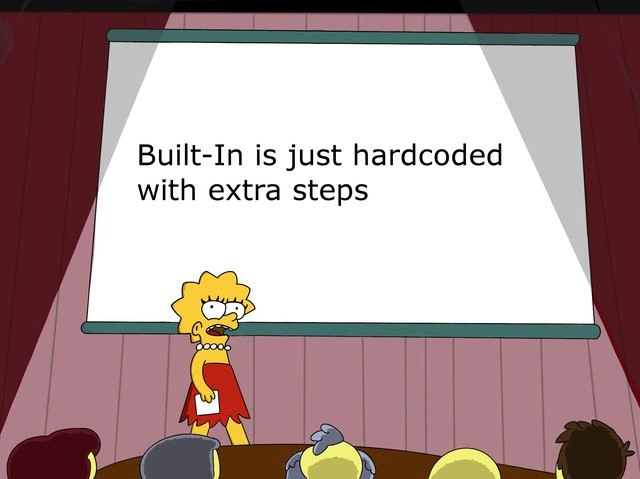
Lisa Simpson standing in front of a presentation screen gives the text the tone of a devastating conference talk delivered by someone too young to have merged a compatibility shim at 2 AM. The joke works because developers love exposing the machinery behind elegant words. "Built-in" sounds official, principled, and inevitable. "Hardcoded with extra steps" makes it sound like the runtime just wrote an if statement, put on a blazer, and got invited to standards meetings.
The satire lands because CodeAbstractionPrinciples and LanguageFeatures live in constant tension. Good abstractions hide complexity so users can think at a higher level. Bad abstractions hide complexity so nobody has to admit the system is a pile of special cases. The meme collapses both into one accusation: maybe the revered built-in is just a workaround that survived long enough to become respectable.
There is real industry history behind that cynicism. Many features become official because developers repeatedly reinvent them:
- string formatting because concatenation became a crime scene
- JSON support because every service started speaking it
- async primitives because callback pyramids became load-bearing architecture
- collection helpers because everyone wrote the same loops badly
- date/time utilities because time zones exist to humble civilization
The senior-level nuance is that a built-in is not automatically better. Once behavior enters the language or runtime, it becomes very hard to remove or change. A questionable API can become permanent because millions of programs depend on its exact weirdness. That is why "just add it as a built-in" is not a casual request; it is a compatibility mortgage with syntax highlighting.
So the meme is funny because it weaponizes literalism. Yes, somewhere under the hood, every abstraction eventually becomes concrete instructions. But dismissing built-ins as mere hardcoding ignores why languages standardize certain behavior: consistency, performance, discoverability, portability, and fewer homegrown helper functions named doThing2Final.
Level 4: Intrinsics Wearing Badges
The slide says:
Built-In is just hardcoded with extra steps
That is funny because it is wrong in the most educational way possible. A built-in often is a privileged piece of behavior, but privilege can come from several different layers: syntax, parser rules, compiler intrinsics, runtime objects, virtual machine opcodes, standard library functions, or host-environment APIs. Calling all of that "hardcoded" is the kind of reductive take that makes language implementers stare at the ceiling for a while.
In a language implementation, "built-in" can mean:
- the parser recognizes special syntax like
if,class, orasync - the compiler lowers a construct into internal intermediate representation
- the runtime provides globally available objects like
Array,Promise, orException - the VM exposes optimized operations for common behavior
- the standard library ships functions that ordinary users could theoretically write, but should not have to
The technical edge is that some built-ins really do start life as special cases. A compiler may recognize len(x) or Math.imul() and emit optimized code. A VM may have fast paths for arrays, strings, hash maps, or regular expressions because general-purpose dispatch would be too slow. Some language features are effectively blessed shortcuts around normal abstraction boundaries. That is not just "hardcoded"; it is language design turning a common pattern into a stable contract.
The "extra steps" matter because those steps are the difference between a hack and a platform feature. A hardcoded special case hidden in application code is brittle because nobody knows its contract, tests, compatibility promise, or performance model. A built-in must survive documentation, versioning, backwards compatibility, security review, optimization, edge cases, and users who will absolutely pass it a value shaped like a philosophical objection.
Description
The image uses the Lisa Simpson presentation format, with Lisa standing in front of an audience and a large projection screen. The slide text reads "Built-In is just hardcoded with extra steps" in plain black type on a white background. The joke reframes language or framework built-ins as merely hardcoded behavior wrapped in enough abstraction to look official. It is a deliberately reductive take on runtime features, standard libraries, and the blurry line between useful abstraction and hidden special cases.
Comments
10Comment deleted
A built-in is just a hack that survived enough release cycles to get syntax highlighting.
А нафига писать image text? Для ботов которые не могут в капчу? Comment deleted
У некоторых изображения не грузятся Comment deleted
Accessibility Comment deleted
Чтоб искать можно было Comment deleted
По той же причине почему аватар сменился Comment deleted
что это за причина? 😳 Comment deleted
Also quite curious why both of these things is same Comment deleted
У меня лично только в коментах хД Comment deleted
Что это за причина? Comment deleted