Welcome to the Literal Cloud: A Data Center with a Fog Machine
Why is this Cloud meme funny?
Level 1: A Cloudy Prank
Imagine you’ve heard grown-ups talk about saving things “in the cloud” – maybe they put photos or music in this so-called cloud. You might picture a fluffy white cloud in the sky holding all your stuff. 🌥️ Of course, it’s not really up in the sky; it's just a bunch of computers in a big room. Now, the funny idea in this meme is to play a prank that makes it look like a real cloud lives in that computer room. How? By using a fog machine (the kind that makes fake smoke at parties).
Picture this: you’re visiting a big room full of computers (a data center) for the first time. The room is usually very cool and a bit noisy with fans, nothing visibly magical. But just as the door opens, poof! A bunch of fog spills out, just like a little rain cloud escaping the room. And someone grins and says, “Welcome to the cloud!” You’d probably giggle because they took the phrase “the cloud” (meaning online computer storage) and turned it into a real cloud you can see. It’s like turning a figure of speech into a practical joke.
Think of it like this: if your teacher said, “Alright class, time to cloud your papers online,” and then actually filled the classroom with puffy white balloon clouds – it would be silly and literal, right? The tweet’s idea is the same kind of playful twist. It makes us laugh because it mixes something serious (a high-tech server room) with something imaginatively literal (a foggy cloud for a grand welcome). The emotional punch is pure fun and surprise. Even though we know computers don’t really sit on sky clouds, seeing fog roll out of a server room door is a goofy, cheerful way to say “here’s the magical cloud where your data lives!” It's a joke that makes the tech world feel a bit more like a playroom, if only for a moment.
Level 2: Not Actually in the Sky
For newer developers or those just learning about cloud tech, let’s break down the joke. First, what is “the cloud”? In simple terms, the cloud refers to computers and servers that you access over the internet, without having to know where they physically are. When you upload a photo to Google or deploy an app on Amazon Web Services, you’re using cloud infrastructure – basically using hardware in someone else’s building. A data center is that building: a facility full of powerful computers (servers) that store data and run applications. The cloud is not a fluffy thing in the sky; it’s a marketing metaphor. In diagrams or presentations, we often draw a cloud shape to represent “all the stuff on the internet” because it’s more abstract than drawing hundreds of servers. So “the cloud” = lots of servers somewhere out there. As the on-running joke goes, “the cloud is just somebody else’s computer.”
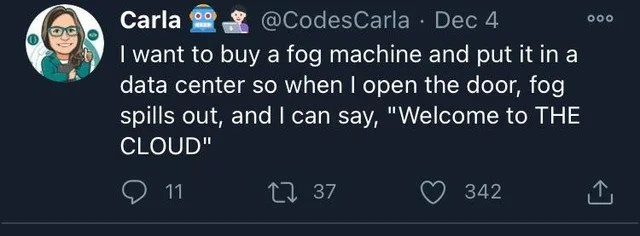
Now, the meme is a tweet where Carla jokes: “I want to buy a fog machine and put it in a data center so when I open the door, fog spills out, and I can say, ‘Welcome to THE CLOUD.’” This is funny because she’s making “the cloud” literal. A fog machine is a device that creates thick mist (like you see at concerts or haunted houses). If you hide one in a server room, then opening the door would release a puff of fog that looks like a small cloud. So imagine taking a tour of a company’s on-premises data center (on-premises means the servers are hosted in the company’s own facility, not outsourced to a cloud provider). The guide dramatically opens the door, fog billows out around the racks of servers, and they quip, “Welcome to the cloud!” It’s a classic literal_cloud_joke – taking a figurative expression (“the cloud” for online services) and playfully turning it into a physical thing you can see.
This joke sits right at the crossroads of CloudHumor and DevOpsHumor. DevOps and SRE (Site Reliability Engineering) folks deal with deploying code to servers and keeping systems running. They know the behind-the-scenes reality of “cloud” computing. Many of them have a foot in both worlds: they maintain physical hardware (racking servers, checking cables in a data center), and they also configure virtual resources online (like AWS EC2 instances or Azure VMs). So they chuckle at this because it pokes fun at how we present the same thing in two different ways. It’s physical vs virtual cloud: the fog machine provides the physical cloud-in-a-room, while normally “the cloud” is a virtual concept (no actual mist involved, just tech services). The tweet’s welcome_to_the_cloud line is basically what an enthusiastic tour guide might say to new engineers or curious visitors, pun fully intended.
Let’s clarify a couple of terms in case you’re new:
- Cloud (Computing): Storing and accessing data and programs over the Internet instead of on your local computer. Big providers (Amazon, Google, Microsoft) run giant data centers and rent out computing power to users. When people say “our app runs in the cloud,” they typically mean it’s hosted in one of these providers’ servers rather than on a server they physically own.
- Data Center: A specialized building or room filled with computer servers, networking gear, and backup power systems. It’s where the “cloud” lives. Companies might have their own data centers (that’s called on-premises infrastructure), or they use third-party ones (public cloud).
- DevOps/SRE: These are roles/approaches in tech focused on operations and development working together. DevOps engineers and SREs handle deployments, monitor servers, and ensure everything stays reliable. They’re the folks who might be giving you that data center tour, explaining how your code runs on real machines. They appreciate jokes about infrastructure because it’s their daily world.
With those terms in mind, the humor becomes clear: it’s an infrastructure geek’s pun. We usually greet new cloud users with a web dashboard or an API – not a swirl of fog at the data center door. Carla’s tweet imagines flipping the script for fun. If you’re a junior developer, picture your first day on the job: you hear “we run our own private cloud.” You’re led to a mysterious, cold room of computers. Suddenly a puff of mist appears, and your mentor grandly announces “Welcome to THE CLOUD!” You’d laugh, right? It’s a silly, theatrical way to drive home the point that “the cloud” isn’t magical – it’s right here in these machines (plus some stage fog for giggles).
Level 3: Fog as a Service (FaaS)
At the highest technical level, this meme plays on the disconnect between cloud computing as a virtual concept and the very physical infrastructure that runs it. In enterprise architecture diagrams, the internet or remote servers are often drawn as a fluffy cloud symbol. Seasoned engineers know that behind every "cloud" service (like AWS, Azure, or GCP) there’s a real data center full of racks, cables, and humming machines. Here, a DevOps jokester wants to bridge that gap quite literally. By installing a fog machine in a server room, they’d create actual water-vapor fog billowing out when the door opens – a tongue-in-cheek literal cloud. This visual gag is essentially offering "Fog as a Service" to the unsuspecting tour group. It’s the kind of CloudHumor that makes experienced engineers smirk, because it pokes fun at the buzzword “cloud” by turning it into a physical cloud you can see and touch.
From a senior DevOps/SRE perspective, the humor cuts deep. We spend our days provisioning virtual machines and containers in "the cloud," which is really just someone else’s computer in a warehouse. The tweet highlights that absurdity: after all the hype about cloud infrastructure, you open a plain old server-room door and – surprise! – out pours theatrical fog as if you’ve entered a magical realm. It’s a gentle jab at marketing lingo, where everything is “in the cloud” these days. In reality, the cloud lives in concrete data centers with blazing AC, not in the sky. By saying “Welcome to THE CLOUD” amid swirling mist, the prankster sysadmin is basically revealing the wizard behind the curtain (with a flourish of stage effects). It’s an inside joke about the physical_vs_virtual_cloud dichotomy: we call it cloud to sound futuristic, but it still boils down to hardware and wires.
This scenario also resonates because it’s exactly the kind of nerdy prank a bored infrastructure engineer might fantasize about. Data center tours are usually dry affairs – you show visitors endless rows of servers, explain backup power and cooling systems. How do you make that exciting? Add a bit of theatrical flair! 😄 The image of fog spilling out is comical precisely because data centers are normally kept pristine and predictable. (Moisture and electronics usually don’t mix – a fog machine in a server room would normally be a huge no-no, likely to trigger alarms or the fire suppression system!) That rebellious impracticality makes the joke even funnier for veterans: it’s so over-the-top that no one would actually do it, but we love to imagine the look on a manager’s face if someone did. It’s a form of DevOpsHumor that acknowledges: yeah, “the cloud” is a silly name, but wouldn’t it be great if we could welcome people with a literal cloud?
In short, the meme cleverly marries the abstract world of cloud computing with its concrete underpinnings. It satirizes how tech culture talks about Cloud Infrastructure in almost mystical terms. By envisioning a fog_machine_prank in the server room, it reminds seasoned developers and SREs of the gap between glossy cloud talk and gritty reality. It’s that shared realization – that behind our fancy DevOps pipelines and scalable microservices, there’s just a data center (now with extra fog FX) – which makes the joke land so well with experienced folks.
Description
A screenshot of a tweet from a user named Carla (@CodesCarla). The tweet reads: 'I want to buy a fog machine and put it in a data center so when I open the door, fog spills out, and I can say, "Welcome to THE CLOUD"'. The user's profile picture is a cartoon avatar of a woman with glasses. The tweet has 11 comments, 37 retweets, and 342 likes. This is a classic tech joke that plays on the abstract marketing term 'the cloud' by taking it literally. For anyone who has worked with infrastructure, it's a humorous reminder that the cloud is not an ethereal entity but a physical network of servers in a data center somewhere. The joke appeals to the senior developer's appreciation for grounding hyped-up concepts in their tangible, hardware reality

Comments
13Comment deleted
The real challenge isn't the fog machine; it's getting the SOC 2 compliance paperwork approved for an unmanaged atmospheric aerosol dispenser in a hot aisle
Just installed a fog machine in the cold aisle - now Finance thinks we’re officially “in the cloud,” Facilities thinks the humidity sensors are broken, and I finally hit our multi-cloud KPI without touching a single Terraform template
After 20 years of explaining to executives that 'the cloud' isn't actually in the sky, someone finally found a way to make the metaphor work - though the cooling bills from fighting the fog machine's humidity might exceed your entire AWS budget
Finally, a practical solution to explaining cloud architecture to stakeholders. Just make sure your fog machine has 99.99% uptime SLA, supports multi-region failover, and is compliant with SOC 2 - because nothing says 'enterprise-ready infrastructure' like theatrical smoke effects that literally obscure visibility of your actual hardware
Careful: your “Welcome to the cloud” demo becomes VESDA-triggered FM-200 - aka a smoke test with a seven-figure blast radius
Our on-prem "cloud migration": fog machine in the data center; Marketing calls it cloud, the architect calls it fog computing, SRE calls it a smoke test, and Facilities call the fire marshal
The ultimate C-suite demo: fog machine for infinite scalability, minus the $10k/month egress fees
I wonder what would the servers think of that Comment deleted
The AC should keep the humidity low enough for it to be fine... Comment deleted
The fog will be blown out the datacenter threw the ac Comment deleted
If you want fog in a DC simply start a fire. The fm2000 gas used in the datacenter should give the fog effect Comment deleted
It'll also look like one of the servers somewhere in there is on fire Comment deleted
Welcome to the cum zone Comment deleted