Skip to content
DevMeme
394 of 7435
The Art of Reclassifying Bugs as Features
Bugs Post #459, on Jun 18, 2019 in TG

The Art of Reclassifying Bugs as Features

Why is this Bugs meme funny?

Level 1: I Meant To Do That

Imagine you accidentally spilled your juice on the kitchen floor. Uh-oh! Instead of admitting it was an accident, you quickly say, “I meant to spill it – see, now the floor is getting cleaned!” 😇 You’re basically claiming your mistake was actually on purpose, like a clever new plan.

That’s exactly what’s happening in this meme, but with software. A programmer made a little mistake in a program (a bug). Instead of saying “oops, my mistake,” they’re telling everyone “no, no, it’s not broken – we just haven’t added that part yet (it’s a feature we plan to add)!” It’s a silly excuse to avoid getting in trouble. We find it funny because the developer is pretending their error was intentional, just like saying you spilled juice to clean the floor. It’s a playful way to cover up a mistake and make people laugh.

Level 2: Bug vs Feature

Let’s break down what’s happening in simple terms. In software, issues that come up can generally be of two types: bugs or features.

  • Bug: This is an error or flaw in the software. It means something is broken or not behaving the way it’s supposed to. For example, if clicking a save button doesn’t actually save your work, that’s a bug. Bugs are unintentional problems – the program is doing something wrong due to a mistake in the code.
  • Feature: This refers to a piece of functionality or a capability of the software. A feature request (or a “missing feature”) means someone wants the software to do something it currently cannot do. It’s not that the software is broken; it’s that it doesn’t have that ability yet. For example, if an app doesn’t have a dark mode, adding dark mode would be a new feature.

Now, on GitHub (a popular platform for hosting code and tracking issues), developers use an issue tracker to manage both bugs and feature requests. They categorize issues with labels – colorful tags that say “bug”, “enhancement”, “documentation”, etc. A red bug label usually flags a reported problem that needs fixing. An “enhancement” or “feature” label would mark something that’s a new idea or improvement to add.

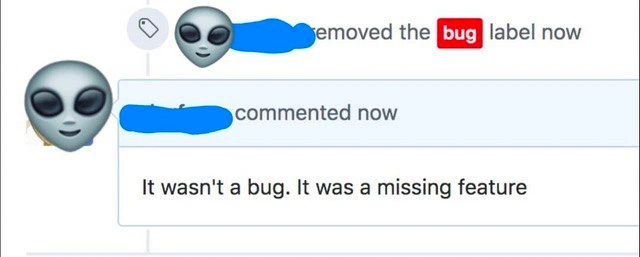
In the meme’s scenario, someone reported a problem and it was labeled as a bug initially. That means it was being treated as a mistake in the software. But then, the issue’s timeline shows that the person removed the bug label. This is literally an action on GitHub: you can add or remove labels on an issue, and the system logs “so-and-so removed the bug label.” By doing that, they’re saying “let’s not call this a bug anymore.” Right after that, the same user leaves a comment: “It wasn’t a bug. It was a missing feature.” They’re reclassifying the problem. Instead of an error that needs a fix, they claim it’s a feature that hasn’t been built. Essentially, they’re saying nothing is wrong with the existing code; it just doesn’t do that yet.

Why would someone do this? The phrase “dodge blame” in the title is key. In a team, when a bug is found, it can imply that a developer made a mistake or QA missed something. It’s a bit embarrassing or stressful – nobody likes their work labelled as “broken.” By contrast, calling it a “missing feature” frames it as a future improvement, not a failure. It’s like saying, “This isn’t broken, we just haven’t added that capability.” That way, no developer is directly at fault for a bug; it’s just something on the to-do list.

This is a humorous example of developer Communication. The person handling the issue is communicating to the team or project maintainers, “Don’t worry, there’s no defect here!” It highlights a common DeveloperHumor theme: the age-old joke “It’s not a bug, it’s a feature.” Developers have been jokingly using that line for ages to defend their code. In practice, sometimes there’s genuine confusion whether something is a bug or a feature request. But often, calling a clear bug a “feature” is just an excuse. It’s a way to lessen the urgency and avoid looking bad.

On GitHub or any version control platform with issue tracking, this kind of label change is visible to everyone (as shown in the screenshot). It’s both funny and a little cringy because the problem hasn’t magically gone away – only the name for it changed. If you were a newcomer reading the issue, you might scratch your head: is it a bug or not? The answer: officially it’s now a “missing feature,” so it will likely be addressed as an enhancement later, not as an urgent fix. Meanwhile, the original bug reporter might be rolling their eyes because from their perspective, something was clearly wrong.

So, in simpler words: The meme shows a developer who doesn’t want the blame of a bug on them or their project. They remove the “bug” tag and say “actually, this isn’t a mistake at all, just something we haven’t done yet.” It’s a playful take on how labels and wording can be used in version control workflows to change how an issue is perceived. Everyone in software can relate to this scenario, which is why it falls under RelatableHumor and makes tech folks smirk.

Level 3: Feature Camouflage

In the trenches of software development, bugs have a sneaky way of disappearing without a single line of code being changed – they just get relabeled. This meme’s GitHub issue timeline captures that exact maneuver: someone literally removed the bright-red bug label from an issue, then immediately commented with the classic developer spin:

“It wasn't a bug. It was a missing feature.”

Every seasoned developer has seen this feature camouflage tactic. It’s a tongue-in-cheek way to dodge responsibility by rebranding a mistake as an unimplemented enhancement. In a typical GitHub issue tracker (or any project management tool like Jira), issues can be tagged with categories like “bug” or “feature request.” Here, an alien-faced avatar (perhaps a cheeky nod to anonymity) flips the script by removing the bug tag – effectively declaring “Nothing to see here, no error at all!” This is Issue Triage Politics 101: if a problem makes your team look bad, just call it something else.

Why is this funny to experienced devs? Because it hits close to home. In many a sprint planning or backlog grooming meeting, there’s that awkward moment when a reported defect isn’t fixed but instead “reclassified” as an enhancement. It’s the software equivalent of a magician’s trick: now you see a bug, now you don’t. By labeling it a “missing feature,” the developer implies the program isn’t broken; it’s simply waiting on a planned improvement. No bug means no fault, which means no blame – at least on paper. It’s a form of semantic ducking and weaving familiar to anyone who’s navigated corporate Communication loopholes or open-source project politics.

This meme also pokes at the fine line between expected behavior and unexpected bug. Often what a user calls a bug (“The app crashes when I click X!”) a defensive developer might call “well, we never built support for X – so technically it’s not a bug.” It’s a risky game of definition dodgeball: one moment the issue counted against our quality metrics, the next it’s transmogrified into a to-do for the future. We laugh (perhaps a bit darkly) because it’s a relatable humor in tech – we’ve either done this renaming dance ourselves or witnessed it. It underscores a truth in software teams: sometimes it’s easier to change the narrative than to change the code.

Beyond the joke, there’s a sting of reality. Removing the bug label doesn’t actually solve anything; users still encounter the problem. But it dodges blame by saying “this isn’t a mistake, it’s just a feature we haven’t gotten around to building.” It’s a form of technical PR or damage control. Long-time devs might recall managers who hate to see open BugsInSoftware on reports – fewer bugs make the project look healthier. So, magically turning bugs into features can be an enticing shortcut to save face. Of course, everyone involved usually knows it’s an excuse. The humor is in the transparent absurdity: the team isn’t fixing the bug today, but hey, at least they’re not calling it a bug anymore!

From a VersionControl perspective, it’s also ironic. GitHub is a platform built for transparency and collaboration – the git tool even has a command named git blame to pinpoint who last changed a line of code (how ironic in a blame-dodging context!). Yet here we have someone expertly editing the issue’s story in plain sight. The github_workflow normally expects honest labeling (bug or enhancement), but real-world developers bend those rules. The screenshot’s timeline (“removed the bug label”) is an immutable public record of the label change, so it’s not exactly a secret cover-up – it’s more like a performative gesture to anyone watching. That’s what gives it comedic punch: the audacity to officially declare “BugVsFeature debate settled – it was never a bug at all!” with a straight face.

In summary, this meme resonates with battle-scarred engineers because it caricatures a common scenario: when confronted with a pesky issue, reframe the narrative rather than admit fault. It’s funny, a bit cynical, and all too true in practice. After all, when production is on fire and product managers demand answers, sometimes a wry dev will shrug and say, “Working as intended – we just haven’t built that feature yet.” Problem solved? Not really – but blame successfully dodged.

Description

A screenshot from a project management or version control system, likely GitHub, showing a user's activity log. The user, represented by a grey alien emoji avatar, first performs an action: "removed the bug label now". Immediately following, the same user posts a comment that reads, "It wasn't a bug. It was a missing feature". This meme captures a classic and cynical joke within software development culture, where a developer or project manager reframes an unexpected behavior or error as an intentional, albeit unimplemented, feature. This is often done to downplay the severity of a mistake, manage stakeholder expectations, or simply to move the issue from a high-priority bug-fix list to a lower-priority feature backlog

Comments

7
Anonymous ★ Top Pick The quickest way to fix a bug is to rename it to 'feature' and move it to the next fiscal year's budget
  1. Anonymous ★ Top Pick

    The quickest way to fix a bug is to rename it to 'feature' and move it to the next fiscal year's budget

  2. Anonymous

    Removed the “bug” label, renamed it “roadmap enhancement,” and suddenly our SEV-1 became “customer-validated discovery.” Grafana’s still red, but the quarterly OKRs look flawless

  3. Anonymous

    The only difference between a bug and a missing feature is whether the PM already promised it to the customer

  4. Anonymous

    Ah yes, the ancient art of semantic versioning for accountability: v1.0 (it's a bug) → v2.0 (it's a missing feature) → v3.0 (it's by design) → v4.0 (it's a platform limitation). By the time you reach v5.0, it's somehow the user's fault for expecting it to work that way. This is why senior engineers know that 'bug' vs 'feature' is really just a question of who's writing the postmortem and whether the PM is in the room

  5. Anonymous

    Classic KPI arbitrage: flip the bug to a 'missing feature' and you hit the OKR without merging a line - APM still shows 500s, but the dashboard says innovation shipped

  6. Anonymous

    Sev0 solved: rename the GitHub label from “bug” to “missing feature” - MTTR 10s; credibility MTTR three quarters

  7. Anonymous

    Bug triage pro move: relabel before the postmortem, lest it becomes your pager duty ticket

Use J and K for navigation