Skip to content
DevMeme
4175 of 7435
Logging a bug meets the legendary “it’s a feature” developer counterattack
Bugs Post #4558, on Jun 23, 2022 in TG

Logging a bug meets the legendary “it’s a feature” developer counterattack

Why is this Bugs meme funny?

Level 1: The “I Meant to Do That” Joke

Imagine you’re playing with a toy and it suddenly does something weird or wrong – like a toy car that’s supposed to go straight instead starts spinning in circles. You go to your friend who built the toy and say, “Hey, it’s not working right!” But instead of fixing it, your friend grins and says, “Oh, that’s not broken. It’s supposed to spin like a ballerina – it’s a special feature of the toy!” 😏 You’d probably give them a look, because you both know the toy is acting goofy by accident.

That’s exactly the joke here, but with computer software. The person finding the problem (like you with the toy) is trying to help by reporting it. The developer (like your friend) doesn’t want to call it a mistake, so they cheekily claim they did it on purpose. It’s like saying “I meant to do that!” after you slip on a banana peel. 🙃 The humor comes from how silly it is: something clearly went wrong, yet the person responsible says, “No, no, it’s meant to be that way!” Everyone who’s been in that situation can’t help but laugh, because it’s a playful way to dodge blame. In simple terms, the meme is funny because it’s showing a pretend rescue of a problem being stopped by someone insisting the problem isn’t a problem at all.

Level 2: Bug or Feature?

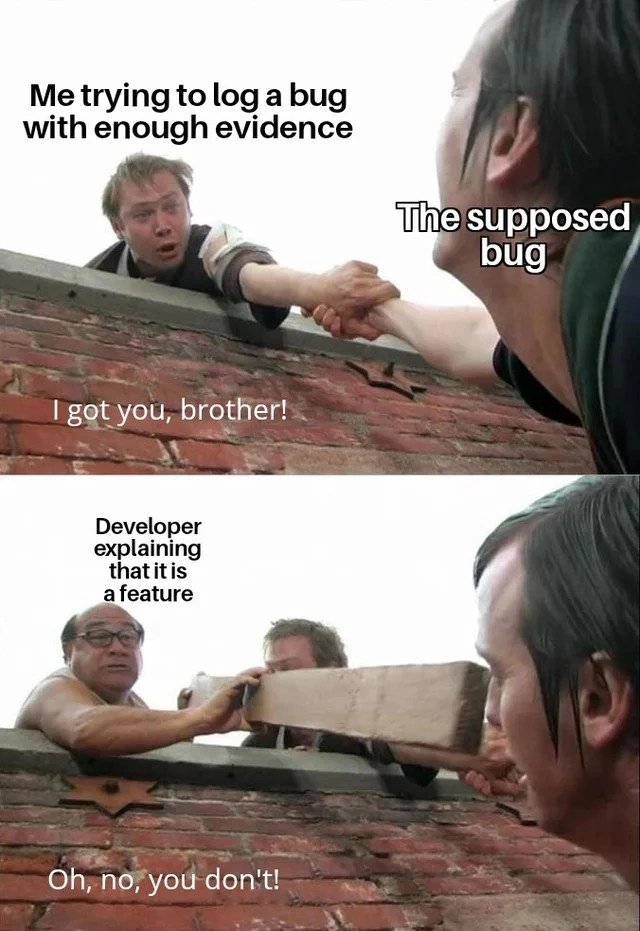
Let’s break down the scene in simpler terms. Quality Assurance (QA) testers are people who try to find problems in software (these problems are called bugs). When a tester finds something wrong – say the app crashes or a button doesn’t do what it should – they log a bug. Logging a bug means writing down the details of the problem, often in a bug tracking system like Jira, so developers can see it and fix it. Testers provide evidence for the bug: for example, the exact steps to make it happen, screenshots of error messages, or logs showing the failure. In the meme’s first panel, the text “Me trying to log a bug with enough evidence” is the tester saying, “I have all the proof I need to show this is a real problem.” The tester character holding the hand of “The supposed bug” symbolizes that the QA is holding onto that problem tightly, not letting it fall through the cracks. The line “I got you, brother!” is basically the tester assuring the bug (and the team) “I’ve captured this issue, I won’t let it go unnoticed.”

Now, what about the second panel? We see another person (labeled “Developer explaining that it is a feature”) swinging a plank and smacking the tester’s arm away. This represents a developer responding to the bug report by saying the bug isn’t a bug at all. Instead, they claim it’s a feature – meaning the software is supposed to behave that way. When the developer says “Oh, no, you don’t!” in the caption, it’s like them saying “Stop right there – that’s not actually a mistake.” This is a well-known scenario in software teams often summed up by the phrase “It’s not a bug, it’s a feature.” Developers sometimes use this phrase humorously (or defensively!) to mean that what looks like a mistake was actually done on purpose (even if it really wasn’t). It’s a bit of an inside joke in programming circles: if something is broken but someone doesn’t want to admit it, they might joke, “Nah, that’s an undocumented feature.”

In reality, why would a developer say something is a feature when a tester calls it a bug? A few reasons:

  • Miscommunication: Maybe the requirements (the plans for how the software should work) were unclear. The developer thinks the program is doing what the requirement said, but the tester expected something else. So the developer explains, “This behavior is intentional” (i.e., a feature).
  • Edge case or Minor Issue: Sometimes the problem happens only in a rare situation (an edge case) or is very minor. The developer might decide it’s not worth fixing and will tell QA it’s meant to be that way. For example, “The app logs you out after 51 minutes exactly – that’s a security feature, not a bug” could be a tongue-in-cheek explanation.
  • Not Enough Time/Fixes are Risky: Perhaps the team is near a deadline (say, a product release) and fixing the bug might take too long or risk breaking other things. The developer (or their manager) might choose to label the issue “Won’t Fix – Working as Intended”. In other words, they treat it as if it were a planned feature so they don’t have to change the code right now.

The meme’s humor comes from this tug-of-war: QA is literally trying to “pull the bug up” into awareness and get it fixed, while the developer comes in and whacks that effort away by rationalizing the bug as a feature. It exaggerates a real feeling in the QA process: it can be frustrating (debugging frustration is real!) when you find a definite problem and someone says, “Nope, that’s supposed to happen.” It’s a bit like if you found a leaky faucet and the plumber said, “Actually, that’s a self-watering floor feature.” You’d probably chuckle or roll your eyes. In development teams, testers and developers ideally cooperate, but sometimes they clash in this QA vs Dev way, and the phrase “it’s not a bug, it’s a feature” has become a running gag.

For context, the meme image itself is using a popular template often called the “plank handshake” rooftop meme. In that template, someone is hanging off a ledge needing rescue, another person tries to save them (that’s our tester and bug), and suddenly a third figure (here, the developer) whacks the rescuer with a plank. It’s a visual way to show betrayal or an unexpected interference. In software terms, the tester thought they had the bug in hand, and the developer’s feature explanation blindsides them. The categories like Bugs, QA, and Debugging/Troubleshooting all point to this situation: it’s about a bug in software, the QA effort to catch it, and the troubleshooting getting derailed by a disagreement over whether it’s really a bug. The tags such as BugVsFeature, TestingHumor, and QAProcess highlight that this is a common humorous anecdote in programming and testing communities. Everyone in software has seen a bug re-labeled as a feature at least once, which is why this meme gets shared with a knowing laugh.

Level 3: Working as Intended

At the highest level, this meme captures a classic QA vs. Developer showdown over what counts as a software bug versus an intended feature. The first panel shows a tester (QA) character grabbing hold of "the supposed bug" with the text “Me trying to log a bug with enough evidence”. This represents a tester painstakingly collecting logs, screenshots, stack traces, and detailed steps to reproduce a suspicious behavior – essentially evidence-based bug reports in a bug tracking system (like JIRA or Bugzilla). The QA is doing everything right in the QA process: identifying an anomaly in the software and documenting it so it can be fixed. The caption “I got you, brother!” parodies the tester saying, “Don’t worry, I have you – I can prove this bug is real.”

Enter the second panel: a developer swings in from the side with a proverbial big plank labeled “Developer explaining that it is a feature,” knocking away the QA’s attempt to pull up the bug. The bottom caption flips to “Oh, no, you don’t!” as the developer smacks down the bug report. This is the infamous “It’s not a bug, it’s a feature” counterattack. In real software teams, this phrase is practically legendary – a tongue-in-cheek way for developers to defend quirky or unintended behavior by claiming it was done on purpose. It’s a form of bug vs feature jiu-jitsu: the developer reframes the irregular behavior as “working as intended”, turning the situation on its head. The humor here is that no matter how much evidence the tester provides, a determined dev can still declare “works as designed” and close the ticket.

Why is this so funny (and painful) to experienced engineers? Because it’s too real. Seasoned developers and testers have all witnessed this scenario:

  • A tester spends hours reproducing a glitch, maybe a weird edge-case where the app crashes if you enter a 21st character in a name field. They write a detailed bug report (the QA in the meme gripping “the supposed bug” firmly with enough evidence).
  • The developer assigned looks at it and, instead of admitting it’s a flaw, responds with something like: “Actually, this is intended behavior due to the way we implemented the requirement”. In other words, “not a bug.” This is analogous to that plank whack: a swift dismissal of the issue by rebranding it as a feature or a necessary outcome of design.

From a senior perspective, this reflects deeper dynamics in software teams. Sometimes developers genuinely believe the behavior is correct according to the specifications (maybe the requirements doc ambiguously allowed it). Other times, calling it a feature is a convenient escape hatch – perhaps fixing the bug would break other things or technical debt makes the fix too risky right before a deadline. In yet other cases, the product team might have decided the odd behavior is acceptable (so the dev labels it “by design” in the ticket). Many issue trackers even have resolution statuses like “Won’t Fix/By Design”, effectively saying “not a bug”. This meme nails that frustrating moment: the tester has the bug hanging right there in plain sight, and the developer whips out the legendary feature explanation to knock the bug report out of their hands. It’s a form of debugging frustration and cross-team friction crystallized in one image, and anyone who has worked in software testing knows the mix of exasperation and dark humor that comes with hearing “Actually, that’s on purpose.”

On a meta level, this meme template (the rooftop rescue with plank ambush) is perfect for illustrating QA vs Dev conflict. The tester trying to save the bug corresponds to QA’s duty to catch and lift bugs in software to attention. The developer with the plank is the sabotage – analogous to a developer dismissing or downgrading the issue. It’s a humorous reminder that in software development, communication issues and differing perspectives on quality can lead to almost comedic confrontations. In the end, the phrase “It’s not a bug, it’s a feature” is classic developer humor (and testing humor from the tester’s perspective) – a wry acknowledgement that sometimes the line between a bug and a feature is just who’s doing the explaining. This meme resonates because it dramatizes that all-too-familiar scenario with cinematic flair (you can almost feel that plank in the second panel!).

Description

Two - panel meme using the rooftop rescue template. Panel 1: a brick rooftop edge; person A (above the wall) clasps the hand of person B (hanging below). Text beside person A reads “Me trying to log a bug with enough evidence,” while text next to person B reads “The supposed bug.” A movie-style caption at the bottom says “I got you, brother!” Panel 2: the same scene, but person C appears on the right, swinging a large wooden plank that smacks person A’s arm. Over person C is the label “Developer explaining that it is a feature,” and the bottom caption now reads “Oh, no, you don’t!” The visual joke highlights the classic QA struggle: even with detailed reproduction steps and logs, developers sometimes re-label defects as intended behaviour, illustrating cross-team communication friction in bug tracking and quality assurance
Comments

7
Anonymous ★ Top Pick QA: “Here’s a reproducible case, full logs, and a HAR file.” Dev (brandishing the original RFC): “See where it says ‘implementation-defined’? That’s Latin for ‘works as designed.’”
  1. Anonymous ★ Top Pick

    QA: “Here’s a reproducible case, full logs, and a HAR file.” Dev (brandishing the original RFC): “See where it says ‘implementation-defined’? That’s Latin for ‘works as designed.’”

  2. Anonymous

    The best bugs are the ones that only happen in production, can't be reproduced locally, but somehow become "working as designed" the moment you attach the Datadog traces, heap dumps, and a 47-slide PowerPoint explaining why this will cost us $2M in Q4

  3. Anonymous

    This perfectly captures the eternal struggle where QA meticulously documents reproduction steps, environment details, and stack traces, only to have the developer invoke the ancient incantation: 'It's not a bug, it's a feature.' Bonus points if they follow up with 'works on my machine' or reference a vague requirement from three sprints ago that nobody remembers discussing

  4. Anonymous

    Nothing says enterprise like closing my repro-with-logs ticket using a backdated ADR called “Expected Behavior.”

  5. Anonymous

    Meticulous STR logged, Heisenbug captured - then bricked by 'That's the monolith-to-microservices migration feature we shipped last quarter.'

  6. Anonymous

    Nothing optimizes MTTR like reclassifying a P0 regression as 'by design' - zero code changes, 100% KPI recovery

  7. @Rxd117 4y

    minecraft

Use J and K for navigation