Skip to content
DevMeme
4176 of 7435
When your indie app awaits revenue without any monetization plan
Startup Post #4559, on Jun 23, 2022 in TG

When your indie app awaits revenue without any monetization plan

Why is this Startup meme funny?

Level 1: Lemonade Stand Lesson

Imagine you open a little lemonade stand on your street. You spend the whole afternoon making tasty lemonade and set up a nice stand. People come by and you give everyone a cup for free, because you never put a price on it and never ask anyone to pay. Now you sit there, waiting and waiting for a pile of money to appear in your cash box... but there’s no money, because you weren’t charging anything! You could wait all day, all week, and eventually you’d be like a cartoon skeleton still waiting, since no one is paying you. This meme is joking about that exact kind of mistake. The person made an app (kind of like your lemonade) and hoped to get rich from it, but they forgot to include any way to earn money. It’s silly and obvious when you think about it: if you don’t ask for money or set up a way for people to pay, you’ll never make a penny. You’ll just keep waiting forever — just like the skeleton in the picture, who waited far too long for something that was never going to happen.

Level 2: Freemium Fumble

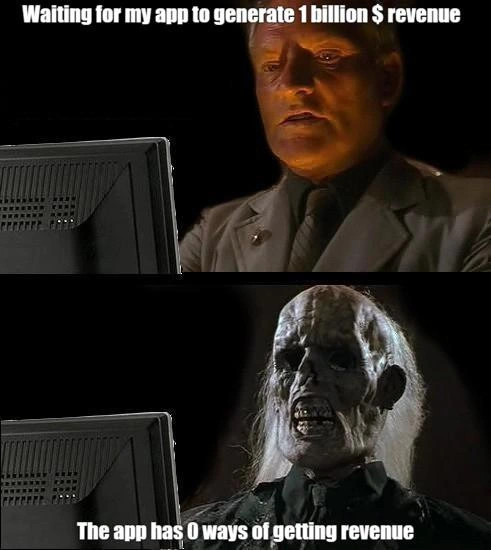
At its core, this meme highlights a very common startup mistake: building something and expecting to make money from it without actually including any way to make money. In the first panel, we see an excited developer in front of the computer, confident and “waiting for my app to generate 1 billion $ revenue.” In the second panel, the same person has turned into a dried-out skeleton still sitting at the desk. Why? Because, as the caption says, “The app has 0 ways of getting revenue.” In plainer terms, the app had no monetization plan at all. The developer could wait forever (hence the skeleton image) and they’d still see $0, since they never added any feature to earn money in the app.

Let’s break down some terms and ideas here. Monetization means figuring out how your product will earn money. For an app, common monetization strategies include things like:

  • Advertisements – showing banner ads or video ads in your app and getting paid by an ad network for impressions or clicks.
  • In-app purchases (IAP) – selling digital goods or upgrades inside the app. For example, a game might let you buy extra lives or a photo app might sell filter packs.
  • Subscriptions – charging users a recurring monthly or yearly fee for premium features or content (like a “Pro” version of the app with more capabilities).
  • One-time purchase – making the app itself paid: users have to spend, say, $0.99 or $4.99 to download it.
  • Affiliate or e-commerce sales – perhaps selling products through the app or earning a commission on referrals, if that fits the app’s purpose.

In modern apps, one popular approach is the freemium model. Freemium means the app is free for everyone to download and use at first (free + premium = freemium), but there are optional paid features or extras for those who choose to spend money. This way, you attract a wide user base with the free part and then convert some loyal users into paying customers for the premium perks. In the meme’s story, however, the developer basically did the “free” part without any “premium” offerings at all. There were no ads, no upgrades, nothing for a user to buy — essentially a freemium model with nothing to sell. That’s a complete fumble if you actually want to earn revenue (hence our subtitle, Freemium Fumble).

Because the developer in the meme forgot to include any of these monetization methods, the app isn’t generating a single cent. This underscores a basic rule of Entrepreneurship and product development: if you want your app (or any product) to make money, you must design a way for money to come in. It won’t happen by magic just because the app exists. A key part of building a product is also planning the business side. In startup culture, people often talk about MVP (Minimum Viable Product) – which is the simplest version of the product that still delivers value to users. But an MVP isn’t the end of the journey; you also have to think about viability in terms of revenue. Releasing even a basic app to test user interest is fine, but you should at least have a hypothesis for monetization. In our meme, the developer’s MVP had zero thought put into how it would generate income. They launched the app to see if people liked the idea, but didn’t consider what to do if they actually got users. So even if the app was useful or fun, there was literally no mechanism for those users (or anyone) to give money back to the creator.

This connects to the idea of Product-Market Fit. Product-market fit is achieved when your product satisfies a real need or desire in the market and you find a way to capture value from that. It usually means users find your product so valuable that your user base is growing and some sustainable revenue model is working (people are paying, or advertisers are paying, etc.). If you have users but no one is paying (and you’ve provided no way to pay), then you haven’t found a viable product-market fit from a business perspective. You might have a product-market gap: people use your product, but it’s not a “market” if there’s no transaction happening. In simpler terms, you built something people might like, but not something that makes money. A product that people love but that earns nothing can’t support a company or a developer’s living for very long.

Now let’s talk about passive income. Passive income is the idea of earning money with little to no daily effort — for example, making an app or writing a book once and then money keeps coming in whenever people download it or buy it, even while you sleep. It’s a very appealing idea (who wouldn’t want to earn money while doing nothing?). Many indie developers dream of releasing a hit app that becomes a source of passive income. However, this meme flags a big passive_income_illusion: the developer assumed they’d get rich by simply putting their app out into the world, but they didn’t set up any actual way for the app to generate income. It’s like dreaming of earning interest on a bank account where you never deposited any money. The illusion is thinking “if I build it, money will come” without any further plan. Reality check: even passive income requires an initial system or strategy that brings in money (like a price tag, or ads, or something). In the meme, that system was non-existent, so the only thing “passive” is the developer passively waiting… indefinitely.

The waiting skeleton meme imagery emphasizes just how long and hopeless that wait is. The skeleton at the computer is a popular meme for “waiting forever.” It’s a humorous exaggeration: it suggests the person waited so long for something that they literally turned into a skeleton covered in dust. In our context, it dramatizes the fact that the app owner could sit there for ages and never see a dime, because, as the caption says, “0 ways of getting revenue.” That visual drives home how crucial a monetization plan is: without one, you’ll be waiting until you’re bone-dry (pun intended) for money that isn’t going to show up.

For a junior developer or first-time founder, the lesson here is very clear. In real startup life, success isn’t just measured by how many users you have or how cool your app is — at some point it’s measured by dollars and cents. If you release an app, you should have an answer to “Where will the money come from?” Maybe not on day one, but eventually. Are you going to show ads? Offer a paid premium feature? Sell subscriptions or merchandise? If you completely ignore that question, you might end up like the person in the meme: lots of enthusiasm, no revenue, and endless waiting. The meme is funny to people in tech and startup communities because it’s like a friendly poke at a RelatableDeveloperExperience. We’ve all seen pitches or projects where someone says, “We got thousands of downloads!” and then when asked about revenue, the answer is “Oh… we haven’t thought about that.” Awkward. That awkward moment is exactly what’s being lampooned here. StakeholderExpectations — whether it’s an investor expecting a return, or even just your own expectation to make a living from your project — come crashing down when there’s no business model to back up the product. The meme’s two-panel format (excited human → skeleton) tells that story at a glance. Essentially, it’s a roast of the rookie mistake of having no plan for monetization. The takeaway: if you don’t want to be a skeleton waiting on nonexistent income, always figure out how your app can make money, not just what it does for users. No plan, no pay!

Level 3: Profit Not Found

This meme perfectly skewers a StartupHumor scenario where a developer launches an app and then just sits back waiting for money to magically roll in. The top panel text (in lofty white letters) reads "Waiting for my app to generate 1 billion $ revenue" — an absurdly optimistic expectation, especially given the app’s total lack of a business model. The bottom panel reveals the punchline: the once-eager founder has become a waiting skeleton at the desk, and the caption bluntly admits, "The app has 0 ways of getting revenue." It’s a darkly comic visualization of MisalignedExpectations: dreaming of unicorn-level riches while forgetting to include even a single revenue stream in your product. This setup is a classic two_panel_reaction meme: the first panel sets the expectation (the developer optimistic in a nice suit), and the second panel delivers the reality (the developer literally decayed into a skeleton). The drastic before-and-after contrast makes the joke land — a visual gotcha about expectation vs. reality.

From a senior developer’s perspective, the humor cuts deep because we’ve seen this movie before. It’s the classic Step 1: Build app. Step 2: ???. Step 3: Profit! business plan — a recipe for turning into that skeleton. In real startup life, hope is not a strategy. You can create the slickest MVP (Minimum Viable Product) with brilliant features, but if you ship it with no monetization strategy whatsoever, your ProductMarketFit is essentially half-baked. Sure, you might get users to download or sign up (yay, growth!), but if there’s no plan for capturing value (i.e. making money), you’ve built a hobby, not a business. The meme exaggerates this truth: the hapless indie developer is literally waiting an eternity (hence the cobweb-covered skeleton) for revenue that will never arrive because they neglected to implement any revenue model (no ads, no in-app purchases, no subscriptions, nothing). For those of us who’ve been around, it also echoes the dot-com bubble days (late 1990s) when startups amassed users with no clear revenue model and assumed they’d figure out profits later. We know how that turned out — many of those companies became skeletons in the tech graveyard. This meme distills that folly down to a single developer’s situation: lots of confidence, zero income, inevitable doom (albeit presented humorously).

The humor lands because it’s so exaggerated yet so true. We chuckle (or cringe) because many of us have witnessed enthusiastic newcomers launch “the next big app” with grand revenue expectations, yet when asked “How will it make money?” they nervously grin and say something like, “We’ll figure that out later — maybe ads once we get millions of users.” Spoiler: later never comes. It’s StartupLife in a nutshell: focusing on user-facing features and shiny tech, while ignoring the boring question of “Who actually pays for this?” The result? An app that might be popular, but generates $0 — exactly as the meme spells out. The developer’s indie_app_woes here stem from the passive_income_illusion that an app can be a cash machine on autopilot. In reality, apps don’t magically mint money; you have to deliberately design how money flows in. Seasoned engineers have a saying: you can’t deposit “great app idea” into the bank. In that spirit, the skeleton becomes a punchy metaphor for waiting forever. It even echoes a dark inside-joke among programmers: leaving a TODO: add monetization comment in the code and never actually implementing it. If we were to express this situation in code humor, it’d look like:

monetization_plan = None  # developer forgot to implement any revenue streams
revenue = 0

while monetization_plan is None:
    # Nothing changes; revenue remains zero
    pass  # the developer waits... and waits... and waits...
# (Loop never breaks. Eventually, the developer becomes a skeleton.)

In essence, the meme is a sardonic reminder that no_monetization_strategy yields no money. It highlights a core startup lesson: even the coolest app won’t generate $1 billion revenue (or even $1) if you haven’t built a path for those dollars to travel into your pocket. The tags like ProductMarketFit and StakeholderExpectations are spot on: a product isn’t truly viable until it finds a way to make money from its market. Our suave founder’s lofty expectations and the grisly skeleton outcome are hilariously out of sync, making for both a biting joke and a cautionary tale. In startup terms: no plan, no pay.

Description

Two-panel meme uses a cinematic scene to show the passage of time. Top panel: a sharply dressed person sits at a desktop computer against a black background; white text reads, "Waiting for my app to generate some revenue." Bottom panel: the same seat now holds a pale, skeletal figure in the same pose, underscoring extreme waiting; caption reads, "The app has 0 ways of getting revenue." The stark before-and-after visual gag highlights developers who launch an MVP expecting passive income while forgetting to add ads, IAPs, subscriptions, or billing hooks. The humor targets startup founders and engineers, illustrating the classic product-market-fit failure of ignoring monetization strategy

Comments

6
Anonymous ★ Top Pick Launching a SaaS without a payment flow is kubectl apply --dry-run for revenue: the YAML looks solid, but nothing ever schedules on the balance sheet
  1. Anonymous ★ Top Pick

    Launching a SaaS without a payment flow is kubectl apply --dry-run for revenue: the YAML looks solid, but nothing ever schedules on the balance sheet

  2. Anonymous

    It's like deploying to production with perfect CI/CD, 100% test coverage, and Kubernetes autoscaling, but forgetting to implement the payment gateway - technically flawless execution of a fundamentally flawed business architecture

  3. Anonymous

    The classic founder dilemma: spent six months building a technically perfect, scalable microservices architecture with 99.99% uptime, but forgot to implement the one service that actually matters - the payment gateway. Now they're pivoting to 'building community' while the AWS bills pile up and VCs ask about that pesky 'business model' slide they skipped in the deck

  4. Anonymous

    Nailed Big O scalability for 1B users, but O(0) revenue paths - optimal pessimization

  5. Anonymous

    We shipped K8s and observability, but forgot the /billing endpoint - MRR is strongly consistent at 0

  6. Anonymous

    We shipped SSO, OTel, and SOC2 - but no checkout; RevenueStrategy is just an interface nobody bound in prod

Use J and K for navigation